Introduction to Matrices
The same cells, many times slower
Spiral Matrix, Rotate Image, Valid Sudoku: matrix problems are loops over rows and columns, and which loop goes inside looks like a matter of taste. Here are the same 9 million cells, a 3,000 × 3,000 grid, added up row by row and then column by column, in every language the judge runs:
import time

n = 3000
grid = [[(r * 7 + c) % 10 for c in range(n)] for r in range(n)]

start = time.perf_counter()
total = 0
for r in range(n):                    # row by row: each row's cells one after another
    for c in range(n):
        total += grid[r][c]
print(f"by rows:    {total} in {(time.perf_counter() - start) * 1000:.0f} ms")

start = time.perf_counter()
total = 0
for c in range(n):                    # column by column: one cell from every row in turn
    for r in range(n):
        total += grid[r][c]
print(f"by columns: {total} in {(time.perf_counter() - start) * 1000:.0f} ms")

# by rows:    40500000 in 1181 ms
# by columns: 40500000 in 1337 ms
public class Main {
public static void main(String[] args) {
int n = 3000;
int[][] grid = new int[n][n];
for (int r = 0; r < n; r++)
for (int c = 0; c < n; c++)
grid[r][c] = (r * 7 + c) % 10;
long start = System.nanoTime();
long total = 0;
for (int r = 0; r < n; r++) // row by row: each row's cells one after another
for (int c = 0; c < n; c++)
total += grid[r][c];
System.out.printf("by rows: %d in %d ms%n", total, (System.nanoTime() - start) / 1000000);
start = System.nanoTime();
total = 0;
for (int c = 0; c < n; c++) // column by column: one cell from every row in turn
for (int r = 0; r < n; r++)
total += grid[r][c];
System.out.printf("by columns: %d in %d ms%n", total, (System.nanoTime() - start) / 1000000);
}
}
// by rows: 40500000 in 13 ms
// by columns: 40500000 in 119 ms#include <bits/stdc++.h>
using namespace std;
int main() {
int n = 3000;
vector<vector<int>> grid(n, vector<int>(n));
for (int r = 0; r < n; r++)
for (int c = 0; c < n; c++)
grid[r][c] = (r * 7 + c) % 10;
auto ms = [](auto start) {
return (long long) chrono::duration_cast<chrono::milliseconds>(chrono::steady_clock::now() - start).count();
};
auto start = chrono::steady_clock::now();
long long total = 0;
for (int r = 0; r < n; r++) // row by row: each row's cells one after another
for (int c = 0; c < n; c++)
total += grid[r][c];
printf("by rows: %lld in %lld ms\n", total, ms(start));
start = chrono::steady_clock::now();
total = 0;
for (int c = 0; c < n; c++) // column by column: one cell from every row in turn
for (int r = 0; r < n; r++)
total += grid[r][c];
printf("by columns: %lld in %lld ms\n", total, ms(start));
}
// by rows: 40500000 in 4 ms
// by columns: 40500000 in 69 msconst n = 3000;
const grid = Array.from({ length: n }, (_, r) => Array.from({ length: n }, (_, c) => (r * 7 + c) % 10));
let start = performance.now();
let total = 0;
for (let r = 0; r < n; r++) // row by row: each row's cells one after another
for (let c = 0; c < n; c++)
total += grid[r][c];
console.log(`by rows: ${total} in ${Math.round(performance.now() - start)} ms`);
start = performance.now();
total = 0;
for (let c = 0; c < n; c++) // column by column: one cell from every row in turn
for (let r = 0; r < n; r++)
total += grid[r][c];
console.log(`by columns: ${total} in ${Math.round(performance.now() - start)} ms`);
// by rows: 40500000 in 15 ms
// by columns: 40500000 in 129 msconst n: number = 3000;
const grid: number[][] = Array.from({ length: n }, (_, r) => Array.from({ length: n }, (_, c) => (r * 7 + c) % 10));
let start: number = performance.now();
let total: number = 0;
for (let r = 0; r < n; r++) // row by row: each row's cells one after another
for (let c = 0; c < n; c++)
total += grid[r][c];
console.log(`by rows: ${total} in ${Math.round(performance.now() - start)} ms`);
start = performance.now();
total = 0;
for (let c = 0; c < n; c++) // column by column: one cell from every row in turn
for (let r = 0; r < n; r++)
total += grid[r][c];
console.log(`by columns: ${total} in ${Math.round(performance.now() - start)} ms`);
// by rows: 40500000 in 15 ms
// by columns: 40500000 in 129 msusing System;
using System.Diagnostics;
class Program {
static void Main() {
int n = 3000;
int[][] grid = new int[n][];
for (int r = 0; r < n; r++) {
grid[r] = new int[n];
for (int c = 0; c < n; c++) grid[r][c] = (r * 7 + c) % 10;
}
var watch = Stopwatch.StartNew();
long total = 0;
for (int r = 0; r < n; r++) // row by row: each row's cells one after another
for (int c = 0; c < n; c++)
total += grid[r][c];
Console.WriteLine($"by rows: {total} in {watch.ElapsedMilliseconds} ms");
watch.Restart();
total = 0;
for (int c = 0; c < n; c++) // column by column: one cell from every row in turn
for (int r = 0; r < n; r++)
total += grid[r][c];
Console.WriteLine($"by columns: {total} in {watch.ElapsedMilliseconds} ms");
}
}
// by rows: 40500000 in 6 ms
// by columns: 40500000 in 118 mspackage main
import (
"fmt"
"time"
)
func main() {
n := 3000
grid := make([][]int, n)
for r := range grid {
grid[r] = make([]int, n)
for c := range grid[r] {
grid[r][c] = (r*7 + c) % 10
}
}
start := time.Now()
total := 0
for r := 0; r < n; r++ { // row by row: each row's cells one after another
for c := 0; c < n; c++ {
total += grid[r][c]
}
}
fmt.Printf("by rows: %d in %d ms\n", total, time.Since(start).Milliseconds())
start = time.Now()
total = 0
for c := 0; c < n; c++ { // column by column: one cell from every row in turn
for r := 0; r < n; r++ {
total += grid[r][c]
}
}
fmt.Printf("by columns: %d in %d ms\n", total, time.Since(start).Milliseconds())
}
// by rows: 40500000 in 9 ms
// by columns: 40500000 in 84 msBoth orders found 40,500,000 in all seven. Column by column took 9 to 20 times as long in Java, C++, JavaScript, TypeScript, C# and Go: 4 ms against 69 ms in C++, 13 ms against 119 ms in Java, 6 ms against 118 ms in C#. In Python it was 1.1 times, 1,181 ms against 1,337 ms: Python's own work for each cell costs far more than reaching it.
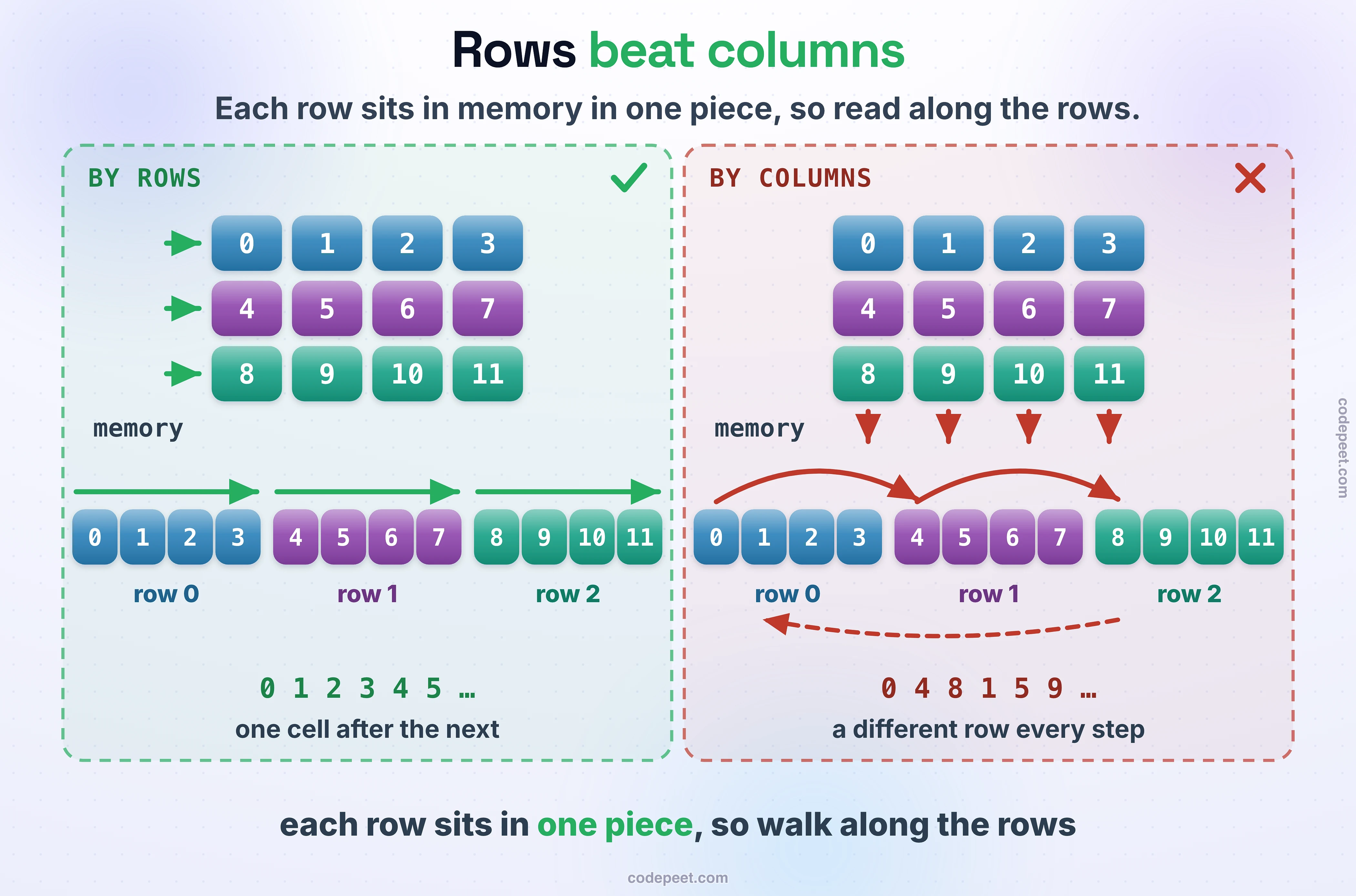
Each row sits in memory in one piece, its values side by side, and memory reaches the processor in small blocks of neighbouring values, a cache line at a time. Row by row uses every value in each block it brings in. Column by column brings in a block for one value, then leaves for the next row, somewhere else in memory. So put the loop over the columns inside the loop over the rows. This lesson is about how a matrix is laid out, how to move around it without falling off, and the walks most matrix problems are built from.
Rows, columns and one index
A matrix with m rows and n columns, m × n, names each cell by its row r and column c, both counted from 0. In code it's a list of rows, so grid[r][c] is row r first, then column c; m is the number of rows and n the length of each row. They're only equal when the matrix is square.
Numbered row after row, cell (r, c) is number r × n + c, and division takes the number back: row i / n, column i % n. The same arithmetic finds a 9 × 9 Sudoku's 3 × 3 box, numbered 0 to 8 by rows, (r / 3) * 3 + c / 3, dividing whole numbers (// in Python):
rows, cols = 3, 4
grid = [[r * cols + c for c in range(cols)] for r in range(rows)]   # each cell holds its index, r * cols + c
for row in grid:
    print(*row)
i = 7
print(f"index {i} is row {i // cols}, column {i % cols}")         # and back
for r, c in ((4, 7), (8, 0)):                                       # a 9 x 9 Sudoku's boxes, 0 to 8
    print(f"({r}, {c}) is in box {(r // 3) * 3 + c // 3}")

# 0 1 2 3
# 4 5 6 7
# 8 9 10 11
# index 7 is row 1, column 3
# (4, 7) is in box 5
# (8, 0) is in box 6
public class Main {
public static void main(String[] args) {
int rows = 3, cols = 4;
int[][] grid = new int[rows][cols];
for (int r = 0; r < rows; r++)
for (int c = 0; c < cols; c++)
grid[r][c] = r * cols + c; // each cell holds its index, r * cols + c
for (int[] row : grid) {
StringBuilder line = new StringBuilder();
for (int v : row) line.append(line.length() == 0 ? "" : " ").append(v);
System.out.println(line);
}
int i = 7;
System.out.println("index " + i + " is row " + i / cols + ", column " + i % cols); // and back
for (int[] cell : new int[][] {{4, 7}, {8, 0}}) // a 9 x 9 Sudoku's boxes, 0 to 8
System.out.println("(" + cell[0] + ", " + cell[1] + ") is in box " + ((cell[0] / 3) * 3 + cell[1] / 3));
}
}
// 0 1 2 3
// 4 5 6 7
// 8 9 10 11
// index 7 is row 1, column 3
// (4, 7) is in box 5
// (8, 0) is in box 6#include <bits/stdc++.h>
using namespace std;
int main() {
int rows = 3, cols = 4;
vector<vector<int>> grid(rows, vector<int>(cols));
for (int r = 0; r < rows; r++)
for (int c = 0; c < cols; c++)
grid[r][c] = r * cols + c; // each cell holds its index, r * cols + c
for (auto& row : grid) {
for (int c = 0; c < cols; c++) cout << (c ? " " : "") << row[c];
cout << "\n";
}
int i = 7;
cout << "index " << i << " is row " << i / cols << ", column " << i % cols << "\n"; // and back
for (auto [r, c] : vector<pair<int, int>>{{4, 7}, {8, 0}}) // a 9 x 9 Sudoku's boxes, 0 to 8
cout << "(" << r << ", " << c << ") is in box " << (r / 3) * 3 + c / 3 << "\n";
}
// 0 1 2 3
// 4 5 6 7
// 8 9 10 11
// index 7 is row 1, column 3
// (4, 7) is in box 5
// (8, 0) is in box 6const rows = 3, cols = 4;
const grid = Array.from({ length: rows }, (_, r) =>
Array.from({ length: cols }, (_, c) => r * cols + c)); // each cell holds its index, r * cols + c
for (const row of grid) console.log(row.join(" "));
const i = 7;
console.log(`index ${i} is row ${Math.floor(i / cols)}, column ${i % cols}`); // and back
for (const [r, c] of [[4, 7], [8, 0]]) // a 9 x 9 Sudoku's boxes, 0 to 8
console.log(`(${r}, ${c}) is in box ${Math.floor(r / 3) * 3 + Math.floor(c / 3)}`);
// 0 1 2 3
// 4 5 6 7
// 8 9 10 11
// index 7 is row 1, column 3
// (4, 7) is in box 5
// (8, 0) is in box 6const rows: number = 3, cols: number = 4;
const grid: number[][] = Array.from({ length: rows }, (_, r) =>
Array.from({ length: cols }, (_, c) => r * cols + c)); // each cell holds its index, r * cols + c
for (const row of grid) console.log(row.join(" "));
const i: number = 7;
console.log(`index ${i} is row ${Math.floor(i / cols)}, column ${i % cols}`); // and back
for (const [r, c] of [[4, 7], [8, 0]]) // a 9 x 9 Sudoku's boxes, 0 to 8
console.log(`(${r}, ${c}) is in box ${Math.floor(r / 3) * 3 + Math.floor(c / 3)}`);
// 0 1 2 3
// 4 5 6 7
// 8 9 10 11
// index 7 is row 1, column 3
// (4, 7) is in box 5
// (8, 0) is in box 6using System;
class Program {
static void Main() {
int rows = 3, cols = 4;
int[][] grid = new int[rows][];
for (int r = 0; r < rows; r++) {
grid[r] = new int[cols];
for (int c = 0; c < cols; c++) grid[r][c] = r * cols + c; // each cell holds its index
}
foreach (int[] row in grid) Console.WriteLine(string.Join(" ", row));
int i = 7;
Console.WriteLine($"index {i} is row {i / cols}, column {i % cols}"); // and back
foreach (var (r, c) in new[] { (4, 7), (8, 0) }) // a 9 x 9 Sudoku's boxes, 0 to 8
Console.WriteLine($"({r}, {c}) is in box {(r / 3) * 3 + c / 3}");
}
}
// 0 1 2 3
// 4 5 6 7
// 8 9 10 11
// index 7 is row 1, column 3
// (4, 7) is in box 5
// (8, 0) is in box 6package main
import (
"fmt"
"strings"
)
func main() {
rows, cols := 3, 4
grid := make([][]int, rows)
for r := range grid {
grid[r] = make([]int, cols)
for c := range grid[r] {
grid[r][c] = r*cols + c // each cell holds its index, r * cols + c
}
}
for _, row := range grid {
fmt.Println(strings.Trim(fmt.Sprint(row), "[]"))
}
i := 7
fmt.Printf("index %d is row %d, column %d\n", i, i/cols, i%cols) // and back
for _, cell := range [][2]int{{4, 7}, {8, 0}} { // a 9 x 9 Sudoku's boxes, 0 to 8
r, c := cell[0], cell[1]
fmt.Printf("(%d, %d) is in box %d\n", r, c, (r/3)*3+c/3)
}
}
// 0 1 2 3
// 4 5 6 7
// 8 9 10 11
// index 7 is row 1, column 3
// (4, 7) is in box 5
// (8, 0) is in box 6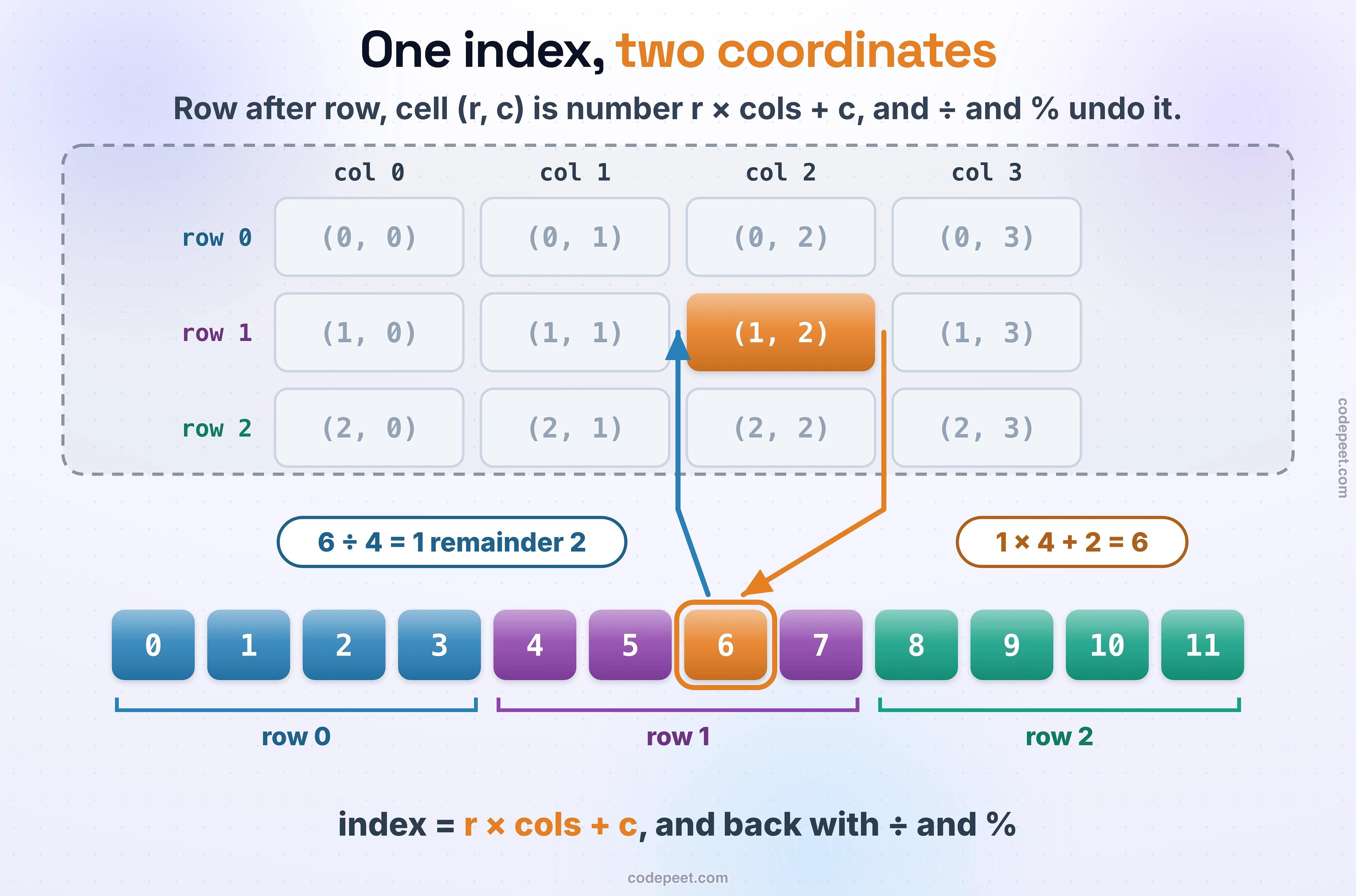
Search a 2D Matrix uses that index to binary search a whole sorted matrix as one array (Binary Search on Two Sorted Arrays and Matrices), and Valid Sudoku files every cell under its row, its column and its box.
Neighbours without falling off
Most grid problems look at the cells around one cell: up, down, left and right, or all eight with the corners. A list of row and column steps keeps that to one loop, and a bounds check keeps it inside the grid, since a cell on the edge has fewer neighbours. Counting the live neighbours of every cell, as Game of Life has to:
grid = [[0, 1, 0, 0],
        [1, 1, 0, 1],
        [0, 1, 1, 0]]
rows, cols = len(grid), len(grid[0])
DIRS = [(-1, -1), (-1, 0), (-1, 1), (0, -1), (0, 1), (1, -1), (1, 0), (1, 1)]   # the eight around a cell


def live_neighbours(r, c):
    count = 0
    for dr, dc in DIRS:
        nr, nc = r + dr, c + dc
        if 0 <= nr < rows and 0 <= nc < cols:      # inside the grid: a corner has 3 neighbours, an edge 5
            count += grid[nr][nc]
    return count


for r in range(rows):
    print(*(live_neighbours(r, c) for c in range(cols)))

# 3 2 3 1
# 3 4 5 1
# 3 3 3 2
public class Main {
static int[][] grid = {{0, 1, 0, 0}, {1, 1, 0, 1}, {0, 1, 1, 0}};
static int rows = grid.length, cols = grid[0].length;
static int[][] DIRS = {{-1, -1}, {-1, 0}, {-1, 1}, {0, -1}, {0, 1}, {1, -1}, {1, 0}, {1, 1}}; // the eight
static int liveNeighbours(int r, int c) {
int count = 0;
for (int[] d : DIRS) {
int nr = r + d[0], nc = c + d[1];
if (nr >= 0 && nr < rows && nc >= 0 && nc < cols) // inside: a corner has 3 neighbours, an edge 5
count += grid[nr][nc];
}
return count;
}
public static void main(String[] args) {
for (int r = 0; r < rows; r++) {
StringBuilder line = new StringBuilder();
for (int c = 0; c < cols; c++) line.append(c == 0 ? "" : " ").append(liveNeighbours(r, c));
System.out.println(line);
}
}
}
// 3 2 3 1
// 3 4 5 1
// 3 3 3 2#include <bits/stdc++.h>
using namespace std;
vector<vector<int>> grid = {{0, 1, 0, 0}, {1, 1, 0, 1}, {0, 1, 1, 0}};
int rows = grid.size(), cols = grid[0].size();
int DIRS[8][2] = {{-1, -1}, {-1, 0}, {-1, 1}, {0, -1}, {0, 1}, {1, -1}, {1, 0}, {1, 1}}; // the eight
int liveNeighbours(int r, int c) {
int count = 0;
for (auto& d : DIRS) {
int nr = r + d[0], nc = c + d[1];
if (nr >= 0 && nr < rows && nc >= 0 && nc < cols) // inside: a corner has 3 neighbours, an edge 5
count += grid[nr][nc];
}
return count;
}
int main() {
for (int r = 0; r < rows; r++) {
for (int c = 0; c < cols; c++) cout << (c ? " " : "") << liveNeighbours(r, c);
cout << "\n";
}
}
// 3 2 3 1
// 3 4 5 1
// 3 3 3 2const grid = [[0, 1, 0, 0],
[1, 1, 0, 1],
[0, 1, 1, 0]];
const rows = grid.length, cols = grid[0].length;
const DIRS = [[-1, -1], [-1, 0], [-1, 1], [0, -1], [0, 1], [1, -1], [1, 0], [1, 1]]; // the eight
function liveNeighbours(r, c) {
let count = 0;
for (const [dr, dc] of DIRS) {
const nr = r + dr, nc = c + dc;
if (nr >= 0 && nr < rows && nc >= 0 && nc < cols) // inside: a corner has 3 neighbours, an edge 5
count += grid[nr][nc];
}
return count;
}
for (let r = 0; r < rows; r++)
console.log(Array.from({ length: cols }, (_, c) => liveNeighbours(r, c)).join(" "));
// 3 2 3 1
// 3 4 5 1
// 3 3 3 2const grid: number[][] = [[0, 1, 0, 0],
[1, 1, 0, 1],
[0, 1, 1, 0]];
const rows: number = grid.length, cols: number = grid[0].length;
const DIRS: [number, number][] = [[-1, -1], [-1, 0], [-1, 1], [0, -1], [0, 1], [1, -1], [1, 0], [1, 1]];
function liveNeighbours(r: number, c: number): number {
let count = 0;
for (const [dr, dc] of DIRS) {
const nr = r + dr, nc = c + dc;
if (nr >= 0 && nr < rows && nc >= 0 && nc < cols) // inside: a corner has 3 neighbours, an edge 5
count += grid[nr][nc];
}
return count;
}
for (let r = 0; r < rows; r++)
console.log(Array.from({ length: cols }, (_, c) => liveNeighbours(r, c)).join(" "));
// 3 2 3 1
// 3 4 5 1
// 3 3 3 2using System;
using System.Linq;
class Program {
static int[][] grid = { new[] {0, 1, 0, 0}, new[] {1, 1, 0, 1}, new[] {0, 1, 1, 0} };
static int rows = grid.Length, cols = grid[0].Length;
static (int, int)[] DIRS = { (-1, -1), (-1, 0), (-1, 1), (0, -1), (0, 1), (1, -1), (1, 0), (1, 1) };
static int LiveNeighbours(int r, int c) {
int count = 0;
foreach (var (dr, dc) in DIRS) {
int nr = r + dr, nc = c + dc;
if (nr >= 0 && nr < rows && nc >= 0 && nc < cols) // inside: a corner has 3 neighbours, an edge 5
count += grid[nr][nc];
}
return count;
}
static void Main() {
for (int r = 0; r < rows; r++)
Console.WriteLine(string.Join(" ", Enumerable.Range(0, cols).Select(c => LiveNeighbours(r, c))));
}
}
// 3 2 3 1
// 3 4 5 1
// 3 3 3 2package main
import "fmt"
var grid = [][]int{{0, 1, 0, 0}, {1, 1, 0, 1}, {0, 1, 1, 0}}
var rows, cols = len(grid), len(grid[0])
var dirs = [][2]int{{-1, -1}, {-1, 0}, {-1, 1}, {0, -1}, {0, 1}, {1, -1}, {1, 0}, {1, 1}} // the eight
func liveNeighbours(r, c int) int {
count := 0
for _, d := range dirs {
nr, nc := r+d[0], c+d[1]
if nr >= 0 && nr < rows && nc >= 0 && nc < cols { // inside: a corner has 3 neighbours, an edge 5
count += grid[nr][nc]
}
}
return count
}
func main() {
for r := 0; r < rows; r++ {
for c := 0; c < cols; c++ {
if c > 0 {
fmt.Print(" ")
}
fmt.Print(liveNeighbours(r, c))
}
fmt.Println()
}
}
// 3 2 3 1
// 3 4 5 1
// 3 3 3 2The corner (0, 0) counts its 3 neighbours, (0, 1), (1, 0) and (1, 1), and finds 3 live ones; the middle cell (1, 2) has all 8, and 5 of them are live. Leave the bounds check out and the languages disagree, two of them silently: that's in Mistakes that cost an interview.
Walking a matrix
Row by row and column by column are two walks. The diagonals are two more: going down and to the right, r and c grow together, so r − c stays the same; going down and to the left, r grows as c shrinks, so r + c stays the same, and those are called the anti-diagonals. Grouping the cells of a 3 × 4 grid by r + c, then reading every other group backwards:
rows, cols = 3, 4
grid = [[r * cols + c for c in range(cols)] for r in range(rows)]
print("r - c = 0:", *(grid[r][r] for r in range(min(rows, cols))))     # down and to the right
order = []
for d in range(rows + cols - 1):                    # every cell with r + c == d, from the top row down
    cells = [grid[r][d - r] for r in range(rows) if 0 <= d - r < cols]
    print(f"r + c = {d}:", *cells)
    order += cells[::-1] if d % 2 == 0 else cells    # Diagonal Traverse: every other one read upwards
print("zigzag:", *order)

# r - c = 0: 0 5 10
# r + c = 0: 0
# r + c = 1: 1 4
# r + c = 2: 2 5 8
# r + c = 3: 3 6 9
# r + c = 4: 7 10
# r + c = 5: 11
# zigzag: 0 1 4 8 5 2 3 6 9 10 7 11
import java.util.*;
public class Main {
public static void main(String[] args) {
int rows = 3, cols = 4;
int[][] grid = new int[rows][cols];
for (int r = 0; r < rows; r++)
for (int c = 0; c < cols; c++) grid[r][c] = r * cols + c;
StringBuilder main = new StringBuilder("r - c = 0:"); // down and to the right
for (int r = 0; r < Math.min(rows, cols); r++) main.append(" ").append(grid[r][r]);
System.out.println(main);
List<Integer> order = new ArrayList<>();
for (int d = 0; d < rows + cols - 1; d++) { // every cell with r + c == d, from the top row down
List<Integer> cells = new ArrayList<>();
for (int r = 0; r < rows; r++)
if (d - r >= 0 && d - r < cols) cells.add(grid[r][d - r]);
StringBuilder line = new StringBuilder("r + c = " + d + ":");
for (int v : cells) line.append(" ").append(v);
System.out.println(line);
if (d % 2 == 0) Collections.reverse(cells); // Diagonal Traverse: every other one read upwards
order.addAll(cells);
}
StringBuilder zigzag = new StringBuilder("zigzag:");
for (int v : order) zigzag.append(" ").append(v);
System.out.println(zigzag);
}
}
// r - c = 0: 0 5 10
// r + c = 0: 0
// r + c = 1: 1 4
// r + c = 2: 2 5 8
// r + c = 3: 3 6 9
// r + c = 4: 7 10
// r + c = 5: 11
// zigzag: 0 1 4 8 5 2 3 6 9 10 7 11#include <bits/stdc++.h>
using namespace std;
int main() {
int rows = 3, cols = 4;
vector<vector<int>> grid(rows, vector<int>(cols));
for (int r = 0; r < rows; r++)
for (int c = 0; c < cols; c++) grid[r][c] = r * cols + c;
cout << "r - c = 0:"; // down and to the right
for (int r = 0; r < min(rows, cols); r++) cout << " " << grid[r][r];
cout << "\n";
vector<int> order;
for (int d = 0; d < rows + cols - 1; d++) { // every cell with r + c == d, from the top row down
vector<int> cells;
for (int r = 0; r < rows; r++)
if (d - r >= 0 && d - r < cols) cells.push_back(grid[r][d - r]);
cout << "r + c = " << d << ":";
for (int v : cells) cout << " " << v;
cout << "\n";
if (d % 2 == 0) reverse(cells.begin(), cells.end()); // Diagonal Traverse: every other one upwards
order.insert(order.end(), cells.begin(), cells.end());
}
cout << "zigzag:";
for (int v : order) cout << " " << v;
cout << "\n";
}
// r - c = 0: 0 5 10
// r + c = 0: 0
// r + c = 1: 1 4
// r + c = 2: 2 5 8
// r + c = 3: 3 6 9
// r + c = 4: 7 10
// r + c = 5: 11
// zigzag: 0 1 4 8 5 2 3 6 9 10 7 11const rows = 3, cols = 4;
const grid = Array.from({ length: rows }, (_, r) => Array.from({ length: cols }, (_, c) => r * cols + c));
const main = [];
for (let r = 0; r < Math.min(rows, cols); r++) main.push(grid[r][r]); // down and to the right
console.log("r - c = 0:", main.join(" "));
const order = [];
for (let d = 0; d < rows + cols - 1; d++) { // every cell with r + c == d, from the top row down
const cells = [];
for (let r = 0; r < rows; r++)
if (d - r >= 0 && d - r < cols) cells.push(grid[r][d - r]);
console.log(`r + c = ${d}:`, cells.join(" "));
order.push(...(d % 2 === 0 ? cells.reverse() : cells)); // Diagonal Traverse: every other one upwards
}
console.log("zigzag:", order.join(" "));
// r - c = 0: 0 5 10
// r + c = 0: 0
// r + c = 1: 1 4
// r + c = 2: 2 5 8
// r + c = 3: 3 6 9
// r + c = 4: 7 10
// r + c = 5: 11
// zigzag: 0 1 4 8 5 2 3 6 9 10 7 11const rows: number = 3, cols: number = 4;
const grid: number[][] = Array.from({ length: rows }, (_, r) => Array.from({ length: cols }, (_, c) => r * cols + c));
const main: number[] = [];
for (let r = 0; r < Math.min(rows, cols); r++) main.push(grid[r][r]); // down and to the right
console.log("r - c = 0:", main.join(" "));
const order: number[] = [];
for (let d = 0; d < rows + cols - 1; d++) { // every cell with r + c == d, from the top row down
const cells: number[] = [];
for (let r = 0; r < rows; r++)
if (d - r >= 0 && d - r < cols) cells.push(grid[r][d - r]);
console.log(`r + c = ${d}:`, cells.join(" "));
order.push(...(d % 2 === 0 ? cells.reverse() : cells)); // Diagonal Traverse: every other one upwards
}
console.log("zigzag:", order.join(" "));
// r - c = 0: 0 5 10
// r + c = 0: 0
// r + c = 1: 1 4
// r + c = 2: 2 5 8
// r + c = 3: 3 6 9
// r + c = 4: 7 10
// r + c = 5: 11
// zigzag: 0 1 4 8 5 2 3 6 9 10 7 11using System;
using System.Collections.Generic;
class Program {
static void Main() {
int rows = 3, cols = 4;
int[][] grid = new int[rows][];
for (int r = 0; r < rows; r++) {
grid[r] = new int[cols];
for (int c = 0; c < cols; c++) grid[r][c] = r * cols + c;
}
var main = new List<int>();
for (int r = 0; r < Math.Min(rows, cols); r++) main.Add(grid[r][r]); // down and to the right
Console.WriteLine("r - c = 0: " + string.Join(" ", main));
var order = new List<int>();
for (int d = 0; d < rows + cols - 1; d++) { // every cell with r + c == d, from the top row down
var cells = new List<int>();
for (int r = 0; r < rows; r++)
if (d - r >= 0 && d - r < cols) cells.Add(grid[r][d - r]);
Console.WriteLine($"r + c = {d}: " + string.Join(" ", cells));
if (d % 2 == 0) cells.Reverse(); // Diagonal Traverse: every other one read upwards
order.AddRange(cells);
}
Console.WriteLine("zigzag: " + string.Join(" ", order));
}
}
// r - c = 0: 0 5 10
// r + c = 0: 0
// r + c = 1: 1 4
// r + c = 2: 2 5 8
// r + c = 3: 3 6 9
// r + c = 4: 7 10
// r + c = 5: 11
// zigzag: 0 1 4 8 5 2 3 6 9 10 7 11package main
import (
"fmt"
"strings"
)
func line(label string, values []int) string {
return strings.TrimSpace(label + " " + strings.Trim(fmt.Sprint(values), "[]"))
}
func main() {
rows, cols := 3, 4
grid := make([][]int, rows)
for r := range grid {
grid[r] = make([]int, cols)
for c := range grid[r] {
grid[r][c] = r*cols + c
}
}
var mainDiagonal []int
for r := 0; r < min(rows, cols); r++ { // down and to the right
mainDiagonal = append(mainDiagonal, grid[r][r])
}
fmt.Println(line("r - c = 0:", mainDiagonal))
var order []int
for d := 0; d < rows+cols-1; d++ { // every cell with r + c == d, from the top row down
var cells []int
for r := 0; r < rows; r++ {
if d-r >= 0 && d-r < cols {
cells = append(cells, grid[r][d-r])
}
}
fmt.Println(line(fmt.Sprintf("r + c = %d:", d), cells))
if d%2 == 0 { // Diagonal Traverse: every other one read upwards
for i, j := 0, len(cells)-1; i < j; i, j = i+1, j-1 {
cells[i], cells[j] = cells[j], cells[i]
}
}
order = append(order, cells...)
}
fmt.Println(line("zigzag:", order))
}
// r - c = 0: 0 5 10
// r + c = 0: 0
// r + c = 1: 1 4
// r + c = 2: 2 5 8
// r + c = 3: 3 6 9
// r + c = 4: 7 10
// r + c = 5: 11
// zigzag: 0 1 4 8 5 2 3 6 9 10 7 11The cells hold their own index, so the zigzag line, 0 1 4 8 5 2 3 6 9 10 7 11, is Diagonal Traverse's order: after 0, the next anti-diagonal goes down, 1 then 4, and the one after it up, 8, 5 then 2. A matrix with m rows and n columns has m + n − 1 of them, r + c from 0 to m + n − 2.
The spiral
Spiral Matrix reads the outer ring clockwise, then the next ring in, and so on. Keep four boundaries, the top and bottom rows and the left and right columns not yet read. Read along the top row and move top down; read down the right column and move right in; then the bottom row backwards and the left column upwards, moving those two in. The cells still unread are always exactly the rectangle between the four boundaries, so the loop ends when it's empty. Two guards matter: after the first two passes, the rectangle may be a single row or a single column, and reading it backwards would read it twice:
def spiral(grid):
    out = []
    top, bottom, left, right = 0, len(grid) - 1, 0, len(grid[0]) - 1
    while top <= bottom and left <= right:            # unread: rows top..bottom, columns left..right
        for c in range(left, right + 1):              # along the top row
            out.append(grid[top][c])
        top += 1
        for r in range(top, bottom + 1):              # down the right column
            out.append(grid[r][right])
        right -= 1
        if top <= bottom:                             # a row is left to read backwards
            for c in range(right, left - 1, -1):      # along the bottom row, backwards
                out.append(grid[bottom][c])
            bottom -= 1
        if left <= right:                             # a column is left to read upwards
            for r in range(bottom, top - 1, -1):      # up the left column
                out.append(grid[r][left])
            left += 1
    return out


for grid in ([[1, 2, 3, 4], [5, 6, 7, 8], [9, 10, 11, 12]], [[1, 2, 3]], [[1], [2], [3]]):
    print(*spiral(grid))

# 1 2 3 4 8 12 11 10 9 5 6 7
# 1 2 3
# 1 2 3
import java.util.*;
public class Main {
static List<Integer> spiral(int[][] grid) {
List<Integer> out = new ArrayList<>();
int top = 0, bottom = grid.length - 1, left = 0, right = grid[0].length - 1;
while (top <= bottom && left <= right) { // unread: rows top..bottom, columns left..right
for (int c = left; c <= right; c++) out.add(grid[top][c]); // along the top row
top++;
for (int r = top; r <= bottom; r++) out.add(grid[r][right]); // down the right column
right--;
if (top <= bottom) { // a row is left to read backwards
for (int c = right; c >= left; c--) out.add(grid[bottom][c]);
bottom--;
}
if (left <= right) { // a column is left to read upwards
for (int r = bottom; r >= top; r--) out.add(grid[r][left]);
left++;
}
}
return out;
}
public static void main(String[] args) {
int[][][] grids = {{{1, 2, 3, 4}, {5, 6, 7, 8}, {9, 10, 11, 12}}, {{1, 2, 3}}, {{1}, {2}, {3}}};
for (int[][] grid : grids) {
StringBuilder line = new StringBuilder();
for (int v : spiral(grid)) line.append(line.length() == 0 ? "" : " ").append(v);
System.out.println(line);
}
}
}
// 1 2 3 4 8 12 11 10 9 5 6 7
// 1 2 3
// 1 2 3#include <bits/stdc++.h>
using namespace std;
vector<int> spiral(const vector<vector<int>>& grid) {
vector<int> out;
int top = 0, bottom = grid.size() - 1, left = 0, right = grid[0].size() - 1;
while (top <= bottom && left <= right) { // unread: rows top..bottom, columns left..right
for (int c = left; c <= right; c++) out.push_back(grid[top][c]); // along the top row
top++;
for (int r = top; r <= bottom; r++) out.push_back(grid[r][right]); // down the right column
right--;
if (top <= bottom) { // a row is left to read backwards
for (int c = right; c >= left; c--) out.push_back(grid[bottom][c]);
bottom--;
}
if (left <= right) { // a column is left to read upwards
for (int r = bottom; r >= top; r--) out.push_back(grid[r][left]);
left++;
}
}
return out;
}
int main() {
vector<vector<vector<int>>> grids = {{{1, 2, 3, 4}, {5, 6, 7, 8}, {9, 10, 11, 12}}, {{1, 2, 3}}, {{1}, {2}, {3}}};
for (auto& grid : grids) {
vector<int> out = spiral(grid);
for (size_t i = 0; i < out.size(); i++) cout << (i ? " " : "") << out[i];
cout << "\n";
}
}
// 1 2 3 4 8 12 11 10 9 5 6 7
// 1 2 3
// 1 2 3function spiral(grid) {
const out = [];
let top = 0, bottom = grid.length - 1, left = 0, right = grid[0].length - 1;
while (top <= bottom && left <= right) { // unread: rows top..bottom, columns left..right
for (let c = left; c <= right; c++) out.push(grid[top][c]); // along the top row
top++;
for (let r = top; r <= bottom; r++) out.push(grid[r][right]); // down the right column
right--;
if (top <= bottom) { // a row is left to read backwards
for (let c = right; c >= left; c--) out.push(grid[bottom][c]);
bottom--;
}
if (left <= right) { // a column is left to read upwards
for (let r = bottom; r >= top; r--) out.push(grid[r][left]);
left++;
}
}
return out;
}
for (const grid of [[[1, 2, 3, 4], [5, 6, 7, 8], [9, 10, 11, 12]], [[1, 2, 3]], [[1], [2], [3]]])
console.log(spiral(grid).join(" "));
// 1 2 3 4 8 12 11 10 9 5 6 7
// 1 2 3
// 1 2 3function spiral(grid: number[][]): number[] {
const out: number[] = [];
let top = 0, bottom = grid.length - 1, left = 0, right = grid[0].length - 1;
while (top <= bottom && left <= right) { // unread: rows top..bottom, columns left..right
for (let c = left; c <= right; c++) out.push(grid[top][c]); // along the top row
top++;
for (let r = top; r <= bottom; r++) out.push(grid[r][right]); // down the right column
right--;
if (top <= bottom) { // a row is left to read backwards
for (let c = right; c >= left; c--) out.push(grid[bottom][c]);
bottom--;
}
if (left <= right) { // a column is left to read upwards
for (let r = bottom; r >= top; r--) out.push(grid[r][left]);
left++;
}
}
return out;
}
const grids: number[][][] = [[[1, 2, 3, 4], [5, 6, 7, 8], [9, 10, 11, 12]], [[1, 2, 3]], [[1], [2], [3]]];
for (const grid of grids) console.log(spiral(grid).join(" "));
// 1 2 3 4 8 12 11 10 9 5 6 7
// 1 2 3
// 1 2 3using System;
using System.Collections.Generic;
class Program {
static List<int> Spiral(int[][] grid) {
var result = new List<int>();
int top = 0, bottom = grid.Length - 1, left = 0, right = grid[0].Length - 1;
while (top <= bottom && left <= right) { // unread: rows top..bottom, columns left..right
for (int c = left; c <= right; c++) result.Add(grid[top][c]); // along the top row
top++;
for (int r = top; r <= bottom; r++) result.Add(grid[r][right]); // down the right column
right--;
if (top <= bottom) { // a row is left to read backwards
for (int c = right; c >= left; c--) result.Add(grid[bottom][c]);
bottom--;
}
if (left <= right) { // a column is left to read upwards
for (int r = bottom; r >= top; r--) result.Add(grid[r][left]);
left++;
}
}
return result;
}
static void Main() {
int[][][] grids = {
new[] { new[] {1, 2, 3, 4}, new[] {5, 6, 7, 8}, new[] {9, 10, 11, 12} },
new[] { new[] {1, 2, 3} },
new[] { new[] {1}, new[] {2}, new[] {3} },
};
foreach (var grid in grids) Console.WriteLine(string.Join(" ", Spiral(grid)));
}
}
// 1 2 3 4 8 12 11 10 9 5 6 7
// 1 2 3
// 1 2 3package main
import (
"fmt"
"strings"
)
func spiral(grid [][]int) []int {
var out []int
top, bottom, left, right := 0, len(grid)-1, 0, len(grid[0])-1
for top <= bottom && left <= right { // unread: rows top..bottom, columns left..right
for c := left; c <= right; c++ { // along the top row
out = append(out, grid[top][c])
}
top++
for r := top; r <= bottom; r++ { // down the right column
out = append(out, grid[r][right])
}
right--
if top <= bottom { // a row is left to read backwards
for c := right; c >= left; c-- {
out = append(out, grid[bottom][c])
}
bottom--
}
if left <= right { // a column is left to read upwards
for r := bottom; r >= top; r-- {
out = append(out, grid[r][left])
}
left++
}
}
return out
}
func main() {
grids := [][][]int{{{1, 2, 3, 4}, {5, 6, 7, 8}, {9, 10, 11, 12}}, {{1, 2, 3}}, {{1}, {2}, {3}}}
for _, grid := range grids {
fmt.Println(strings.Trim(fmt.Sprint(spiral(grid)), "[]"))
}
}
// 1 2 3 4 8 12 11 10 9 5 6 7
// 1 2 3
// 1 2 3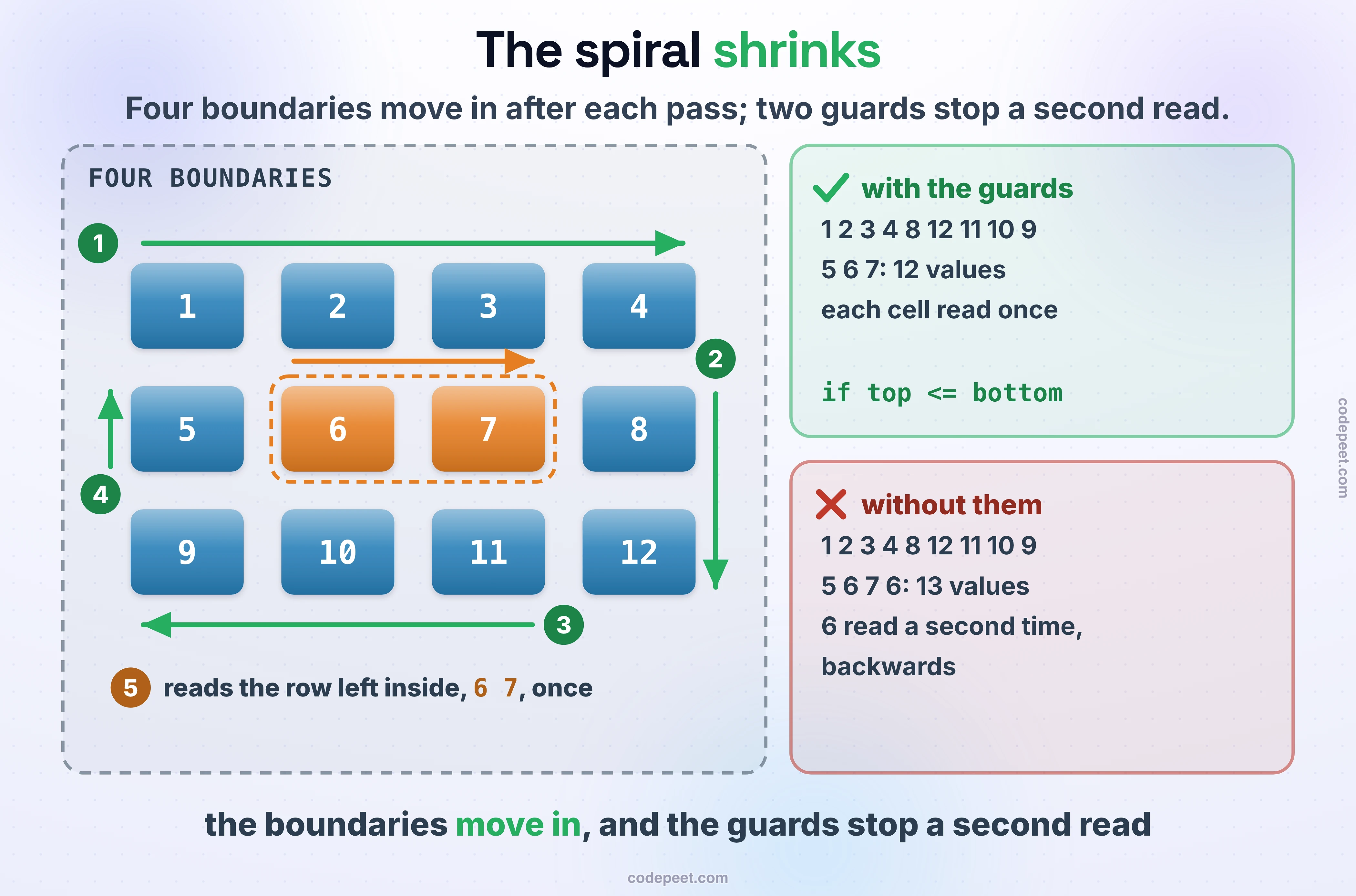
1 2 3 4 8 12 11 10 9 5 6 7 for the 3 × 4 grid, and a single row or a single column comes out once, 1 2 3. Each cell is read once, so it's O(m · n) time.
Walk the Matrix. Steer a walk yourself: a spiral that turns at the boundaries, or Diagonal Traverse's zigzag. A step off the grid, or onto a cell you've already read, is refused.
The transpose
The transpose turns rows into columns: cell (r, c) moves to (c, r). An m × n matrix becomes n × m, so Transpose Matrix builds a new one. Only a square matrix can be transposed in place, swapping each pair across the diagonal once:
def show(grid):
    return " | ".join(" ".join(map(str, row)) for row in grid)


def transpose(grid):                              # m x n in, n x m out: cell (r, c) goes to (c, r)
    rows, cols = len(grid), len(grid[0])
    return [[grid[r][c] for r in range(rows)] for c in range(cols)]


print(show(transpose([[1, 2, 3], [4, 5, 6]])))

square = [[1, 2, 3], [4, 5, 6], [7, 8, 9]]
n = len(square)
for r in range(n):                                # in place, square only: each pair above the diagonal, once
    for c in range(r + 1, n):
        square[r][c], square[c][r] = square[c][r], square[r][c]
print(show(square))

# 1 4 | 2 5 | 3 6
# 1 4 7 | 2 5 8 | 3 6 9
public class Main {
static String show(int[][] grid) {
StringBuilder sb = new StringBuilder();
for (int[] row : grid) {
if (sb.length() > 0) sb.append(" | ");
for (int c = 0; c < row.length; c++) sb.append(c == 0 ? "" : " ").append(row[c]);
}
return sb.toString();
}
static int[][] transpose(int[][] grid) { // m x n in, n x m out: cell (r, c) goes to (c, r)
int rows = grid.length, cols = grid[0].length;
int[][] t = new int[cols][rows];
for (int r = 0; r < rows; r++)
for (int c = 0; c < cols; c++) t[c][r] = grid[r][c];
return t;
}
public static void main(String[] args) {
System.out.println(show(transpose(new int[][] {{1, 2, 3}, {4, 5, 6}})));
int[][] square = {{1, 2, 3}, {4, 5, 6}, {7, 8, 9}};
int n = square.length;
for (int r = 0; r < n; r++) // in place, square only: each pair above the diagonal, once
for (int c = r + 1; c < n; c++) {
int keep = square[r][c];
square[r][c] = square[c][r];
square[c][r] = keep;
}
System.out.println(show(square));
}
}
// 1 4 | 2 5 | 3 6
// 1 4 7 | 2 5 8 | 3 6 9#include <bits/stdc++.h>
using namespace std;
string show(const vector<vector<int>>& grid) {
string s;
for (auto& row : grid) {
if (!s.empty()) s += " | ";
for (size_t c = 0; c < row.size(); c++) s += (c ? " " : "") + to_string(row[c]);
}
return s;
}
vector<vector<int>> transpose(const vector<vector<int>>& grid) { // m x n in, n x m out: (r, c) goes to (c, r)
int rows = grid.size(), cols = grid[0].size();
vector<vector<int>> t(cols, vector<int>(rows));
for (int r = 0; r < rows; r++)
for (int c = 0; c < cols; c++) t[c][r] = grid[r][c];
return t;
}
int main() {
cout << show(transpose({{1, 2, 3}, {4, 5, 6}})) << "\n";
vector<vector<int>> square = {{1, 2, 3}, {4, 5, 6}, {7, 8, 9}};
int n = square.size();
for (int r = 0; r < n; r++) // in place, square only: each pair above the diagonal, once
for (int c = r + 1; c < n; c++) swap(square[r][c], square[c][r]);
cout << show(square) << "\n";
}
// 1 4 | 2 5 | 3 6
// 1 4 7 | 2 5 8 | 3 6 9const show = grid => grid.map(row => row.join(" ")).join(" | ");
function transpose(grid) { // m x n in, n x m out: cell (r, c) goes to (c, r)
const rows = grid.length, cols = grid[0].length;
return Array.from({ length: cols }, (_, c) => Array.from({ length: rows }, (_, r) => grid[r][c]));
}
console.log(show(transpose([[1, 2, 3], [4, 5, 6]])));
const square = [[1, 2, 3], [4, 5, 6], [7, 8, 9]];
const n = square.length;
for (let r = 0; r < n; r++) // in place, square only: each pair above the diagonal, once
for (let c = r + 1; c < n; c++) [square[r][c], square[c][r]] = [square[c][r], square[r][c]];
console.log(show(square));
// 1 4 | 2 5 | 3 6
// 1 4 7 | 2 5 8 | 3 6 9const show = (grid: number[][]): string => grid.map(row => row.join(" ")).join(" | ");
function transpose(grid: number[][]): number[][] { // m x n in, n x m out: cell (r, c) goes to (c, r)
const rows = grid.length, cols = grid[0].length;
return Array.from({ length: cols }, (_, c) => Array.from({ length: rows }, (_, r) => grid[r][c]));
}
console.log(show(transpose([[1, 2, 3], [4, 5, 6]])));
const square: number[][] = [[1, 2, 3], [4, 5, 6], [7, 8, 9]];
const n: number = square.length;
for (let r = 0; r < n; r++) // in place, square only: each pair above the diagonal, once
for (let c = r + 1; c < n; c++) [square[r][c], square[c][r]] = [square[c][r], square[r][c]];
console.log(show(square));
// 1 4 | 2 5 | 3 6
// 1 4 7 | 2 5 8 | 3 6 9using System;
using System.Linq;
class Program {
static string Show(int[][] grid) => string.Join(" | ", grid.Select(row => string.Join(" ", row)));
static int[][] Transpose(int[][] grid) { // m x n in, n x m out: cell (r, c) goes to (c, r)
int rows = grid.Length, cols = grid[0].Length;
int[][] t = new int[cols][];
for (int c = 0; c < cols; c++) {
t[c] = new int[rows];
for (int r = 0; r < rows; r++) t[c][r] = grid[r][c];
}
return t;
}
static void Main() {
Console.WriteLine(Show(Transpose(new[] { new[] {1, 2, 3}, new[] {4, 5, 6} })));
int[][] square = { new[] {1, 2, 3}, new[] {4, 5, 6}, new[] {7, 8, 9} };
int n = square.Length;
for (int r = 0; r < n; r++) // in place, square only: each pair above the diagonal, once
for (int c = r + 1; c < n; c++) (square[r][c], square[c][r]) = (square[c][r], square[r][c]);
Console.WriteLine(Show(square));
}
}
// 1 4 | 2 5 | 3 6
// 1 4 7 | 2 5 8 | 3 6 9package main
import (
"fmt"
"strings"
)
func show(grid [][]int) string {
rows := make([]string, len(grid))
for i, row := range grid {
rows[i] = strings.Trim(fmt.Sprint(row), "[]")
}
return strings.Join(rows, " | ")
}
func transpose(grid [][]int) [][]int { // m x n in, n x m out: cell (r, c) goes to (c, r)
rows, cols := len(grid), len(grid[0])
t := make([][]int, cols)
for c := range t {
t[c] = make([]int, rows)
for r := 0; r < rows; r++ {
t[c][r] = grid[r][c]
}
}
return t
}
func main() {
fmt.Println(show(transpose([][]int{{1, 2, 3}, {4, 5, 6}})))
square := [][]int{{1, 2, 3}, {4, 5, 6}, {7, 8, 9}}
n := len(square)
for r := 0; r < n; r++ { // in place, square only: each pair above the diagonal, once
for c := r + 1; c < n; c++ {
square[r][c], square[c][r] = square[c][r], square[r][c]
}
}
fmt.Println(show(square))
}
// 1 4 | 2 5 | 3 6
// 1 4 7 | 2 5 8 | 3 6 9The 2 × 3 matrix came out 3 × 2, 1 4 | 2 5 | 3 6, and the 3 × 3 one, 1 4 7 | 2 5 8 | 3 6 9. The inner loop starts at r + 1, so each pair above the diagonal is swapped once; the cells on it stay where they are. Rotating a square matrix is a transpose and one more step: that's the next lesson, Changing a Matrix in Place.
Spotting it
The clues: a "matrix", "grid", "board" or "image" given as rows of values, an m × n input, cells and their neighbours, or a reading order: spiral, diagonal, row by row, column by column. Near misses:
- The shortest way through a grid, or how many islands it holds: a graph search on the cells (Graphs).
- Sums over many rectangles of one grid: Difference Arrays and 2D Prefix Sums.
- Finding a value in a matrix sorted along its rows and columns: Binary Search on Two Sorted Arrays and Matrices.
- Filling a grid by trying choices and undoing them, like a Sudoku solver: Backtracking on Grids and Constraints.
Mistakes that cost an interview
One row, three times. A grid of zeros made in one line can hold the same row three times, so writing one cell changes a whole column:
grid = [[0] * 3] * 3                  # one row, and the same row twice more
grid[0][0] = 1
for row in grid:
    print(*row)

# 1 0 0
# 1 0 0
# 1 0 0
import java.util.Arrays;
public class Main {
public static void main(String[] args) {
int[][] grid = new int[3][];
Arrays.fill(grid, new int[3]); // one row, in all three places
grid[0][0] = 1;
for (int[] row : grid) System.out.println(row[0] + " " + row[1] + " " + row[2]);
}
}
// 1 0 0
// 1 0 0
// 1 0 0#include <bits/stdc++.h>
using namespace std;
int main() {
vector<vector<int>> grid(3, vector<int>(3)); // three copies of one row
grid[0][0] = 1;
for (auto& row : grid) cout << row[0] << " " << row[1] << " " << row[2] << "\n";
}
// 1 0 0
// 0 0 0
// 0 0 0const grid = Array(3).fill(Array(3).fill(0)); // one row, in all three places
grid[0][0] = 1;
for (const row of grid) console.log(row.join(" "));
// 1 0 0
// 1 0 0
// 1 0 0const grid: number[][] = Array(3).fill(Array(3).fill(0)); // one row, in all three places
grid[0][0] = 1;
for (const row of grid) console.log(row.join(" "));
// 1 0 0
// 1 0 0
// 1 0 0using System;
class Program {
static void Main() {
int[][] grid = new int[3][];
Array.Fill(grid, new int[3]); // one row, in all three places
grid[0][0] = 1;
foreach (int[] row in grid) Console.WriteLine(string.Join(" ", row));
}
}
// 1 0 0
// 1 0 0
// 1 0 0package main
import (
"fmt"
"strings"
)
func main() {
row := make([]int, 3)
grid := [][]int{row, row, row} // one row, in all three places
grid[0][0] = 1
for _, row := range grid {
fmt.Println(strings.Trim(fmt.Sprint(row), "[]"))
}
}
// 1 0 0
// 1 0 0
// 1 0 0Python, Java, JavaScript, TypeScript, C# and Go put one row in all three places, so setting grid[0][0] set the first cell of every row. C++'s vector copies its fill value, so its three rows are three. Build each row on its own:
grid = [[0] * 3 for _ in range(3)]    # a new row each time
grid[0][0] = 1
for row in grid:
    print(*row)

# 1 0 0
# 0 0 0
# 0 0 0
public class Main {
public static void main(String[] args) {
int[][] grid = new int[3][3]; // three rows of their own
grid[0][0] = 1;
for (int[] row : grid) System.out.println(row[0] + " " + row[1] + " " + row[2]);
}
}
// 1 0 0
// 0 0 0
// 0 0 0#include <bits/stdc++.h>
using namespace std;
int main() {
vector<vector<int>> grid(3, vector<int>(3)); // three copies of one row
grid[0][0] = 1;
for (auto& row : grid) cout << row[0] << " " << row[1] << " " << row[2] << "\n";
}
// 1 0 0
// 0 0 0
// 0 0 0const grid = Array.from({ length: 3 }, () => Array(3).fill(0)); // a new row each time
grid[0][0] = 1;
for (const row of grid) console.log(row.join(" "));
// 1 0 0
// 0 0 0
// 0 0 0const grid: number[][] = Array.from({ length: 3 }, () => Array(3).fill(0)); // a new row each time
grid[0][0] = 1;
for (const row of grid) console.log(row.join(" "));
// 1 0 0
// 0 0 0
// 0 0 0using System;
class Program {
static void Main() {
int[][] grid = new int[3][];
for (int r = 0; r < 3; r++) grid[r] = new int[3]; // a new row each time
grid[0][0] = 1;
foreach (int[] row in grid) Console.WriteLine(string.Join(" ", row));
}
}
// 1 0 0
// 0 0 0
// 0 0 0package main
import (
"fmt"
"strings"
)
func main() {
grid := make([][]int, 3)
for r := range grid {
grid[r] = make([]int, 3) // a new row each time
}
grid[0][0] = 1
for _, row := range grid {
fmt.Println(strings.Trim(fmt.Sprint(row), "[]"))
}
}
// 1 0 0
// 0 0 0
// 0 0 0No bounds check. Counting the eight neighbours of the corner (0, 0) without one reads row −1 and column −1. The right count is 0:
grid = [[1, 0, 0],
        [0, 0, 1],
        [1, 1, 1]]
count = 0
for dr in (-1, 0, 1):                 # the eight neighbours of (0, 0), with no bounds check
    for dc in (-1, 0, 1):
        if dr or dc:
            count += grid[0 + dr][0 + dc]
print(count)

# 4
public class Main {
public static void main(String[] args) {
int[][] grid = {{1, 0, 0}, {0, 0, 1}, {1, 1, 1}};
int count = 0;
for (int dr = -1; dr <= 1; dr++) // the eight neighbours of (0, 0), with no bounds check
for (int dc = -1; dc <= 1; dc++)
if (dr != 0 || dc != 0) count += grid[0 + dr][0 + dc];
System.out.println(count);
}
}
// (stopped: ArrayIndexOutOfBoundsException: Index -1 out of bounds for length 3)#include <bits/stdc++.h>
using namespace std;
int main() {
vector<vector<int>> grid = {{1, 0, 0}, {0, 0, 1}, {1, 1, 1}};
int count = 0;
for (int dr = -1; dr <= 1; dr++) // the eight neighbours of (0, 0), with no bounds check
for (int dc = -1; dc <= 1; dc++)
if (dr != 0 || dc != 0) count += grid[0 + dr][0 + dc];
cout << count << "\n";
}
// 3const grid = [[1, 0, 0], [0, 0, 1], [1, 1, 1]];
let count = 0;
for (let dr = -1; dr <= 1; dr++) // the eight neighbours of (0, 0), with no bounds check
for (let dc = -1; dc <= 1; dc++)
if (dr !== 0 || dc !== 0) count += grid[0 + dr][0 + dc];
console.log(count);
// (stopped: TypeError: Cannot read properties of undefined (reading '-1'))const grid: number[][] = [[1, 0, 0], [0, 0, 1], [1, 1, 1]];
let count: number = 0;
for (let dr = -1; dr <= 1; dr++) // the eight neighbours of (0, 0), with no bounds check
for (let dc = -1; dc <= 1; dc++)
if (dr !== 0 || dc !== 0) count += grid[0 + dr][0 + dc];
console.log(count);
// (stopped: TypeError: Cannot read properties of undefined (reading '-1'))using System;
class Program {
static void Main() {
int[][] grid = { new[] {1, 0, 0}, new[] {0, 0, 1}, new[] {1, 1, 1} };
int count = 0;
for (int dr = -1; dr <= 1; dr++) // the eight neighbours of (0, 0), with no bounds check
for (int dc = -1; dc <= 1; dc++)
if (dr != 0 || dc != 0) count += grid[0 + dr][0 + dc];
Console.WriteLine(count);
}
}
// (stopped: IndexOutOfRangeException: Index was outside the bounds of the array.)package main
import "fmt"
func main() {
grid := [][]int{{1, 0, 0}, {0, 0, 1}, {1, 1, 1}}
count := 0
for dr := -1; dr <= 1; dr++ { // the eight neighbours of (0, 0), with no bounds check
for dc := -1; dc <= 1; dc++ {
if dr != 0 || dc != 0 {
count += grid[0+dr][0+dc]
}
}
}
fmt.Println(count)
}
// (stopped: panic: index out of range [-1])Python printed 4: a negative index counts from the end, so row −1 is the last row and the mistake gives a number, not an error. C++ printed 3, reading whatever memory sat next to the rows, which is undefined behaviour. Java, C# and Go stopped with an index out of range, JavaScript and TypeScript with a TypeError, reading a cell of the row that isn't there. Check 0 <= nr < rows and 0 <= nc < cols before every read.
The spiral without its guards. Leave out if top <= bottom and if left <= right and the last row or column inside is read a second time, backwards:
def spiral(grid):
    out = []
    top, bottom, left, right = 0, len(grid) - 1, 0, len(grid[0]) - 1
    while top <= bottom and left <= right:
        for c in range(left, right + 1):              # along the top row
            out.append(grid[top][c])
        top += 1
        for r in range(top, bottom + 1):              # down the right column
            out.append(grid[r][right])
        right -= 1
        for c in range(right, left - 1, -1):          # along the bottom row, backwards: no guard
            out.append(grid[bottom][c])
        bottom -= 1
        for r in range(bottom, top - 1, -1):          # up the left column: no guard
            out.append(grid[r][left])
        left += 1
    return out


for grid in ([[1, 2, 3, 4], [5, 6, 7, 8], [9, 10, 11, 12]], [[1, 2, 3]], [[1], [2], [3]]):
    print(*spiral(grid))

# 1 2 3 4 8 12 11 10 9 5 6 7 6
# 1 2 3 2 1
# 1 2 3 2
import java.util.*;
public class Main {
static List<Integer> spiral(int[][] grid) {
List<Integer> out = new ArrayList<>();
int top = 0, bottom = grid.length - 1, left = 0, right = grid[0].length - 1;
while (top <= bottom && left <= right) {
for (int c = left; c <= right; c++) out.add(grid[top][c]); // along the top row
top++;
for (int r = top; r <= bottom; r++) out.add(grid[r][right]); // down the right column
right--;
for (int c = right; c >= left; c--) out.add(grid[bottom][c]); // backwards: no guard
bottom--;
for (int r = bottom; r >= top; r--) out.add(grid[r][left]); // upwards: no guard
left++;
}
return out;
}
public static void main(String[] args) {
int[][][] grids = {{{1, 2, 3, 4}, {5, 6, 7, 8}, {9, 10, 11, 12}}, {{1, 2, 3}}, {{1}, {2}, {3}}};
for (int[][] grid : grids) {
StringBuilder line = new StringBuilder();
for (int v : spiral(grid)) line.append(line.length() == 0 ? "" : " ").append(v);
System.out.println(line);
}
}
}
// 1 2 3 4 8 12 11 10 9 5 6 7 6
// 1 2 3 2 1
// 1 2 3 2#include <bits/stdc++.h>
using namespace std;
vector<int> spiral(const vector<vector<int>>& grid) {
vector<int> out;
int top = 0, bottom = grid.size() - 1, left = 0, right = grid[0].size() - 1;
while (top <= bottom && left <= right) {
for (int c = left; c <= right; c++) out.push_back(grid[top][c]); // along the top row
top++;
for (int r = top; r <= bottom; r++) out.push_back(grid[r][right]); // down the right column
right--;
for (int c = right; c >= left; c--) out.push_back(grid[bottom][c]); // backwards: no guard
bottom--;
for (int r = bottom; r >= top; r--) out.push_back(grid[r][left]); // upwards: no guard
left++;
}
return out;
}
int main() {
vector<vector<vector<int>>> grids = {{{1, 2, 3, 4}, {5, 6, 7, 8}, {9, 10, 11, 12}}, {{1, 2, 3}}, {{1}, {2}, {3}}};
for (auto& grid : grids) {
vector<int> out = spiral(grid);
for (size_t i = 0; i < out.size(); i++) cout << (i ? " " : "") << out[i];
cout << "\n";
}
}
// 1 2 3 4 8 12 11 10 9 5 6 7 6
// 1 2 3 2 1
// 1 2 3 2function spiral(grid) {
const out = [];
let top = 0, bottom = grid.length - 1, left = 0, right = grid[0].length - 1;
while (top <= bottom && left <= right) {
for (let c = left; c <= right; c++) out.push(grid[top][c]); // along the top row
top++;
for (let r = top; r <= bottom; r++) out.push(grid[r][right]); // down the right column
right--;
for (let c = right; c >= left; c--) out.push(grid[bottom][c]); // backwards: no guard
bottom--;
for (let r = bottom; r >= top; r--) out.push(grid[r][left]); // upwards: no guard
left++;
}
return out;
}
for (const grid of [[[1, 2, 3, 4], [5, 6, 7, 8], [9, 10, 11, 12]], [[1, 2, 3]], [[1], [2], [3]]])
console.log(spiral(grid).join(" "));
// 1 2 3 4 8 12 11 10 9 5 6 7 6
// 1 2 3 2 1
// 1 2 3 2function spiral(grid: number[][]): number[] {
const out: number[] = [];
let top = 0, bottom = grid.length - 1, left = 0, right = grid[0].length - 1;
while (top <= bottom && left <= right) {
for (let c = left; c <= right; c++) out.push(grid[top][c]); // along the top row
top++;
for (let r = top; r <= bottom; r++) out.push(grid[r][right]); // down the right column
right--;
for (let c = right; c >= left; c--) out.push(grid[bottom][c]); // backwards: no guard
bottom--;
for (let r = bottom; r >= top; r--) out.push(grid[r][left]); // upwards: no guard
left++;
}
return out;
}
const grids: number[][][] = [[[1, 2, 3, 4], [5, 6, 7, 8], [9, 10, 11, 12]], [[1, 2, 3]], [[1], [2], [3]]];
for (const grid of grids) console.log(spiral(grid).join(" "));
// 1 2 3 4 8 12 11 10 9 5 6 7 6
// 1 2 3 2 1
// 1 2 3 2using System;
using System.Collections.Generic;
class Program {
static List<int> Spiral(int[][] grid) {
var result = new List<int>();
int top = 0, bottom = grid.Length - 1, left = 0, right = grid[0].Length - 1;
while (top <= bottom && left <= right) {
for (int c = left; c <= right; c++) result.Add(grid[top][c]); // along the top row
top++;
for (int r = top; r <= bottom; r++) result.Add(grid[r][right]); // down the right column
right--;
for (int c = right; c >= left; c--) result.Add(grid[bottom][c]); // backwards: no guard
bottom--;
for (int r = bottom; r >= top; r--) result.Add(grid[r][left]); // upwards: no guard
left++;
}
return result;
}
static void Main() {
int[][][] grids = {
new[] { new[] {1, 2, 3, 4}, new[] {5, 6, 7, 8}, new[] {9, 10, 11, 12} },
new[] { new[] {1, 2, 3} },
new[] { new[] {1}, new[] {2}, new[] {3} },
};
foreach (var grid in grids) Console.WriteLine(string.Join(" ", Spiral(grid)));
}
}
// 1 2 3 4 8 12 11 10 9 5 6 7 6
// 1 2 3 2 1
// 1 2 3 2package main
import (
"fmt"
"strings"
)
func spiral(grid [][]int) []int {
var out []int
top, bottom, left, right := 0, len(grid)-1, 0, len(grid[0])-1
for top <= bottom && left <= right {
for c := left; c <= right; c++ { // along the top row
out = append(out, grid[top][c])
}
top++
for r := top; r <= bottom; r++ { // down the right column
out = append(out, grid[r][right])
}
right--
for c := right; c >= left; c-- { // along the bottom row, backwards: no guard
out = append(out, grid[bottom][c])
}
bottom--
for r := bottom; r >= top; r-- { // up the left column: no guard
out = append(out, grid[r][left])
}
left++
}
return out
}
func main() {
grids := [][][]int{{{1, 2, 3, 4}, {5, 6, 7, 8}, {9, 10, 11, 12}}, {{1, 2, 3}}, {{1}, {2}, {3}}}
for _, grid := range grids {
fmt.Println(strings.Trim(fmt.Sprint(spiral(grid)), "[]"))
}
}
// 1 2 3 4 8 12 11 10 9 5 6 7 6
// 1 2 3 2 1
// 1 2 3 2The 3 × 4 grid gave 1 2 3 4 8 12 11 10 9 5 6 7 6: 6 twice, 13 values for 12 cells. One row gave 1 2 3 2 1, one column 1 2 3 2. A square grid hides the bug, so test a single row and a single column.
An in-place transpose over every pair. With the inner loop starting at 0 instead of r + 1, each pair is swapped twice, which swaps it back:
square = [[1, 2, 3], [4, 5, 6], [7, 8, 9]]
n = len(square)
for r in range(n):
    for c in range(n):                            # every pair, from c = 0: each one is swapped twice
        square[r][c], square[c][r] = square[c][r], square[r][c]
print(" | ".join(" ".join(map(str, row)) for row in square))

# 1 2 3 | 4 5 6 | 7 8 9
public class Main {
public static void main(String[] args) {
int[][] square = {{1, 2, 3}, {4, 5, 6}, {7, 8, 9}};
int n = square.length;
for (int r = 0; r < n; r++)
for (int c = 0; c < n; c++) { // every pair, from c = 0: each one is swapped twice
int keep = square[r][c];
square[r][c] = square[c][r];
square[c][r] = keep;
}
StringBuilder sb = new StringBuilder();
for (int[] row : square) {
if (sb.length() > 0) sb.append(" | ");
sb.append(row[0]).append(" ").append(row[1]).append(" ").append(row[2]);
}
System.out.println(sb);
}
}
// 1 2 3 | 4 5 6 | 7 8 9#include <bits/stdc++.h>
using namespace std;
int main() {
vector<vector<int>> square = {{1, 2, 3}, {4, 5, 6}, {7, 8, 9}};
int n = square.size();
for (int r = 0; r < n; r++)
for (int c = 0; c < n; c++) swap(square[r][c], square[c][r]); // every pair: each one twice
for (int r = 0; r < n; r++)
cout << (r ? " | " : "") << square[r][0] << " " << square[r][1] << " " << square[r][2];
cout << "\n";
}
// 1 2 3 | 4 5 6 | 7 8 9const square = [[1, 2, 3], [4, 5, 6], [7, 8, 9]];
const n = square.length;
for (let r = 0; r < n; r++)
for (let c = 0; c < n; c++) // every pair, from c = 0: each one is swapped twice
[square[r][c], square[c][r]] = [square[c][r], square[r][c]];
console.log(square.map(row => row.join(" ")).join(" | "));
// 1 2 3 | 4 5 6 | 7 8 9const square: number[][] = [[1, 2, 3], [4, 5, 6], [7, 8, 9]];
const n: number = square.length;
for (let r = 0; r < n; r++)
for (let c = 0; c < n; c++) // every pair, from c = 0: each one is swapped twice
[square[r][c], square[c][r]] = [square[c][r], square[r][c]];
console.log(square.map(row => row.join(" ")).join(" | "));
// 1 2 3 | 4 5 6 | 7 8 9using System;
using System.Linq;
class Program {
static void Main() {
int[][] square = { new[] {1, 2, 3}, new[] {4, 5, 6}, new[] {7, 8, 9} };
int n = square.Length;
for (int r = 0; r < n; r++)
for (int c = 0; c < n; c++) // every pair, from c = 0: each one is swapped twice
(square[r][c], square[c][r]) = (square[c][r], square[r][c]);
Console.WriteLine(string.Join(" | ", square.Select(row => string.Join(" ", row))));
}
}
// 1 2 3 | 4 5 6 | 7 8 9package main
import (
"fmt"
"strings"
)
func main() {
square := [][]int{{1, 2, 3}, {4, 5, 6}, {7, 8, 9}}
n := len(square)
for r := 0; r < n; r++ {
for c := 0; c < n; c++ { // every pair, from c = 0: each one is swapped twice
square[r][c], square[c][r] = square[c][r], square[r][c]
}
}
rows := make([]string, n)
for r, row := range square {
rows[r] = strings.Trim(fmt.Sprint(row), "[]")
}
fmt.Println(strings.Join(rows, " | "))
}
// 1 2 3 | 4 5 6 | 7 8 9The square came out as it went in, 1 2 3 | 4 5 6 | 7 8 9. Swap only the pairs above the diagonal, c from r + 1.
Check yourself
Quiz
1 / 6Multiple choice
int matrix in C++: which loop order ran faster on our judge?Multiple choice
Multiple choice
Multiple choice
grid = [[0] * 2] * 2, then grid[1][0] = 7. What does print(grid) show?Multiple choice
Multiple choice
Practice
In this section, easy to hard:
- Transpose Matrix: a new n × m matrix, cell (r, c) to (c, r).
- Spiral Matrix: four boundaries and the two guards.
- Diagonal Traverse: the anti-diagonals r + c, every other one read upwards.
- Valid Sudoku: every cell checked against its row, its column and its box,
(r / 3) * 3 + c / 3.
Next: Changing a Matrix in Place, where the answer has to be written into the matrix you were given.