Introduction to Greedy Algorithms
Take the best now, never undo it
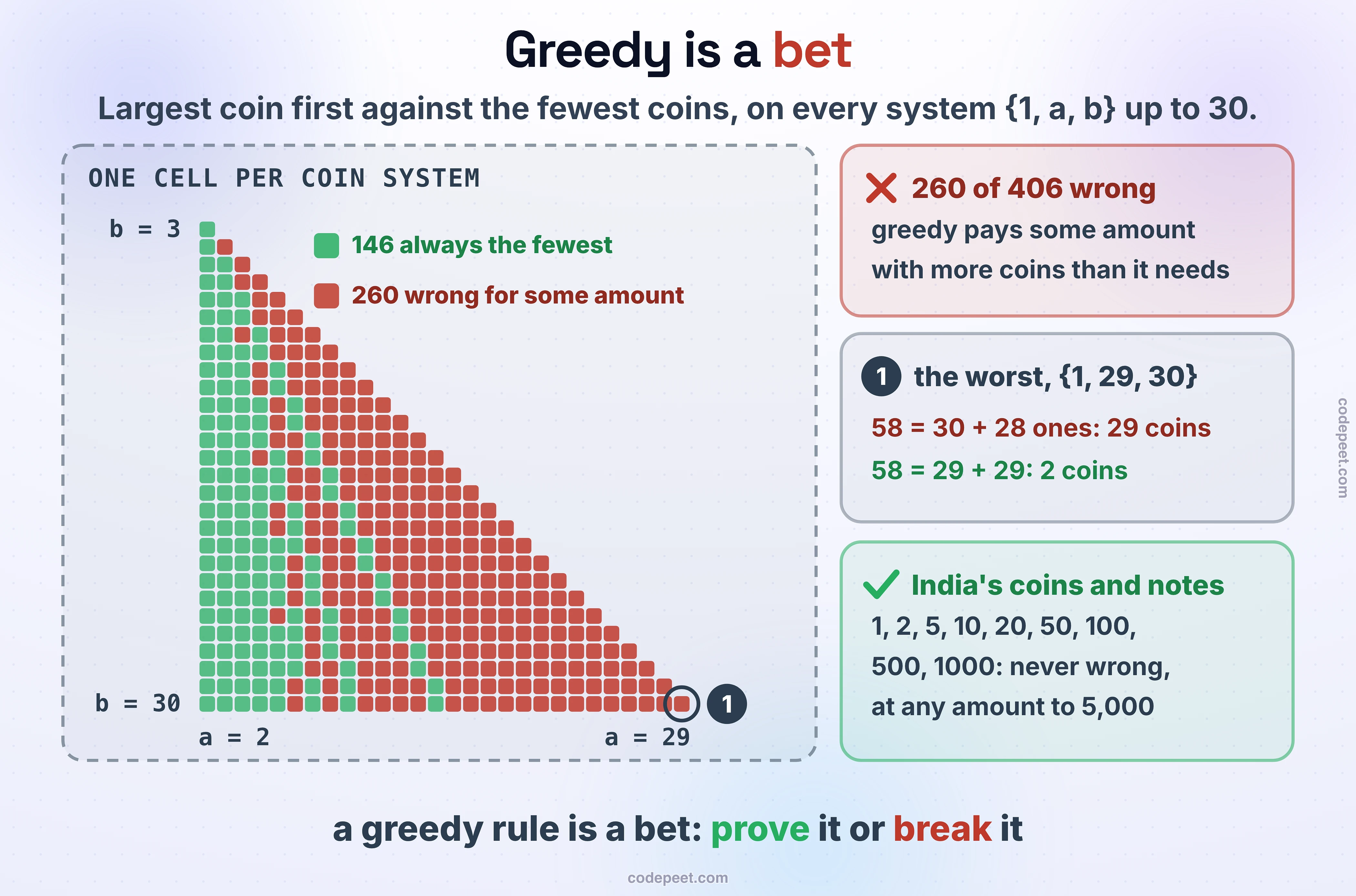
A greedy algorithm makes the choice that looks best right now and never goes back on it. Paying an amount with the fewest coins is where everyone starts: take the largest coin that fits, then again, until nothing is left. Whether that's right depends on the coins. Here it runs on every coin system {1, a, b} with b up to 30, against the true fewest, worked out by trying every coin at every amount:
def greedy(coins, x):                          # largest coin first; the coins come largest first
    count = 0
    for c in coins:
        count += x // c
        x %= c
    return count


def fewest(coins, top):                        # the fewest coins for every amount up to top
    best = [0] * (top + 1)
    for x in range(1, top + 1):
        best[x] = min(best[x - c] + 1 for c in coins if c <= x)
    return best


systems = wrong = 0
worst = (0, None, 0)                           # coins too many, the coin system, the amount
for a in range(2, 30):
    for b in range(a + 1, 31):
        coins = [b, a, 1]
        best = fewest(coins, 2 * b)
        systems += 1
        bad = False
        for x in range(1, 2 * b + 1):
            extra = greedy(coins, x) - best[x]
            if extra > 0:
                bad = True
                if extra > worst[0]:
                    worst = (extra, coins, x)
        wrong += bad
print(f"{systems} coin systems {{1, a, b}} with b up to 30: greedy pays some amount with too many coins in {wrong}")
extra, coins, x = worst
g = greedy(coins, x)
print(f"the worst, {{1, {coins[1]}, {coins[0]}}}: {x} paid with {g} coins, where {g - extra} do")
india = [1000, 500, 100, 50, 20, 10, 5, 2, 1]
india_best = fewest(india, 5000)
always = all(greedy(india, x) == india_best[x] for x in range(1, 5001))
print("India's coins and notes, every amount up to 5,000:",
      "greedy is always the fewest" if always else "greedy is wrong somewhere")

# 406 coin systems {1, a, b} with b up to 30: greedy pays some amount with too many coins in 260
# the worst, {1, 29, 30}: 58 paid with 29 coins, where 2 do
# India's coins and notes, every amount up to 5,000: greedy is always the fewest
public class Main {
static int greedy(int[] coins, int x) { // largest coin first; the coins come largest first
int count = 0;
for (int c : coins) {
count += x / c;
x %= c;
}
return count;
}
static int[] fewest(int[] coins, int top) { // the fewest coins for every amount up to top
int[] best = new int[top + 1];
for (int x = 1; x <= top; x++) {
best[x] = Integer.MAX_VALUE;
for (int c : coins) if (c <= x) best[x] = Math.min(best[x], best[x - c] + 1);
}
return best;
}
public static void main(String[] args) {
int systems = 0, wrong = 0, worstExtra = 0, worstAmount = 0;
int[] worstCoins = null; // coins too many, the coin system, the amount
for (int a = 2; a < 30; a++) {
for (int b = a + 1; b <= 30; b++) {
int[] coins = {b, a, 1};
int[] best = fewest(coins, 2 * b);
systems++;
boolean bad = false;
for (int x = 1; x <= 2 * b; x++) {
int extra = greedy(coins, x) - best[x];
if (extra > 0) {
bad = true;
if (extra > worstExtra) {
worstExtra = extra;
worstCoins = coins;
worstAmount = x;
}
}
}
if (bad) wrong++;
}
}
System.out.println(systems + " coin systems {1, a, b} with b up to 30: greedy pays some amount with too many coins in " + wrong);
int g = greedy(worstCoins, worstAmount);
System.out.println("the worst, {1, " + worstCoins[1] + ", " + worstCoins[0] + "}: " + worstAmount + " paid with " + g
+ " coins, where " + (g - worstExtra) + " do");
int[] india = {1000, 500, 100, 50, 20, 10, 5, 2, 1};
int[] indiaBest = fewest(india, 5000);
boolean always = true;
for (int x = 1; x <= 5000; x++) if (greedy(india, x) != indiaBest[x]) always = false;
System.out.println("India's coins and notes, every amount up to 5,000: "
+ (always ? "greedy is always the fewest" : "greedy is wrong somewhere"));
}
}
// 406 coin systems {1, a, b} with b up to 30: greedy pays some amount with too many coins in 260
// the worst, {1, 29, 30}: 58 paid with 29 coins, where 2 do
// India's coins and notes, every amount up to 5,000: greedy is always the fewest#include <bits/stdc++.h>
using namespace std;
int greedy(const vector<int>& coins, int x) { // largest coin first; the coins come largest first
int count = 0;
for (int c : coins) {
count += x / c;
x %= c;
}
return count;
}
vector<int> fewest(const vector<int>& coins, int top) { // the fewest coins for every amount up to top
vector<int> best(top + 1, 0);
for (int x = 1; x <= top; x++) {
best[x] = INT_MAX;
for (int c : coins) if (c <= x) best[x] = min(best[x], best[x - c] + 1);
}
return best;
}
int main() {
int systems = 0, wrong = 0, worstExtra = 0, worstAmount = 0;
vector<int> worstCoins; // coins too many, the coin system, the amount
for (int a = 2; a < 30; a++) {
for (int b = a + 1; b <= 30; b++) {
vector<int> coins = {b, a, 1};
vector<int> best = fewest(coins, 2 * b);
systems++;
bool bad = false;
for (int x = 1; x <= 2 * b; x++) {
int extra = greedy(coins, x) - best[x];
if (extra > 0) {
bad = true;
if (extra > worstExtra) {
worstExtra = extra;
worstCoins = coins;
worstAmount = x;
}
}
}
if (bad) wrong++;
}
}
cout << systems << " coin systems {1, a, b} with b up to 30: greedy pays some amount with too many coins in " << wrong
<< "\n";
int g = greedy(worstCoins, worstAmount);
cout << "the worst, {1, " << worstCoins[1] << ", " << worstCoins[0] << "}: " << worstAmount << " paid with " << g
<< " coins, where " << g - worstExtra << " do\n";
vector<int> india = {1000, 500, 100, 50, 20, 10, 5, 2, 1};
vector<int> indiaBest = fewest(india, 5000);
bool always = true;
for (int x = 1; x <= 5000; x++) if (greedy(india, x) != indiaBest[x]) always = false;
cout << "India's coins and notes, every amount up to 5,000: "
<< (always ? "greedy is always the fewest" : "greedy is wrong somewhere") << "\n";
}
// 406 coin systems {1, a, b} with b up to 30: greedy pays some amount with too many coins in 260
// the worst, {1, 29, 30}: 58 paid with 29 coins, where 2 do
// India's coins and notes, every amount up to 5,000: greedy is always the fewestfunction greedy(coins, x) { // largest coin first; the coins come largest first
let count = 0;
for (const c of coins) {
count += Math.floor(x / c);
x %= c;
}
return count;
}
function fewest(coins, top) { // the fewest coins for every amount up to top
const best = new Array(top + 1).fill(0);
for (let x = 1; x <= top; x++) {
best[x] = Infinity;
for (const c of coins) if (c <= x) best[x] = Math.min(best[x], best[x - c] + 1);
}
return best;
}
let systems = 0, wrong = 0;
let worst = [0, null, 0]; // coins too many, the coin system, the amount
for (let a = 2; a < 30; a++) {
for (let b = a + 1; b <= 30; b++) {
const coins = [b, a, 1];
const best = fewest(coins, 2 * b);
systems++;
let bad = false;
for (let x = 1; x <= 2 * b; x++) {
const extra = greedy(coins, x) - best[x];
if (extra > 0) {
bad = true;
if (extra > worst[0]) worst = [extra, coins, x];
}
}
if (bad) wrong++;
}
}
console.log(`${systems} coin systems {1, a, b} with b up to 30: greedy pays some amount with too many coins in ${wrong}`);
const [extra, coins, amount] = worst;
const g = greedy(coins, amount);
console.log(`the worst, {1, ${coins[1]}, ${coins[0]}}: ${amount} paid with ${g} coins, where ${g - extra} do`);
const india = [1000, 500, 100, 50, 20, 10, 5, 2, 1];
const indiaBest = fewest(india, 5000);
let always = true;
for (let x = 1; x <= 5000; x++) if (greedy(india, x) !== indiaBest[x]) always = false;
console.log(`India's coins and notes, every amount up to 5,000: ${always ? "greedy is always the fewest" : "greedy is wrong somewhere"}`);
// 406 coin systems {1, a, b} with b up to 30: greedy pays some amount with too many coins in 260
// the worst, {1, 29, 30}: 58 paid with 29 coins, where 2 do
// India's coins and notes, every amount up to 5,000: greedy is always the fewestfunction greedy(coins: number[], x: number): number { // largest coin first; the coins come largest first
let count = 0;
for (const c of coins) {
count += Math.floor(x / c);
x %= c;
}
return count;
}
function fewest(coins: number[], top: number): number[] { // the fewest coins for every amount up to top
const best: number[] = new Array(top + 1).fill(0);
for (let x = 1; x <= top; x++) {
best[x] = Infinity;
for (const c of coins) if (c <= x) best[x] = Math.min(best[x], best[x - c] + 1);
}
return best;
}
let systems = 0, wrong = 0;
let worst: [number, number[], number] = [0, [], 0]; // coins too many, the coin system, the amount
for (let a = 2; a < 30; a++) {
for (let b = a + 1; b <= 30; b++) {
const coins = [b, a, 1];
const best = fewest(coins, 2 * b);
systems++;
let bad = false;
for (let x = 1; x <= 2 * b; x++) {
const extra = greedy(coins, x) - best[x];
if (extra > 0) {
bad = true;
if (extra > worst[0]) worst = [extra, coins, x];
}
}
if (bad) wrong++;
}
}
console.log(`${systems} coin systems {1, a, b} with b up to 30: greedy pays some amount with too many coins in ${wrong}`);
const [extra, coins, amount] = worst;
const g = greedy(coins, amount);
console.log(`the worst, {1, ${coins[1]}, ${coins[0]}}: ${amount} paid with ${g} coins, where ${g - extra} do`);
const india = [1000, 500, 100, 50, 20, 10, 5, 2, 1];
const indiaBest = fewest(india, 5000);
let always = true;
for (let x = 1; x <= 5000; x++) if (greedy(india, x) !== indiaBest[x]) always = false;
console.log(`India's coins and notes, every amount up to 5,000: ${always ? "greedy is always the fewest" : "greedy is wrong somewhere"}`);
// 406 coin systems {1, a, b} with b up to 30: greedy pays some amount with too many coins in 260
// the worst, {1, 29, 30}: 58 paid with 29 coins, where 2 do
// India's coins and notes, every amount up to 5,000: greedy is always the fewestusing System;
class Program {
static int Greedy(int[] coins, int x) { // largest coin first; the coins come largest first
int count = 0;
foreach (int c in coins) {
count += x / c;
x %= c;
}
return count;
}
static int[] Fewest(int[] coins, int top) { // the fewest coins for every amount up to top
var best = new int[top + 1];
for (int x = 1; x <= top; x++) {
best[x] = int.MaxValue;
foreach (int c in coins) if (c <= x) best[x] = Math.Min(best[x], best[x - c] + 1);
}
return best;
}
static void Main() {
int systems = 0, wrong = 0, worstExtra = 0, worstAmount = 0;
int[] worstCoins = Array.Empty<int>(); // coins too many, the coin system, the amount
for (int a = 2; a < 30; a++) {
for (int b = a + 1; b <= 30; b++) {
int[] coins = { b, a, 1 };
int[] best = Fewest(coins, 2 * b);
systems++;
bool bad = false;
for (int x = 1; x <= 2 * b; x++) {
int extra = Greedy(coins, x) - best[x];
if (extra > 0) {
bad = true;
if (extra > worstExtra) {
worstExtra = extra;
worstCoins = coins;
worstAmount = x;
}
}
}
if (bad) wrong++;
}
}
Console.WriteLine($"{systems} coin systems {{1, a, b}} with b up to 30: greedy pays some amount with too many coins in {wrong}");
int g = Greedy(worstCoins, worstAmount);
Console.WriteLine($"the worst, {{1, {worstCoins[1]}, {worstCoins[0]}}}: {worstAmount} paid with {g} coins, where {g - worstExtra} do");
int[] india = { 1000, 500, 100, 50, 20, 10, 5, 2, 1 };
int[] indiaBest = Fewest(india, 5000);
bool always = true;
for (int x = 1; x <= 5000; x++) if (Greedy(india, x) != indiaBest[x]) always = false;
Console.WriteLine("India's coins and notes, every amount up to 5,000: "
+ (always ? "greedy is always the fewest" : "greedy is wrong somewhere"));
}
}
// 406 coin systems {1, a, b} with b up to 30: greedy pays some amount with too many coins in 260
// the worst, {1, 29, 30}: 58 paid with 29 coins, where 2 do
// India's coins and notes, every amount up to 5,000: greedy is always the fewestpackage main
import (
"fmt"
"math"
)
func greedy(coins []int, x int) int { // largest coin first; the coins come largest first
count := 0
for _, c := range coins {
count += x / c
x %= c
}
return count
}
func fewest(coins []int, top int) []int { // the fewest coins for every amount up to top
best := make([]int, top+1)
for x := 1; x <= top; x++ {
best[x] = math.MaxInt32
for _, c := range coins {
if c <= x && best[x-c]+1 < best[x] {
best[x] = best[x-c] + 1
}
}
}
return best
}
func main() {
systems, wrong, worstExtra, worstAmount := 0, 0, 0, 0
var worstCoins []int // coins too many, the coin system, the amount
for a := 2; a < 30; a++ {
for b := a + 1; b <= 30; b++ {
coins := []int{b, a, 1}
best := fewest(coins, 2*b)
systems++
bad := false
for x := 1; x <= 2*b; x++ {
extra := greedy(coins, x) - best[x]
if extra > 0 {
bad = true
if extra > worstExtra {
worstExtra, worstCoins, worstAmount = extra, coins, x
}
}
}
if bad {
wrong++
}
}
}
fmt.Printf("%d coin systems {1, a, b} with b up to 30: greedy pays some amount with too many coins in %d\n", systems, wrong)
g := greedy(worstCoins, worstAmount)
fmt.Printf("the worst, {1, %d, %d}: %d paid with %d coins, where %d do\n", worstCoins[1], worstCoins[0], worstAmount, g, g-worstExtra)
india := []int{1000, 500, 100, 50, 20, 10, 5, 2, 1}
indiaBest := fewest(india, 5000)
always := true
for x := 1; x <= 5000; x++ {
if greedy(india, x) != indiaBest[x] {
always = false
}
}
verdict := "greedy is wrong somewhere"
if always {
verdict = "greedy is always the fewest"
}
fmt.Println("India's coins and notes, every amount up to 5,000: " + verdict)
}
// 406 coin systems {1, a, b} with b up to 30: greedy pays some amount with too many coins in 260
// the worst, {1, 29, 30}: 58 paid with 29 coins, where 2 do
// India's coins and notes, every amount up to 5,000: greedy is always the fewestGreedy pays some amount with more coins than it needs in 260 of the 406 systems. The worst is {1, 29, 30}: 58 takes one 30 and then 28 ones, 29 coins, where two 29s do. With India's coins and notes it's never wrong, at any amount up to 5,000. A greedy rule is a bet: when it holds, nothing is faster; when it doesn't, it's wrong with no sign of it. The rest of this lesson is how to tell which.
Proving the bet: the exchange argument
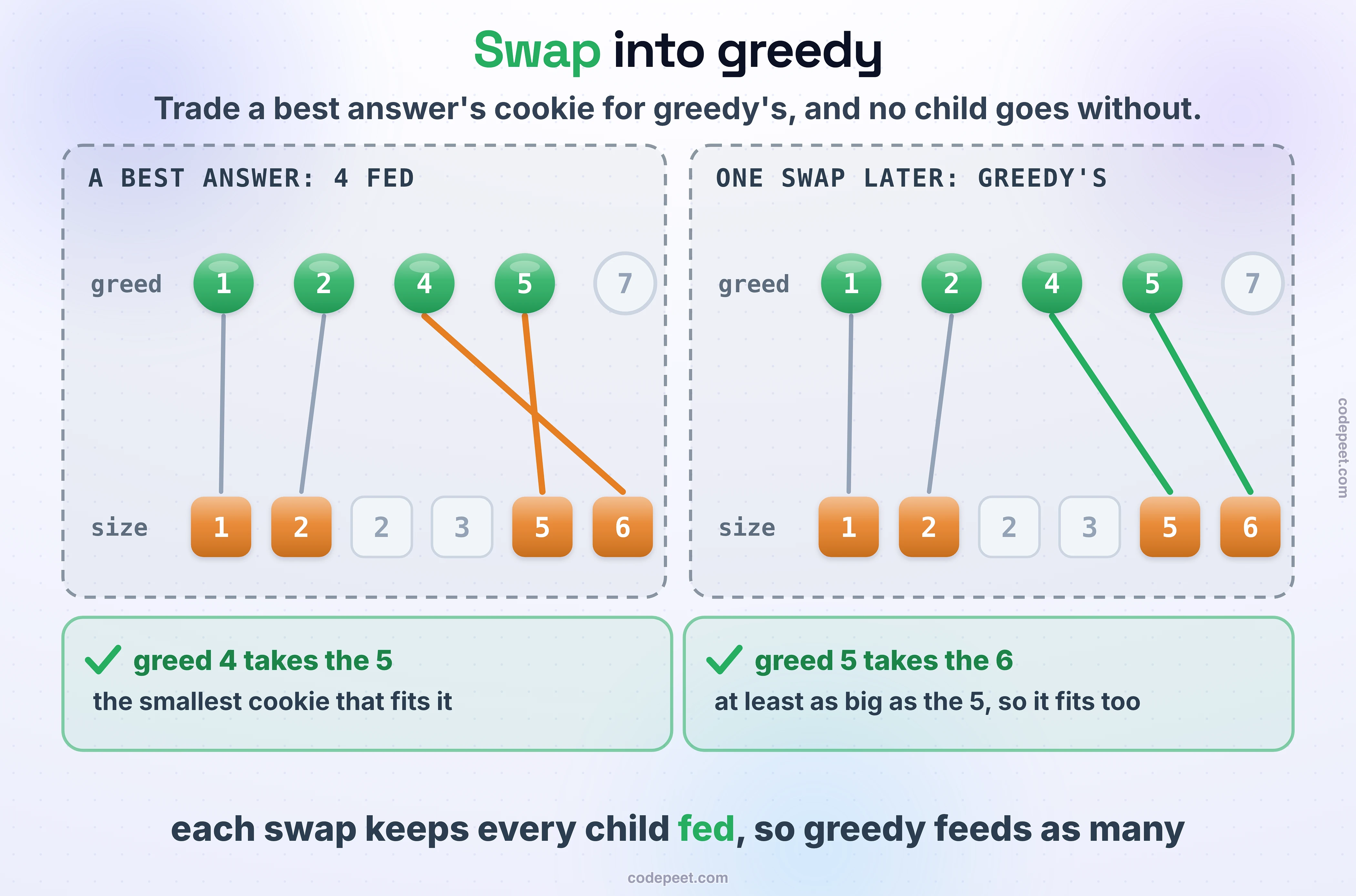
A greedy rule is right when any best answer can be turned into the greedy one, one swap at a time, without getting worse. That's an exchange argument. Assign Cookies has children who each need a cookie at least as big as their greed, one cookie each, and asks how many can be fed. Sort both, then give each child, smallest greed first, the smallest cookie that's enough:
greed, cookies = sorted([4, 2, 7, 1, 5]), sorted([3, 6, 1, 5, 2, 2])
got, j = [], 0
for g in greed:                                # smallest greed first, each gets the smallest cookie that's enough
    while j < len(cookies) and cookies[j] < g:
        j += 1                                 # too small for this child, so too small for every child after
    if j == len(cookies):
        break
    got.append(f"greed {g} gets {cookies[j]}")
    j += 1
print(f"fed {len(got)} of {len(greed)} children:", ", ".join(got))

# fed 4 of 5 children: greed 1 gets 1, greed 2 gets 2, greed 4 gets 5, greed 5 gets 6
import java.util.*;
public class Main {
public static void main(String[] args) {
int[] greed = {4, 2, 7, 1, 5}, cookies = {3, 6, 1, 5, 2, 2};
Arrays.sort(greed);
Arrays.sort(cookies);
List<String> got = new ArrayList<>();
int j = 0;
for (int g : greed) { // smallest greed first, each gets the smallest cookie that's enough
while (j < cookies.length && cookies[j] < g) j++; // too small for this child, so for every child after
if (j == cookies.length) break;
got.add("greed " + g + " gets " + cookies[j]);
j++;
}
System.out.println("fed " + got.size() + " of " + greed.length + " children: " + String.join(", ", got));
}
}
// fed 4 of 5 children: greed 1 gets 1, greed 2 gets 2, greed 4 gets 5, greed 5 gets 6#include <bits/stdc++.h>
using namespace std;
int main() {
vector<int> greed = {4, 2, 7, 1, 5}, cookies = {3, 6, 1, 5, 2, 2};
sort(greed.begin(), greed.end());
sort(cookies.begin(), cookies.end());
vector<string> got;
size_t j = 0;
for (int g : greed) { // smallest greed first, each gets the smallest cookie that's enough
while (j < cookies.size() && cookies[j] < g) j++; // too small for this child, so for every child after
if (j == cookies.size()) break;
got.push_back("greed " + to_string(g) + " gets " + to_string(cookies[j]));
j++;
}
cout << "fed " << got.size() << " of " << greed.size() << " children: ";
for (size_t k = 0; k < got.size(); k++) cout << (k ? ", " : "") << got[k];
cout << "\n";
}
// fed 4 of 5 children: greed 1 gets 1, greed 2 gets 2, greed 4 gets 5, greed 5 gets 6const greed = [4, 2, 7, 1, 5].sort((a, b) => a - b), cookies = [3, 6, 1, 5, 2, 2].sort((a, b) => a - b);
const got = [];
let j = 0;
for (const g of greed) { // smallest greed first, each gets the smallest cookie that's enough
while (j < cookies.length && cookies[j] < g) j++; // too small for this child, so for every child after
if (j === cookies.length) break;
got.push(`greed ${g} gets ${cookies[j]}`);
j++;
}
console.log(`fed ${got.length} of ${greed.length} children: ${got.join(", ")}`);
// fed 4 of 5 children: greed 1 gets 1, greed 2 gets 2, greed 4 gets 5, greed 5 gets 6const greed: number[] = [4, 2, 7, 1, 5].sort((a, b) => a - b);
const cookies: number[] = [3, 6, 1, 5, 2, 2].sort((a, b) => a - b);
const got: string[] = [];
let j = 0;
for (const g of greed) { // smallest greed first, each gets the smallest cookie that's enough
while (j < cookies.length && cookies[j] < g) j++; // too small for this child, so for every child after
if (j === cookies.length) break;
got.push(`greed ${g} gets ${cookies[j]}`);
j++;
}
console.log(`fed ${got.length} of ${greed.length} children: ${got.join(", ")}`);
// fed 4 of 5 children: greed 1 gets 1, greed 2 gets 2, greed 4 gets 5, greed 5 gets 6using System;
using System.Collections.Generic;
class Program {
static void Main() {
int[] greed = { 4, 2, 7, 1, 5 }, cookies = { 3, 6, 1, 5, 2, 2 };
Array.Sort(greed);
Array.Sort(cookies);
var got = new List<string>();
int j = 0;
foreach (int g in greed) { // smallest greed first, each gets the smallest cookie that's enough
while (j < cookies.Length && cookies[j] < g) j++; // too small for this child, so for every child after
if (j == cookies.Length) break;
got.Add($"greed {g} gets {cookies[j]}");
j++;
}
Console.WriteLine($"fed {got.Count} of {greed.Length} children: {string.Join(", ", got)}");
}
}
// fed 4 of 5 children: greed 1 gets 1, greed 2 gets 2, greed 4 gets 5, greed 5 gets 6package main
import (
"fmt"
"sort"
"strings"
)
func main() {
greed, cookies := []int{4, 2, 7, 1, 5}, []int{3, 6, 1, 5, 2, 2}
sort.Ints(greed)
sort.Ints(cookies)
var got []string
j := 0
for _, g := range greed { // smallest greed first, each gets the smallest cookie that's enough
for j < len(cookies) && cookies[j] < g {
j++ // too small for this child, so too small for every child after
}
if j == len(cookies) {
break
}
got = append(got, fmt.Sprintf("greed %d gets %d", g, cookies[j]))
j++
}
fmt.Printf("fed %d of %d children: %s\n", len(got), len(greed), strings.Join(got, ", "))
}
// fed 4 of 5 children: greed 1 gets 1, greed 2 gets 2, greed 4 gets 5, greed 5 gets 6Four of the five are fed: greed 1 gets 1, greed 2 gets 2, greed 4 gets 5 and greed 5 gets 6, and nothing is left for 7. The swap: take any best answer. If it gives the child with the smallest greed some other cookie, trade it for greedy's, the smallest that fits. That child is still fed, and whoever held greedy's cookie gets the other one, at least as big, which fits them too. Child by child, the best answer turns into greedy's and never feeds fewer. A cookie too small for one child is too small for every child after, since both are sorted, so after the sorts one pass does it: O(n log n).
Keep the change that stays useful
Lemonade Change: a lemonade costs 5, customers pay with a 5, a 10 or a 20 in turn, and the till starts empty. A 10 needs a 5 back; a 20 needs 15, as a 10 and a 5 or as three 5s. Greedy keeps what stays useful: a 5 is change for every bill and a 10 only for a 20, so a 20 gets the 10 first:
def change(bills):                             # every lemonade costs 5; give change from what's in the till
    fives = tens = 0
    for i, bill in enumerate(bills):
        if bill == 5:
            fives += 1
        elif bill == 10:
            if not fives:
                return f"stuck at bill {i + 1}"
            fives, tens = fives - 1, tens + 1
        elif tens and fives:                   # a 20: a 10 and a 5 back keeps the 5s, which more bills need
            tens, fives = tens - 1, fives - 1
        elif fives >= 3:
            fives -= 3
        else:
            return f"stuck at bill {i + 1}"
    return f"everyone served, {fives} fives and {tens} tens left"


print(change([5, 5, 5, 5, 10, 20, 10, 10]))

# everyone served, 0 fives and 2 tens left
public class Main {
static String change(int[] bills) { // every lemonade costs 5; give change from what's in the till
int fives = 0, tens = 0;
for (int i = 0; i < bills.length; i++) {
int bill = bills[i];
if (bill == 5) fives++;
else if (bill == 10) {
if (fives == 0) return "stuck at bill " + (i + 1);
fives--;
tens++;
} else if (tens > 0 && fives > 0) { // a 20: a 10 and a 5 back keeps the 5s, which more bills need
tens--;
fives--;
} else if (fives >= 3) fives -= 3;
else return "stuck at bill " + (i + 1);
}
return "everyone served, " + fives + " fives and " + tens + " tens left";
}
public static void main(String[] args) {
System.out.println(change(new int[] {5, 5, 5, 5, 10, 20, 10, 10}));
}
}
// everyone served, 0 fives and 2 tens left#include <bits/stdc++.h>
using namespace std;
string change(const vector<int>& bills) { // every lemonade costs 5; give change from what's in the till
int fives = 0, tens = 0;
for (size_t i = 0; i < bills.size(); i++) {
int bill = bills[i];
if (bill == 5) fives++;
else if (bill == 10) {
if (fives == 0) return "stuck at bill " + to_string(i + 1);
fives--;
tens++;
} else if (tens > 0 && fives > 0) { // a 20: a 10 and a 5 back keeps the 5s, which more bills need
tens--;
fives--;
} else if (fives >= 3) fives -= 3;
else return "stuck at bill " + to_string(i + 1);
}
return "everyone served, " + to_string(fives) + " fives and " + to_string(tens) + " tens left";
}
int main() {
cout << change({5, 5, 5, 5, 10, 20, 10, 10}) << "\n";
}
// everyone served, 0 fives and 2 tens leftfunction change(bills) { // every lemonade costs 5; give change from what's in the till
let fives = 0, tens = 0;
for (let i = 0; i < bills.length; i++) {
const bill = bills[i];
if (bill === 5) fives++;
else if (bill === 10) {
if (fives === 0) return `stuck at bill ${i + 1}`;
fives--;
tens++;
} else if (tens > 0 && fives > 0) { // a 20: a 10 and a 5 back keeps the 5s, which more bills need
tens--;
fives--;
} else if (fives >= 3) fives -= 3;
else return `stuck at bill ${i + 1}`;
}
return `everyone served, ${fives} fives and ${tens} tens left`;
}
console.log(change([5, 5, 5, 5, 10, 20, 10, 10]));
// everyone served, 0 fives and 2 tens leftfunction change(bills: number[]): string { // every lemonade costs 5; give change from what's in the till
let fives = 0, tens = 0;
for (let i = 0; i < bills.length; i++) {
const bill = bills[i];
if (bill === 5) fives++;
else if (bill === 10) {
if (fives === 0) return `stuck at bill ${i + 1}`;
fives--;
tens++;
} else if (tens > 0 && fives > 0) { // a 20: a 10 and a 5 back keeps the 5s, which more bills need
tens--;
fives--;
} else if (fives >= 3) fives -= 3;
else return `stuck at bill ${i + 1}`;
}
return `everyone served, ${fives} fives and ${tens} tens left`;
}
console.log(change([5, 5, 5, 5, 10, 20, 10, 10]));
// everyone served, 0 fives and 2 tens leftusing System;
class Program {
static string Change(int[] bills) { // every lemonade costs 5; give change from what's in the till
int fives = 0, tens = 0;
for (int i = 0; i < bills.Length; i++) {
int bill = bills[i];
if (bill == 5) fives++;
else if (bill == 10) {
if (fives == 0) return $"stuck at bill {i + 1}";
fives--;
tens++;
} else if (tens > 0 && fives > 0) { // a 20: a 10 and a 5 back keeps the 5s, which more bills need
tens--;
fives--;
} else if (fives >= 3) fives -= 3;
else return $"stuck at bill {i + 1}";
}
return $"everyone served, {fives} fives and {tens} tens left";
}
static void Main() {
Console.WriteLine(Change(new[] { 5, 5, 5, 5, 10, 20, 10, 10 }));
}
}
// everyone served, 0 fives and 2 tens leftpackage main
import "fmt"
func change(bills []int) string { // every lemonade costs 5; give change from what's in the till
fives, tens := 0, 0
for i, bill := range bills {
switch {
case bill == 5:
fives++
case bill == 10:
if fives == 0 {
return fmt.Sprintf("stuck at bill %d", i+1)
}
fives--
tens++
case tens > 0 && fives > 0: // a 20: a 10 and a 5 back keeps the 5s, which more bills need
tens--
fives--
case fives >= 3:
fives -= 3
default:
return fmt.Sprintf("stuck at bill %d", i+1)
}
}
return fmt.Sprintf("everyone served, %d fives and %d tens left", fives, tens)
}
func main() {
fmt.Println(change([]int{5, 5, 5, 5, 10, 20, 10, 10}))
}
// everyone served, 0 fives and 2 tens leftWhen the 20 comes, the till holds three 5s and a 10. A 10 and a 5 back leave two 5s for the two 10s still in line, and everyone is served, with 2 tens left at the end. Three 5s back would have left nothing for them; that version runs in Mistakes that look right.
Largest first, on coins made for it
Minimum Number of Coins pays with India's coins and notes, the system the opening showed greedy is always right for. A coin system like that is called canonical, and for it the largest coin first is the whole algorithm:
coins = [1000, 500, 100, 50, 20, 10, 5, 2, 1]   # India's coins and notes, largest first
amount, paid, left = 1988, [], 1988
for c in coins:
    while left >= c:                           # the largest that still fits, as many times as it fits
        paid.append(c)
        left -= c
print(f"{amount}:", " ".join(map(str, paid)), f"({len(paid)} in all)")

# 1988: 1000 500 100 100 100 100 50 20 10 5 2 1 (12 in all)
import java.util.*;
public class Main {
public static void main(String[] args) {
int[] coins = {1000, 500, 100, 50, 20, 10, 5, 2, 1}; // India's coins and notes, largest first
int amount = 1988, left = amount;
List<String> paid = new ArrayList<>();
for (int c : coins) {
while (left >= c) { // the largest that still fits, as many times as it fits
paid.add(String.valueOf(c));
left -= c;
}
}
System.out.println(amount + ": " + String.join(" ", paid) + " (" + paid.size() + " in all)");
}
}
// 1988: 1000 500 100 100 100 100 50 20 10 5 2 1 (12 in all)#include <bits/stdc++.h>
using namespace std;
int main() {
vector<int> coins = {1000, 500, 100, 50, 20, 10, 5, 2, 1}; // India's coins and notes, largest first
int amount = 1988, left = amount;
vector<int> paid;
for (int c : coins) {
while (left >= c) { // the largest that still fits, as many times as it fits
paid.push_back(c);
left -= c;
}
}
cout << amount << ":";
for (int c : paid) cout << " " << c;
cout << " (" << paid.size() << " in all)\n";
}
// 1988: 1000 500 100 100 100 100 50 20 10 5 2 1 (12 in all)const coins = [1000, 500, 100, 50, 20, 10, 5, 2, 1]; // India's coins and notes, largest first
const amount = 1988, paid = [];
let left = amount;
for (const c of coins) {
while (left >= c) { // the largest that still fits, as many times as it fits
paid.push(c);
left -= c;
}
}
console.log(`${amount}: ${paid.join(" ")} (${paid.length} in all)`);
// 1988: 1000 500 100 100 100 100 50 20 10 5 2 1 (12 in all)const coins: number[] = [1000, 500, 100, 50, 20, 10, 5, 2, 1]; // India's coins and notes, largest first
const amount = 1988, paid: number[] = [];
let left = amount;
for (const c of coins) {
while (left >= c) { // the largest that still fits, as many times as it fits
paid.push(c);
left -= c;
}
}
console.log(`${amount}: ${paid.join(" ")} (${paid.length} in all)`);
// 1988: 1000 500 100 100 100 100 50 20 10 5 2 1 (12 in all)using System;
using System.Collections.Generic;
class Program {
static void Main() {
int[] coins = { 1000, 500, 100, 50, 20, 10, 5, 2, 1 }; // India's coins and notes, largest first
int amount = 1988, left = amount;
var paid = new List<int>();
foreach (int c in coins) {
while (left >= c) { // the largest that still fits, as many times as it fits
paid.Add(c);
left -= c;
}
}
Console.WriteLine($"{amount}: {string.Join(" ", paid)} ({paid.Count} in all)");
}
}
// 1988: 1000 500 100 100 100 100 50 20 10 5 2 1 (12 in all)package main
import (
"fmt"
"strings"
)
func main() {
coins := []int{1000, 500, 100, 50, 20, 10, 5, 2, 1} // India's coins and notes, largest first
amount, left := 1988, 1988
var paid []string
for _, c := range coins {
for left >= c { // the largest that still fits, as many times as it fits
paid = append(paid, fmt.Sprint(c))
left -= c
}
}
fmt.Printf("%d: %s (%d in all)\n", amount, strings.Join(paid, " "), len(paid))
}
// 1988: 1000 500 100 100 100 100 50 20 10 5 2 1 (12 in all)1,988 takes 12 coins and notes. When a system isn't canonical, the fewest coins is a job for Dynamic Programming, as Coin Change there shows. And if greedy is ever wrong for a system, it's already wrong for some amount below the sum of the two largest coins, so checking that far settles which kind a system is.
Greedy or Not? Pay three amounts by hand, largest coin first, and see the fewest coins beside each; then try any amount on four coin sets and mark the ones greedy fails.
Sort, then sweep
Most Profit Assigning Work: each worker can take one job no harder than their ability, any number of workers can take the same job, and the total pay should be the most. Sort the jobs by difficulty and the workers by ability, then sweep both once, carrying the best pay seen so far:
difficulty, profit, workers = [7, 3, 9, 1, 4, 6], [12, 5, 30, 2, 8, 1], [2, 5, 10, 8, 1]
jobs = sorted(zip(difficulty, profit))         # easiest job first
best, j, earned = 0, 0, []
for w in sorted(workers):                      # weakest worker first
    while j < len(jobs) and jobs[j][0] <= w:
        best = max(best, jobs[j][1])           # the best pay among every job this worker can do
        j += 1
    earned.append(best)
print("workers", " ".join(map(str, sorted(workers))), "earn", " ".join(map(str, earned)) + f": {sum(earned)} in all")

# workers 1 2 5 8 10 earn 2 2 8 12 30: 54 in all
import java.util.*;
public class Main {
public static void main(String[] args) {
int[] difficulty = {7, 3, 9, 1, 4, 6}, profit = {12, 5, 30, 2, 8, 1}, workers = {2, 5, 10, 8, 1};
int n = difficulty.length;
int[][] jobs = new int[n][];
for (int i = 0; i < n; i++) jobs[i] = new int[] {difficulty[i], profit[i]};
Arrays.sort(jobs, (a, b) -> a[0] != b[0] ? Integer.compare(a[0], b[0]) : Integer.compare(a[1], b[1])); // easiest first
Arrays.sort(workers); // weakest worker first
int best = 0, j = 0, total = 0;
StringJoiner who = new StringJoiner(" "), earned = new StringJoiner(" ");
for (int w : workers) {
while (j < n && jobs[j][0] <= w) best = Math.max(best, jobs[j++][1]); // the best pay this worker can get
who.add(String.valueOf(w));
earned.add(String.valueOf(best));
total += best;
}
System.out.println("workers " + who + " earn " + earned + ": " + total + " in all");
}
}
// workers 1 2 5 8 10 earn 2 2 8 12 30: 54 in all#include <bits/stdc++.h>
using namespace std;
int main() {
vector<int> difficulty = {7, 3, 9, 1, 4, 6}, profit = {12, 5, 30, 2, 8, 1}, workers = {2, 5, 10, 8, 1};
vector<pair<int, int>> jobs;
for (size_t i = 0; i < difficulty.size(); i++) jobs.push_back({difficulty[i], profit[i]});
sort(jobs.begin(), jobs.end()); // easiest job first
sort(workers.begin(), workers.end()); // weakest worker first
int best = 0, total = 0;
size_t j = 0;
string who, earned;
for (int w : workers) {
while (j < jobs.size() && jobs[j].first <= w) best = max(best, jobs[j++].second); // the best pay this worker can get
who += (who.empty() ? "" : " ") + to_string(w);
earned += (earned.empty() ? "" : " ") + to_string(best);
total += best;
}
cout << "workers " << who << " earn " << earned << ": " << total << " in all\n";
}
// workers 1 2 5 8 10 earn 2 2 8 12 30: 54 in allconst difficulty = [7, 3, 9, 1, 4, 6], profit = [12, 5, 30, 2, 8, 1], workers = [2, 5, 10, 8, 1];
const jobs = difficulty.map((d, i) => [d, profit[i]]).sort((a, b) => a[0] - b[0] || a[1] - b[1]); // easiest first
workers.sort((a, b) => a - b); // weakest worker first
let best = 0, j = 0;
const earned = [];
for (const w of workers) {
while (j < jobs.length && jobs[j][0] <= w) best = Math.max(best, jobs[j++][1]); // the best pay this worker can get
earned.push(best);
}
console.log(`workers ${workers.join(" ")} earn ${earned.join(" ")}: ${earned.reduce((s, x) => s + x, 0)} in all`);
// workers 1 2 5 8 10 earn 2 2 8 12 30: 54 in allconst difficulty = [7, 3, 9, 1, 4, 6], profit = [12, 5, 30, 2, 8, 1], workers = [2, 5, 10, 8, 1];
const jobs: number[][] = difficulty.map((d, i) => [d, profit[i]]).sort((a, b) => a[0] - b[0] || a[1] - b[1]); // easiest first
workers.sort((a, b) => a - b); // weakest worker first
let best = 0, j = 0;
const earned: number[] = [];
for (const w of workers) {
while (j < jobs.length && jobs[j][0] <= w) best = Math.max(best, jobs[j++][1]); // the best pay this worker can get
earned.push(best);
}
console.log(`workers ${workers.join(" ")} earn ${earned.join(" ")}: ${earned.reduce((s, x) => s + x, 0)} in all`);
// workers 1 2 5 8 10 earn 2 2 8 12 30: 54 in allusing System;
using System.Collections.Generic;
using System.Linq;
class Program {
static void Main() {
int[] difficulty = { 7, 3, 9, 1, 4, 6 }, profit = { 12, 5, 30, 2, 8, 1 }, workers = { 2, 5, 10, 8, 1 };
var jobs = difficulty.Select((d, i) => (d, p: profit[i])).OrderBy(x => x.d).ThenBy(x => x.p).ToList(); // easiest first
Array.Sort(workers); // weakest worker first
int best = 0, j = 0;
var earned = new List<int>();
foreach (int w in workers) {
while (j < jobs.Count && jobs[j].d <= w) best = Math.Max(best, jobs[j++].p); // the best pay this worker can get
earned.Add(best);
}
Console.WriteLine($"workers {string.Join(" ", workers)} earn {string.Join(" ", earned)}: {earned.Sum()} in all");
}
}
// workers 1 2 5 8 10 earn 2 2 8 12 30: 54 in allpackage main
import (
"fmt"
"sort"
"strings"
)
func main() {
difficulty, profit, workers := []int{7, 3, 9, 1, 4, 6}, []int{12, 5, 30, 2, 8, 1}, []int{2, 5, 10, 8, 1}
jobs := make([][2]int, len(difficulty))
for i := range difficulty {
jobs[i] = [2]int{difficulty[i], profit[i]}
}
sort.Slice(jobs, func(a, b int) bool { // easiest job first
if jobs[a][0] != jobs[b][0] {
return jobs[a][0] < jobs[b][0]
}
return jobs[a][1] < jobs[b][1]
})
sort.Ints(workers) // weakest worker first
best, j, total := 0, 0, 0
var who, earned []string
for _, w := range workers {
for j < len(jobs) && jobs[j][0] <= w { // the best pay this worker can get
if jobs[j][1] > best {
best = jobs[j][1]
}
j++
}
who = append(who, fmt.Sprint(w))
earned = append(earned, fmt.Sprint(best))
total += best
}
fmt.Printf("workers %s earn %s: %d in all\n", strings.Join(who, " "), strings.Join(earned, " "), total)
}
// workers 1 2 5 8 10 earn 2 2 8 12 30: 54 in allThe worker of ability 8 reaches the jobs of difficulty 1, 3, 4, 6 and 7, and the best of them pays 12; the job of difficulty 6 pays only 1, and it doesn't lower the best. Carrying the best so far is safe because a stronger worker can do everything a weaker one can. 54 in all, in O(n log n + m log m) for n jobs and m workers.
Fractions yes, whole items no
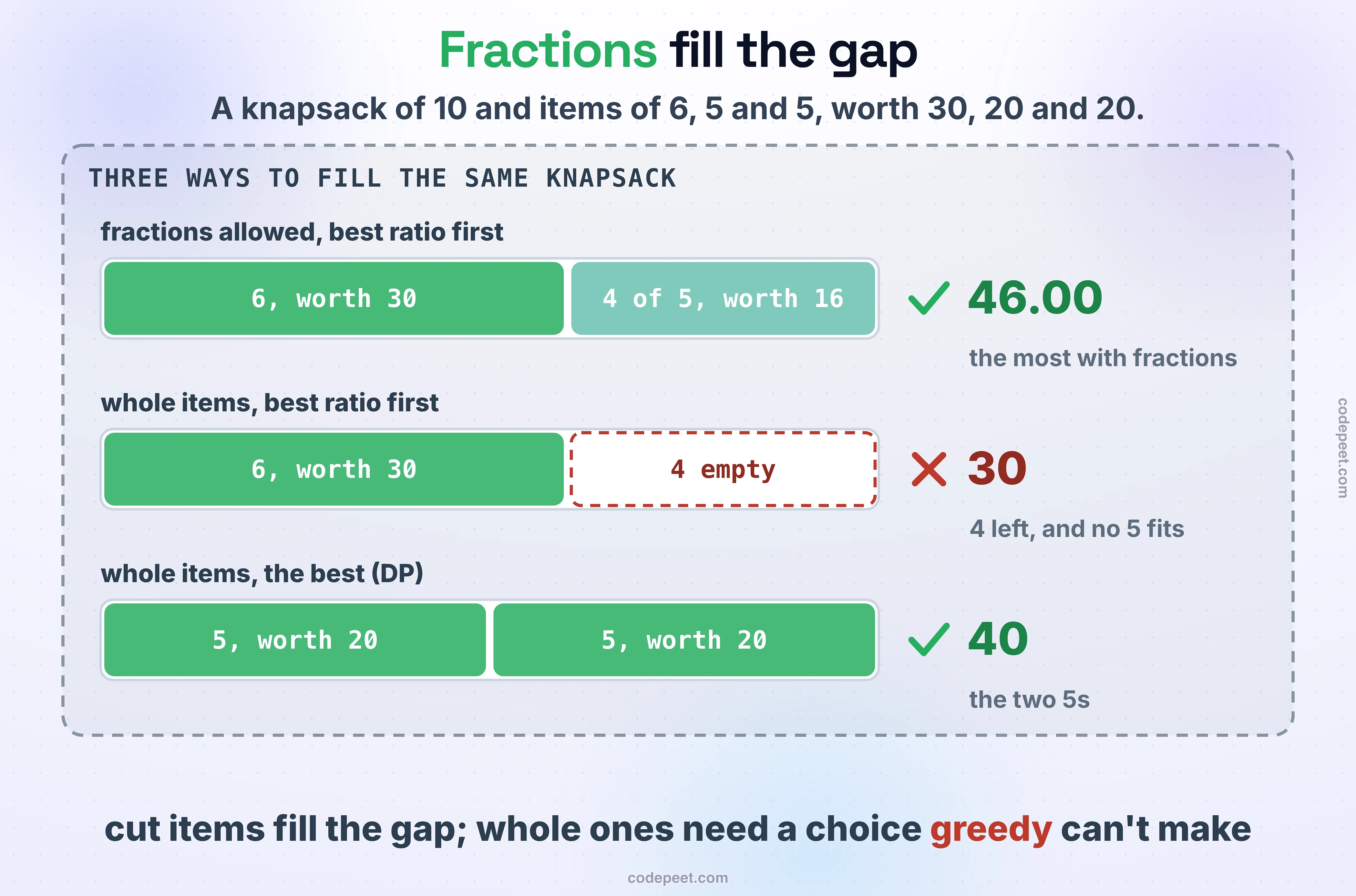
For a knapsack the greedy rule is the most value per weight first, and it's right only when items can be cut. A knapsack of capacity 10 and three items weighing 6, 5 and 5, worth 30, 20 and 20, so 5, 4 and 4 a unit:
items, room = [(6, 30), (5, 20), (5, 20)], 10   # (weight, value) and the knapsack's capacity
by_ratio = sorted(items, key=lambda it: it[1] / it[0], reverse=True)

value, left = 0.0, room                        # fractions allowed: best value per weight first, the last one cut
for w, v in by_ratio:
    take = min(w, left)
    value += v * take / w
    left -= take

whole, left = 0, room                          # whole items, the same order: take each that still fits
for w, v in by_ratio:
    if w <= left:
        whole, left = whole + v, left - w

best = [0] * (room + 1)                        # 0/1 knapsack: the most value for every capacity, item by item
for w, v in items:
    for c in range(room, w - 1, -1):
        best[c] = max(best[c], best[c - w] + v)
print(f"fractional, best ratio first: {value:.2f} | whole items, best ratio first: {whole} | whole items, the best: {best[room]}")

# fractional, best ratio first: 46.00 | whole items, best ratio first: 30 | whole items, the best: 40
import java.util.*;
public class Main {
public static void main(String[] args) {
int[][] items = {{6, 30}, {5, 20}, {5, 20}}; // {weight, value}
int room = 10;
Integer[] order = {0, 1, 2};
Arrays.sort(order, (a, b) -> Double.compare((double) items[b][1] / items[b][0], (double) items[a][1] / items[a][0]));
double value = 0; // fractions allowed: best value per weight first, the last one cut
int left = room;
for (int i : order) {
int take = Math.min(items[i][0], left);
value += (double) items[i][1] * take / items[i][0];
left -= take;
}
int whole = 0; // whole items, the same order: take each that still fits
left = room;
for (int i : order) {
if (items[i][0] <= left) {
whole += items[i][1];
left -= items[i][0];
}
}
int[] best = new int[room + 1]; // 0/1 knapsack: the most value for every capacity, item by item
for (int[] it : items)
for (int c = room; c >= it[0]; c--) best[c] = Math.max(best[c], best[c - it[0]] + it[1]);
System.out.println(String.format(Locale.ROOT, "fractional, best ratio first: %.2f", value)
+ " | whole items, best ratio first: " + whole + " | whole items, the best: " + best[room]);
}
}
// fractional, best ratio first: 46.00 | whole items, best ratio first: 30 | whole items, the best: 40#include <bits/stdc++.h>
using namespace std;
int main() {
vector<pair<int, int>> items = {{6, 30}, {5, 20}, {5, 20}}; // (weight, value)
int room = 10;
vector<int> order = {0, 1, 2};
stable_sort(order.begin(), order.end(), [&](int a, int b) {
return (double) items[a].second / items[a].first > (double) items[b].second / items[b].first;
});
double value = 0; // fractions allowed: best value per weight first, the last one cut
int left = room;
for (int i : order) {
int take = min(items[i].first, left);
value += (double) items[i].second * take / items[i].first;
left -= take;
}
int whole = 0; // whole items, the same order: take each that still fits
left = room;
for (int i : order) {
if (items[i].first <= left) {
whole += items[i].second;
left -= items[i].first;
}
}
vector<int> best(room + 1, 0); // 0/1 knapsack: the most value for every capacity, item by item
for (auto [w, v] : items)
for (int c = room; c >= w; c--) best[c] = max(best[c], best[c - w] + v);
printf("fractional, best ratio first: %.2f | whole items, best ratio first: %d | whole items, the best: %d\n", value,
whole, best[room]);
}
// fractional, best ratio first: 46.00 | whole items, best ratio first: 30 | whole items, the best: 40const items = [[6, 30], [5, 20], [5, 20]], room = 10; // [weight, value] and the knapsack's capacity
const byRatio = [...items].sort((a, b) => b[1] / b[0] - a[1] / a[0]);
let value = 0, left = room; // fractions allowed: best value per weight first, the last one cut
for (const [w, v] of byRatio) {
const take = Math.min(w, left);
value += v * take / w;
left -= take;
}
let whole = 0; // whole items, the same order: take each that still fits
left = room;
for (const [w, v] of byRatio) {
if (w <= left) {
whole += v;
left -= w;
}
}
const best = new Array(room + 1).fill(0); // 0/1 knapsack: the most value for every capacity, item by item
for (const [w, v] of items) for (let c = room; c >= w; c--) best[c] = Math.max(best[c], best[c - w] + v);
console.log(`fractional, best ratio first: ${value.toFixed(2)} | whole items, best ratio first: ${whole} | whole items, the best: ${best[room]}`);
// fractional, best ratio first: 46.00 | whole items, best ratio first: 30 | whole items, the best: 40const items: [number, number][] = [[6, 30], [5, 20], [5, 20]]; // [weight, value]
const room = 10;
const byRatio = [...items].sort((a, b) => b[1] / b[0] - a[1] / a[0]);
let value = 0, left = room; // fractions allowed: best value per weight first, the last one cut
for (const [w, v] of byRatio) {
const take = Math.min(w, left);
value += v * take / w;
left -= take;
}
let whole = 0; // whole items, the same order: take each that still fits
left = room;
for (const [w, v] of byRatio) {
if (w <= left) {
whole += v;
left -= w;
}
}
const best: number[] = new Array(room + 1).fill(0); // 0/1 knapsack: the most value for every capacity, item by item
for (const [w, v] of items) for (let c = room; c >= w; c--) best[c] = Math.max(best[c], best[c - w] + v);
console.log(`fractional, best ratio first: ${value.toFixed(2)} | whole items, best ratio first: ${whole} | whole items, the best: ${best[room]}`);
// fractional, best ratio first: 46.00 | whole items, best ratio first: 30 | whole items, the best: 40using System;
using System.Globalization;
using System.Linq;
class Program {
static void Main() {
(int w, int v)[] items = { (6, 30), (5, 20), (5, 20) }; // (weight, value)
int room = 10;
var byRatio = items.OrderByDescending(it => (double) it.v / it.w).ToArray();
double value = 0; // fractions allowed: best value per weight first, the last one cut
int left = room;
foreach (var (w, v) in byRatio) {
int take = Math.Min(w, left);
value += (double) v * take / w;
left -= take;
}
int whole = 0; // whole items, the same order: take each that still fits
left = room;
foreach (var (w, v) in byRatio) {
if (w <= left) {
whole += v;
left -= w;
}
}
var best = new int[room + 1]; // 0/1 knapsack: the most value for every capacity, item by item
foreach (var (w, v) in items)
for (int c = room; c >= w; c--) best[c] = Math.Max(best[c], best[c - w] + v);
Console.WriteLine("fractional, best ratio first: " + value.ToString("F2", CultureInfo.InvariantCulture)
+ $" | whole items, best ratio first: {whole} | whole items, the best: {best[room]}");
}
}
// fractional, best ratio first: 46.00 | whole items, best ratio first: 30 | whole items, the best: 40package main
import (
"fmt"
"sort"
)
func main() {
items := [][2]int{{6, 30}, {5, 20}, {5, 20}} // {weight, value}
room := 10
byRatio := append([][2]int{}, items...)
sort.SliceStable(byRatio, func(a, b int) bool {
return float64(byRatio[a][1])/float64(byRatio[a][0]) > float64(byRatio[b][1])/float64(byRatio[b][0])
})
value, left := 0.0, room // fractions allowed: best value per weight first, the last one cut
for _, it := range byRatio {
take := it[0]
if left < take {
take = left
}
value += float64(it[1]*take) / float64(it[0])
left -= take
}
whole := 0 // whole items, the same order: take each that still fits
left = room
for _, it := range byRatio {
if it[0] <= left {
whole += it[1]
left -= it[0]
}
}
best := make([]int, room+1) // 0/1 knapsack: the most value for every capacity, item by item
for _, it := range items {
for c := room; c >= it[0]; c-- {
if best[c-it[0]]+it[1] > best[c] {
best[c] = best[c-it[0]] + it[1]
}
}
}
fmt.Printf("fractional, best ratio first: %.2f | whole items, best ratio first: %d | whole items, the best: %d\n", value, whole, best[room])
}
// fractional, best ratio first: 46.00 | whole items, best ratio first: 30 | whole items, the best: 40With fractions, the 6 goes in whole and four fifths of a 5 fill the rest: 46.00. Moving any weight from a lower ratio to a higher one can only gain, which is the exchange argument for fractions. With whole items the same order takes the 6, and then neither 5 fits in the 4 left: 30, where the two 5s give 40. That's 0/1 knapsack, a yes or a no for every item, which greedy can't decide; Dynamic Programming solves it, as the last loop here does.
Greedy or DP: break it first
Greedy shows up as a min or a max, one choice at a time, and a sort that puts the choices in order. Before trusting it, try to break it: a small input where the greedy pick blocks a better answer. If none turns up and an exchange argument goes through, keep it; if one does, the problem needs to weigh more than one choice at each step, which is DP:
| The problem | Greedy right? | Why |
|---|---|---|
| India's coins | Yes | Canonical: no amount up to 5,000 breaks it |
| Coins {1, 29, 30} | No | 58 is two 29s, not a 30 and 28 ones |
| Assign Cookies | Yes | Any best matching swaps into greedy's |
| Lemonade Change | Yes | A 5 is change for more bills than a 10 |
| Fractional knapsack | Yes | Weight moved to a higher ratio only gains |
| 0/1 knapsack | No | Whole items leave room nothing fills |
Near misses: interval greedy, by the earliest end, is Intervals; greedy with a heap, such as Task Scheduler, is Heaps & Priority Queues; reach and balance are the next lesson, Greedy on Reach and Balance.
Mistakes that look right
Two of these run below in every language. The others are just as common:
- The biggest cookie first: a big cookie spent on a small greed is gone when a big greed needs it.
- Three 5s back for a 20: the 5s the next 10s needed are gone.
- Value per weight for whole items: the 0/1 knapsack above, 30 where 40 fits.
- Largest coin first on any coins: right only on a canonical system; {1, 29, 30} pays 58 with 29.
- Sorting by the wrong key: sorted by pay instead of difficulty, the jobs can't be swept once.
- No counterexample, so it must be right: not finding one isn't a proof; look for the swap.
def fed(greed, cookies, biggest_first):        # Assign Cookies, smallest greed first
    greed, left, count = sorted(greed), sorted(cookies), 0
    for g in greed:
        fits = [c for c in left if c >= g]
        if fits:                               # the mistake hands over the biggest left; the fix, the smallest that's enough
            pick = max(left) if biggest_first else min(fits)
            if pick >= g:
                left.remove(pick)
                count += 1
    return count


def served(bills, three_fives_first):          # Lemonade Change
    fives = tens = 0
    for i, bill in enumerate(bills):
        if bill == 5:
            fives += 1
        elif bill == 10:
            if not fives:
                return f"stuck at bill {i + 1}"
            fives, tens = fives - 1, tens + 1
        elif three_fives_first and fives >= 3:
            fives -= 3
        elif tens and fives:
            tens, fives = tens - 1, fives - 1
        elif fives >= 3:
            fives -= 3
        else:
            return f"stuck at bill {i + 1}"
    return "everyone served"


greed, cookies, bills = [4, 2, 7, 1, 5], [3, 6, 1, 5, 2, 2], [5, 5, 5, 5, 10, 20, 10, 10]
print(f"the biggest cookie first: fed {fed(greed, cookies, True)}, where the smallest that's enough feeds {fed(greed, cookies, False)}")
print(f"three 5s back for a 20: {served(bills, True)}, where a 10 and a 5 first: {served(bills, False)}")

# the biggest cookie first: fed 2, where the smallest that's enough feeds 4
# three 5s back for a 20: stuck at bill 7, where a 10 and a 5 first: everyone served
import java.util.*;
public class Main {
static int fed(int[] greed, int[] cookies, boolean biggestFirst) { // Assign Cookies, smallest greed first
int[] g = greed.clone();
Arrays.sort(g);
List<Integer> left = new ArrayList<>();
for (int c : cookies) left.add(c);
Collections.sort(left);
int count = 0;
for (int x : g) {
int pick = -1;
for (int c : left) if (c >= x && (pick < 0 || c < pick)) pick = c; // the smallest that's enough
if (pick < 0) continue;
if (biggestFirst) pick = left.get(left.size() - 1); // the mistake hands over the biggest left
if (pick >= x) {
left.remove(Integer.valueOf(pick));
count++;
}
}
return count;
}
static String served(int[] bills, boolean threeFivesFirst) { // Lemonade Change
int fives = 0, tens = 0;
for (int i = 0; i < bills.length; i++) {
int bill = bills[i];
if (bill == 5) fives++;
else if (bill == 10) {
if (fives == 0) return "stuck at bill " + (i + 1);
fives--;
tens++;
} else if (threeFivesFirst && fives >= 3) fives -= 3;
else if (tens > 0 && fives > 0) {
tens--;
fives--;
} else if (fives >= 3) fives -= 3;
else return "stuck at bill " + (i + 1);
}
return "everyone served";
}
public static void main(String[] args) {
int[] greed = {4, 2, 7, 1, 5}, cookies = {3, 6, 1, 5, 2, 2}, bills = {5, 5, 5, 5, 10, 20, 10, 10};
System.out.println("the biggest cookie first: fed " + fed(greed, cookies, true) + ", where the smallest that's enough feeds "
+ fed(greed, cookies, false));
System.out.println("three 5s back for a 20: " + served(bills, true) + ", where a 10 and a 5 first: " + served(bills, false));
}
}
// the biggest cookie first: fed 2, where the smallest that's enough feeds 4
// three 5s back for a 20: stuck at bill 7, where a 10 and a 5 first: everyone served#include <bits/stdc++.h>
using namespace std;
int fed(vector<int> greed, vector<int> left, bool biggestFirst) { // Assign Cookies, smallest greed first
sort(greed.begin(), greed.end());
sort(left.begin(), left.end());
int count = 0;
for (int g : greed) {
int pick = -1;
for (int c : left) if (c >= g && (pick < 0 || c < pick)) pick = c; // the smallest that's enough
if (pick < 0) continue;
if (biggestFirst) pick = left.back(); // the mistake hands over the biggest left
if (pick >= g) {
left.erase(find(left.begin(), left.end(), pick));
count++;
}
}
return count;
}
string served(const vector<int>& bills, bool threeFivesFirst) { // Lemonade Change
int fives = 0, tens = 0;
for (size_t i = 0; i < bills.size(); i++) {
int bill = bills[i];
if (bill == 5) fives++;
else if (bill == 10) {
if (fives == 0) return "stuck at bill " + to_string(i + 1);
fives--;
tens++;
} else if (threeFivesFirst && fives >= 3) fives -= 3;
else if (tens > 0 && fives > 0) {
tens--;
fives--;
} else if (fives >= 3) fives -= 3;
else return "stuck at bill " + to_string(i + 1);
}
return "everyone served";
}
int main() {
vector<int> greed = {4, 2, 7, 1, 5}, cookies = {3, 6, 1, 5, 2, 2}, bills = {5, 5, 5, 5, 10, 20, 10, 10};
cout << "the biggest cookie first: fed " << fed(greed, cookies, true) << ", where the smallest that's enough feeds "
<< fed(greed, cookies, false) << "\n";
cout << "three 5s back for a 20: " << served(bills, true) << ", where a 10 and a 5 first: " << served(bills, false) << "\n";
}
// the biggest cookie first: fed 2, where the smallest that's enough feeds 4
// three 5s back for a 20: stuck at bill 7, where a 10 and a 5 first: everyone servedfunction fed(greed, cookies, biggestFirst) { // Assign Cookies, smallest greed first
const g = [...greed].sort((a, b) => a - b), left = [...cookies].sort((a, b) => a - b);
let count = 0;
for (const x of g) {
const fits = left.filter((c) => c >= x);
if (!fits.length) continue;
const pick = biggestFirst ? left[left.length - 1] : Math.min(...fits); // the mistake: the biggest left
if (pick >= x) {
left.splice(left.indexOf(pick), 1);
count++;
}
}
return count;
}
function served(bills, threeFivesFirst) { // Lemonade Change
let fives = 0, tens = 0;
for (let i = 0; i < bills.length; i++) {
const bill = bills[i];
if (bill === 5) fives++;
else if (bill === 10) {
if (fives === 0) return `stuck at bill ${i + 1}`;
fives--;
tens++;
} else if (threeFivesFirst && fives >= 3) fives -= 3;
else if (tens > 0 && fives > 0) {
tens--;
fives--;
} else if (fives >= 3) fives -= 3;
else return `stuck at bill ${i + 1}`;
}
return "everyone served";
}
const greed = [4, 2, 7, 1, 5], cookies = [3, 6, 1, 5, 2, 2], bills = [5, 5, 5, 5, 10, 20, 10, 10];
console.log(`the biggest cookie first: fed ${fed(greed, cookies, true)}, where the smallest that's enough feeds ${fed(greed, cookies, false)}`);
console.log(`three 5s back for a 20: ${served(bills, true)}, where a 10 and a 5 first: ${served(bills, false)}`);
// the biggest cookie first: fed 2, where the smallest that's enough feeds 4
// three 5s back for a 20: stuck at bill 7, where a 10 and a 5 first: everyone servedfunction fed(greed: number[], cookies: number[], biggestFirst: boolean): number { // Assign Cookies, smallest greed first
const g = [...greed].sort((a, b) => a - b), left = [...cookies].sort((a, b) => a - b);
let count = 0;
for (const x of g) {
const fits = left.filter((c) => c >= x);
if (!fits.length) continue;
const pick = biggestFirst ? left[left.length - 1] : Math.min(...fits); // the mistake: the biggest left
if (pick >= x) {
left.splice(left.indexOf(pick), 1);
count++;
}
}
return count;
}
function served(bills: number[], threeFivesFirst: boolean): string { // Lemonade Change
let fives = 0, tens = 0;
for (let i = 0; i < bills.length; i++) {
const bill = bills[i];
if (bill === 5) fives++;
else if (bill === 10) {
if (fives === 0) return `stuck at bill ${i + 1}`;
fives--;
tens++;
} else if (threeFivesFirst && fives >= 3) fives -= 3;
else if (tens > 0 && fives > 0) {
tens--;
fives--;
} else if (fives >= 3) fives -= 3;
else return `stuck at bill ${i + 1}`;
}
return "everyone served";
}
const greed = [4, 2, 7, 1, 5], cookies = [3, 6, 1, 5, 2, 2], bills = [5, 5, 5, 5, 10, 20, 10, 10];
console.log(`the biggest cookie first: fed ${fed(greed, cookies, true)}, where the smallest that's enough feeds ${fed(greed, cookies, false)}`);
console.log(`three 5s back for a 20: ${served(bills, true)}, where a 10 and a 5 first: ${served(bills, false)}`);
// the biggest cookie first: fed 2, where the smallest that's enough feeds 4
// three 5s back for a 20: stuck at bill 7, where a 10 and a 5 first: everyone servedusing System;
using System.Collections.Generic;
using System.Linq;
class Program {
static int Fed(int[] greed, int[] cookies, bool biggestFirst) { // Assign Cookies, smallest greed first
var g = greed.OrderBy(x => x).ToArray();
var left = cookies.OrderBy(x => x).ToList();
int count = 0;
foreach (int x in g) {
var fits = left.Where(c => c >= x).ToList();
if (fits.Count == 0) continue;
int pick = biggestFirst ? left[left.Count - 1] : fits.Min(); // the mistake: the biggest left
if (pick >= x) {
left.Remove(pick);
count++;
}
}
return count;
}
static string Served(int[] bills, bool threeFivesFirst) { // Lemonade Change
int fives = 0, tens = 0;
for (int i = 0; i < bills.Length; i++) {
int bill = bills[i];
if (bill == 5) fives++;
else if (bill == 10) {
if (fives == 0) return $"stuck at bill {i + 1}";
fives--;
tens++;
} else if (threeFivesFirst && fives >= 3) fives -= 3;
else if (tens > 0 && fives > 0) {
tens--;
fives--;
} else if (fives >= 3) fives -= 3;
else return $"stuck at bill {i + 1}";
}
return "everyone served";
}
static void Main() {
int[] greed = { 4, 2, 7, 1, 5 }, cookies = { 3, 6, 1, 5, 2, 2 }, bills = { 5, 5, 5, 5, 10, 20, 10, 10 };
Console.WriteLine($"the biggest cookie first: fed {Fed(greed, cookies, true)}, where the smallest that's enough feeds {Fed(greed, cookies, false)}");
Console.WriteLine($"three 5s back for a 20: {Served(bills, true)}, where a 10 and a 5 first: {Served(bills, false)}");
}
}
// the biggest cookie first: fed 2, where the smallest that's enough feeds 4
// three 5s back for a 20: stuck at bill 7, where a 10 and a 5 first: everyone servedpackage main
import (
"fmt"
"sort"
)
func fed(greed, cookies []int, biggestFirst bool) int { // Assign Cookies, smallest greed first
g := append([]int{}, greed...)
left := append([]int{}, cookies...)
sort.Ints(g)
sort.Ints(left)
count := 0
for _, x := range g {
pick := -1
for _, c := range left {
if c >= x && (pick < 0 || c < pick) {
pick = c // the smallest that's enough
}
}
if pick < 0 {
continue
}
if biggestFirst {
pick = left[len(left)-1] // the mistake hands over the biggest left
}
if pick >= x {
for k, c := range left {
if c == pick {
left = append(left[:k], left[k+1:]...)
break
}
}
count++
}
}
return count
}
func served(bills []int, threeFivesFirst bool) string { // Lemonade Change
fives, tens := 0, 0
for i, bill := range bills {
switch {
case bill == 5:
fives++
case bill == 10:
if fives == 0 {
return fmt.Sprintf("stuck at bill %d", i+1)
}
fives--
tens++
case threeFivesFirst && fives >= 3:
fives -= 3
case tens > 0 && fives > 0:
tens--
fives--
case fives >= 3:
fives -= 3
default:
return fmt.Sprintf("stuck at bill %d", i+1)
}
}
return "everyone served"
}
func main() {
greed, cookies, bills := []int{4, 2, 7, 1, 5}, []int{3, 6, 1, 5, 2, 2}, []int{5, 5, 5, 5, 10, 20, 10, 10}
fmt.Printf("the biggest cookie first: fed %d, where the smallest that's enough feeds %d\n", fed(greed, cookies, true), fed(greed, cookies, false))
fmt.Printf("three 5s back for a 20: %s, where a 10 and a 5 first: %s\n", served(bills, true), served(bills, false))
}
// the biggest cookie first: fed 2, where the smallest that's enough feeds 4
// three 5s back for a 20: stuck at bill 7, where a 10 and a 5 first: everyone servedThe biggest cookie first fed 2 children: the 6 and the 5 went to greeds 1 and 2, and nothing left was enough for 4, 5 or 7, where the smallest that's enough feeds 4. Three 5s back for the 20 emptied the till of 5s, so the 10 at bill 7 couldn't be changed; a 10 and a 5 back serve everyone.
Check yourself
Quiz
1 / 6Multiple choice
Multiple choice
Multiple choice
Multiple choice
Multiple choice
Multiple choice
Practice
The problems in this group, each mapped to the idea it trains:
- Assign Cookies: sort both, the smallest cookie that's enough.
- Lemonade Change: keep the 5s; a 10 first for a 20.
- Minimum Number of Coins: the largest coin first, on a canonical system.
- Fractional Knapsack: the best value per weight first, the last item cut.
- Most Profit Assigning Work: sort both, carry the best pay so far.