COALESCE vs ISNULL
Introduction
When working with NULL values, you often need to replace them with meaningful default values. SQL provides functions to handle this: COALESCE (standard SQL) and ISNULL (SQL Server specific).
In this tutorial, you will learn:
- How COALESCE works and its syntax
- How ISNULL works (SQL Server)
- Key differences between the two
- SQLite alternatives for NULL handling
- When to use each approach
COALESCE Function
COALESCE is a standard SQL function that returns the first non-NULL value from a list of expressions.
Syntax
COALESCE(expression1, expression2, ..., expressionN)
How It Works
- Evaluates expressions from left to right
- Returns the first expression that is NOT NULL
- If all expressions are NULL, returns NULL
Key Features
| Feature | Description |
|---|---|
| ANSI Standard | Works in all major databases |
| Multiple arguments | Can accept 2 or more expressions |
| Type consistency | All expressions should be compatible types |
| Short-circuit | Stops evaluating after finding non-NULL |
-- COALESCE basic examples
SELECT
    COALESCE(NULL, 'Default') AS single_null,
    COALESCE('Value', 'Default') AS no_null,
    COALESCE(NULL, NULL, 'Third') AS multiple_nulls,
    COALESCE(NULL, NULL, NULL) AS all_null;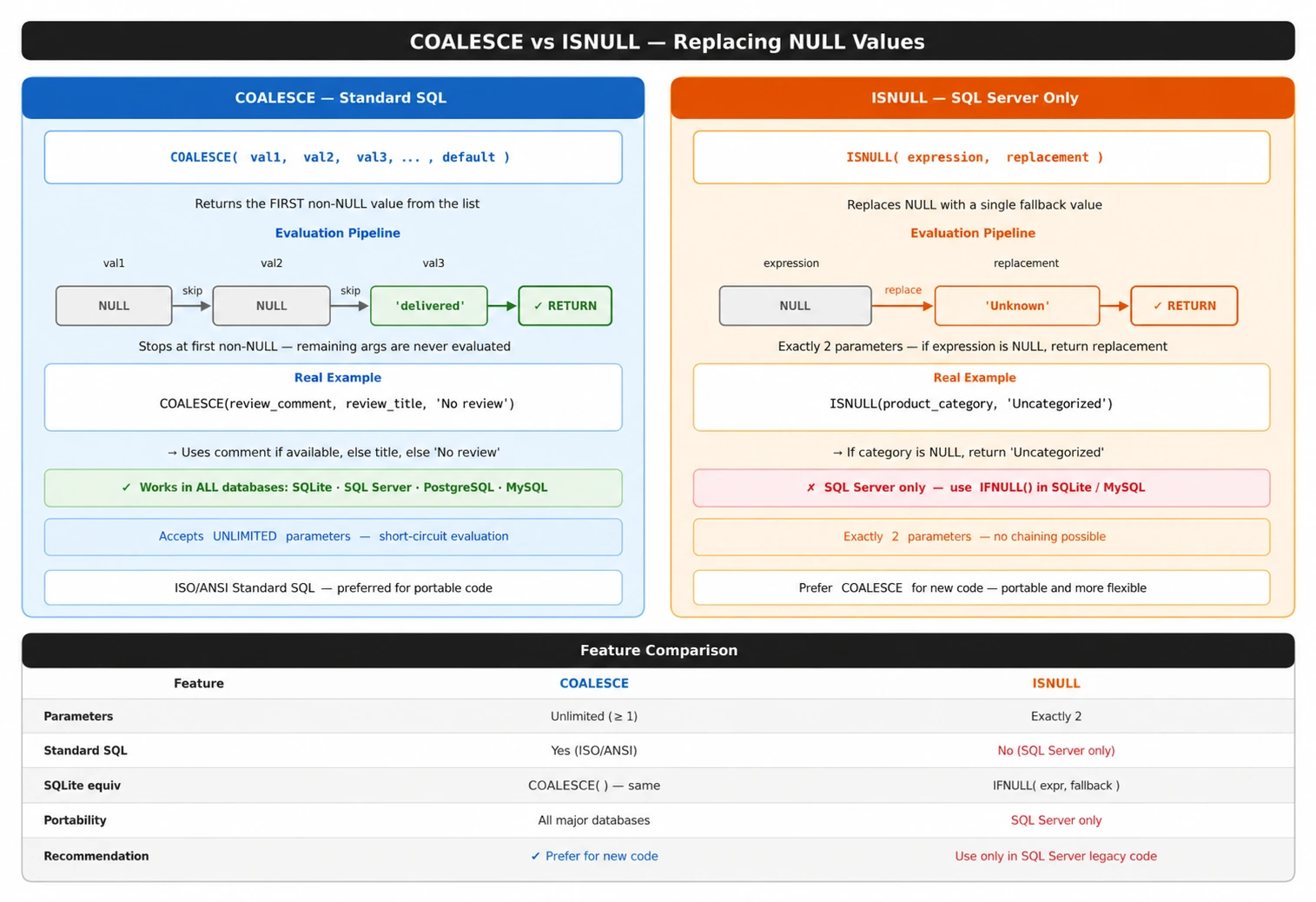
ISNULL Function (SQL Server)
ISNULL is a SQL Server-specific function that replaces NULL with a specified replacement value.
Syntax
ISNULL(expression, replacement_value)
How It Works
- Checks if the expression is NULL
- If NULL, returns the replacement value
- If NOT NULL, returns the original expression
Key Features
| Feature | Description |
|---|---|
| SQL Server only | Not available in SQLite, MySQL, PostgreSQL |
| Two arguments only | Unlike COALESCE, accepts exactly 2 values |
| Data type | Returns data type of first argument |
| Performance | Slightly faster than COALESCE in SQL Server |
SQL Server Example (for reference)
-- SQL Server ISNULL syntax
SELECT ISNULL(NULL, 'Default');      -- Returns 'Default'
SELECT ISNULL('Value', 'Default');   -- Returns 'Value'
SQLite: IFNULL and COALESCE
SQLite supports COALESCE (standard SQL) and IFNULL (SQLite-specific, similar to ISNULL).
-- SQLite NULL handling functions
SELECT
    -- COALESCE - returns first non-NULL
    COALESCE(NULL, 'Fallback') AS coalesce_result,
    COALESCE(NULL, NULL, 'Third Option') AS coalesce_multiple,

    -- IFNULL - SQLite's version of ISNULL (2 arguments)
    IFNULL(NULL, 'Fallback') AS ifnull_result,
    IFNULL('Original', 'Fallback') AS ifnull_not_null;
Practical Example: Replacing NULL Delivery Dates
Let's use COALESCE to replace NULL delivery dates with a meaningful message:
-- Replace NULL delivery dates with status message
SELECT
    order_id,
    order_status,
    order_purchase_timestamp,
    order_delivered_customer_date,
    COALESCE(order_delivered_customer_date, 'Not Delivered Yet') AS delivery_display
FROM olist_orders_dataset
WHERE order_status IN ('shipped', 'processing', 'delivered')
LIMIT 15;
COALESCE with Multiple Fallbacks
COALESCE shines when you need a cascade of fallback values:
-- Multiple fallback values for delivery date
SELECT
    order_id,
    order_status,
    -- Try delivery date, then carrier date, then approval date, then message
    COALESCE(
        order_delivered_customer_date,
        order_delivered_carrier_date,
        order_approved_at,
        'Pending'
    ) AS best_available_date
FROM olist_orders_dataset
LIMIT 15;
This is where COALESCE excels over ISNULL - you can chain multiple fallbacks in a single function call.
COALESCE vs ISNULL: Key Differences
Comparison Table
| Feature | COALESCE | ISNULL (SQL Server) |
|---|---|---|
| SQL Standard | ✅ Yes (ANSI) | ❌ No (proprietary) |
| Arguments | 2 or more | Exactly 2 |
| Works in SQLite | ✅ Yes | ❌ No (use IFNULL) |
| Data type | Highest precedence type | First argument type |
| Nested calls | Not needed | Required for 3+ values |
| Performance | Standard | Slightly faster in SQL Server |
When to Use Each
Use COALESCE when:
- Writing portable SQL that works across databases
- You need more than 2 fallback values
- You want standard-compliant code
Use ISNULL/IFNULL when:
- Working exclusively in SQL Server/SQLite
- You only need one fallback value
- You need specific data type behavior
-- Demonstrating the difference with IFNULL vs COALESCE
SELECT
    order_id,
    order_delivered_customer_date,

    -- IFNULL: Only 2 arguments
    IFNULL(order_delivered_customer_date, 'N/A') AS using_ifnull,

    -- COALESCE: Can chain multiple
    COALESCE(
        order_delivered_customer_date,
        order_delivered_carrier_date,
        'In Transit'
    ) AS using_coalesce
FROM olist_orders_dataset
WHERE order_status != 'delivered'
LIMIT 10;
Replacing NULL with Default Numbers
COALESCE is commonly used to replace NULL numeric values with zero or other defaults:
-- Replace NULL freight values with 0 for calculations
SELECT
    oi.order_id,
    oi.product_id,
    oi.price,
    oi.freight_value,
    -- Replace NULL freight with 0
    COALESCE(oi.freight_value, 0) AS freight_safe,
    -- Calculate total with NULL-safe freight
    oi.price + COALESCE(oi.freight_value, 0) AS total_price
FROM olist_order_items_dataset oi
LIMIT 15;
COALESCE in Aggregations
Use COALESCE to provide meaningful values when aggregations return NULL:
-- Handling NULL in aggregation results
SELECT
    c.customer_state,
    COUNT(DISTINCT o.order_id) AS order_count,
    -- AVG might return NULL if no orders
    COALESCE(AVG(oi.price), 0) AS avg_price,
    -- SUM might return NULL for empty groups
    COALESCE(SUM(oi.price), 0) AS total_sales
FROM olist_customers_dataset c
LEFT JOIN olist_orders_dataset o ON c.customer_id = o.customer_id
LEFT JOIN olist_order_items_dataset oi ON o.order_id = oi.order_id
WHERE c.customer_state IN ('SP', 'RJ', 'MG')
GROUP BY c.customer_state
ORDER BY total_sales DESC;
Building Display-Friendly Values
COALESCE helps create user-friendly output by replacing NULL with readable text:
-- Create display-friendly order status report
SELECT
    order_id,
    order_status,
    COALESCE(date(order_purchase_timestamp), 'Unknown') AS purchase_date,
    COALESCE(date(order_approved_at), 'Pending Approval') AS approval_date,
    COALESCE(date(order_delivered_carrier_date), 'Not Shipped') AS ship_date,
    COALESCE(date(order_delivered_customer_date), 'Not Delivered') AS delivery_date
FROM olist_orders_dataset
LIMIT 15;
Practice: NULL Replacement
Try using COALESCE to create a comprehensive order summary:
-- Practice: Create NULL-safe order summary
SELECT
    o.order_id,
    o.order_status,
    -- Replace NULL review scores with 'No Review'
    COALESCE(CAST(r.review_score AS TEXT), 'No Review') AS review,
    -- Replace NULL payment values with 0
    COALESCE(p.payment_value, 0) AS payment,
    -- Cascade through date fields
    COALESCE(
        date(o.order_delivered_customer_date),
        date(o.order_delivered_carrier_date),
        date(o.order_approved_at),
        date(o.order_purchase_timestamp)
    ) AS latest_known_date
FROM olist_orders_dataset o
LEFT JOIN olist_order_reviews_dataset r ON o.order_id = r.order_id
LEFT JOIN olist_order_payments_dataset p ON o.order_id = p.order_id
LIMIT 15;
Summary
Key Takeaways
-
COALESCE Syntax
COALESCE(value1, value2, ..., valueN) -- Returns first non-NULL value -
ISNULL/IFNULL Syntax
ISNULL(value, replacement) -- SQL Server IFNULL(value, replacement) -- SQLite/MySQL -
Key Differences
Aspect COALESCE ISNULL/IFNULL Standard ANSI SQL Database-specific Arguments Multiple Two only Portability High Limited -
Common Use Cases
- Replace NULL with default text:
COALESCE(name, 'Unknown') - Replace NULL with 0 for math:
COALESCE(price, 0) - Cascade through fallbacks:
COALESCE(a, b, c, 'default')
- Replace NULL with default text:
-
Best Practice
- Use COALESCE for portable code
- Use IFNULL in SQLite when you only need 2 values
- Always handle NULLs before displaying to users
What's Next?
In the next lesson, we'll explore Handling NULLs in Data Aggregation - how aggregate functions like COUNT, SUM, and AVG behave with NULL values.