Unique Index
Introduction
A unique index serves a dual purpose: it provides the performance benefits of a regular index AND enforces a business rule — no two rows can have the same value in the indexed column(s). It is one of the most practical index types you will use.
In this tutorial, you will learn:
- What a unique index is and how it differs from a regular index
- The relationship between unique indexes and constraints
- How to create unique indexes
- How unique indexes handle NULL values
- When and why to use unique indexes
What is a Unique Index?
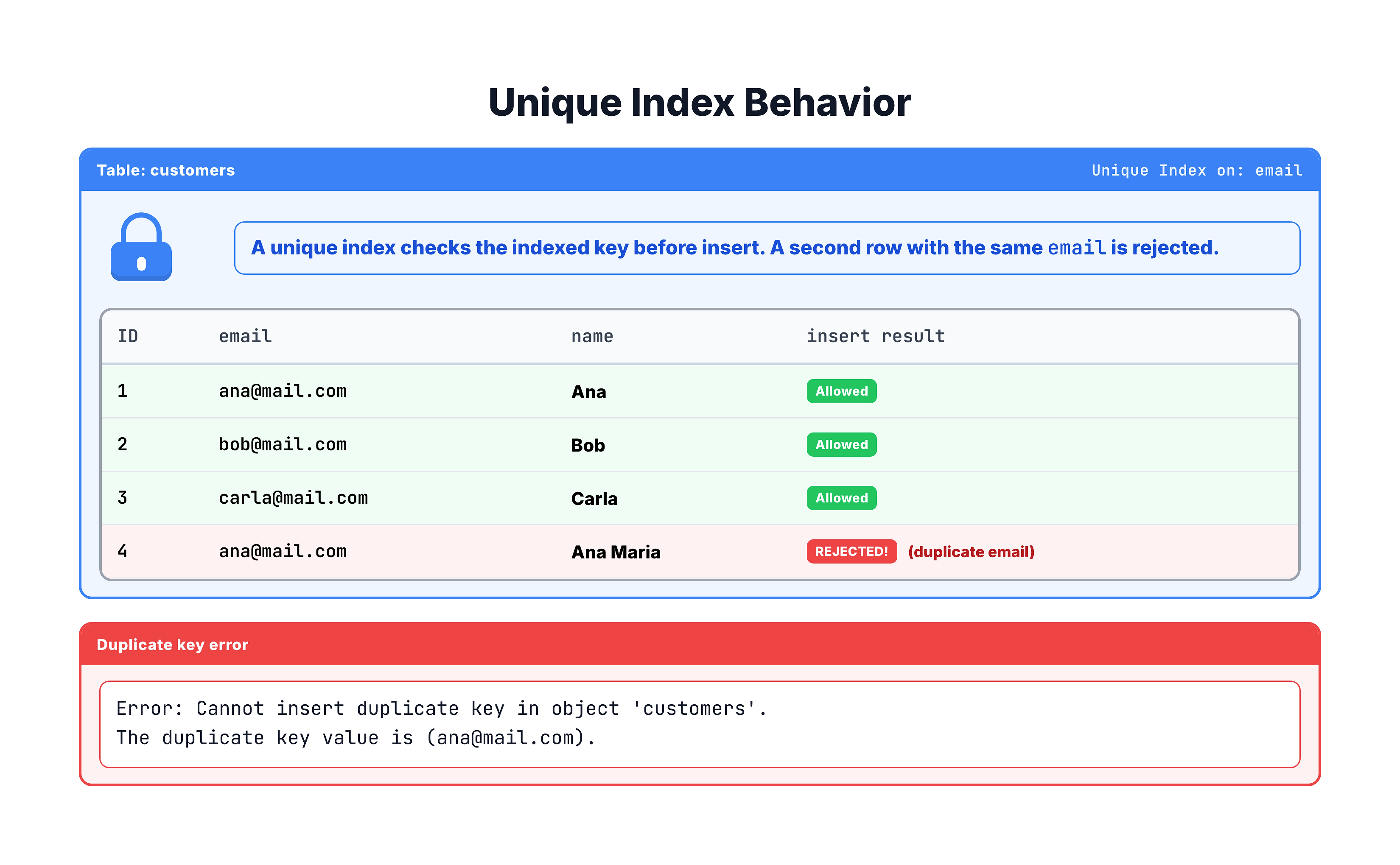
A unique index guarantees that no two rows in the table can have the same value (or combination of values) in the indexed column(s). If someone tries to insert or update a row that would create a duplicate, the database rejects the operation with an error.
Unique Index vs UNIQUE Constraint
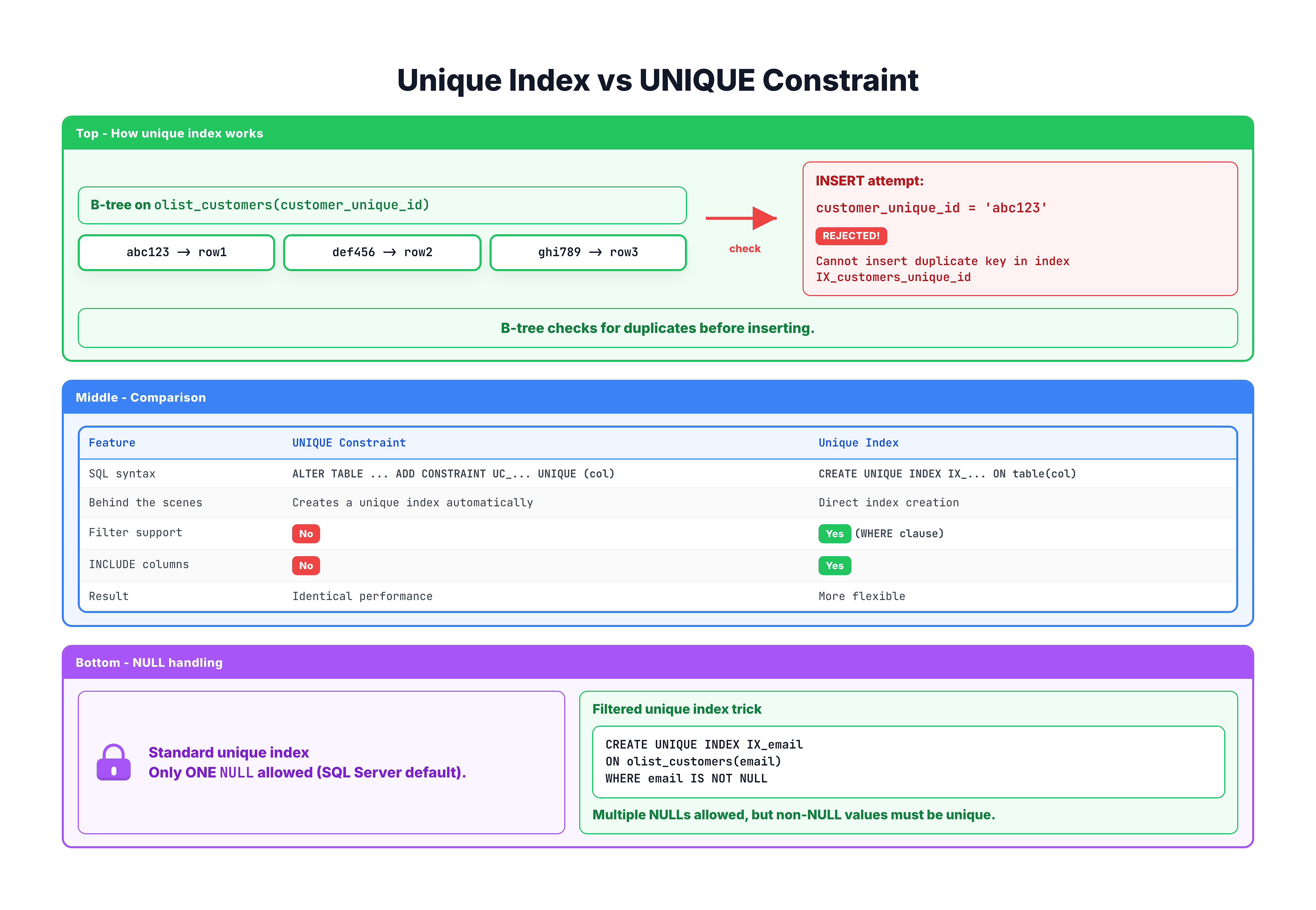
There are two ways to enforce uniqueness in SQL Server. They are functionally almost identical:
Method 1: CREATE UNIQUE INDEX
-- Using CREATE UNIQUE INDEX
CREATE UNIQUE NONCLUSTERED INDEX UX_Customers_Email
ON customers (email);
Method 2: UNIQUE Constraint
-- Using a UNIQUE CONSTRAINT (creates a unique index behind the scenes)
ALTER TABLE customers
ADD CONSTRAINT UQ_Customers_Email UNIQUE (email);
Comparison
| Feature | UNIQUE INDEX | UNIQUE CONSTRAINT |
|---|---|---|
| Enforces uniqueness | Yes | Yes |
| Creates an index | Yes (you define it) | Yes (auto-created behind the scenes) |
| INCLUDE columns | Yes | No |
| Filtered | Yes (WHERE clause) | No |
| Referenced by FK | No | Yes |
| Shows in constraints | No | Yes |
| Flexibility | More options | Simpler syntax |
When to Use Which
| Scenario | Recommendation |
|---|---|
| Need a foreign key reference | Use UNIQUE CONSTRAINT |
| Need INCLUDE columns or filtering | Use UNIQUE INDEX |
| Simple uniqueness enforcement | Either works |
| Need the index to be self-documenting as a constraint | Use UNIQUE CONSTRAINT |
Creating Unique Indexes
Single Column Unique Index
-- Ensure each customer has a unique email
CREATE UNIQUE NONCLUSTERED INDEX UX_Customers_Email
ON customers (email);
Composite Unique Index
-- Ensure each product appears only once per order
CREATE UNIQUE NONCLUSTERED INDEX UX_OrderItems_Order_Product
ON order_items (order_id, product_id);
Unique Index with INCLUDE
-- Unique on email, but also include name for covering
CREATE UNIQUE NONCLUSTERED INDEX UX_Customers_Email_Cover
ON customers (email)
INCLUDE (customer_city, customer_state);
Unique Clustered Index
-- A unique clustered index (this is what PRIMARY KEY creates by default)
CREATE UNIQUE CLUSTERED INDEX UCX_Orders_OrderID
ON orders (order_id);
NULL Handling in Unique Indexes
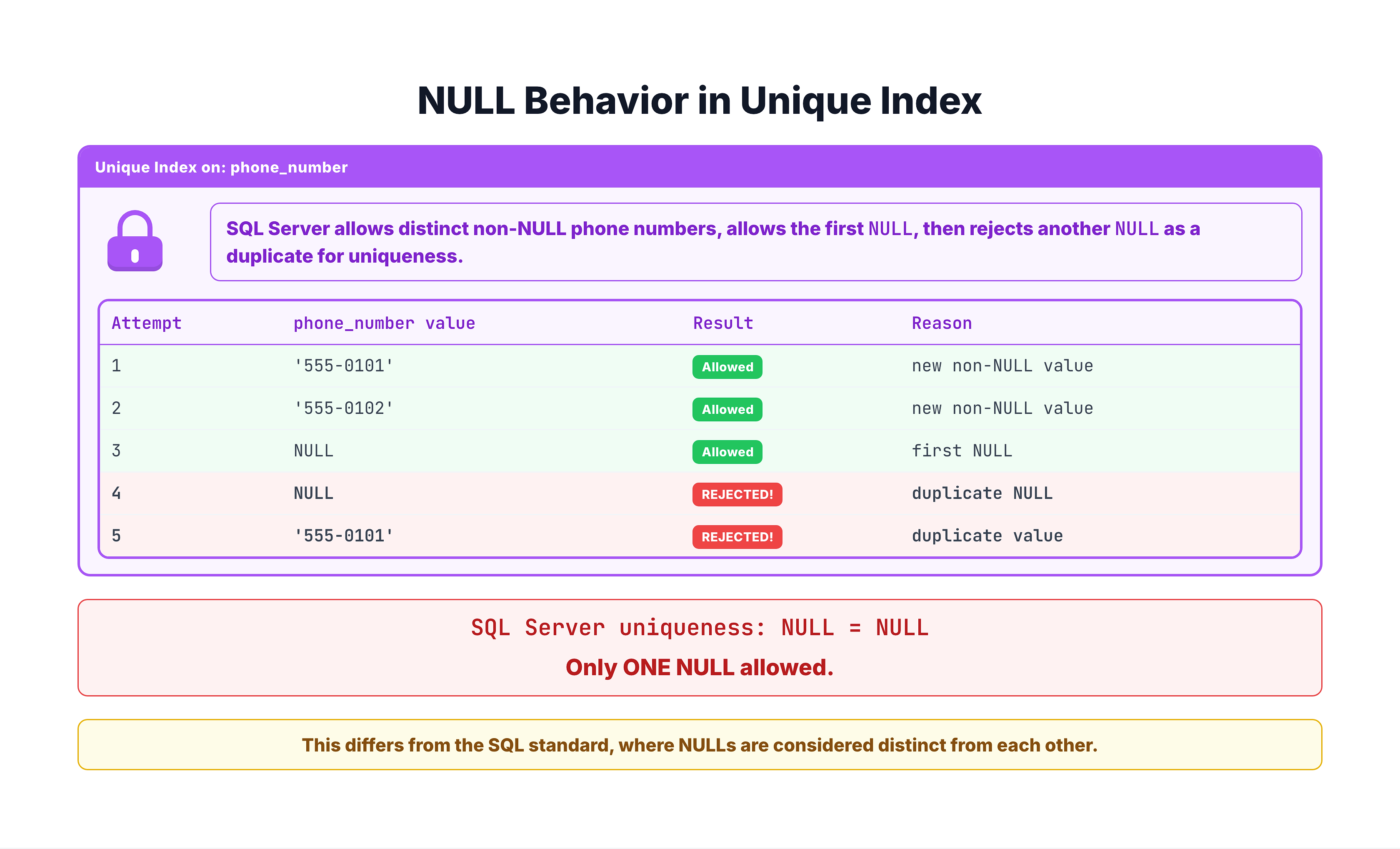
In SQL Server, a unique index treats NULL as a value for uniqueness purposes. This means only one NULL is allowed in a unique index column.
Workaround: Allow Multiple NULLs
If you need to allow multiple NULL values while enforcing uniqueness for non-NULL values, use a filtered unique index:
-- Allow multiple NULLs, but enforce uniqueness for non-NULL values
CREATE UNIQUE NONCLUSTERED INDEX UX_Customers_Phone
ON customers (phone_number)
WHERE phone_number IS NOT NULL;
Summary
Here is what you should remember about unique indexes:
| Concept | Key Takeaway |
|---|---|
| What | An index that prevents duplicate values in the indexed column(s) |
| Dual purpose | Performance improvement + data integrity enforcement |
| NULL handling | Only one NULL allowed (in SQL Server) |
| vs Constraint | More flexible (supports INCLUDE, WHERE) but not FK-referenceable |
| Primary Key | Automatically creates a unique clustered index |
| Multiple NULLs | Use a filtered unique index to allow them |
Common Use Cases
| Column | Why Unique |
|---|---|
| Email address | Each customer must have a distinct email |
| Username | No two users should share a username |
| Order + Product combo | Each product appears once per order |
| Employee ID | Natural business identifier |
| Social Security Number | Government-issued unique identifier |
In the next tutorial, you will learn about Filtered Indexes — indexes that only cover a subset of rows.