Introduction to TEMP Tables
Introduction
Temporary tables (TEMP tables) are a special type of table that exists only for the duration of your database session. They provide a workspace for intermediate calculations without cluttering your database with permanent objects.
In this tutorial, you will learn:
- What temporary tables are and how they differ from regular tables
- When to use temporary tables
- The lifecycle of temporary tables
- Key benefits and limitations
What is a Temporary Table?
Session-Scoped Storage
A temporary table is a table that:
- Is created within a database session
- Is automatically deleted when the session ends
- Is visible only to your session (in most databases)
- Behaves like a regular table while it exists
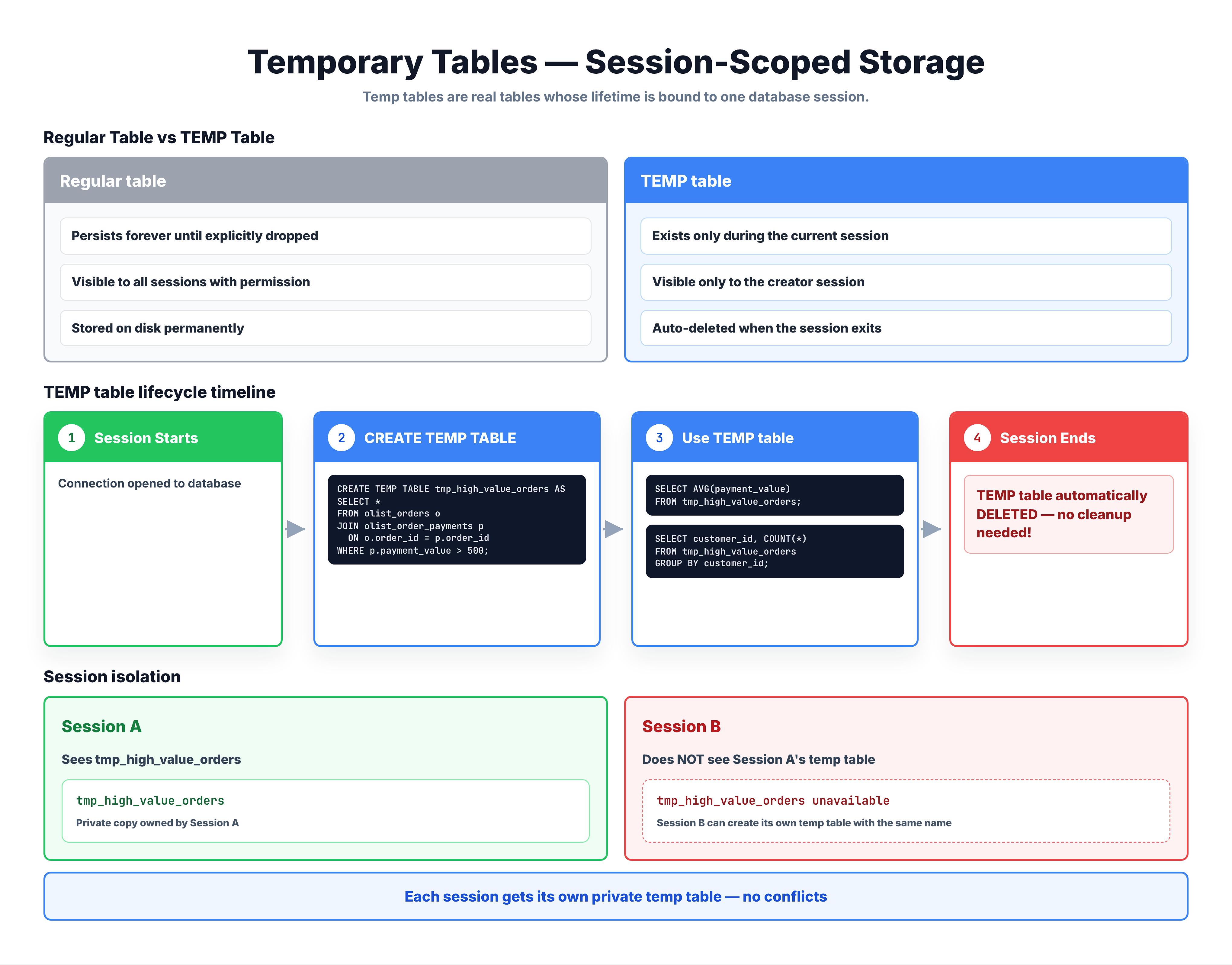
Regular Tables vs TEMP Tables
Key Differences
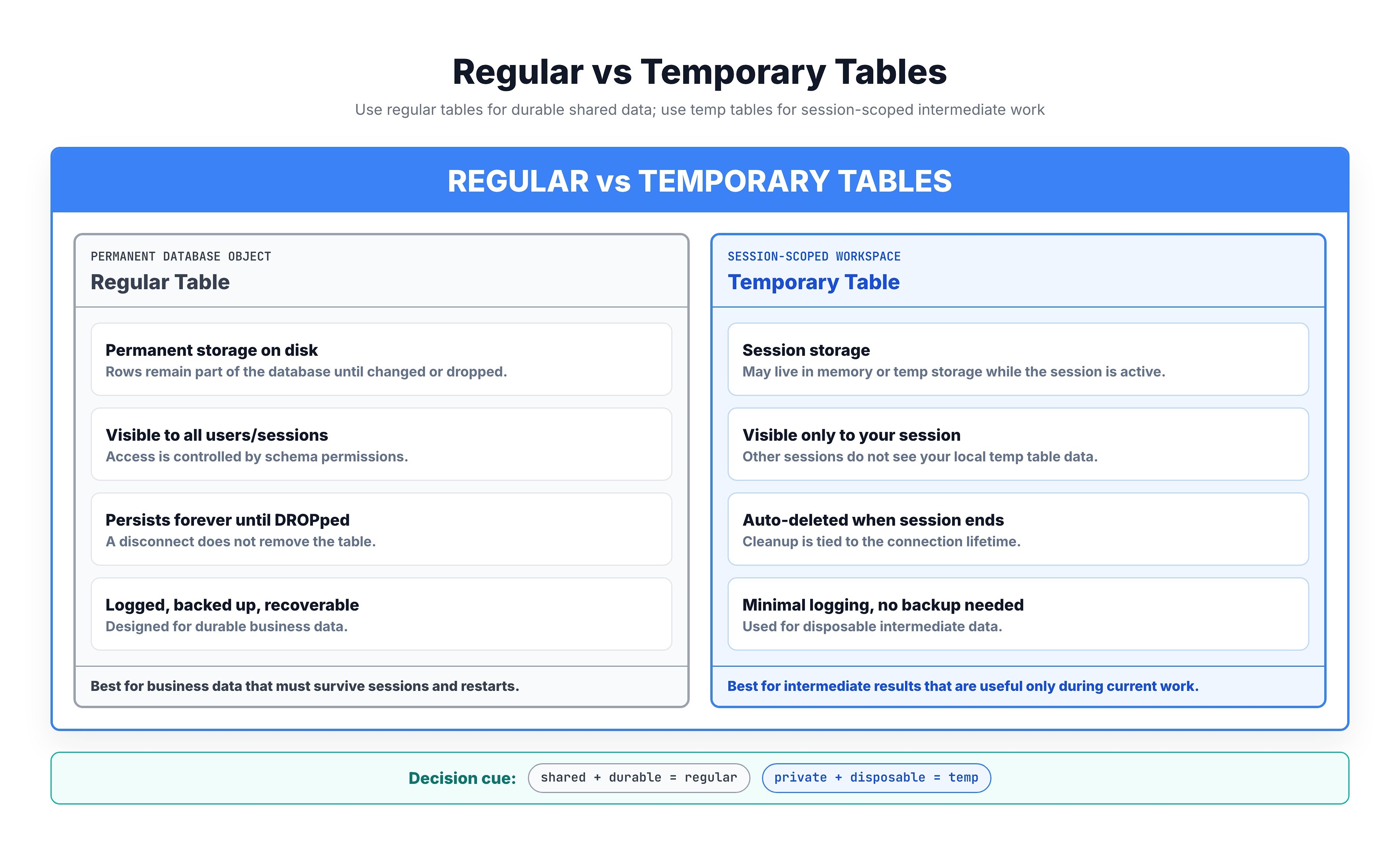
Comparison Table
| Feature | Regular Table | TEMP Table |
|---|---|---|
| Lifespan | Until explicitly dropped | Session only |
| Visibility | All users | Current session only |
| Storage | Disk (permanent) | Memory or temp disk |
| Logging | Full transaction logging | Minimal |
| Backup | Included in backups | Not backed up |
| Cleanup | Manual DROP required | Automatic |
| Namespace | Schema namespace | Session namespace |
| Indexes | Yes | Yes (session-scoped) |
| Use case | Permanent data | Intermediate work |
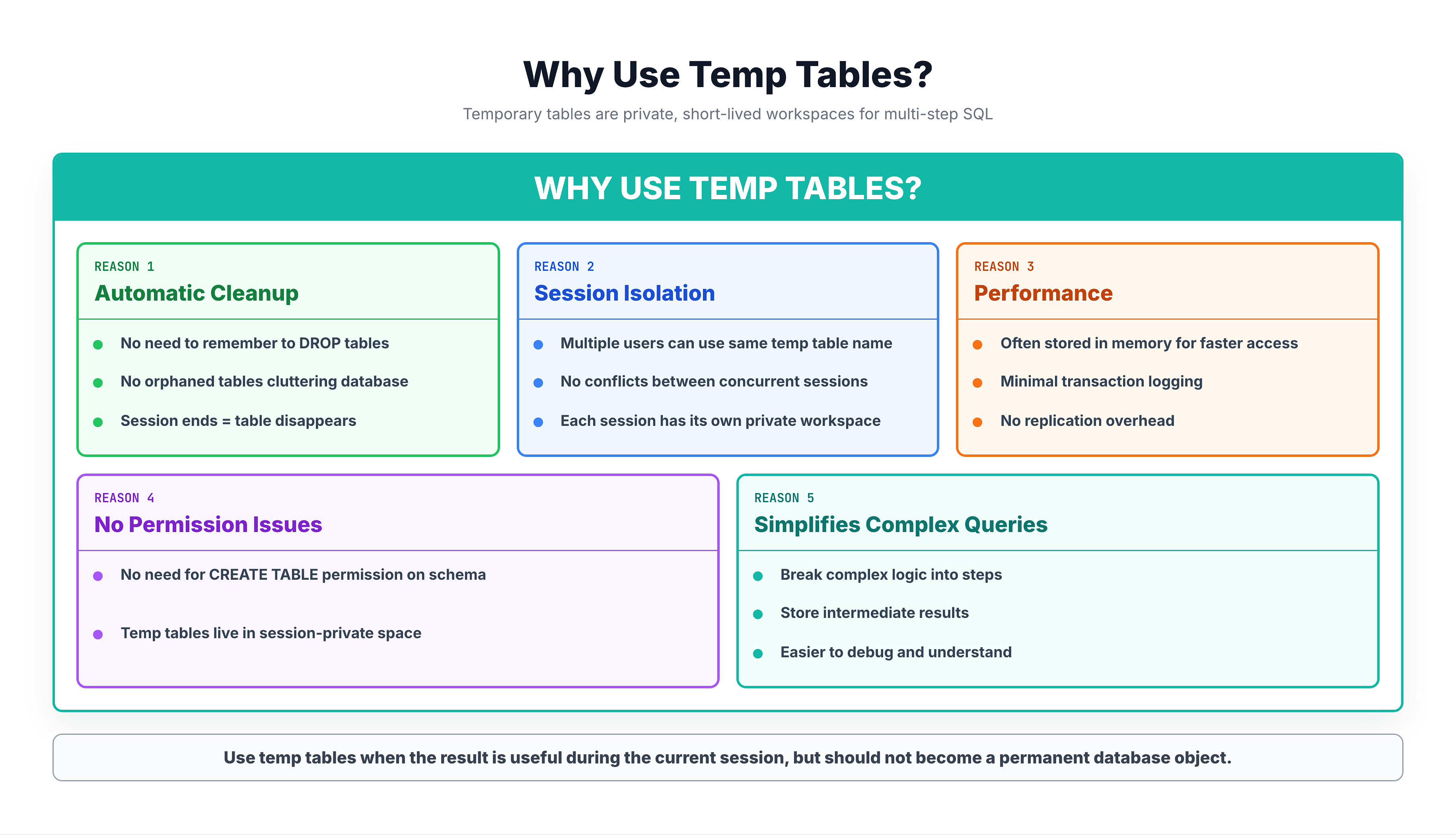
Why Use Temporary Tables?
Benefits of Temporary Tables
Types of Temporary Tables
Database-Specific Variations
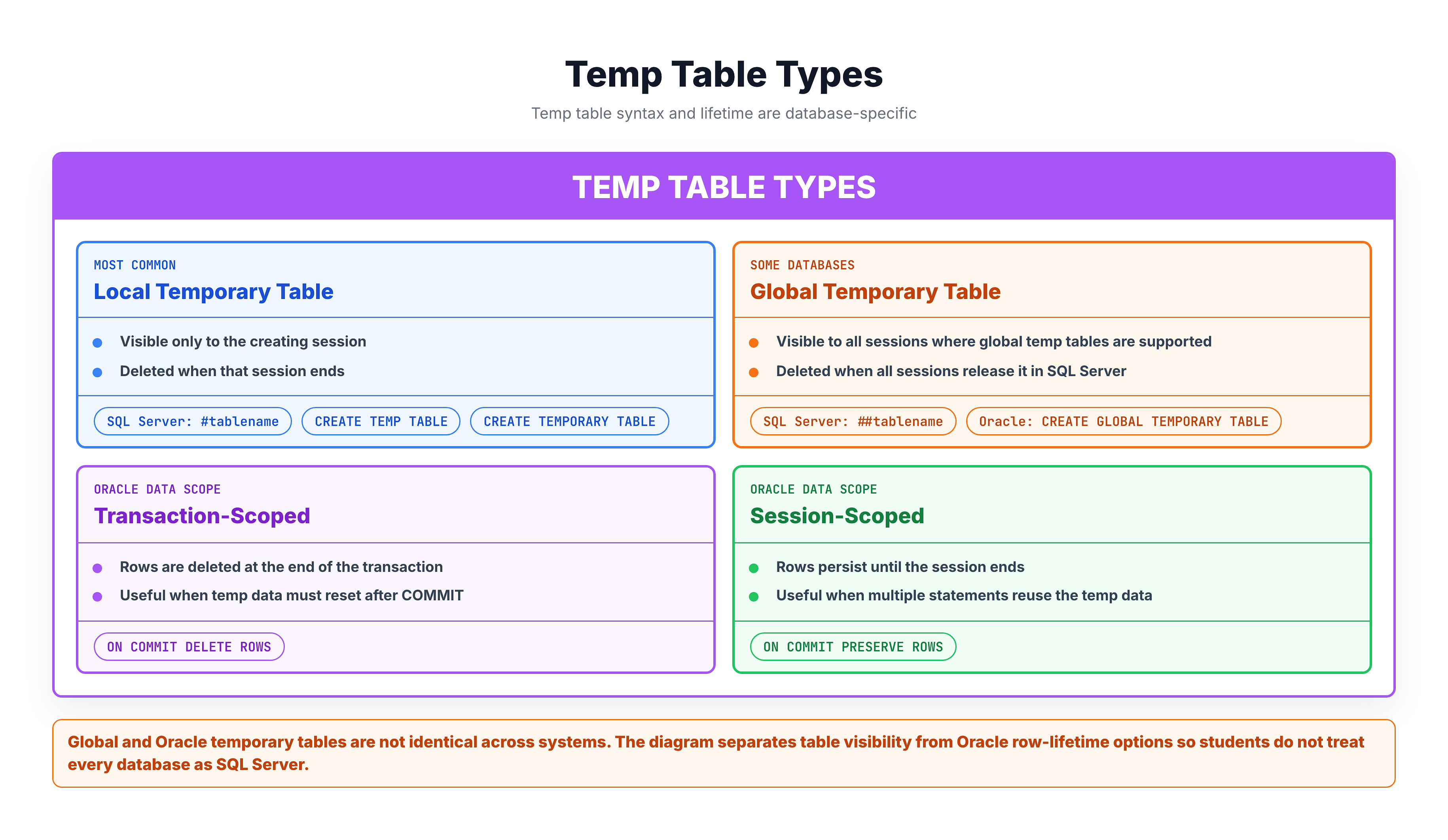
Database Syntax Overview
| Database | Local Temp Table | Global Temp Table |
|---|---|---|
| SQLite | CREATE TEMP TABLE | Not supported |
| PostgreSQL | CREATE TEMP TABLE | Not native |
| MySQL | CREATE TEMPORARY TABLE | Not supported |
| SQL Server | CREATE TABLE #name | CREATE TABLE ##name |
| Oracle | Via GTT with session scope | CREATE GLOBAL TEMPORARY TABLE |
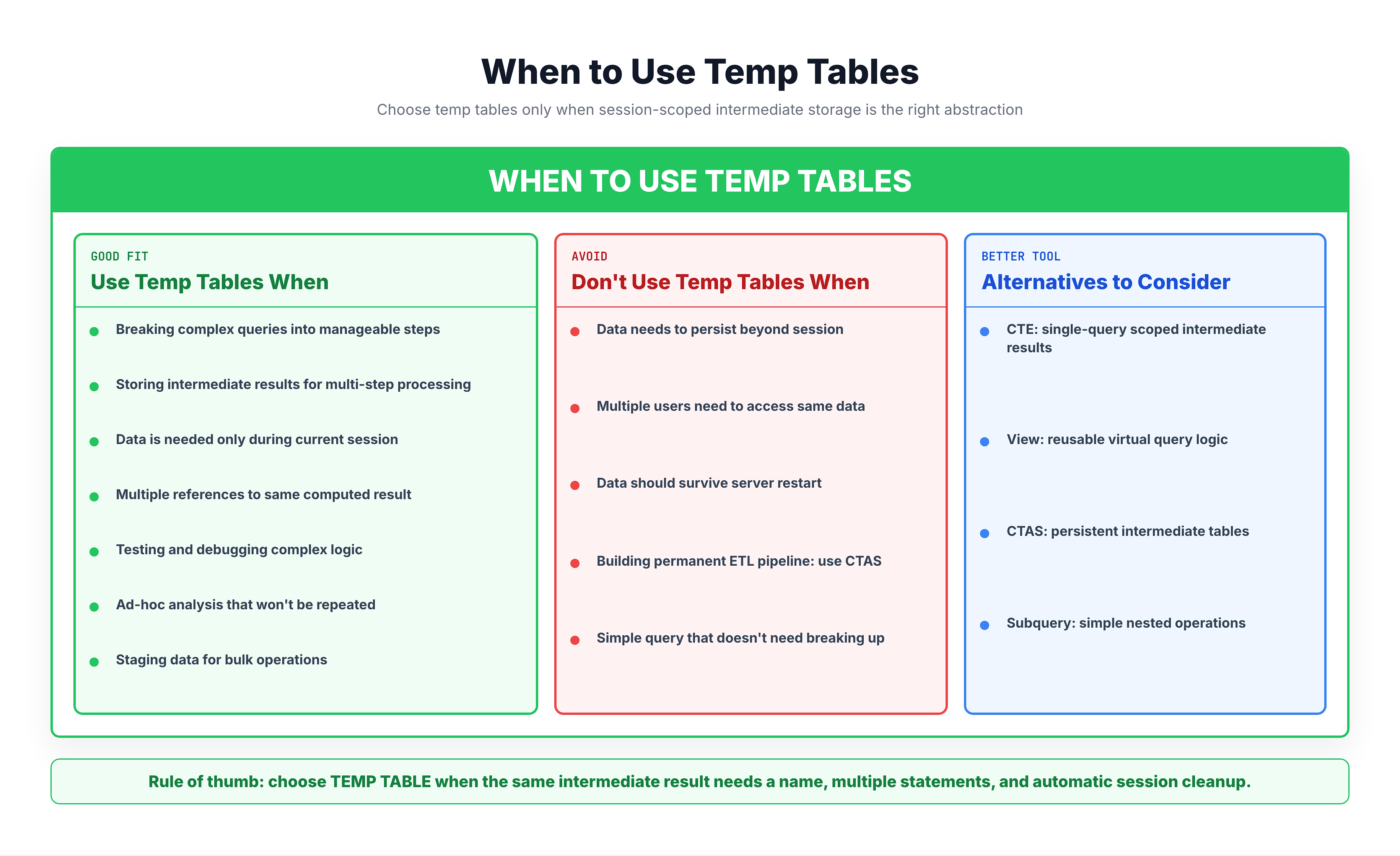
When to Use TEMP Tables
Decision Framework
Quick Preview
Here's a preview of what working with temp tables looks like:
-- This query demonstrates the CONCEPT of temp tables
-- (We can't actually create temp tables in this read-only environment)

-- Imagine this as STEP 1: Create temp table with filtered data
-- CREATE TEMP TABLE temp_sp_customers AS
SELECT
    customer_id,
    customer_unique_id,
    customer_city,
    customer_state
FROM olist_customers_dataset
WHERE customer_state = 'SP'
LIMIT 10;

-- Then STEP 2: Use the temp table in further analysis
-- SELECT * FROM temp_sp_customers ...
In the following lessons, we'll explore:
- The exact syntax for creating temp tables
- How databases execute temp table operations
- Practical use cases for temp tables
Summary
Key Takeaways
-
Temp tables are session-scoped - They exist only during your database session
-
Automatic cleanup - No need to DROP; tables disappear when session ends
-
Session isolation - Other users cannot see your temp tables
-
Performance benefits - Often stored in memory, minimal logging
-
Use for intermediate work - Complex query steps, ad-hoc analysis, testing
Quick Comparison
| Aspect | TEMP Table | Regular Table | CTE |
|---|---|---|---|
| Lifespan | Session | Permanent | Single query |
| Visibility | Session only | All users | Query only |
| Storage | Memory/temp | Disk | Memory |
| Cleanup | Automatic | Manual | Automatic |
| Reusable | Yes (in session) | Yes | Within query |
What's Next?
Let's learn the TEMP Table Syntax for creating and using temporary tables.