Clustered Index
Introduction
A clustered index is the most fundamental and impactful type of index in SQL Server. Unlike a heap where data sits in no particular order, a clustered index physically sorts and organizes the actual table data on disk. It transforms a disorganized pile of rows into a neatly ordered structure.
In this tutorial, you will learn:
- What a clustered index is and how it works
- How a clustered index physically organizes data
- The B-tree structure of a clustered index
- How queries benefit from a clustered index
- The relationship between primary keys and clustered indexes
- Rules and limitations of clustered indexes
What is a Clustered Index?
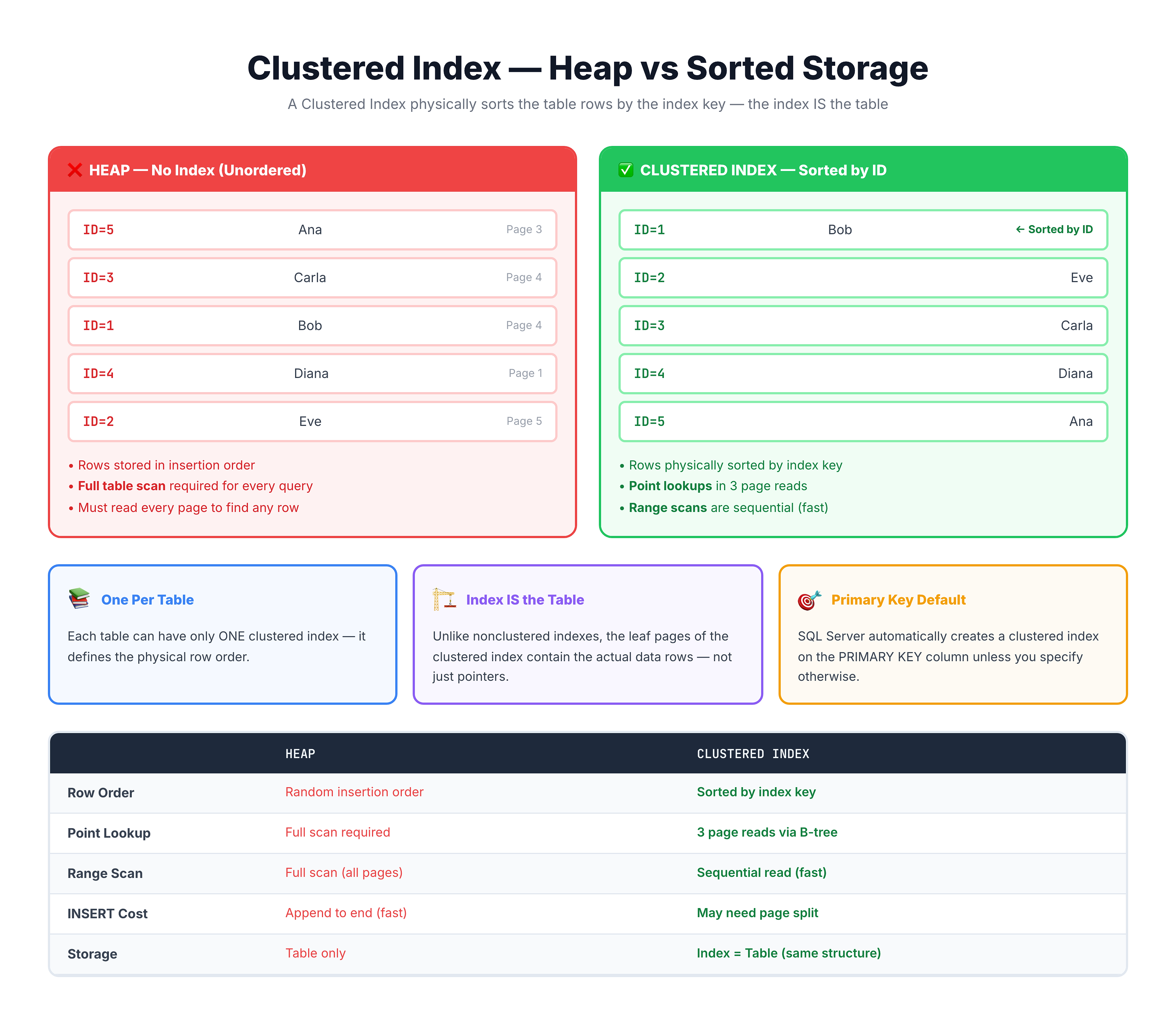
A clustered index defines the physical order of data in a table. When you create a clustered index on a column, SQL Server sorts all the rows in the table by that column and stores them on disk in that sorted order.
Think of it like a dictionary. The words in a dictionary are stored in alphabetical order — you do not need a separate lookup table to find a word. You simply go to the right section (A, B, C...) and quickly narrow down to the exact word. The data IS the index.
The One-Per-Table Rule
Because a clustered index determines the physical order of rows, a table can have only one clustered index. You cannot sort the same data in two different physical orders simultaneously — just like you cannot arrange a deck of cards by both suit and number at the same time.
B-Tree Structure of a Clustered Index
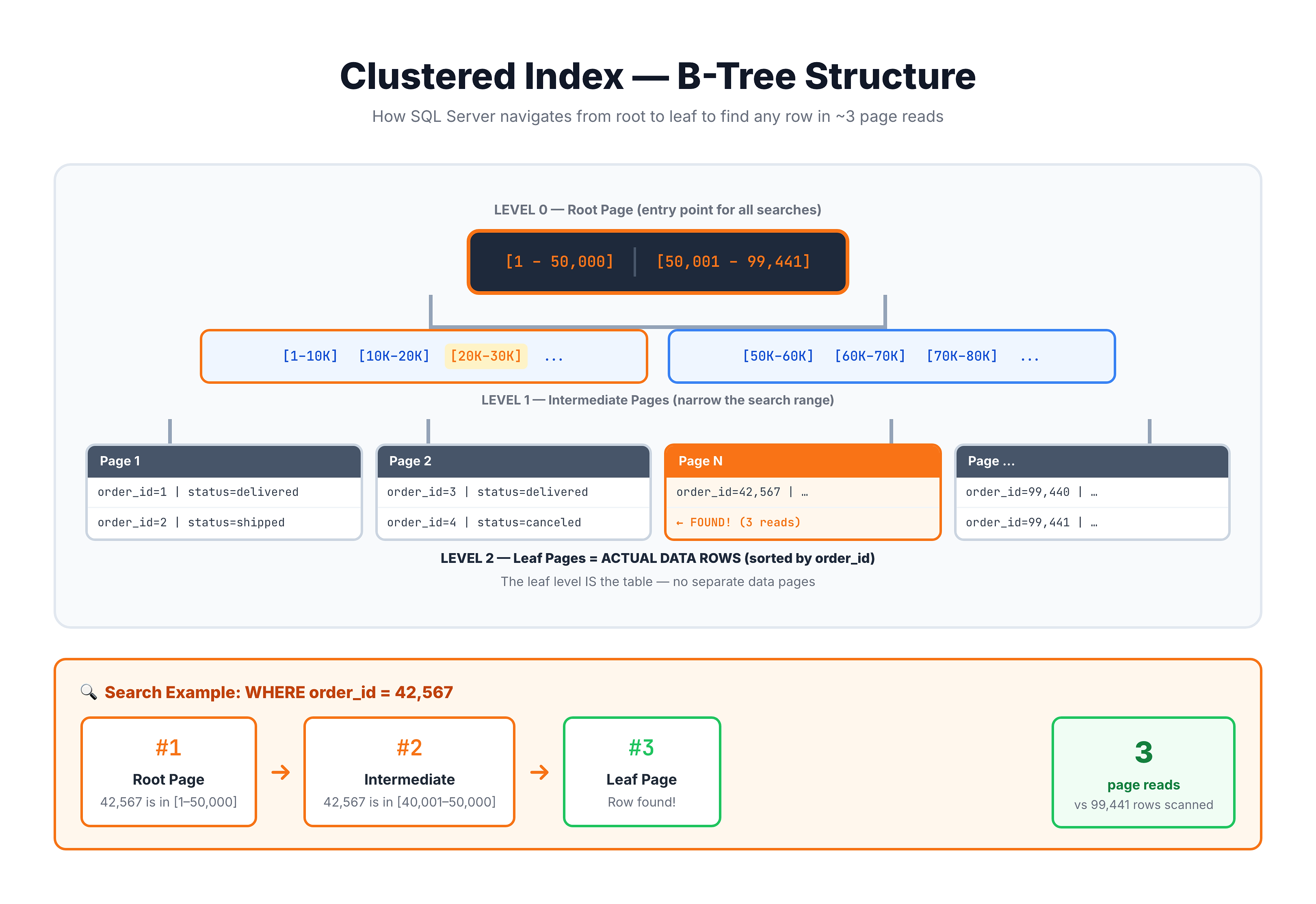
A clustered index uses a B-tree (balanced tree) structure with three levels:
Level Breakdown
| Level | Name | Contains |
|---|---|---|
| Root | Top of the tree | Pointers to intermediate pages |
| Intermediate | Middle layers | Pointers to other intermediate or leaf pages |
| Leaf | Bottom level | The actual data rows of the table |
The critical difference between a clustered index and a nonclustered index is that the leaf level of a clustered index IS the table data. There is no separate step to go from the index to the data — they are the same thing.
How Queries Use a Clustered Index
Let's trace how SQL Server uses a clustered index to find data.
Point Lookup (Equality Search)
-- Find a specific order by its ID
SELECT *
FROM orders
WHERE order_id = 'ORD_5432';
With a clustered index on order_id, SQL Server:
- Starts at the root node — determines which branch to follow
- Navigates to the correct intermediate node
- Arrives at the leaf page containing the actual row
- Returns the data directly — no extra lookup needed
This typically requires reading only 2-4 pages regardless of table size.
Range Scan
-- Find all orders in a date range
SELECT *
FROM orders
WHERE order_purchase_timestamp BETWEEN '2017-01-01' AND '2017-03-31'
ORDER BY order_purchase_timestamp;
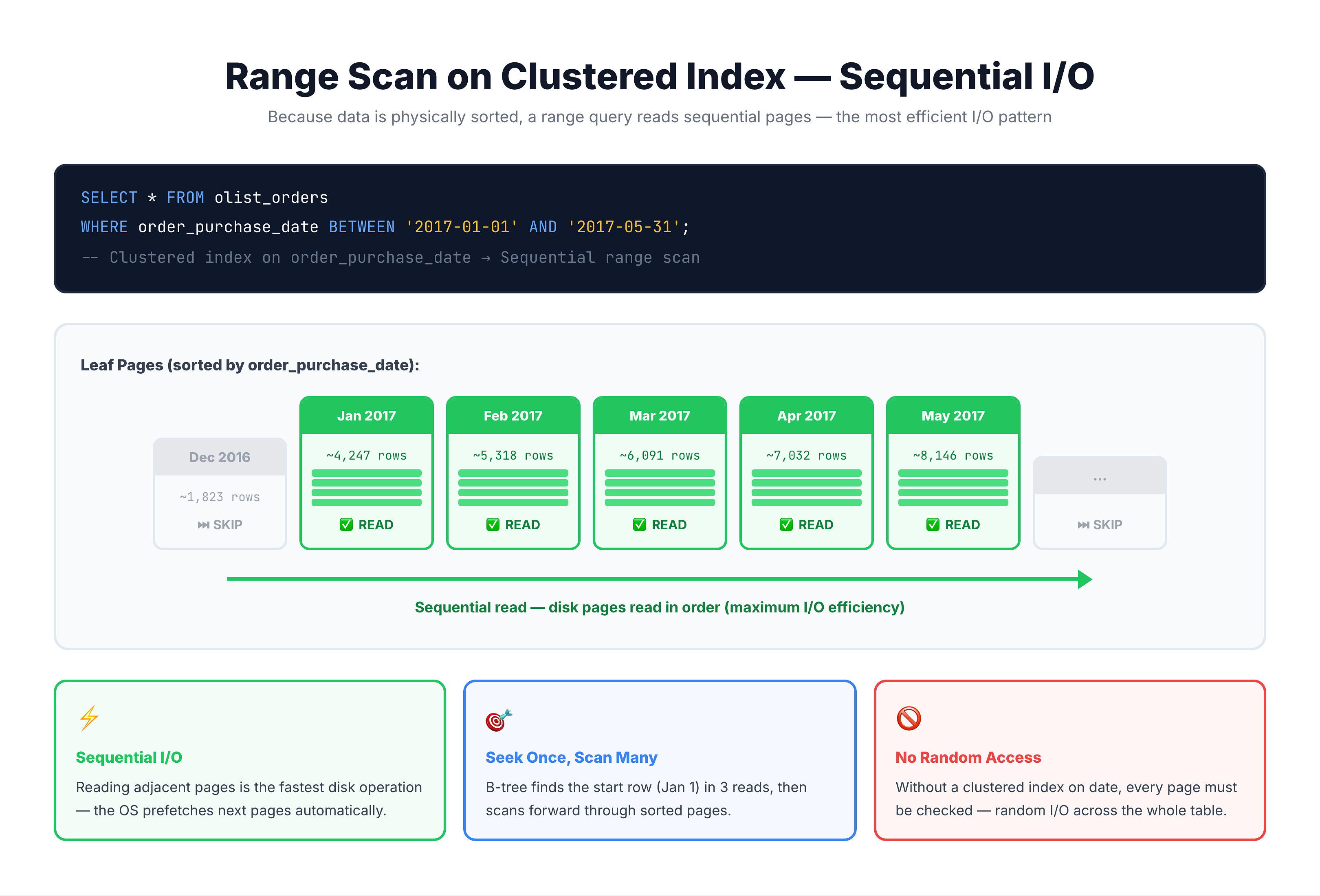
If the clustered index is on order_purchase_timestamp, this query benefits enormously:
- SQL Server navigates the B-tree to find the first matching row (Jan 1, 2017)
- Since data is physically sorted, it simply reads consecutive pages forward until it passes March 31, 2017
- The ORDER BY comes for free — the data is already sorted!
Primary Keys and Clustered Indexes
When you create a PRIMARY KEY constraint, SQL Server automatically creates a clustered index on that column (unless you explicitly specify otherwise).
-- This automatically creates a clustered index on order_id
CREATE TABLE orders (
    order_id INT PRIMARY KEY,
    customer_id INT,
    order_date DATE
);
This is equivalent to:
CREATE TABLE orders (
    order_id INT NOT NULL,
    customer_id INT,
    order_date DATE
);

CREATE CLUSTERED INDEX CX_Orders_ID ON orders (order_id);
ALTER TABLE orders ADD CONSTRAINT PK_Orders PRIMARY KEY (order_id);
Important Distinction
| Concept | What It Does |
|---|---|
| PRIMARY KEY | A constraint that enforces uniqueness and NOT NULL |
| Clustered Index | Determines physical data order |
They often go together, but they are not the same thing. You can have:
- A PRIMARY KEY that uses a nonclustered index
- A clustered index on a column that is not the primary key
-- Primary key with nonclustered index
-- Clustered index on a different column
CREATE TABLE orders (
    order_id INT NOT NULL,
    order_date DATE,
    customer_id INT,
    CONSTRAINT PK_Orders PRIMARY KEY NONCLUSTERED (order_id)
);

CREATE CLUSTERED INDEX CX_Orders_Date ON orders (order_date);
Rules and Best Practices
Clustered Index Rules
| Rule | Description |
|---|---|
| One per table | Only one clustered index per table |
| Defines physical order | The table data is sorted by the clustered index key |
| Affects all queries | Every query on the table is affected by the clustered index choice |
| Impacts nonclustered indexes | Nonclustered indexes store the clustered key as their row locator |
Choosing the Right Column for Clustered Index
The choice of clustered index column is one of the most important design decisions:
| Criteria | Good Choice | Bad Choice |
|---|---|---|
| Uniqueness | Unique or nearly unique values | Many duplicate values |
| Width | Narrow columns (INT, BIGINT) | Wide columns (NVARCHAR(500)) |
| Static | Rarely updated values | Frequently changing values |
| Query pattern | Frequently used in WHERE/JOIN | Rarely queried |
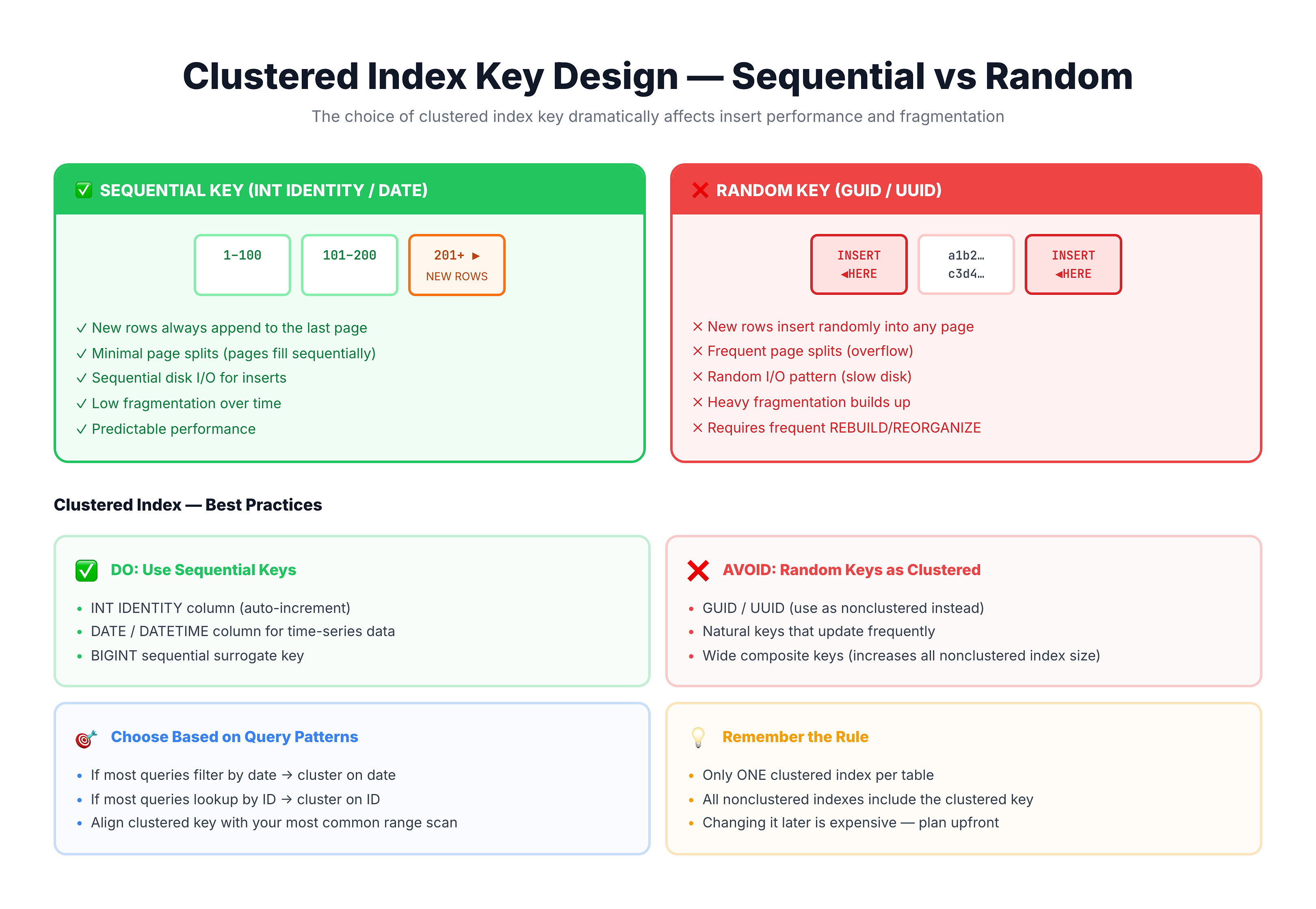
| Sequential | Ever-increasing (identity, date) | Random (GUID) |
Why Sequential Values Are Preferred
Summary
Here is what you should remember about clustered indexes:
| Concept | Key Takeaway |
|---|---|
| What | An index that defines the physical order of table data |
| Limit | Only one per table |
| Leaf level | Contains the actual data rows |
| Primary Key | Automatically creates a clustered index by default |
| Best for | Range queries, ordered access, primary key lookups |
| Choose column | Narrow, unique, static, sequential, frequently queried |
Key Differences from Heap
| Aspect | Heap | Clustered Index |
|---|---|---|
| Data order | Random | Sorted |
| Point lookup | Full scan | B-tree seek (fast) |
| Range query | Full scan | Sequential read (fast) |
| ORDER BY | Requires explicit sort | May come for free |
| Insert behavior | Goes anywhere | Must go in sorted position |
In the next tutorial, you will learn about nonclustered indexes — separate structures that provide additional lookup paths without changing the physical data order.