Introduction to Stored Procedures
Introduction
Welcome to the Stored Procedures section of our SQL journey! As your SQL skills advance beyond writing individual queries, you will encounter scenarios where you need to execute the same set of operations repeatedly, enforce business logic at the database level, or automate routine tasks. This is exactly where stored procedures come in.
In this tutorial, you will learn:
- What stored procedures are and why they exist
- How stored procedures fit into the broader SQL ecosystem
- The advantages and disadvantages of using stored procedures
- When to use stored procedures versus other SQL constructs
- How different database systems handle stored procedures
What is a Stored Procedure?
Definition
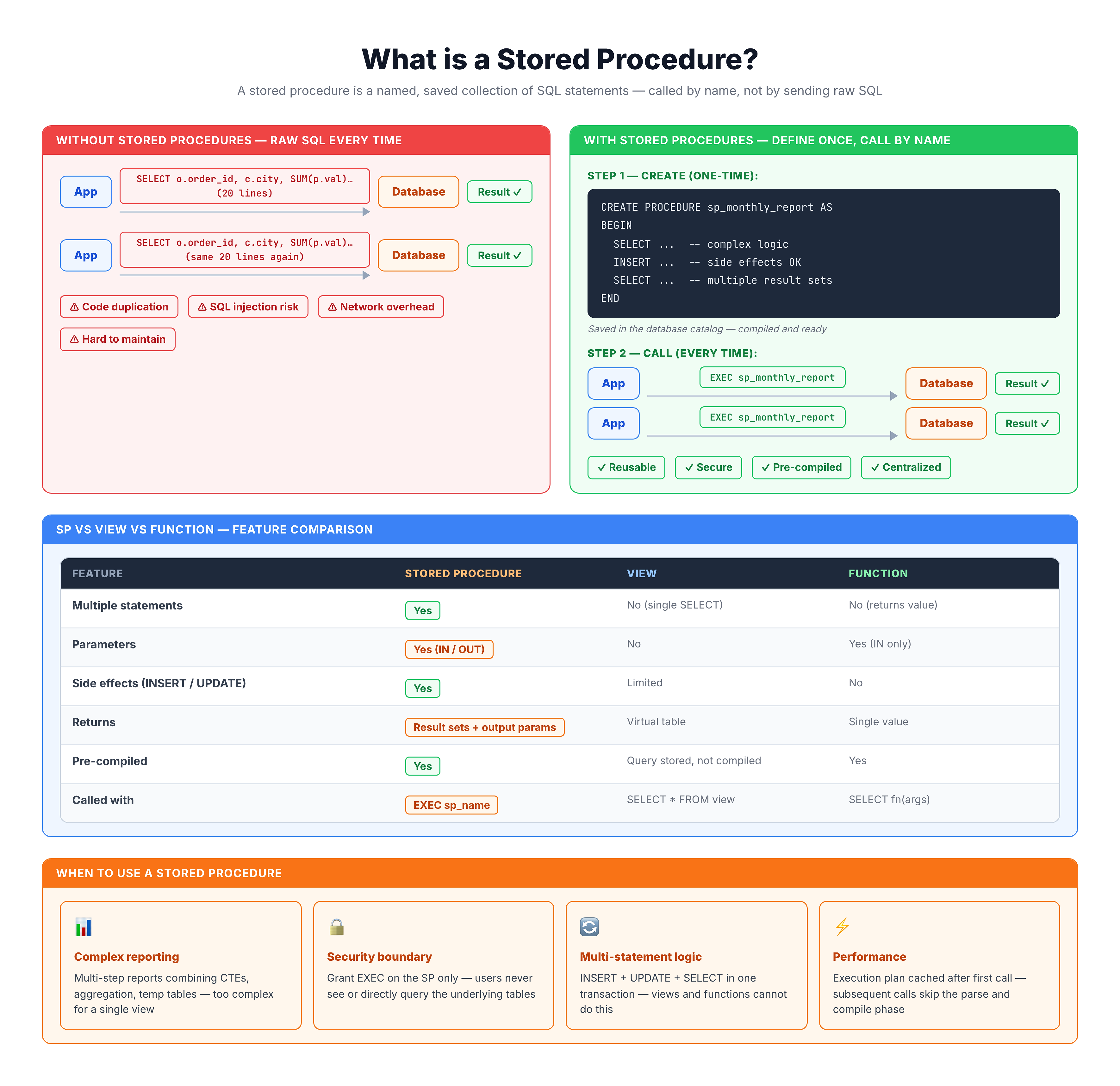
A stored procedure is a prepared collection of one or more SQL statements that is saved in the database and can be executed (called) whenever needed. Think of it like a reusable function or script that lives inside your database server rather than in your application code.
Simple Analogy
Imagine you are a chef in a restaurant. Every time a customer orders a "Margherita Pizza," you follow the same recipe:
- Prepare the dough
- Add tomato sauce
- Add mozzarella
- Bake at 450°F for 12 minutes
Instead of memorizing these steps every single time, you write the recipe once and just say "Make a Margherita" — the kitchen knows exactly what to do.
A stored procedure works the same way. You write the SQL logic once, save it with a name, and simply call that name whenever you need those operations performed.
Why Stored Procedures Exist
The Problem They Solve
Without stored procedures, every SQL operation requires:
- Writing the full SQL query in your application code
- Sending it across the network to the database server
- The server parsing and compiling it from scratch each time
- Executing the query and returning results
Core Benefits
| Benefit | Description |
|---|---|
| Reusability | Write once, execute many times |
| Performance | Pre-compiled execution plans reduce overhead |
| Security | Users can execute procedures without direct table access |
| Maintainability | Change logic in one place, all callers get updates |
| Network Efficiency | Send a short procedure call instead of long SQL text |
| Consistency | Ensures the same logic is applied every time |
Stored Procedures vs Other SQL Constructs
How Do Stored Procedures Compare?
You have already learned about several ways to organize and reuse SQL logic. Here is how stored procedures compare to those alternatives:
| Feature | View | CTE | Stored Procedure |
|---|---|---|---|
| Persistence | Saved in database | Query-scoped only | Saved in database |
| Parameters | No | No | Yes |
| Multiple Statements | Single SELECT | Single query chain | Multiple statements |
| Control Flow | No | No | IF/ELSE, WHILE, loops |
| Variables | No | No | Yes |
| Error Handling | No | No | TRY/CATCH |
| Modifies Data | No (read-only) | No | Yes (INSERT, UPDATE, DELETE) |
| Returns Data | Yes (like a table) | Yes (like a table) | Yes (result sets, output params) |
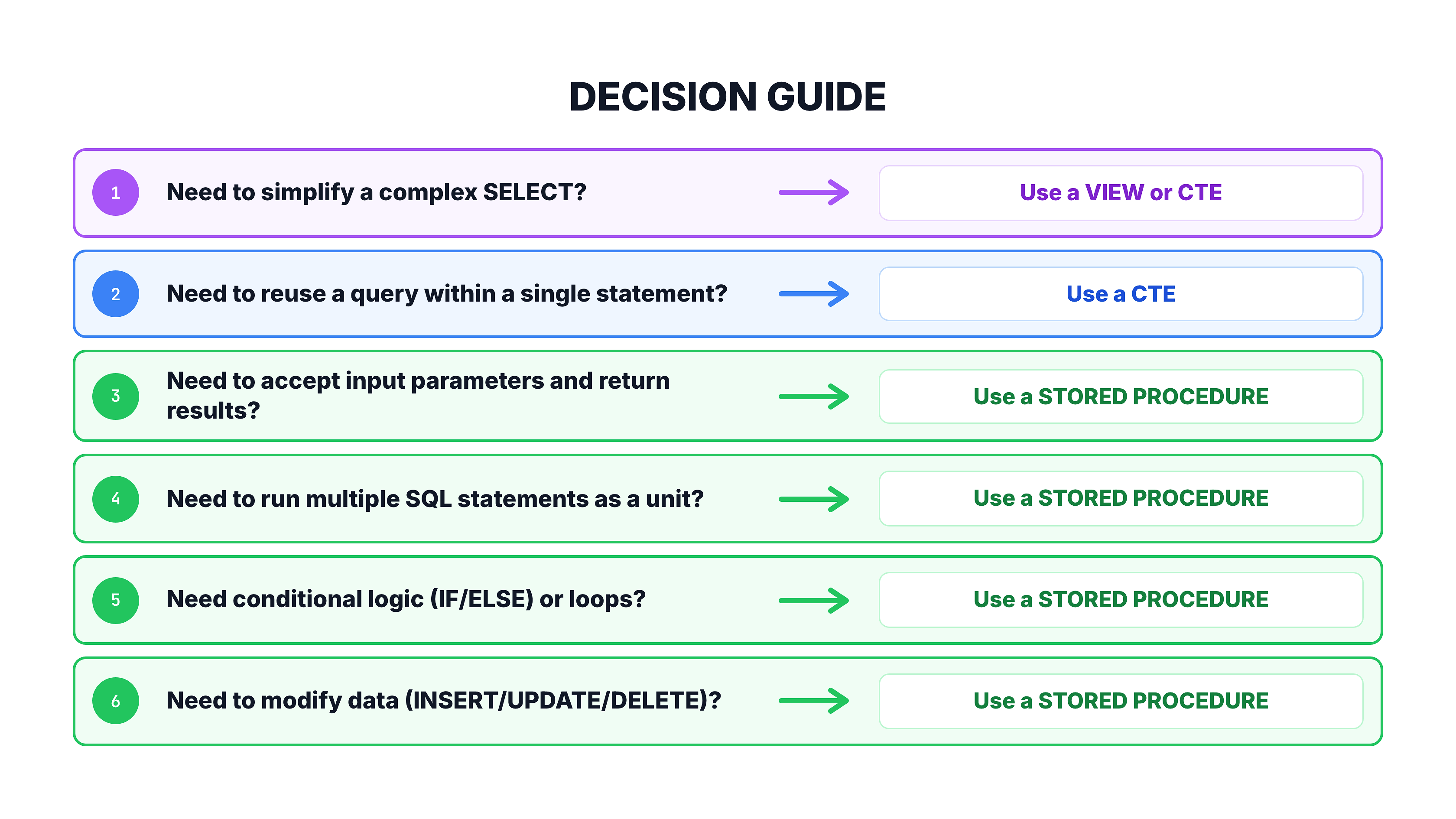
When to Use Each
Database Support
Stored Procedures Across Database Systems
Stored procedure support and syntax varies across database systems:
| Database | Supports Stored Procedures | Language |
|---|---|---|
| SQL Server | Full support | T-SQL |
| MySQL | Full support | MySQL procedural SQL |
| PostgreSQL | Full support (as functions) | PL/pgSQL |
| Oracle | Full support | PL/SQL |
| SQLite | Not supported | N/A |
Important Note About SQLite
SQLite does not support stored procedures. Since our live practice database uses SQLite, the code examples in this section are for learning purposes and demonstrate the concepts using SQL Server (T-SQL) syntax, which is the most commonly taught dialect for stored procedures.
In the real world, stored procedures are primarily used in enterprise database systems like SQL Server, Oracle, MySQL, and PostgreSQL.
Syntax Variations
┌─────────────────────────────────────────────────────────────────────────┐
│  SQL Server:    CREATE PROCEDURE proc_name AS BEGIN ... END             │
│  MySQL:         CREATE PROCEDURE proc_name() BEGIN ... END              │
│  PostgreSQL:    CREATE FUNCTION func_name() RETURNS ... AS $$ ... $$    │
│  Oracle:        CREATE PROCEDURE proc_name AS BEGIN ... END             │
└─────────────────────────────────────────────────────────────────────────┘
Throughout this section, we will primarily use SQL Server (T-SQL) syntax, as it is the most widely used for teaching stored procedure concepts.
What You Will Learn in This Section
Roadmap for the Stored Procedures Section
- Introduction (You are here!)
└── What, Why, and When - Basics
└── CREATE, EXEC, ALTER, DROP - Parameters
└── Input, Output, and Default parameters - Multi-Queries
└── Running multiple statements in one procedure - Variables
└── DECLARE, SET, and using variables - Control Flow (IF/ELSE)
└── Conditional logic inside procedures - Error Handling (TRY/CATCH)
└── Graceful error management - Styling
└── Best practices for readable procedures - Triggers
└── Automatic actions on data changes - Trigger Use Cases
└── Real-world trigger applications
This section will take you from zero knowledge to a solid understanding of stored procedures:
Summary
Key Takeaways
| Concept | Summary |
|---|---|
| What | A stored procedure is a saved collection of SQL statements in the database |
| Why | Reusability, performance, security, maintainability |
| When | When you need parameterized, reusable logic with control flow |
| Where | SQL Server, MySQL, PostgreSQL, Oracle (not SQLite) |
What is Next?
In the next tutorial, we will dive into the basics of stored procedures — learning how to create, execute, modify, and delete stored procedures with hands-on examples.