Columnstore vs Rowstore Index
Introduction
You now know how both rowstore (traditional B-tree) and columnstore indexes work. The natural question is: when should you use which? The answer depends entirely on your workload — the types of queries your application runs most frequently.
In this tutorial, you will learn:
- A detailed comparison of rowstore vs columnstore across all dimensions
- Performance benchmarks for different query patterns
- How to identify which workload matches which index type
- Real-world scenarios and recommendations
Complete Comparison Table
| Dimension | Rowstore Index | Columnstore Index |
|---|---|---|
| Data layout | Row by row | Column by column |
| Best for | Point lookups, small result sets | Aggregations over large datasets |
| Compression | Moderate (row + page) | Excellent (10x typical) |
| Storage size | Larger | Much smaller |
| Execution mode | Row mode (1 row at a time) | Batch mode (up to 900 rows) |
| Point lookup speed | Excellent | Poor |
| Aggregation speed | Good | Excellent (10-100x faster) |
| Scan speed | Moderate | Very fast |
| INSERT speed | Fast (into B-tree) | Moderate (via deltastore) |
| UPDATE speed | Fast (in-place) | Slower (delete + insert internally) |
| DELETE speed | Fast | Moderate (soft delete + cleanup) |
| Concurrent writes | Excellent | Good |
| Index count | 1 clustered + many NC | 1 clustered CS + NC CS |
Query Pattern Comparison
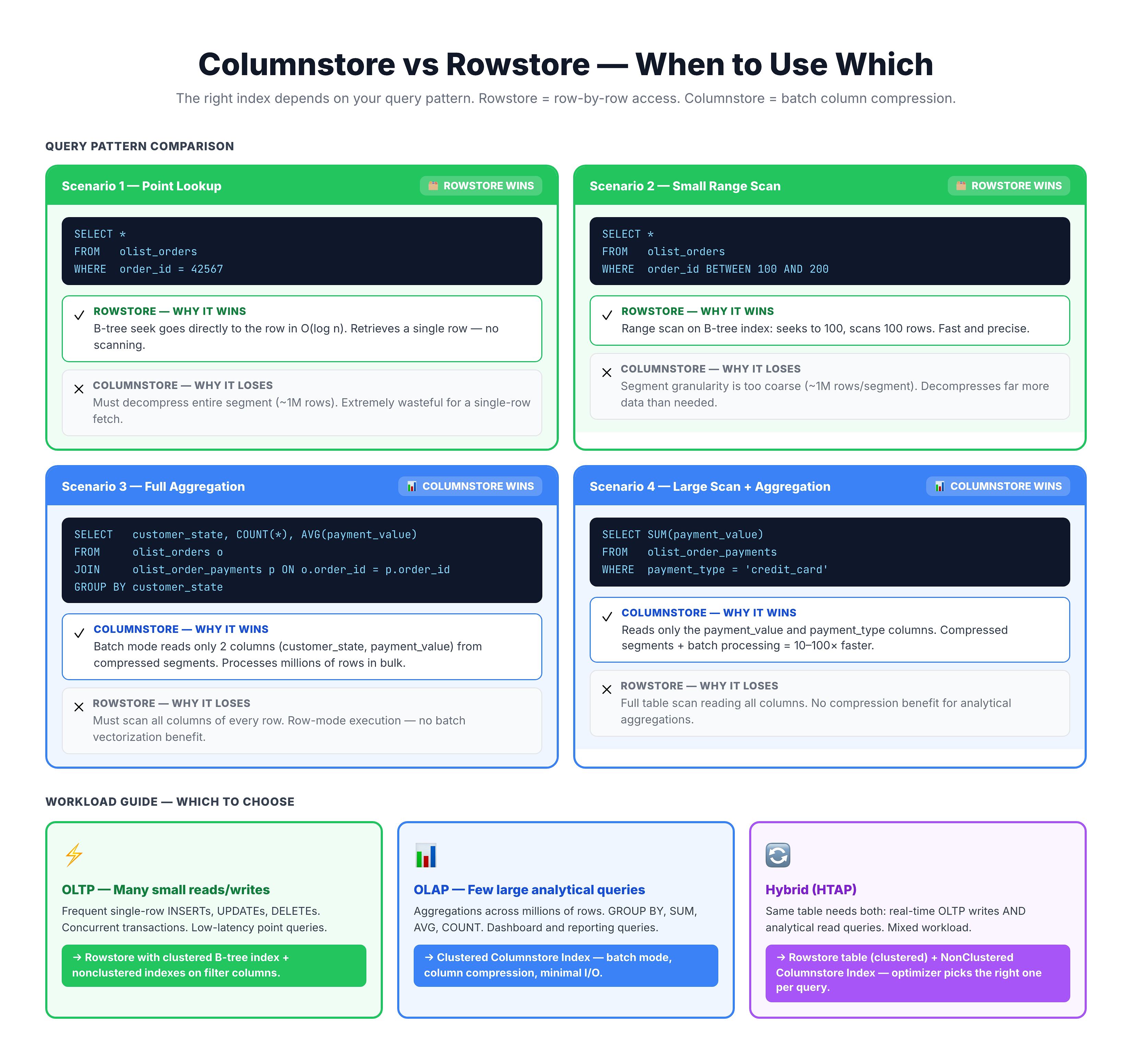
Let's compare how each index type handles common query patterns:
Pattern 1: Point Lookup
SELECT * FROM orders WHERE order_id = 'ORD_5432';
| Rowstore | Columnstore | |
|---|---|---|
| Method | B-tree seek (2-4 page reads) | Scan through compressed segments |
| Speed | ⚡ Milliseconds | 🐢 Slower (must decompress) |
| Winner | ✅ Rowstore |
Pattern 2: Aggregation
SELECT customer_state, SUM(price), COUNT(*)
FROM orders JOIN order_items ON orders.order_id = order_items.order_id
GROUP BY customer_state;
| Rowstore | Columnstore | |
|---|---|---|
| Method | Full scan, row-by-row processing | Read only needed columns, batch processing |
| Speed | 🐢 Seconds to minutes | ⚡ Sub-second |
| Winner | ✅ Columnstore |
Pattern 3: Full Table Scan with Filter
SELECT * FROM orders WHERE order_status = 'canceled';
| Rowstore | Columnstore | |
|---|---|---|
| Without NC index | Full table scan | Segment elimination + batch filter |
| With NC index | Index seek + lookup | (Columnstore IS the table) |
| Winner | Depends on selectivity | Better for low selectivity |
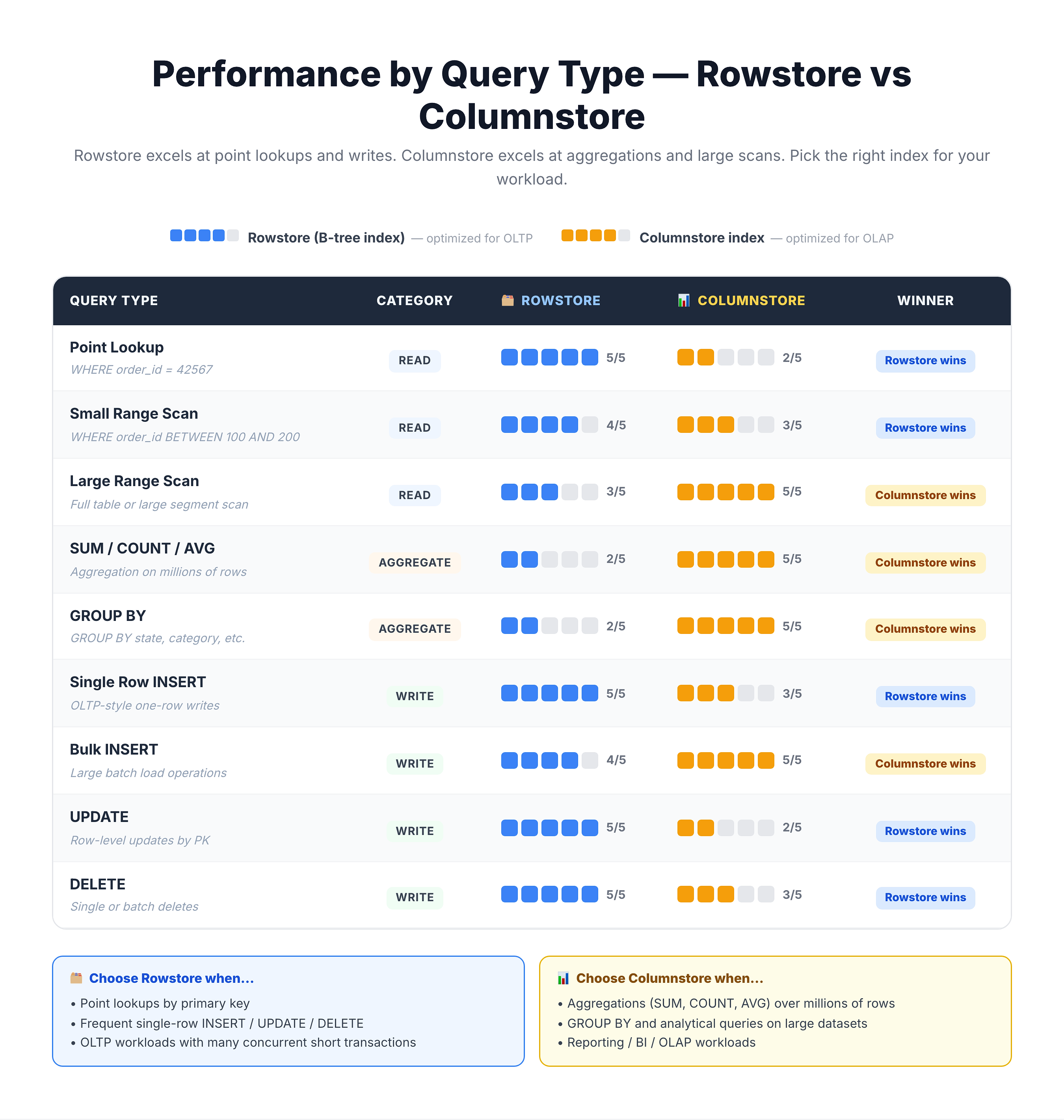
Performance Summary
Workload Types: OLTP vs OLAP
The choice between rowstore and columnstore often comes down to your workload type:
OLTP (Online Transaction Processing)
Characteristics:
- Many small, fast transactions
- Single-row inserts, updates, deletes
- Point lookups by primary key
- Short-running queries
Recommendation: Rowstore indexes
OLAP (Online Analytical Processing)
Characteristics:
- Few large, complex queries
- Aggregations over millions of rows
- Read-heavy workload
- Reporting and dashboards
Recommendation: Columnstore indexes
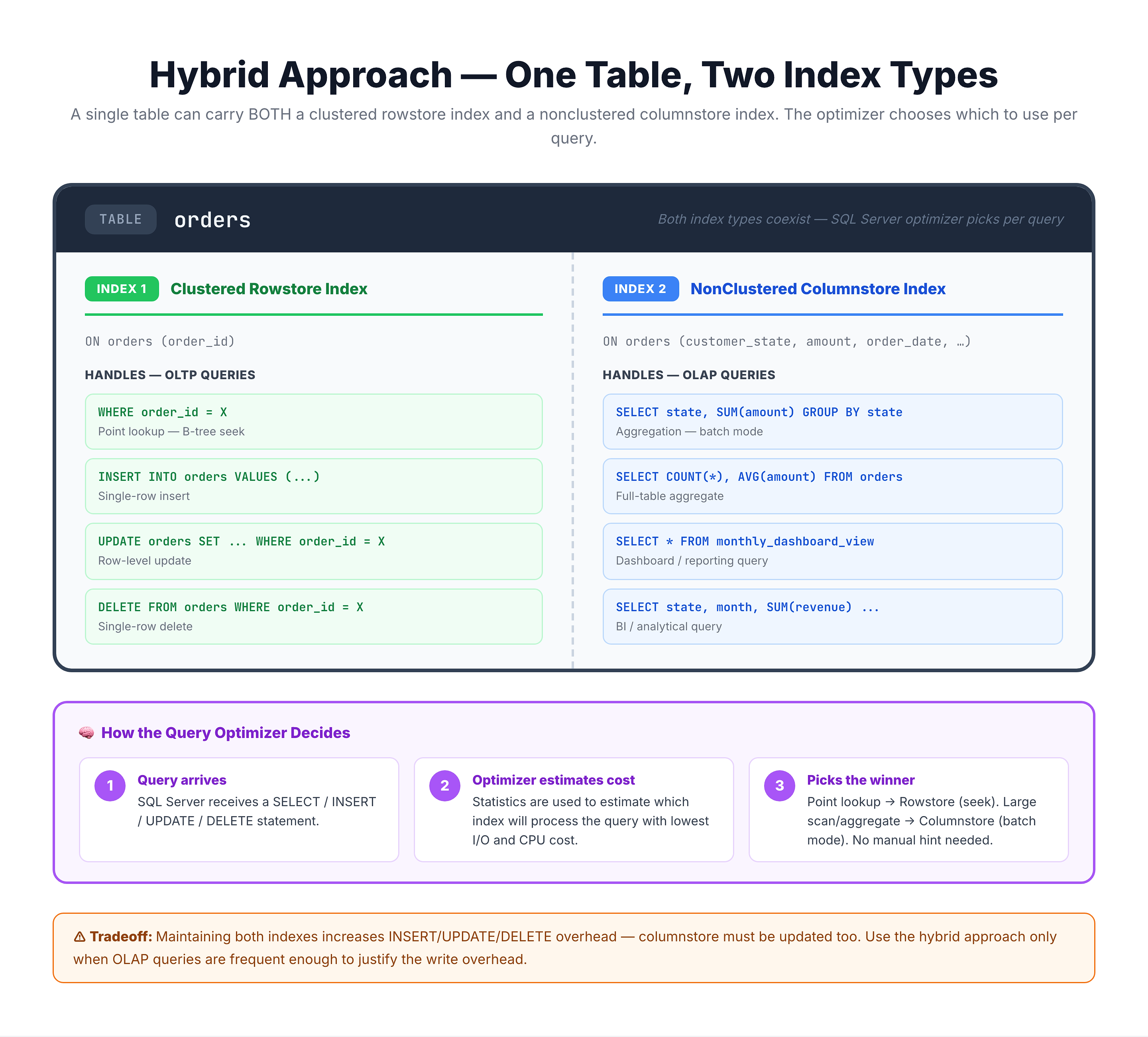
Hybrid (HTAP)
Some tables need both transactional and analytical capabilities:
Storage Comparison
One of the biggest advantages of columnstore is storage efficiency:
| Metric | Rowstore | Columnstore |
|---|---|---|
| 1 million rows (typical table) | ~500 MB | ~50 MB |
| Compression ratio | 2-3x with page compression | 10-15x typical |
| I/O for full scan | Read all 500 MB | Read only 50 MB |
| Memory footprint | Large | Small (compressed in memory) |
This means:
- Columnstore tables use less disk space
- Queries read less data from disk (faster I/O)
- More data fits in memory (better cache utilization)
- Backup and restore operations are faster
Summary
Here is your decision guide for choosing between rowstore and columnstore:
| Choose Rowstore When... | Choose Columnstore When... |
|---|---|
| Queries look up single rows | Queries aggregate millions of rows |
| High volume of INSERT/UPDATE/DELETE | Read-heavy, few writes |
| Short transactions (OLTP) | Reporting and analytics (OLAP) |
| Need fast point lookups | Need fast SUM, COUNT, AVG |
| Many concurrent users writing | Few concurrent analytical queries |
The Hybrid Strategy
For many real-world systems, the answer is both:
- Clustered rowstore index for transactional access
- Nonclustered columnstore index for analytical queries
This gives you the best of both worlds at the cost of some additional storage and write overhead.
In the next tutorial, you will learn the exact syntax for creating columnstore indexes.