Window SUM
Introduction
The SUM window function is essential for financial analysis, cumulative calculations, and comparing individual values to totals. With SUM() OVER(), you can calculate totals while preserving every row of detail.
In this lesson, you will learn:
- How to use SUM as a window function
- Calculate running totals and cumulative sums
- Partition sums by different dimensions
- Practical use cases for financial and business analysis
Basic Syntax
The window SUM function follows this pattern:
SUM(column) OVER (
    [PARTITION BY column(s)]
    [ORDER BY column(s)]
    [frame_clause]
)
Key Behaviors
| OVER() Contents | Result |
|---|---|
Empty OVER() | Sum of all rows in result set |
PARTITION BY | Sum within each partition |
ORDER BY | Running (cumulative) sum |
| Both | Running sum within each partition |
Visualization
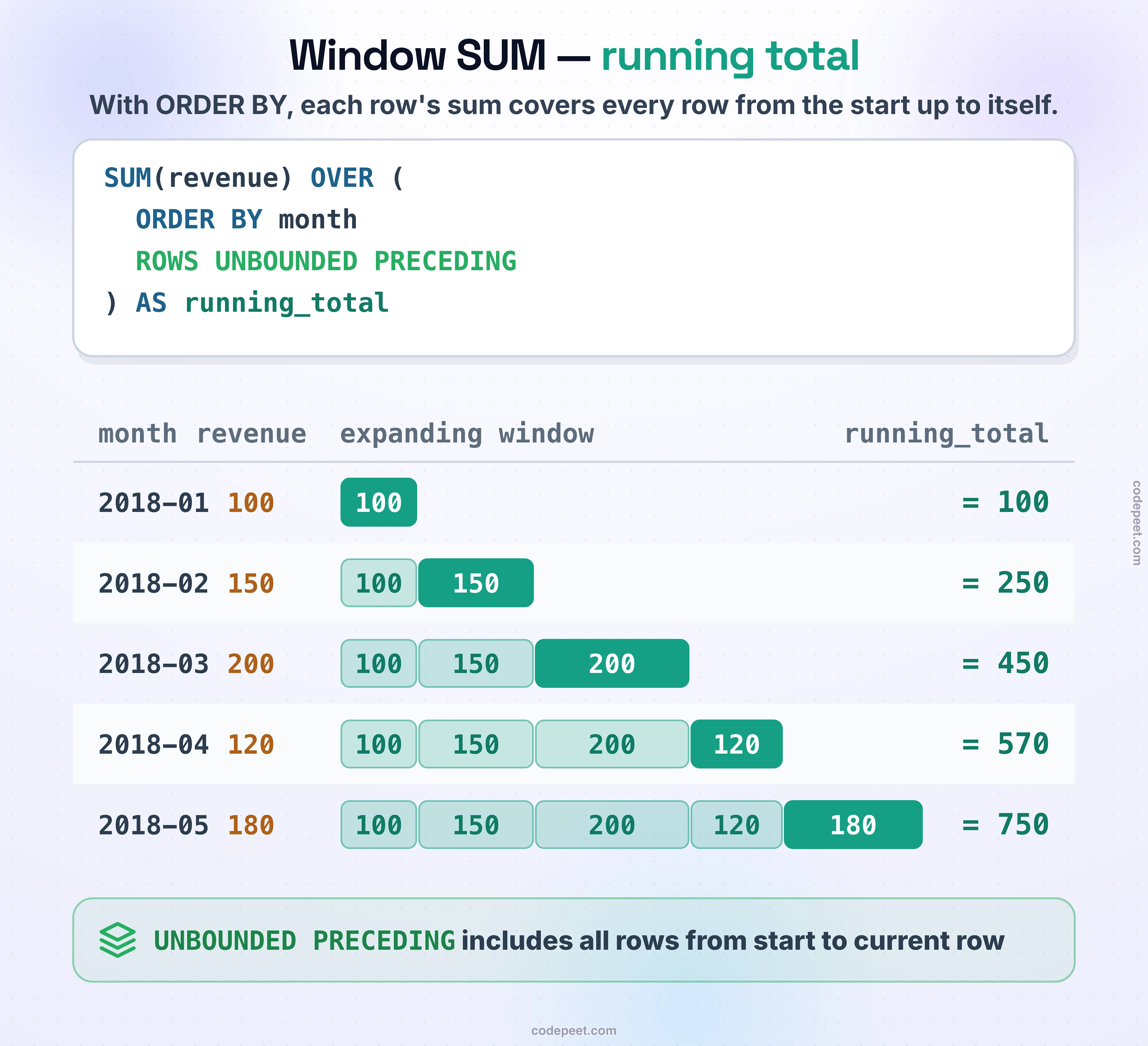
Window SUM -- Running Totals and Cumulative Sums
SUM with PARTITION BY
PARTITION BY divides your data into groups and calculates a separate sum for each group.
Total Sales per Seller
-- Sum of sales per seller, shown on every item row
SELECT
    seller_id,
    order_id,
    price,
    SUM(price) OVER (PARTITION BY seller_id) AS seller_total_sales
FROM olist_order_items_dataset
LIMIT 20;
Each row now shows the seller's total sales alongside the individual item price.
Total Order Value
-- Total value per order, shown on every item
SELECT
    order_id,
    product_id,
    price,
    freight_value,
    SUM(price) OVER (PARTITION BY order_id) AS order_total_price,
    SUM(freight_value) OVER (PARTITION BY order_id) AS order_total_freight
FROM olist_order_items_dataset
LIMIT 20;
This shows each item with its order's total price and total freight.
SUM with Empty OVER()
When OVER() has no arguments, the sum includes all rows in the result set.
Grand Total on Every Row
-- Show grand total on every row
SELECT
    order_id,
    price,
    SUM(price) OVER () AS grand_total
FROM olist_order_items_dataset
LIMIT 15;
Calculate Percentage of Total
This pattern is extremely useful for seeing each item's contribution to the whole:
-- Each item as percentage of total revenue
SELECT
    order_id,
    seller_id,
    price,
    SUM(price) OVER () AS total_revenue,
    ROUND(100.0 * price / SUM(price) OVER (), 4) AS pct_of_total
FROM olist_order_items_dataset
LIMIT 15;
Percentage Within Groups
Combine both patterns to see percentage within each group:
-- Item as percentage of seller's total
SELECT
    seller_id,
    order_id,
    price,
    SUM(price) OVER (PARTITION BY seller_id) AS seller_total,
    ROUND(100.0 * price / SUM(price) OVER (PARTITION BY seller_id), 2) AS pct_of_seller_total
FROM olist_order_items_dataset
LIMIT 20;
Running Sum (Cumulative Total)
Adding ORDER BY creates a running sum (also called cumulative sum). The sum accumulates as you move through the ordered rows.
Basic Running Total
-- Running total of prices
SELECT
    order_id,
    price,
    SUM(price) OVER (ORDER BY order_id) AS running_total
FROM olist_order_items_dataset
LIMIT 15;
Notice how each row's running_total includes all previous prices plus the current price.
How Running Sum Works
Row 1: price = 100 → running = 100
Row 2: price = 50  → running = 100 + 50 = 150
Row 3: price = 75  → running = 150 + 75 = 225
Row 4: price = 200 → running = 225 + 200 = 425
Running Sum Within Partitions
Combine PARTITION BY and ORDER BY for running sums that restart for each group:
-- Running total per seller
SELECT
    seller_id,
    order_id,
    price,
    SUM(price) OVER (
        PARTITION BY seller_id
        ORDER BY order_id
    ) AS seller_running_total
FROM olist_order_items_dataset
LIMIT 20;
The running total resets to zero at the start of each new seller.
Combining SUM with Other Calculations
Window SUM is powerful when combined with arithmetic operations.
Difference from Total
-- How much above/below average is each item's price compared to seller total
SELECT
    seller_id,
    price,
    SUM(price) OVER (PARTITION BY seller_id) AS seller_total,
    price - (SUM(price) OVER (PARTITION BY seller_id) / COUNT(*) OVER (PARTITION BY seller_id)) AS diff_from_avg
FROM olist_order_items_dataset
LIMIT 15;
Revenue Breakdown Analysis
-- Complete revenue breakdown
SELECT
    seller_id,
    order_id,
    price,
    SUM(price) OVER () AS total_revenue,
    SUM(price) OVER (PARTITION BY seller_id) AS seller_revenue,
    ROUND(100.0 * SUM(price) OVER (PARTITION BY seller_id) / SUM(price) OVER (), 2) AS seller_pct_of_total
FROM olist_order_items_dataset
LIMIT 20;
Practical Use Cases
Use Case 1: Payment Analysis
Analyze payment values with totals by payment type:
-- Payment analysis with percentages
SELECT
    order_id,
    payment_type,
    payment_value,
    SUM(payment_value) OVER (PARTITION BY payment_type) AS type_total,
    SUM(payment_value) OVER () AS grand_total,
    ROUND(100.0 * payment_value / SUM(payment_value) OVER (PARTITION BY payment_type), 2) AS pct_of_type
FROM olist_order_payments_dataset
LIMIT 20;
Use Case 2: Order Item Analysis
Calculate cumulative order value:
-- Cumulative item value within each order
SELECT
    order_id,
    order_item_id,
    price,
    SUM(price) OVER (PARTITION BY order_id ORDER BY order_item_id) AS cumulative_order_value,
    SUM(price) OVER (PARTITION BY order_id) AS final_order_total
FROM olist_order_items_dataset
LIMIT 20;
Use Case 3: Revenue Contribution by State
See each customer's contribution to their state's revenue:
-- Revenue contribution analysis by state
SELECT
    c.customer_state,
    c.customer_city,
    SUM(i.price) AS customer_revenue,
    SUM(SUM(i.price)) OVER (PARTITION BY c.customer_state) AS state_revenue,
    ROUND(100.0 * SUM(i.price) / SUM(SUM(i.price)) OVER (PARTITION BY c.customer_state), 2) AS pct_of_state
FROM olist_customers_dataset c
JOIN olist_orders_dataset o ON c.customer_id = o.customer_id
JOIN olist_order_items_dataset i ON o.order_id = i.order_id
GROUP BY c.customer_state, c.customer_city
ORDER BY c.customer_state, customer_revenue DESC
LIMIT 20;
Practice
Practice using window SUM with these exercises.
Exercise 1: Total and Percentage
Show each payment with the grand total and the payment's percentage of total:
-- Calculate payment percentage of total

SELECT
    order_id,
    payment_type,
    payment_value,
    SUM(payment_value) OVER () AS grand_total,
    ROUND(100.0 * payment_value / SUM(payment_value) OVER (), 4) AS pct_of_total
FROM olist_order_payments_dataset
LIMIT 20;
Exercise 2: Running Total
Create a running total of item prices ordered by order_id:
-- Running total of prices

SELECT
    order_id,
    product_id,
    price,
    SUM(price) OVER (ORDER BY order_id) AS running_total
FROM olist_order_items_dataset
LIMIT 20;
Exercise 3: Partition Sum
Show each item with its seller's total revenue and the item's percentage of seller revenue:
-- Seller revenue analysis

SELECT
    seller_id,
    order_id,
    price,
    SUM(price) OVER (PARTITION BY seller_id) AS seller_total,
    ROUND(100.0 * price / SUM(price) OVER (PARTITION BY seller_id), 2) AS pct_of_seller
FROM olist_order_items_dataset
LIMIT 20;
Key Takeaways
Here's what you've learned about window SUM:
- Partition Sum:
SUM(col) OVER (PARTITION BY group)for group totals - Grand Total:
SUM(col) OVER ()for total across all rows - Running Sum: Add
ORDER BYfor cumulative totals - Percentages: Divide by
SUM() OVER ()for proportion calculations - Combined Patterns: Mix PARTITION BY and ORDER BY for complex analysis
Common Patterns
| Pattern | Purpose |
|---|---|
SUM(col) OVER (PARTITION BY group) | Group total |
SUM(col) OVER () | Grand total |
SUM(col) OVER (ORDER BY sort) | Running total |
price / SUM(price) OVER () | Percentage of total |
SUM(col) OVER (PARTITION BY group ORDER BY sort) | Running total per group |