Introduction to CTE
Introduction
A Common Table Expression (CTE) is one of the most powerful features in SQL for writing clean, readable, and maintainable queries. It allows you to define a temporary named result set that exists only for the duration of a single query.
In this tutorial, you will learn:
- What a CTE is and how it works
- Basic CTE syntax and structure
- How CTEs differ from subqueries
- When to use CTEs in your SQL queries
What is a CTE?
Definition
A Common Table Expression (CTE) is a temporary named result set that you can reference within a SELECT, INSERT, UPDATE, or DELETE statement. Think of it as creating a temporary table that exists only for the duration of your query.
Simple Analogy
Imagine you're writing a complex report and need to use the same calculated data multiple times. Instead of recalculating it each time, you:
- Calculate once and give it a name
- Reference that name wherever you need the data
A CTE works exactly like this – you define a result set once, name it, and reference it throughout your query.
Visualization
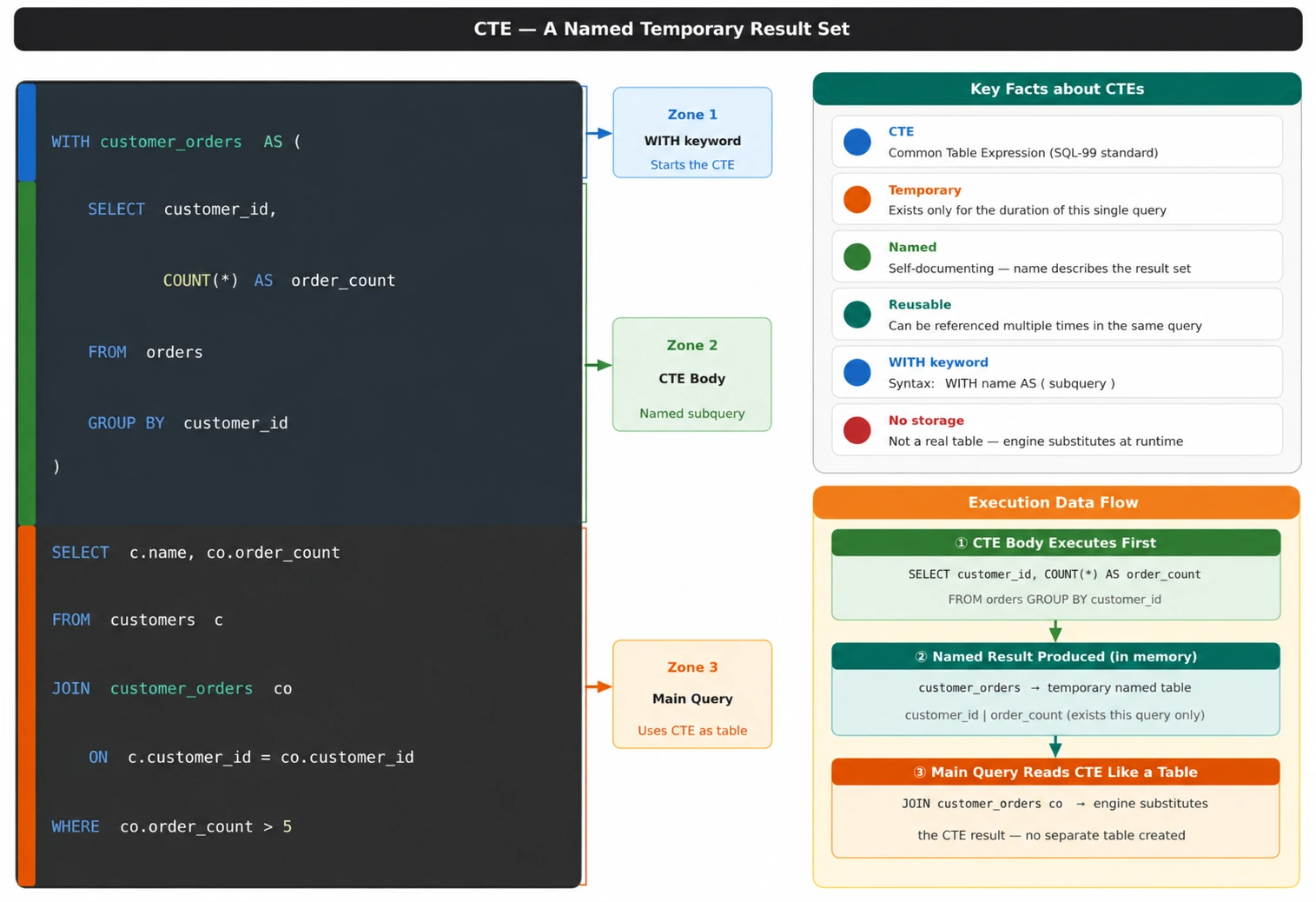
Introduction to CTEs -- Named Temporary Queries
Basic Syntax
CTE Structure
WITH cte_name AS (
    -- CTE query definition
    SELECT column1, column2
    FROM table_name
    WHERE condition
)
-- Main query that uses the CTE
SELECT *
FROM cte_name;
Key Components
| Component | Description | Required |
|---|---|---|
WITH | Keyword that starts a CTE definition | Yes |
cte_name | The name you assign to your temporary result set | Yes |
AS | Keyword connecting name to query definition | Yes |
(query) | The SELECT statement that defines the CTE's data | Yes |
| Main Query | The query that references and uses the CTE | Yes |
Naming Rules
- CTE names follow the same rules as table names
- Use descriptive names that indicate what data the CTE contains
- Names are case-insensitive in most databases
- Cannot use reserved SQL keywords as CTE names
CTE vs Subquery
Side-by-Side Comparison
Using a Subquery:
SELECT *
FROM (
    SELECT seller_id, SUM(price) as total_sales
    FROM olist_order_items_dataset
    GROUP BY seller_id
) AS seller_totals
WHERE total_sales > 1000;
Using a CTE:
WITH seller_totals AS (
    SELECT seller_id, SUM(price) as total_sales
    FROM olist_order_items_dataset
    GROUP BY seller_id
)
SELECT *
FROM seller_totals
WHERE total_sales > 1000;
Key Differences
| Aspect | Subquery | CTE |
|---|---|---|
| Placement | Inside the main query | Before the main query |
| Readability | Can become nested and hard to read | Linear, top-to-bottom reading |
| Reusability | Must repeat for each use | Define once, use multiple times |
| Debugging | Harder to isolate issues | Easy to test independently |
| Self-reference | Not possible | Possible (recursive CTEs) |
When CTEs Shine
CTEs are particularly useful when:
- You need to reference the same derived data multiple times
- Your query has multiple levels of nesting
- You want to break complex logic into named, logical steps
- You need recursion (which subqueries cannot do)
Practice
Let's practice writing basic CTEs with our e-commerce dataset.
Exercise 1: Your First CTE
Create a simple CTE that calculates total payments per order:
-- Define a CTE to calculate total payment per order
WITH order_totals AS (
    SELECT
        order_id,
        SUM(payment_value) AS total_payment
    FROM olist_order_payments_dataset
    GROUP BY order_id
)
-- Use the CTE in the main query
SELECT
    order_id,
    total_payment
FROM order_totals
WHERE total_payment > 500
ORDER BY total_payment DESC
LIMIT 10;
Exercise 2: CTE with Column Aliases
You can specify column names in the CTE definition for clearer code:
-- CTE with explicit column names
WITH customer_orders (customer_id, order_count, first_order, last_order) AS (
    SELECT
        customer_id,
        COUNT(*) AS order_count,
        MIN(order_purchase_timestamp) AS first_order,
        MAX(order_purchase_timestamp) AS last_order
    FROM olist_orders_dataset
    GROUP BY customer_id
)
SELECT *
FROM customer_orders
WHERE order_count > 1
LIMIT 10;
Exercise 3: Using CTE Multiple Times
One of the main advantages of CTEs is referencing them multiple times:
-- CTE referenced multiple times in the main query
WITH state_stats AS (
    SELECT
        customer_state,
        COUNT(*) AS customer_count
    FROM olist_customers_dataset
    GROUP BY customer_state
)
SELECT
    s1.customer_state,
    s1.customer_count,
    -- Compare each state to the average
    ROUND(s1.customer_count * 1.0 / (SELECT AVG(customer_count) FROM state_stats), 2) AS ratio_to_avg
FROM state_stats s1
ORDER BY s1.customer_count DESC
LIMIT 10;
Common Mistakes
Mistake 1: Missing the Main Query
❌ Wrong:
WITH my_cte AS (
    SELECT * FROM orders
);
-- Error: CTE defined but never used!
✅ Correct:
WITH my_cte AS (
    SELECT * FROM orders
)
SELECT * FROM my_cte;  -- Must have a main query
Mistake 2: Referencing CTE Before Definition
❌ Wrong:
SELECT * FROM my_cte;  -- CTE doesn't exist yet!

WITH my_cte AS (
    SELECT * FROM orders
)
✅ Correct:
WITH my_cte AS (
    SELECT * FROM orders
)
SELECT * FROM my_cte;  -- CTE is defined first
Mistake 3: Trying to Use CTE Outside Its Scope
❌ Wrong:
WITH my_cte AS (
    SELECT * FROM orders
)
SELECT * FROM my_cte;

SELECT * FROM my_cte;  -- Error: CTE no longer exists!
CTEs only exist for the single statement that follows them. Each new statement requires its own CTE definition.
Summary
Key Takeaways
-
A CTE (Common Table Expression) is a temporary named result set defined with the
WITHclause -
Syntax:
WITH cte_name AS (SELECT ...) SELECT ... FROM cte_name -
Benefits over subqueries:
- More readable (top-to-bottom flow)
- Reusable within the same query
- Can be self-referencing (recursive)
- Easier to debug and maintain
-
Scope: CTEs exist only for the duration of the single statement that follows
-
Naming: Use descriptive names that indicate the CTE's purpose
Quick Reference
-- Basic CTE template
WITH cte_name AS (
SELECT columns
FROM table
WHERE conditions
)
SELECT *
FROM cte_name;
What's Next?
Now that you understand what a CTE is, let's explore why you should use CTEs and the specific advantages they provide for writing better SQL queries.