ROW_NUMBER vs RANK vs DENSE_RANK
Introduction
Now that you've learned about ROW_NUMBER, RANK, and DENSE_RANK individually, let's put them side by side to understand when to use each one. Choosing the right ranking function can make the difference between correct and incorrect results.
In this lesson, you will learn:
- A direct comparison of all three functions
- How each handles tied values differently
- Decision criteria for choosing the right function
- Real-world scenarios and best practices
Side-by-Side Comparison
Let's start with a comprehensive comparison table:
| Feature | ROW_NUMBER | RANK | DENSE_RANK |
|---|---|---|---|
| Ties | Different numbers | Same number | Same number |
| Gaps | Never | After ties | Never |
| Sequence | Always 1,2,3,4,... | May skip: 1,1,3,4,... | Always consecutive: 1,1,2,3,... |
| Max Value | Row count | Row count | Distinct value count |
| Uniqueness | Always unique | May repeat | May repeat |
Visualization
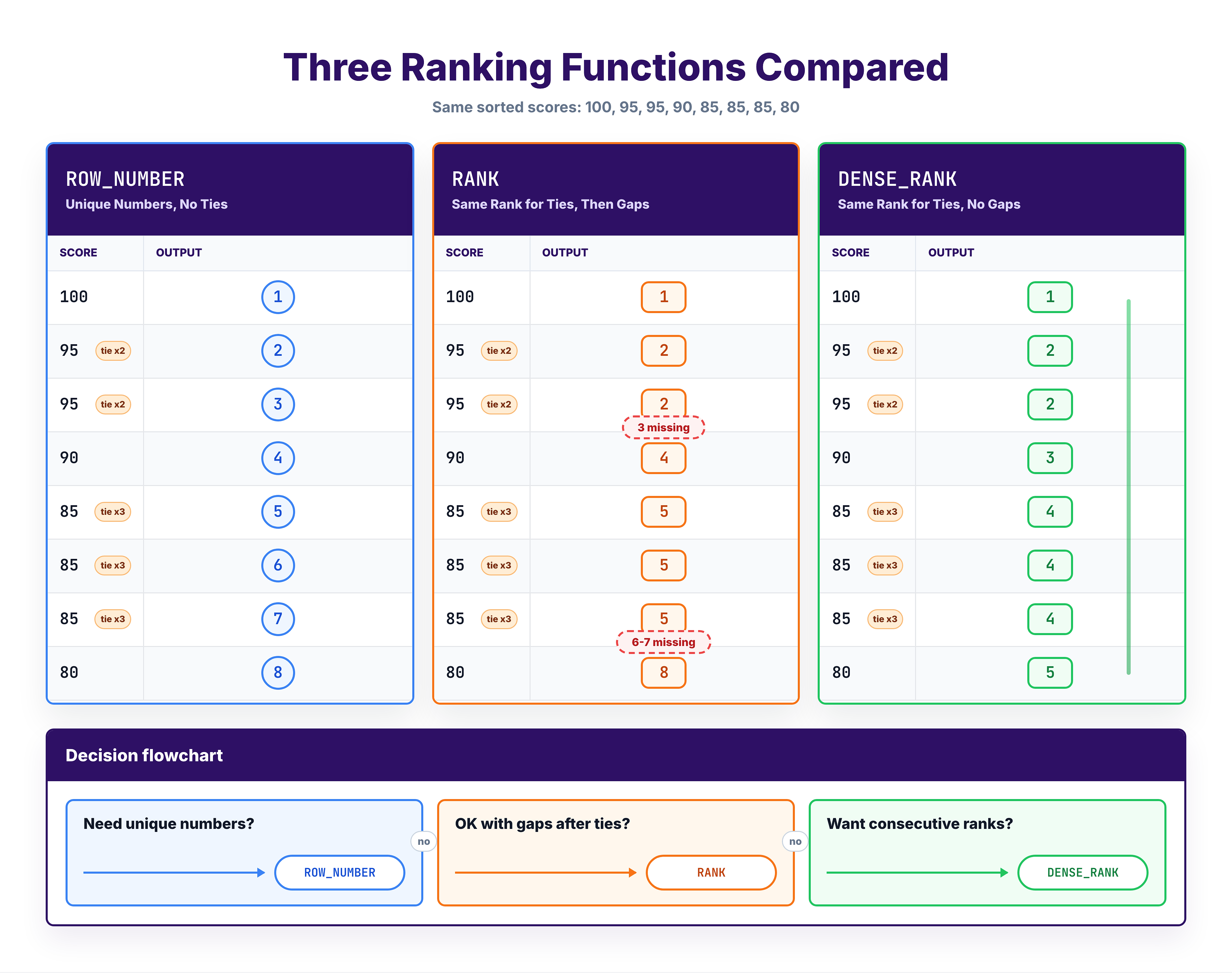
ROW_NUMBER vs RANK vs DENSE_RANK -- Complete Comparison
Visual Demonstration
Let's see all three functions on the same data:
-- Compare all three ranking functions
SELECT
    order_id,
    price,
    ROW_NUMBER() OVER (ORDER BY price DESC) AS row_num,
    RANK() OVER (ORDER BY price DESC) AS rank_val,
    DENSE_RANK() OVER (ORDER BY price DESC) AS dense_rank_val
FROM olist_order_items_dataset
LIMIT 25;
Example with Values: 100, 100, 90, 90, 80, 70
| Price | ROW_NUMBER | RANK | DENSE_RANK |
|---|---|---|---|
| 100 | 1 | 1 | 1 |
| 100 | 2 | 1 | 1 |
| 90 | 3 | 3 | 2 |
| 90 | 4 | 3 | 2 |
| 80 | 5 | 5 | 3 |
| 70 | 6 | 6 | 4 |
Observations:
- ROW_NUMBER: 1-6, all unique, never repeats
- RANK: 1,1,3,3,5,6 – ties share rank, then skips
- DENSE_RANK: 1,1,2,2,3,4 – ties share rank, no skipping
Tie Handling Deep Dive
Understanding how ties are handled is crucial for choosing the right function.
ROW_NUMBER with Ties
ROW_NUMBER always assigns different numbers. When values tie, the order is non-deterministic (arbitrary):
-- ROW_NUMBER with ties - order is arbitrary
SELECT
    product_id,
    price,
    ROW_NUMBER() OVER (ORDER BY price DESC) AS row_num
FROM olist_order_items_dataset
WHERE price BETWEEN 99 AND 101
LIMIT 15;
RANK with Ties
RANK gives ties the same number, then skips to account for how many rows share that rank:
-- RANK with ties - same rank, then skip
SELECT
    product_id,
    price,
    RANK() OVER (ORDER BY price DESC) AS rank_val
FROM olist_order_items_dataset
WHERE price BETWEEN 99 AND 101
LIMIT 15;
DENSE_RANK with Ties
DENSE_RANK gives ties the same number, then continues with the next consecutive number:
-- DENSE_RANK with ties - same rank, no skip
SELECT
    product_id,
    price,
    DENSE_RANK() OVER (ORDER BY price DESC) AS dense_rank_val
FROM olist_order_items_dataset
WHERE price BETWEEN 99 AND 101
LIMIT 15;
Decision Guide
Use this decision tree to choose the right function:
Do you need unique numbers for every row?
- YES → Use ROW_NUMBER
- NO → Continue...
Should tied values get the same rank?
- YES → Continue to next question
- NO → Use ROW_NUMBER (but be aware of arbitrary tie handling)
Should the rank after ties reflect the "position among all rows"?
- YES (gaps matter) → Use RANK
- NO (just need consecutive tiers) → Use DENSE_RANK
Quick Reference
| If You Need... | Use |
|---|---|
| Unique ID for each row | ROW_NUMBER |
| Pagination (rows 1-10, 11-20) | ROW_NUMBER |
| First/last record per group | ROW_NUMBER |
| Competition-style ranking (ties share, gaps after) | RANK |
| "How many rows are ranked higher?" | RANK |
| Tier/level assignment (consecutive numbers) | DENSE_RANK |
| "How many distinct values are ranked higher?" | DENSE_RANK |
| Top-N distinct values | DENSE_RANK |
Practical Scenarios
Scenario 1: Selecting Top 3 Items
Different functions give different results for "top 3":
-- Top 3 with ROW_NUMBER (exactly 3 rows)
SELECT product_id, price, row_num
FROM (
    SELECT
        product_id,
        price,
        ROW_NUMBER() OVER (ORDER BY price DESC) AS row_num
    FROM olist_order_items_dataset
) r
WHERE row_num <= 3;
-- Top 3 with RANK (may include ties for 3rd)
SELECT product_id, price, rank_val
FROM (
SELECT
product_id,
price,
RANK() OVER (ORDER BY price DESC) AS rank_val
FROM olist_order_items_dataset
) r
WHERE rank_val <= 3
LIMIT 15;-- Top 3 with DENSE_RANK (top 3 price tiers)
SELECT product_id, price, dense_rank_val
FROM (
SELECT
product_id,
price,
DENSE_RANK() OVER (ORDER BY price DESC) AS dense_rank_val
FROM olist_order_items_dataset
) r
WHERE dense_rank_val <= 3
LIMIT 15;Scenario 2: Employee Salary Ranking
Imagine ranking employees by salary:
| Employee | Salary | Context | Best Function |
|---|---|---|---|
| Need unique badge numbers | $80K | Arbitrary order OK | ROW_NUMBER |
| Competition ranking | $80K | "You're 5th out of 10" | RANK |
| Salary tier assignment | $80K | "Tier 3 salary" | DENSE_RANK |
Within Partitions
All three functions work identically with PARTITION BY - they just restart ranking for each partition:
-- Compare all three with PARTITION BY
SELECT
    seller_id,
    price,
    ROW_NUMBER() OVER (PARTITION BY seller_id ORDER BY price DESC) AS row_num,
    RANK() OVER (PARTITION BY seller_id ORDER BY price DESC) AS rank_val,
    DENSE_RANK() OVER (PARTITION BY seller_id ORDER BY price DESC) AS dense_rank_val
FROM olist_order_items_dataset
LIMIT 25;
Each seller's items are ranked independently, with numbering restarting for each partition.
Common Mistakes
Mistake 1: Using ROW_NUMBER When Ties Matter
Problem: You want the top 3 products by sales, but ROW_NUMBER arbitrarily excludes one of two tied products.
Solution: Use RANK or DENSE_RANK to include all ties.
Mistake 2: Using RANK for Pagination
Problem: Using WHERE rank <= 10 might return more than 10 rows if there are ties.
Solution: Use ROW_NUMBER for exact row counts in pagination.
Mistake 3: Expecting DENSE_RANK to Match Row Count
Problem: Assuming DENSE_RANK's maximum value equals the number of rows.
Solution: Remember that DENSE_RANK's max equals the number of distinct values.
Practice
Practice comparing all three functions with these exercises.
Exercise 1: Full Comparison
Compare all three functions on payment values:
-- Compare on payment data
SELECT
    order_id,
    payment_value,
    ROW_NUMBER() OVER (ORDER BY payment_value DESC) AS row_num,
    RANK() OVER (ORDER BY payment_value DESC) AS rank_val,
    DENSE_RANK() OVER (ORDER BY payment_value DESC) AS dense_rank_val
FROM olist_order_payments_dataset
LIMIT 25;
Exercise 2: Top N Analysis
Experiment with different functions for top 5 selection:
-- Try changing the function to see different results
SELECT *
FROM (
    SELECT
        seller_id,
        item_count,
        DENSE_RANK() OVER (ORDER BY item_count DESC) AS seller_rank
    FROM (
        SELECT seller_id, COUNT(*) AS item_count
        FROM olist_order_items_dataset
        GROUP BY seller_id
    ) counts
) ranked
WHERE seller_rank <= 5;
Exercise 3: Partitioned Comparison
Compare all three within partitions:
-- Compare within each order
SELECT
    order_id,
    product_id,
    price,
    ROW_NUMBER() OVER (PARTITION BY order_id ORDER BY price DESC) AS row_num,
    RANK() OVER (PARTITION BY order_id ORDER BY price DESC) AS rank_val,
    DENSE_RANK() OVER (PARTITION BY order_id ORDER BY price DESC) AS dense_rank
FROM olist_order_items_dataset
WHERE order_id IN (
    SELECT order_id
    FROM olist_order_items_dataset
    GROUP BY order_id
    HAVING COUNT(*) >= 3
)
LIMIT 25;
Key Takeaways
Here's a summary of when to use each function:
ROW_NUMBER
- Need unique sequential numbers
- Pagination and slicing
- Picking one record per group
- Arbitrary selection when ties exist
RANK
- Competition-style ranking
- Need to know position among all rows
- Include all ties in Top-N
- Gaps after ties are acceptable/desired
DENSE_RANK
- Tier/level assignment
- Count distinct ranking positions
- Top-N distinct values
- Consecutive ranks without gaps
Final Decision Matrix
| Requirement | ROW_NUMBER | RANK | DENSE_RANK |
|---|---|---|---|
| Unique numbers | ✅ | ❌ | ❌ |
| Same rank for ties | ❌ | ✅ | ✅ |
| Gaps after ties | ❌ | ✅ | ❌ |
| Exact row limit | ✅ | ❌ | ❌ |
| Fair tie handling | ❌ | ✅ | ✅ |