Scalability: Vertical vs Horizontal
Introduction
For an entire section you lived inside one machine, and you learned exactly how it dies: under enough load, one of its four resources — CPU, memory, disk, or network — saturates, and the whole box grinds to a halt. So here's the question that opens the rest of this course, the one every growing system eventually has to answer:
Your one server is maxed out. Now what?
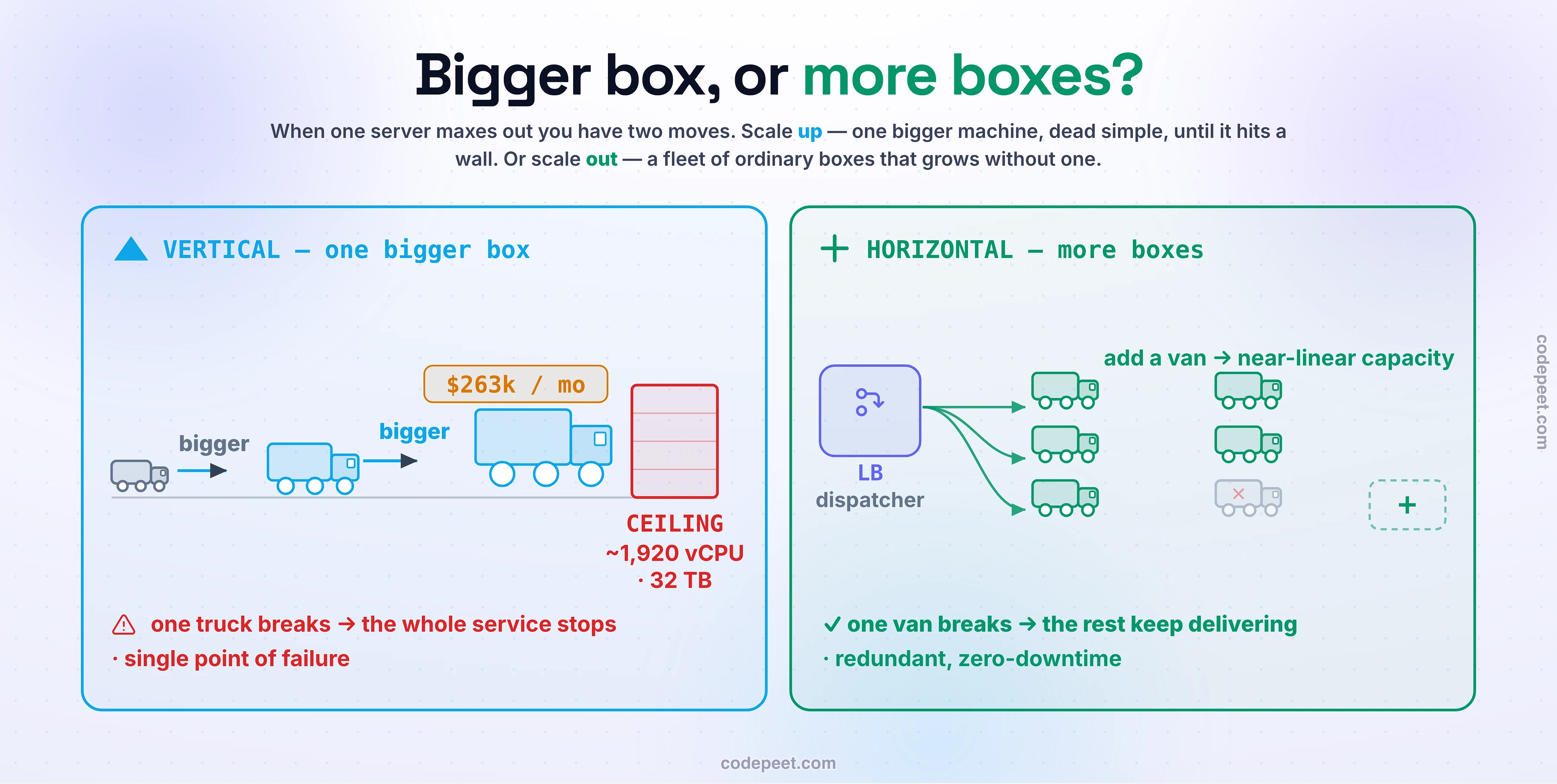
There are exactly two answers, and the entire future of your system rides on which you pick. You can get a bigger box — swap your server for one with more cores, more RAM, more everything. Or you can get more boxes — add a second server, a fifth, a hundredth, and spread the work across them. That's it. Those are the two axes of scaling: vertical (up — a bigger machine) and horizontal (out — more machines).
This choice is deceptively deep. One path is gloriously simple and takes you further than most people think — right up until it hits a wall you cannot climb. The other path scales to billions of users and survives hardware failures gracefully — but it drags in a whole universe of new problems that the rest of this course exists to solve. Knowing when to switch from one to the other, and what the switch really costs, is one of the most valuable instincts in system design.
Scope: this lesson is the map of the two paths and where each dies. The one thing that makes the horizontal path possible — keeping your app stateless — is important enough to get its own lesson next, and the traffic cop that sits in front of a fleet (the load balancer) comes a bit later. Today: bigger box, or more boxes?
Vertical Scaling: Just Get a Bigger Box
Start with the simple answer, because it's simple for a reason and it's better than its reputation. Vertical scaling — "scaling up" — means making your one server more powerful: add CPU cores, add RAM, add faster disks. Same server, same code, same architecture — it just has more muscle.
Think of it as trading a small truck for a bigger truck, and then a giant eighteen-wheeler. It's still one truck with one driver; it just hauls a heavier load. And the beauty is there's nothing to redesign. Your application doesn't know or care that it's running on a bigger machine. No load balancer, no distributed anything, no new failure modes. In a cloud console it's often a dropdown and a reboot.
How far does it go? Astonishingly far. The largest machine you can rent today has on the order of 1,920 CPU cores and 32 terabytes of RAM — a single box more powerful than a data center from twenty years ago. Stack Overflow — a top-2,000 website serving tens of millions of page views a month — famously runs on a handful of big servers, joking that they use "one-tenth the hardware" of comparable sites. For the overwhelming majority of systems, a beefy vertical box is not just adequate, it's the smart, cheap, boring choice. Most sites are not Google, and don't need to pretend to be.
So why doesn't everyone just buy a bigger box forever? Because that bigger box eventually runs into three walls.
The Three Walls of a Bigger Box
Vertical scaling is a straight road with a cliff at the end. Three of them, actually:
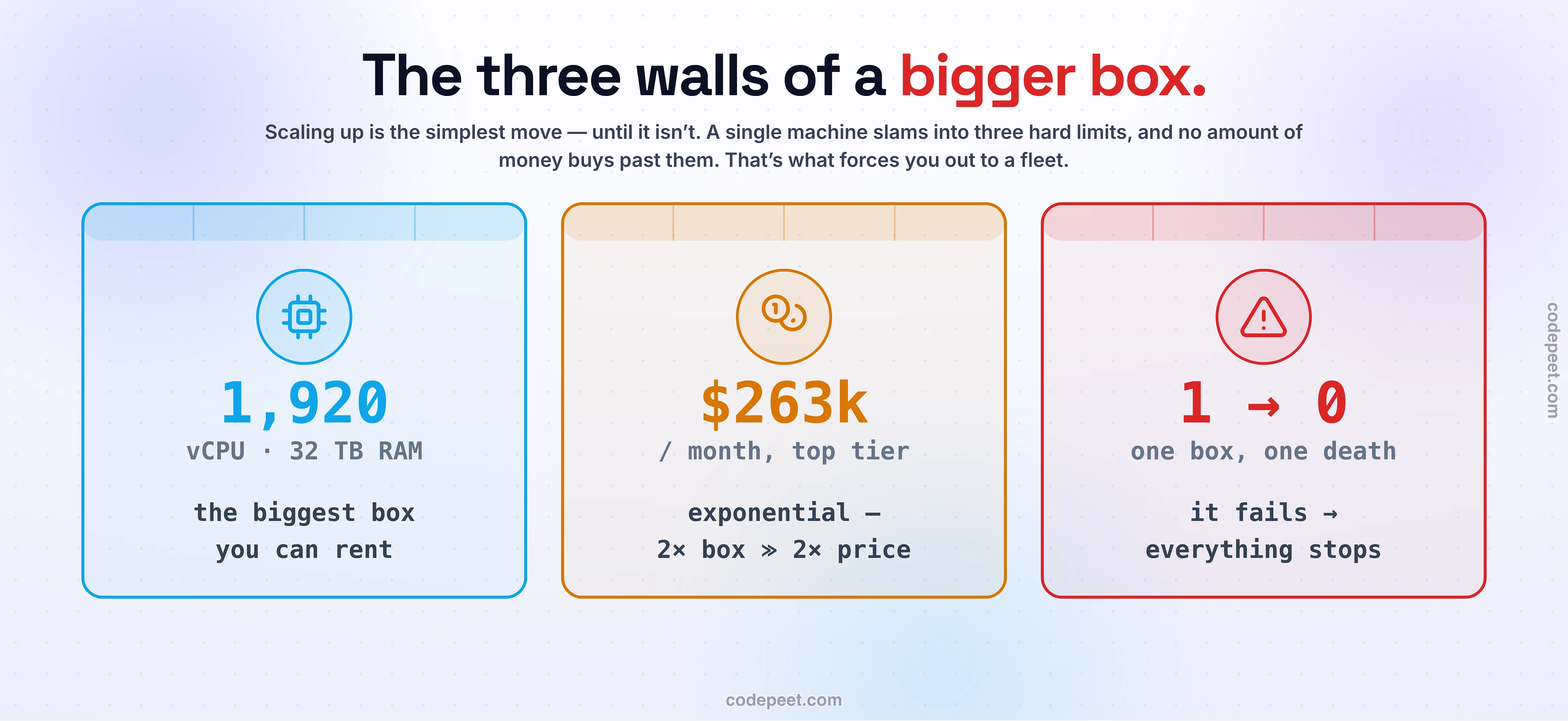
Wall 1 — the ceiling. There is a biggest truck ever built. At some point you reach the largest machine that exists — that ~1,920-core, 32 TB box — and there is simply nothing bigger to buy. Your growth stops at the edge of what one computer can physically be. If your load keeps climbing, vertical scaling has no more moves.
Wall 2 — the cost cliff. Long before the ceiling, the price stops making sense. Hardware cost doesn't rise linearly with power — it rises exponentially at the top end. That biggest box costs roughly $263,000 per month. Doubling a small server's specs might double its price; doubling a huge server's specs can quadruple it. You pay a brutal premium for the last slice of a single machine — which is exactly why a rack of ordinary boxes becomes cheaper per unit of work as you grow.
Wall 3 — the single point of failure. This is the quiet one, and often the real dealbreaker. No matter how magnificent your one box is, it is one box. When it fails — and hardware fails — your entire service goes down with it. There is no redundancy, no backup carrying the load, no graceful degradation. One truck, one breakdown, everything stops. For anything that needs to stay up, a single machine is a single bet you will eventually lose.
Vertical scaling is the right first move and a great long stretch of road — but it's a road with a ceiling, a cost cliff, and no spare tire. When any of those three bites, you need a fundamentally different shape.
Horizontal Scaling: Get More Boxes
The other answer changes the shape entirely. Horizontal scaling — "scaling out" — means instead of one bigger machine, you run many ordinary machines that share the work. Not a bigger truck: a fleet of delivery vans.
This flips every one of vertical's walls into a strength:
- No ceiling — near-linear growth. Need twice the capacity? Add twice the vans. Need to serve millions more users? Add more nodes. There's no single-machine limit to slam into, because you're never leaning on a single machine. Capacity becomes something you add, almost linearly, for as far as you need to go.
- Redundancy — no single point of failure. One van breaks down and the others keep delivering. Lose a server in a fleet of twenty and you lose 5% of capacity for a few minutes, not 100% of your service. This is often the real reason teams go horizontal — not raw capacity, but the ability to survive a machine dying at 3 a.m.
- Elastic, zero-downtime scaling. You can add and remove boxes while the system runs. Traffic spikes for a sale? Autoscaling spins up ten more vans; when it's over, they spin back down. No reboot, no maintenance window — the fleet just grows and shrinks with demand.
This is how every internet-scale system is built. Google pioneered it with racks of cheap commodity machines; every large web app you use is a fleet of stateless servers behind a load balancer. Horizontal scaling is the shape of the modern internet.
So if it's limitless, resilient, and elastic... why not start here and skip vertical entirely? Because a fleet has two hard requirements — and a tax.
See It: Scale Up or Out Under Load
The trade-off between these two paths is a thing you should watch, not just read. Below, you run a service under rising load and choose how to keep up. Crank the load higher, then decide each upgrade: ⬆ a bigger box (vertical) or ➕ another box (horizontal).
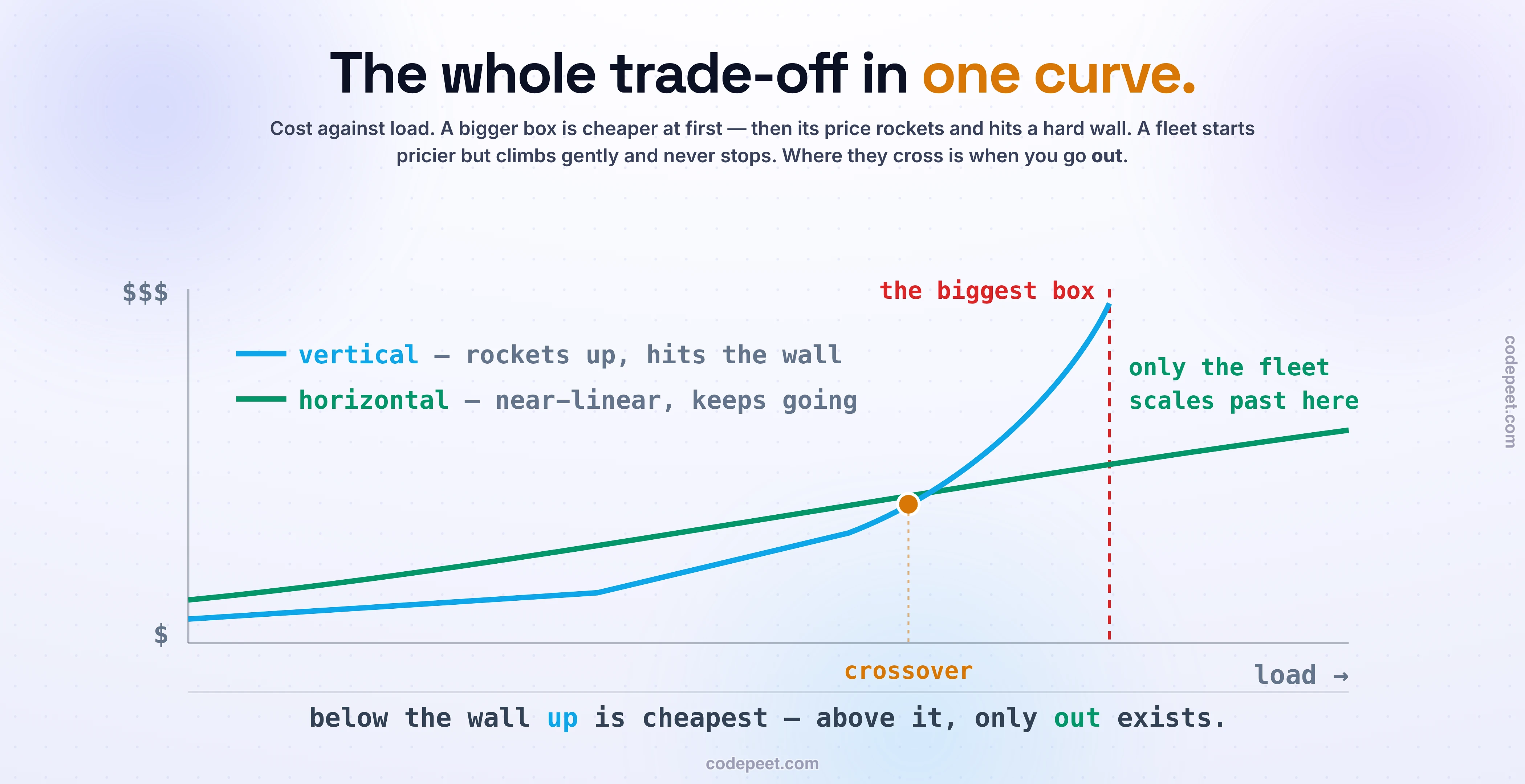
Watch the live cost-versus-load chart as you go. Push the vertical path and see its cost curve bend upward — gently at first, then steeply — until it hits the "biggest box" wall and can't grow at all. Push the horizontal path and watch its cost climb in a near-straight line, right past where vertical gave up. Then, for the lesson that numbers can't teach, hit 💥 kill a server: kill the one big vertical box and the whole service goes down; kill one box out of a horizontal fleet and the service dips for a moment and keeps running. That difference — total outage versus a shrug — is why redundancy alone is often worth the switch.
The Catch: Statelessness and a Traffic Cop
A fleet of servers only works if two things are true — and they're the reason horizontal scaling isn't just "buy more boxes."
First, the app has to be stateless. Picture the fleet of vans again: a package can be handed to any free van, because no van holds anything special. But what if van #3 was the only one carrying your customer's shopping cart? The moment the load balancer sends that customer's next request to van #7, their cart is gone. For any-box-can-handle-any-request to work, no box may hold data that only it knows — sessions, carts, uploaded files must live in a shared place (a database, a cache, object storage) that all boxes can reach. Making your app forget which box is which is the single most important prerequisite of horizontal scaling — and it's important enough that it's the very next lesson.
Second, you need a traffic cop in front — a load balancer. Something has to receive every incoming request and hand it to one of the healthy boxes, spreading the work evenly and routing around any box that has died. That dispatcher is what turns a pile of servers into a fleet. (We'll give it a full lesson of its own later.)
And beyond the two requirements, there's the tax. The instant your system spans multiple machines, a new class of problems appears that simply doesn't exist on one box: the network between them can fail, messages can arrive late or out of order, and two servers can genuinely disagree about what's true. Keeping data consistent across a fleet is one of the hardest problems in computing — and, not coincidentally, the subject of much of the rest of this course. Going horizontal doesn't just add boxes; it enrolls you in distributed systems.
The Trade-off
Lay the two paths side by side and the decision sharpens into a single honest comparison:
| Vertical (bigger box) | Horizontal (more boxes) | |
|---|---|---|
| Complexity | trivial — same app | high — stateless + LB + distributed systems |
| Growth limit | a hard ceiling (~1 machine) | near-limitless (add boxes) |
| Cost curve | exponential at the top | near-linear |
| Failure | single point of failure | redundant — survives a box dying |
| Scaling | usually downtime to upgrade | live, elastic, autoscaling |
Here's the senior read that beginners miss: horizontal is not automatically "better." It's more powerful and far more complex, and complexity is a cost you pay forever, in engineering hours and in whole new categories of bugs. If a single mid-size box comfortably handles your load, reaching for a distributed fleet is premature — you take on coordination, consistency, and operational overhead for capacity you don't need. Teams routinely find that a bigger box delivers better reliability per engineering hour than a fleet they're not equipped to run. Sharding a database across machines, in particular, is complex and fragile enough that most mid-size systems are far better off just upgrading the database box.
So the real question is never "which is better?" It's "have I actually hit a wall that horizontal solves — the ceiling, the cost cliff, or the need for redundancy — and am I ready to pay its tax?" Until then, the boring bigger box is often the wise choice.
The Real Answer Is Both
In practice, mature systems don't choose vertical or horizontal — they use both, on purpose, in different places. The trick is that different parts of a system scale in different ways, so you scale each part the way it scales best.
The classic shape looks like this. Your web and application servers — the parts that just run logic and hold no permanent data — are made stateless and scaled horizontally: a fleet behind a load balancer, growing and shrinking with traffic. But your database — the part that holds the actual truth, the state everything else depends on — is genuinely hard to spread across machines (that whole saga is the data-systems course), so it's often scaled vertically for as long as possible: one big, powerful box holding the source of truth, with the stateless fleet in front of it.
This is exactly the progression you saw in the growth-staircase lesson, now with names attached: a system starts on one box (vertical, cheap, simple), splits its tiers, then scales the stateless tier out horizontally while keeping the stateful tier on the biggest box it can afford — until even that isn't enough, and the hardest part of the course begins: scaling state itself across machines.
Don't think "up or out." Think: which part is this, and how does it scale best? Stateless things love going out; stateful things resist it — and knowing the difference is the whole game.
Mental-Model Corrections
"Horizontal scaling is always better / more modern." No — it's more complex, and usually overkill. Most systems are Stack-Overflow-scale (a few big boxes), not Google-scale. Don't pay the distributed-systems tax until a real wall forces you to.
"Vertical scaling doesn't really scale." It scales astonishingly far — a single box can be ~1,920 cores and 32 TB. It has a ceiling and a cost cliff, not a low limit.
"Just add more servers and you get more capacity." Only if the app is stateless and a load balancer sits in front. Add servers to a stateful app and you get broken sessions, not capacity — horizontal has prerequisites.
"Horizontal scaling gives linear speedup forever." The stateless tier is near-linear, but coordination and consistency overhead grows, and data doesn't shard for free. There's no free infinite lunch.
"You go horizontal for capacity." Often the real reason is redundancy — killing the single point of failure — and zero-downtime scaling, not raw throughput.
"You have to pick one." Real systems are hybrid: a horizontal stateless web tier in front of a big vertical database, each scaled the way it scales best.
Try It Yourself: Price the Two Paths
Ten minutes with a cloud pricing page turns this from theory into a number you'll never forget. Predict first: to double a server's CPU and RAM, does the price double — or more?
- Feel the vertical cost cliff. Open any cloud provider's instance pricing (AWS EC2, GCP, Azure — all public). Note the hourly price of a small box (say 4 vCPU / 16 GB). Now find one with 16× the resources (64 vCPU / 256 GB) and then the largest box they offer. Watch the price per core climb as the boxes get huge — and note where the list simply ends. That ending is the ceiling; that price-per-core climb is the cost cliff.
- Feel the horizontal math. Now price four of the small boxes instead of one big one. Compare the total to a single box with the same combined specs. Which is cheaper? Which survives one machine failing?
- Spot the hybrid in the wild. Look at the architecture page of any product you use (many publish them). You'll almost always find the same shape: a fleet of stateless app servers behind a load balancer, in front of a much smaller number of big database machines.
The gap between your "double the box, double the price" prediction and the real, steeper curve is exactly the pressure that pushes growing systems from up to out.
Recap & What's Next
The first and most fundamental scaling decision, in five lines:
- When one server maxes out, you have two moves: vertical (a bigger box) or horizontal (more boxes).
- Vertical is dead simple and goes surprisingly far — but hits three walls: a hard ceiling (~one machine), an exponential cost cliff, and a single point of failure.
- Horizontal is near-limitless, redundant, and elastic — but it requires a stateless app and a load balancer, and it enrolls you in the distributed-systems tax (the network fails, nodes disagree, consistency is hard).
- Horizontal isn't automatically better — it's more complex. Go horizontal when you hit a real wall (ceiling, cost, or redundancy), not before. Most systems are smaller than they think.
- Real systems are hybrid: scale the stateless tier out, the stateful tier up — because different parts scale differently.
That last point hides the hinge the entire rest of this section turns on. Twice now we've said the same magic word: horizontal scaling requires your app to be stateless. But what does that actually mean? Where does a user's login session, their shopping cart, their half-finished upload go, if it can't live on any one server? The answer is the single most important enabler of everything ahead — and it's next: Stateful vs Stateless: Where Does State Live?