From One User to One Million: How a System Grows
Introduction
Launch night. Your delivery marketplace — the one you met in What Is System Design? (And Why It Runs the World) — takes its first 30 orders. The entire company runs on one $40-a-month box: app code and database, same machine, sharing everything.
Here's what most courses won't tell you: that architecture is correct. Not a compromise, not technical debt — correct. You have 30 orders.
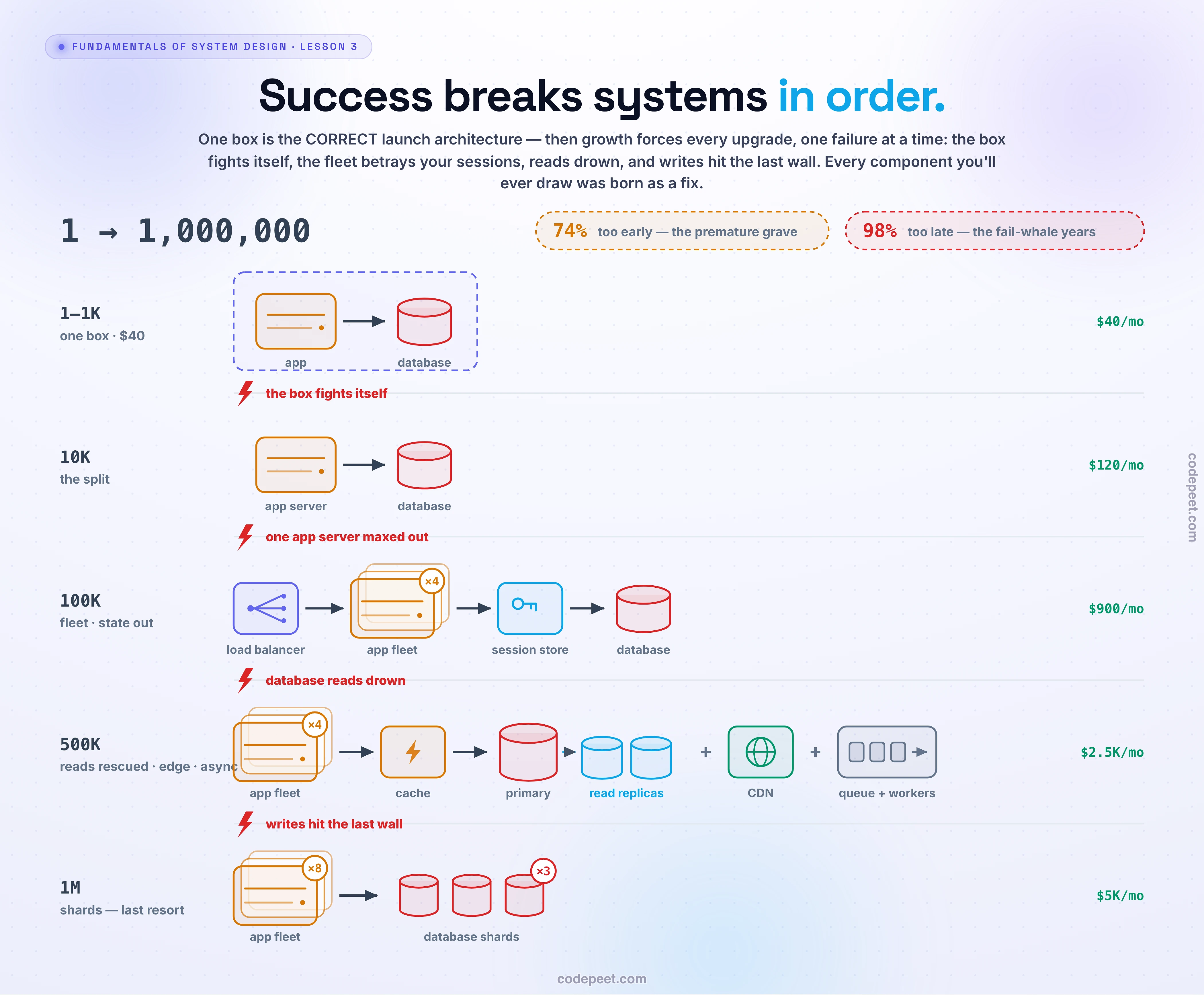
But success is coming, and success breaks systems. The interesting part — the part this lesson exists for — is that it breaks them in a predictable order. First the box fights itself. Then one server isn't enough, and the moment you add a second, something you never thought about (sessions) betrays you. Then the database starts crying — reads first, writes much later. Every component in Lesson 1's twelve-system diagram was born at one of these moments, as the fix for one specific failure.
By the end you'll know the whole staircase — which step comes next, what pushes you onto it, and what it costs. Then you'll climb it yourself, in a simulator that punishes both kinds of mistake: scaling too late, and the statistically deadlier one — scaling too early.
Scope: every component here gets its own deep lesson later in this course (caching has a whole section; so do load balancing and queues) — today is the why-in-this-order story. Sharding and replication mechanics live in Data Systems at Scale.
Stage 0: One Box, On Purpose
Everything on one machine. The app answers requests; three feet of copper away (well — zero feet), the database holds the truth. No network hops between them, no moving parts, deploys take a minute, and when something breaks there is exactly one place to look.
Instagram launched close to this. So did almost everything you use today.
And the data says respect this stage: the Startup Genome project found that premature scaling — building machinery before the users exist — is the killer in roughly 74% of failed high-growth startups. Failed startups in their study wrote about 3.4× more code before product-market fit than the ones that made it. Every hour spent sharding a database with 400 users in it is an hour not spent finding user 401.
So the one-box stage isn't something to escape. It's something to outgrow — and it will tell you, loudly, when. The first sign has a specific shape: the box starts fighting itself.
The First Crack: The Box Fights Itself
Around a few thousand users a day, something subtle happens. Order lookups get slow — but only at lunch. The culprit isn't code. It's cohabitation: your app and your database share one CPU, one disk, one pool of memory. When the app gets busy, the database starves, and vice versa. Two tenants, one kitchen.
There are exactly two ways out, and they're this course's first real fork:
- Scale up (vertical): rent a bigger box. Zero code changes, one afternoon of work. And it goes further than people think — AWS will happily rent you a machine with 1,920 vCPUs and 32 TiB of RAM (the u7inh, built for monster in-memory databases). The ceiling is real but distant. The problems are the price curve — each doubling costs more than the last — and the fact that it's still one machine: one power supply, one failure away from Single Point of Failure — and Redundancy, the Antidote becoming your personal story.
- Split (the first horizontal step): app on one box, database on another. The bill: your queries now cross a network, and you own two machines.
Most real systems do a little of both — split first (it's cheap), size each box to its job. And there's a quieter ceiling hiding here that almost everyone hits unprepared: Postgres ships with max_connections = 100 by default. One busy app fleet later, that number becomes a wall — which is exactly why Connection Pools: Reuse Beats Re-open exists in the section before this one.
More Servers — and the First Betrayal
The split buys you months. Then the app server itself saturates — too many simultaneous requests for one machine, no matter its size. The fix you already know from Lesson 1: a load balancer in front of a fleet of identical app servers. Traffic spreads, capacity multiplies, and any one server can die without a headline.
And then, the same afternoon, the support tickets arrive: "the app keeps logging me out."
Nothing crashed. The betrayal is architectural: user sessions — who's logged in — were living in each server's memory. Alice logged in on server 2; the load balancer's next flip sent her to server 7, which has never heard of her. Your fleet multiplied capacity AND multiplied ignorance.
This is the single most instructive failure in all of scaling, because it reveals the real enemy. Adding servers was easy. It's STATE that resists scaling — and the fix is to take state out of the servers (into an external session store) so every server becomes interchangeable: stateless. That one idea — statelessness as the unlock for horizontal scale — is so load-bearing it gets its own lesson two sections from now (Stateful vs Stateless: Where Does State Live?). Here, it's enough to feel the shape: the fleet didn't fail; the state did.
The Database Cries First (and Cries About Reads)
With a stateless fleet, app capacity is now a dial — need more, add servers. Which means the next wall is the one component you can't just photocopy: the database.
It cries in a specific way. Look at your marketplace's traffic honestly and you'll find something like three reads for every write — browsing menus vastly outnumbers placing orders (many systems run 10:1 or worse). So the read side drowns first, and the two rescues are both read-shaped:
- A cache — the menu that was read 4,000 times today gets served from memory in half a millisecond; the database only sees the 4,001st, changed version. Bill: two copies of the truth, and the invalidation headaches you already tasted in The Trade-off Mindset.
- Read replicas — copies of the database that answer reads, while all writes still go to the one primary. Bill: replication lag; a user can write, re-read from a replica, and briefly not see their own change. (That rabbit hole — Consistency — opens in this section's later lesson and doesn't fully close until Data Systems at Scale.)
Notice what did NOT get fixed: writes. Every order still lands on one primary. Remember that — the staircase's final step is waiting there.
Spikes, the Planet, and the Last Wall
Three walls remain, and they arrive roughly in this order.
Friday, 7 PM. Traffic triples in twenty minutes — not growth, a spike. Buying enough servers for Friday means paying for them all week. The grown-up fix is the queue from Lesson 1: take the work that doesn't need to finish now (receipts, notifications, dispatch) off the request path and let workers chew through the backlog at their own pace. Spikes stop being emergencies and become queues that drain.
Your first user in Australia. Every image she loads crosses an ocean, twice. No server purchase fixes the speed of light — the fix is the CDN: static content copied to edges near every user.
And finally, around the million mark: writes. The one primary database — the last un-photocopied component — saturates on order INSERTs alone. The answer is to stop having one database: shard — split the data itself (users A-M here, N-Z there), so writes spread. It's also the most invasive surgery on the whole staircase, which is precisely why it's the LAST resort, not the first — and why Data Systems at Scale devotes a full section to doing it without regrets.
Step back and look at the shape of what just happened: box → split → fleet (state out!) → reads → spikes/geography → writes. Six failures, six fixes, in an order that physics and traffic patterns chose — not fashion.
Proof: The Boring Giants
This staircase isn't theory. You can watch the best engineering teams of a generation climb it — and, just as instructively, watch one get dragged up it.
Instagram, December 2011: 14 million users, 3 engineers. Django on Gunicorn, PostgreSQL, a Redis instance cleverly packing 300 million photo-to-user mappings into ~5 GB, photos on S3 behind CloudFront. Every piece is a staircase step you now recognize — and nothing more. Three people slept at night because they climbed only when pushed.
WhatsApp: ~900 million users, ~50 engineers — Erlang squeezing 2M+ connections per server, MySQL sharded for persistence. Different vocabulary, same grammar.
Stack Overflow, still today: about 9 on-prem web servers. A .NET monolith and SQL Server handling ~1.3 billion monthly pageviews — roughly 450 peak requests/second per server at 12% CPU. Arguably the loudest "boring wins" statement in the industry.
And the other grave: Twitter, 2007-2010. All tweets in one giant MySQL table while usage grew 1,382% in a year; ~98% uptime in 2007 (that's six full days down); the fail whale becoming a cultural icon on election night 2008. They were dragged up the staircase in public. One nuance worth keeping: when Twitter later rebuilt on the JVM and went from ~200-300 to ~10,000-20,000 requests/sec per host, Rails' own creator pointed out the original sin wasn't the framework — it was the architecture. The staircase doesn't care what language you skip it in.
Climb It: Grow the Marketplace
Your turn — same marketplace, one $40 box, and a load slider that goes to a million.
Try this first: drag the load up slowly and watch the dashboard before buying anything — latency hockey-sticks as the bottleneck saturates, and the event log tells you exactly what's dying. Buy the cheapest fix for the CURRENT failure, then push on. Two traps are live: add the load balancer and see what happens to logins before you fix sessions; and try buying shards at 10K users — the simulator will happily bill you for the 74% club.
The Trade-off
Scaling timing is a two-sided grave, and this lesson has now shown you both headstones.
Scale too early and you join the 74%: months spent on sharding, service meshes, and fleet automation for users who never came — machinery that costs money monthly and understanding daily.
Scale too late and you're 2008 Twitter: growth arrives and the whale eats six days of your year while engineers rebuild the plane mid-flight.
The way out is the tool you built in The Trade-off Mindset: There Are No Right Answers: flip conditions. You don't pre-build the next step — you pre-decide it. "In-memory sessions until we run a second server." "One primary until write latency crosses 50ms at peak." Written down, the staircase stops being a gamble in either direction: you're not building for a million users, and you're not surprised by ten thousand.
🧪 Try It Yourself
Take a system you know — your side project, your team's service, even this course's marketplace if you have nothing running.
- Place it on the staircase. One box? Split? Fleet? Which stage, honestly?
- Predict the next break. At 10× today's traffic, what fails FIRST — app CPU, DB reads, DB writes, or a spike? (Hint from this lesson: check your read:write ratio and where your state lives.)
- Write the flip condition for the next step, one sentence: "we buy ___ when ___."
Check: if your answer to #2 was "add more servers" for a database problem, revisit the betrayal section — photocopying servers only works on the stateless part. And if your #3 has no measurable trigger in it, it's a vibe, not a plan.
Mental-Model Corrections
- "Scaling means adding servers." → Adding stateless servers is the easy 20%. The real war is state: sessions, then the database — the parts that can't be photocopied. That's why the session betrayal and the shard step hurt, and the fleet step doesn't.
- "We're on the cloud — it autoscales." → Autoscaling multiplies stateless app servers. It cannot split your database, fix your sessions, or invalidate your cache. The hard staircase steps are exactly the ones autoscaling skips.
- "We'll just rewrite it properly when we're big." → Instagram, WhatsApp, and Stack Overflow never had a Big Rewrite moment — they evolved, component by component, under real pressure. Even Twitter's famous overhaul replaced parts (the queue, then the serving layer), not the whole.
- "Twitter proves you shouldn't build on Rails/Python/anything slow." → Twitter's first wall was one MySQL table under write pressure — an architecture choice. Language migrations made headlines; the schema and sharding work did the saving. Blame the staircase step, not the framework.
- "Real companies design for a million users from day one." → The companies that reached a million mostly did the opposite (3 engineers, 14M users) — and the ones that designed for a million first are heavily represented in the 74%.
Key Takeaways
- Success breaks systems in a predictable order: one box fights itself → the split → the fleet (and the session betrayal — state moves OUT) → reads drown (cache, replicas) → spikes and geography (queue, CDN) → writes hit the last wall (shards).
- Every component is a fix for a specific failure. If you can't name the failure, you don't need the component yet — that instinct alone beats most architecture reviews.
- State is the real boss fight. Stateless things photocopy; sessions and databases don't. (Full treatment: Stateful vs Stateless: Where Does State Live?)
- Both graves are real: ~74% of failed high-growth startups died of premature scaling; Twitter's whale years show the opposite headstone. The escape is written flip conditions, not prediction.
- The giants are boring on purpose: 3 engineers/14M users; ~50 engineers/900M; 9 servers/1.3B pageviews. Climbed only when pushed.
- Next — System Design in 30 Concepts: The Aerial View: the whole territory you'll spend this course exploring, on one map.