Diagnostic: Where Should You Start?
Introduction
You have a map (thirty concepts) and three routes. One question remains, and it's a surprisingly hard one to answer honestly: where do you start?
Most people guess — and guess badly, in a specific, well-documented direction. So instead of guessing, this lesson measures. Eight real scenario questions, four tiers of difficulty, and a recommendation routed to the exact point where your knowledge runs out.
Two promises up front. It will not ask you to rate your own confidence — that turns out to be nearly useless, for a reason worth understanding. And it is not a grade: every question you miss is a small gift, and I'll show you why in a moment.
Scope: the previous lesson routed you by goal and time; this one routes by knowledge. Take the diagnostic, get your starting point, and the Welcome section is done — you'll begin exactly where you should.
Why Not Just Ask Yourself?
The obvious diagnostic is a slider: "rate your confidence with sharding, 1 to 10." Every course that tries it produces garbage placements, and there's a famous reason.
In 1999, Kruger and Dunning ran the experiments that became a household name. Their finding, stripped of the memes: people are poor judges of their own competence, and the error isn't random. Beginners systematically over-rate themselves — they don't yet know enough to see what they're missing. And genuine experts often under-rate themselves, assuming what's obvious to them is obvious to everyone.
So a confidence slider measures the one thing you can't reliably report: your own blind spots. A beginner rates sharding a 7 ("I've heard of it") and gets placed too high; an expert rates it a 6 ("there's always more") and gets placed too low.
The fix is boring and effective: ask real questions with real answers. You can't over-rate your way past "what's the first cheap fix for a read-heavy database?" — either the fix comes to mind or it doesn't. Knowledge, tested, doesn't lie the way self-assessment does.
Every Miss Is a Win
Here's the part that changes how the next ten minutes should feel. When you hit a question you can't answer, the instinct is to wince. Resist it — you just did something measurably useful.
There's a well-replicated result called the pre-testing effect: attempting a question before you've been taught the material — even when you get it wrong — improves how well you later learn that material. The failed attempt primes your attention. When the real lesson arrives, your brain is already leaning forward, because it has an unresolved question waiting.
So a diagnostic isn't only placement. The act of taking it teaches, and the questions you miss are the ones that will stick best when you reach them. A miss isn't a verdict on you — it's a bookmark that makes a future lesson land harder.
Read the explanation after each answer, right or wrong. That's the pre-test doing its work.
The Four Tiers
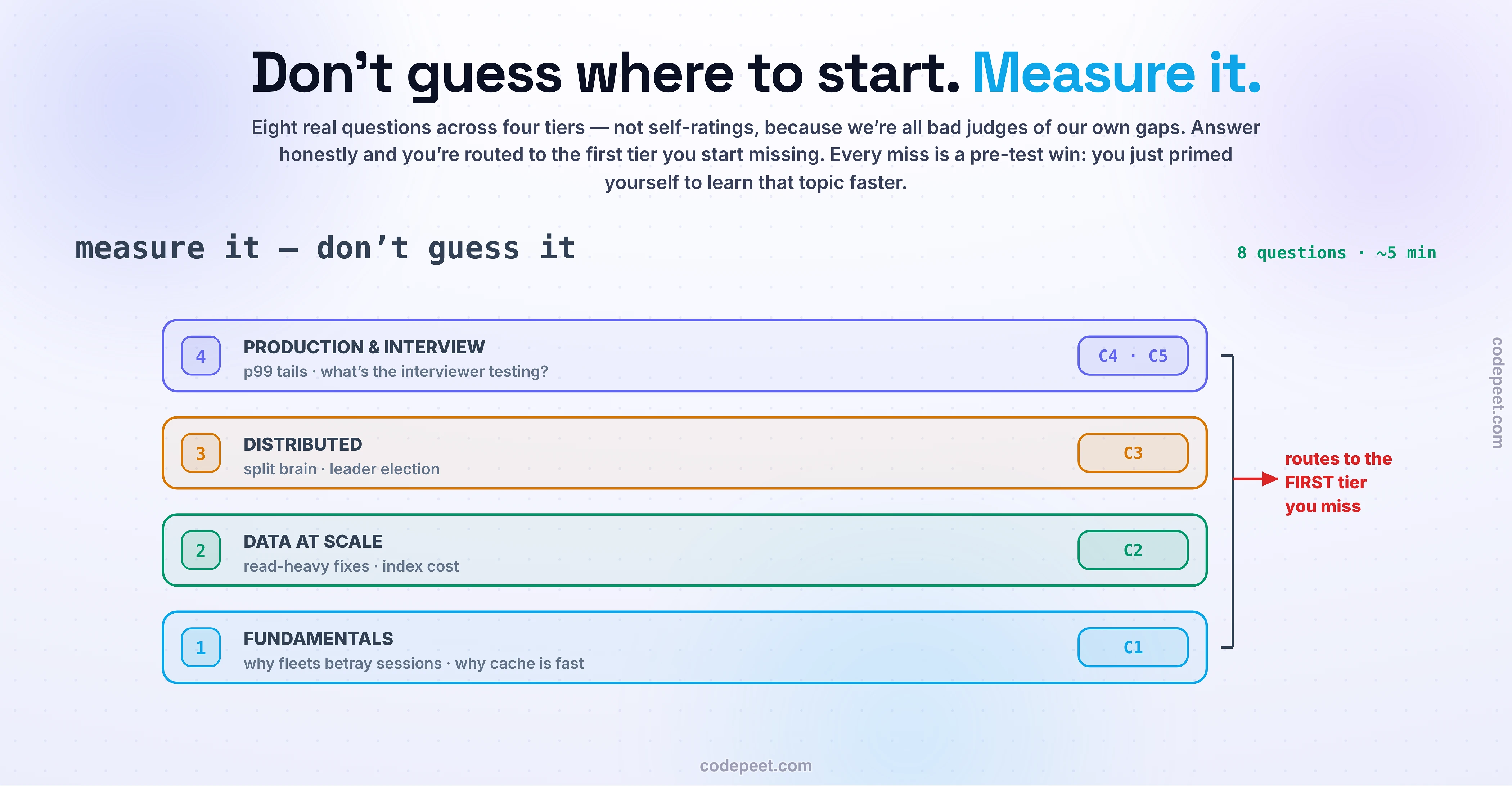
The eight questions climb four tiers — the same shape as the courses ahead:
- Fundamentals — the C1 floor. Can you explain why adding a server logged everyone out, or why RAM beats disk? (You've met both already.)
- Data at Scale — the C2 layer. Read-heavy rescue order, the true cost of an index.
- Distributed — the C3 frontier. Split brain, how machines agree on a leader while crashing. This is where most self-taught engineers have holes.
- Production & Interview — the C4/C5 ceiling. Living at p99, and hearing what an interviewer is actually testing behind a "why X over Y?"
The routing rule is simple and kind: you're sent to the first tier where you start missing. Ace fundamentals but stumble on data? Skim C1, start at C2. Strong through distributed? Head straight for the production and interview courses. The diagnostic will happily tell a senior engineer to skip most of this curriculum — that's a correct answer, not a rejection.
Take the Diagnostic
Eight questions. Answer each honestly — first instinct, no looking things up (that defeats the measurement). Watch the readiness bars fill on the right as you prove each tier, and read every explanation, hit or miss.
Try this first: don't optimize for a high score. Optimize for truth — a diagnostic you game just places you into lessons that'll feel too hard. The most useful outcome is an honest one.
The Trade-off
A diagnostic buys a precise starting point and pays with a moment of discomfort — the questions you can't answer, seen in plain light. That trade is worth making, but it has an edge to respect.
Read too much into eight questions and you'll mis-place yourself in the other direction: a nervous engineer who knows plenty talks themselves into starting from scratch "just to be safe," and spends two weeks re-learning what they already had. The diagnostic is a signal, not a sentence. If it routes you to C2 but C1's checkpoints turn out easy, trust that and move faster. If it routes you high but the material bites, drop back a course without shame.
The honest use is the one from The Trade-off Mindset: take the reading, name a flip condition ("start at C2 — but if the first section humbles me, restart at C1"), and begin. A placement you'll adjust beats a perfect placement you agonize over.
🧪 Try It Yourself
You've just taken the diagnostic — now make it stick:
- Note your entry point and your two weakest tiers.
- Write your missed questions as questions — "how DO machines agree on a leader while crashing?" Keep the list. It's your personal hit-list of highest-value lessons.
- Set your flip condition: "Starting at ___ — I'll drop back / jump ahead if ___."
Check: if you scored 8/8 on your very first attempt without guessing, either you're ready for C5 and the problems (great — go), or a couple were lucky guesses (retake honestly). And if you missed most of them? You're the learner this entire curriculum was built for — the dark tiles ahead are exactly the point.
Mental-Model Corrections
- "I can just tell where I should start." → The calibration gap says otherwise — and it's worst exactly at the extremes (new and expert). Measured beats guessed.
- "Missing questions means I'm not ready for this course." → Backwards. Missing questions is the pre-test working; those topics will land harder when you reach them. The course is built for the misses.
- "A diagnostic is a test I can pass or fail." → There's no failing a placement. Every outcome is a correct starting point. 2/8 and 8/8 are both just addresses.
- "I should start at lesson 1 no matter what, to be thorough." → Thoroughness that re-teaches what you know is just slowness. If the diagnostic says jump, jumping is the diligent move.
- "Self-rating and real questions are basically the same signal." → They're not even close. One measures your confidence; the other measures your knowledge. Only the second predicts how the lessons will feel.
Key Takeaways
- Measure your starting point, don't guess it — the calibration gap (Dunning-Kruger) makes self-rating unreliable, worst at the extremes. Real questions with real answers don't lie.
- Every miss is a pre-test win: attempting a question before instruction, even wrong, makes you learn that topic faster. The diagnostic teaches as it places.
- The eight questions climb four tiers (Fundamentals → Data → Distributed → Production & Interview); you're routed to the first tier you start missing.
- The output is a positive next step, never a grade — sometimes it blesses a senior engineer to skip most of the course.
- Treat the result as a signal with a flip condition, not a sentence — adjust as the material tells you.
- Next — One System, Five Passes: Meet Your Capstone: the running project you'll re-design after every course, from single box to staff-level.