Data Architecture Approaches
Introduction
Before building a data warehouse, you need to decide how to organize the data. This decision is your data architecture — the blueprint that dictates how data flows from source systems into a structure that analysts can query.
Over the decades, the industry has developed several proven approaches. Each has trade-offs in complexity, flexibility, and speed of delivery. In this lesson, you'll explore four of the most widely used architectures, compare them side by side, and understand why Medallion Architecture is the right fit for this project.
Kimball Methodology (Bottom-Up)
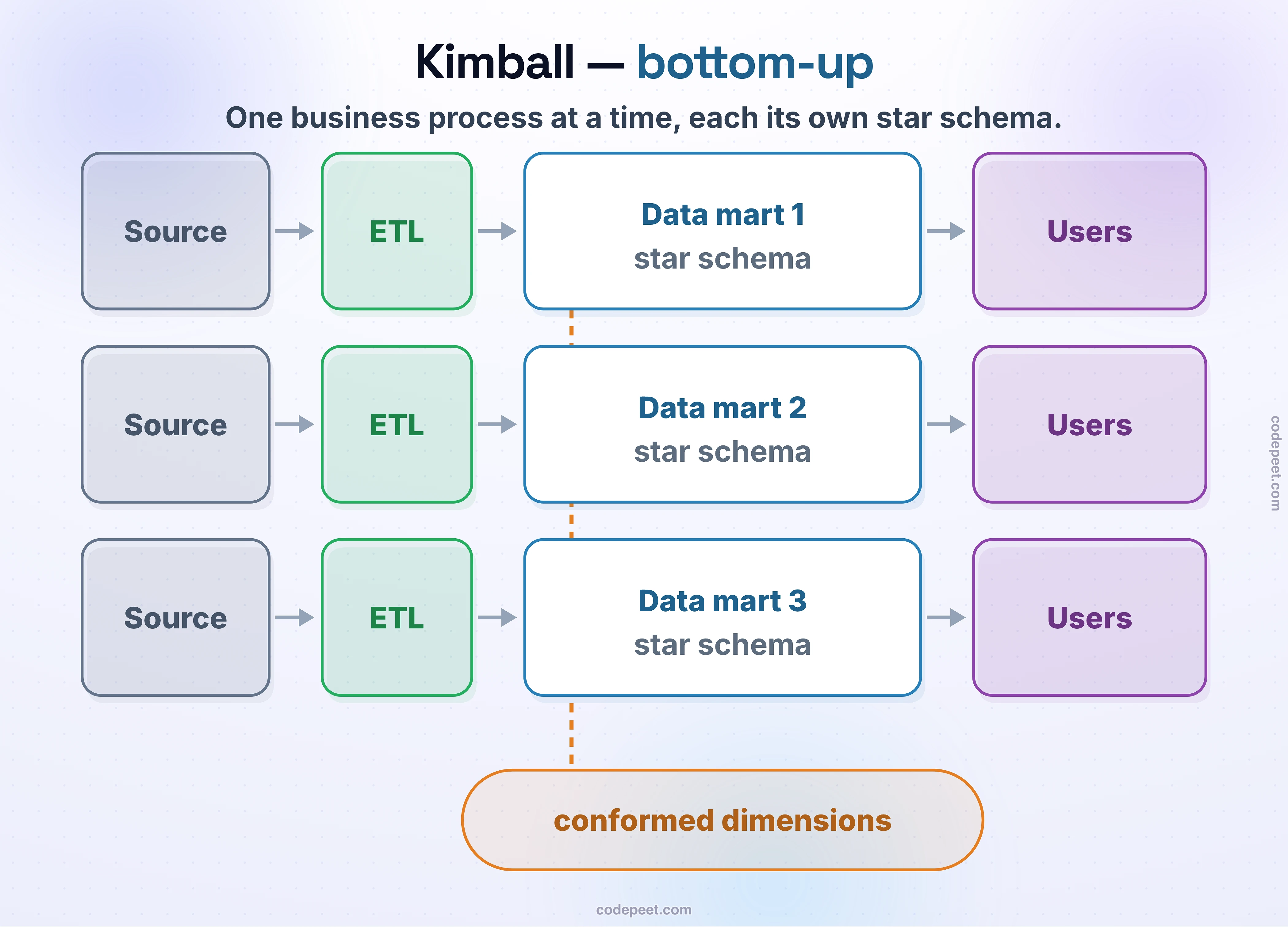
The Kimball approach, pioneered by Ralph Kimball, builds the data warehouse from the bottom up. You start by identifying a single business process (e.g., sales), model it as a star schema, and deliver it to users. Then you repeat for the next process.
Key characteristics:
- Dimensional modeling — data is organized into facts and dimensions.
- Star schema — one fact table surrounded by dimension tables.
- Bus architecture — shared (conformed) dimensions allow individual star schemas to be queried together.
- Fast time-to-value — you deliver usable data marts quickly.
Pros:
- Quick wins — analysts get usable data fast.
- Easy for business users to understand (star schema is intuitive).
- Well-suited for BI tools and OLAP queries.
Cons:
- Can become inconsistent if conformed dimensions are not maintained.
- Harder to retrofit when new business processes arrive.
- No single "source of truth" layer — each mart is somewhat independent.
Inmon Methodology (Top-Down)
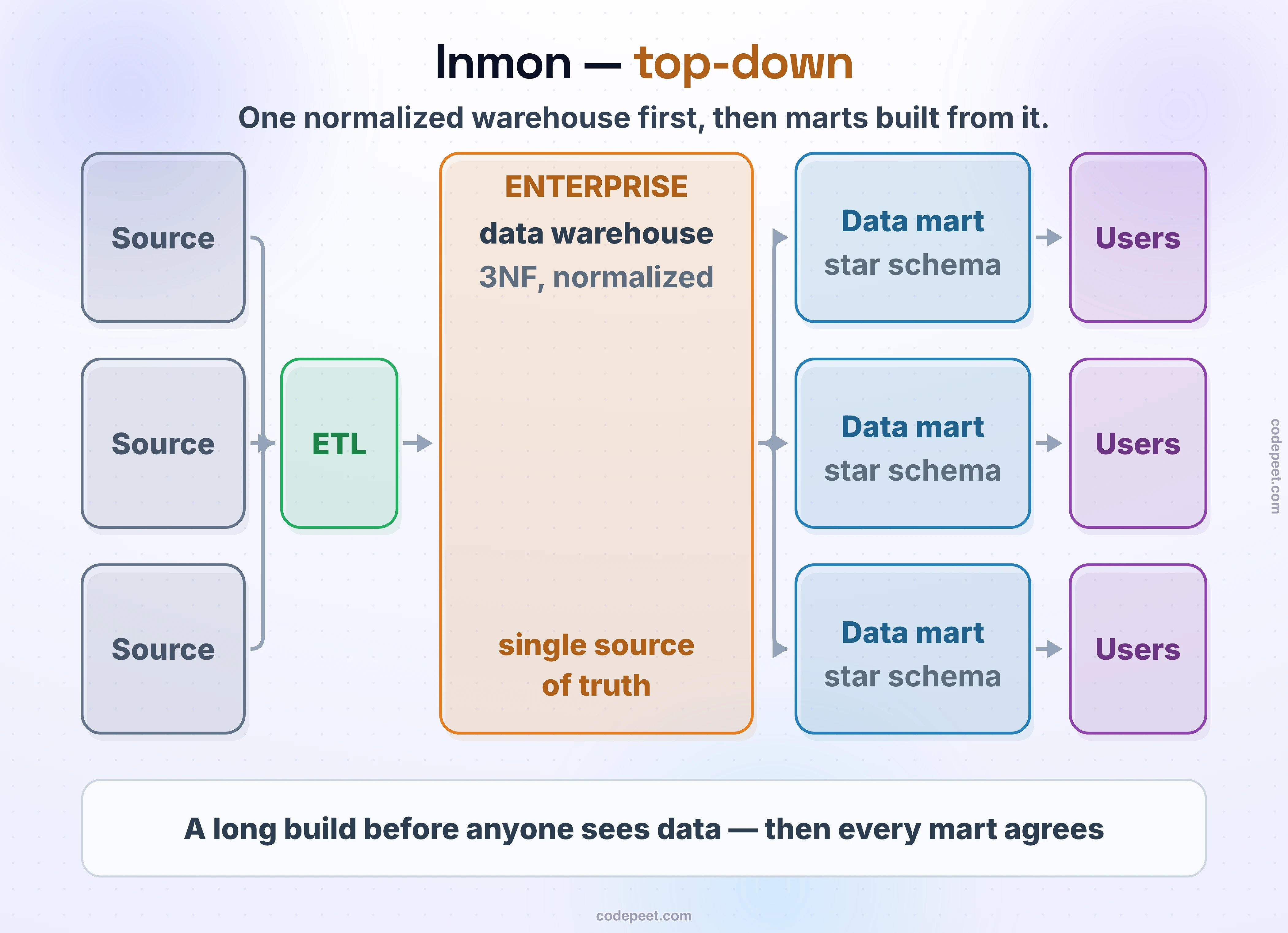
The Inmon approach, championed by Bill Inmon (often called the "Father of Data Warehousing"), takes the opposite direction: top down. You first build a single, enterprise-wide, normalized data warehouse, and then derive data marts from it.
Key characteristics:
- Third Normal Form (3NF) — the central warehouse is fully normalized to eliminate redundancy.
- Enterprise Data Warehouse (EDW) — one centralized repository of all organizational data.
- Dependent data marts — star schemas are created on top of the EDW for specific departments.
Pros:
- True single source of truth — all data is integrated in one place.
- High data consistency and minimal redundancy.
- Easier to add new subject areas over time.
Cons:
- Long initial build time before analysts see any results.
- 3NF can be complex and harder for business users to query directly.
- Requires significant upfront planning and enterprise-wide agreement.
Data Vault
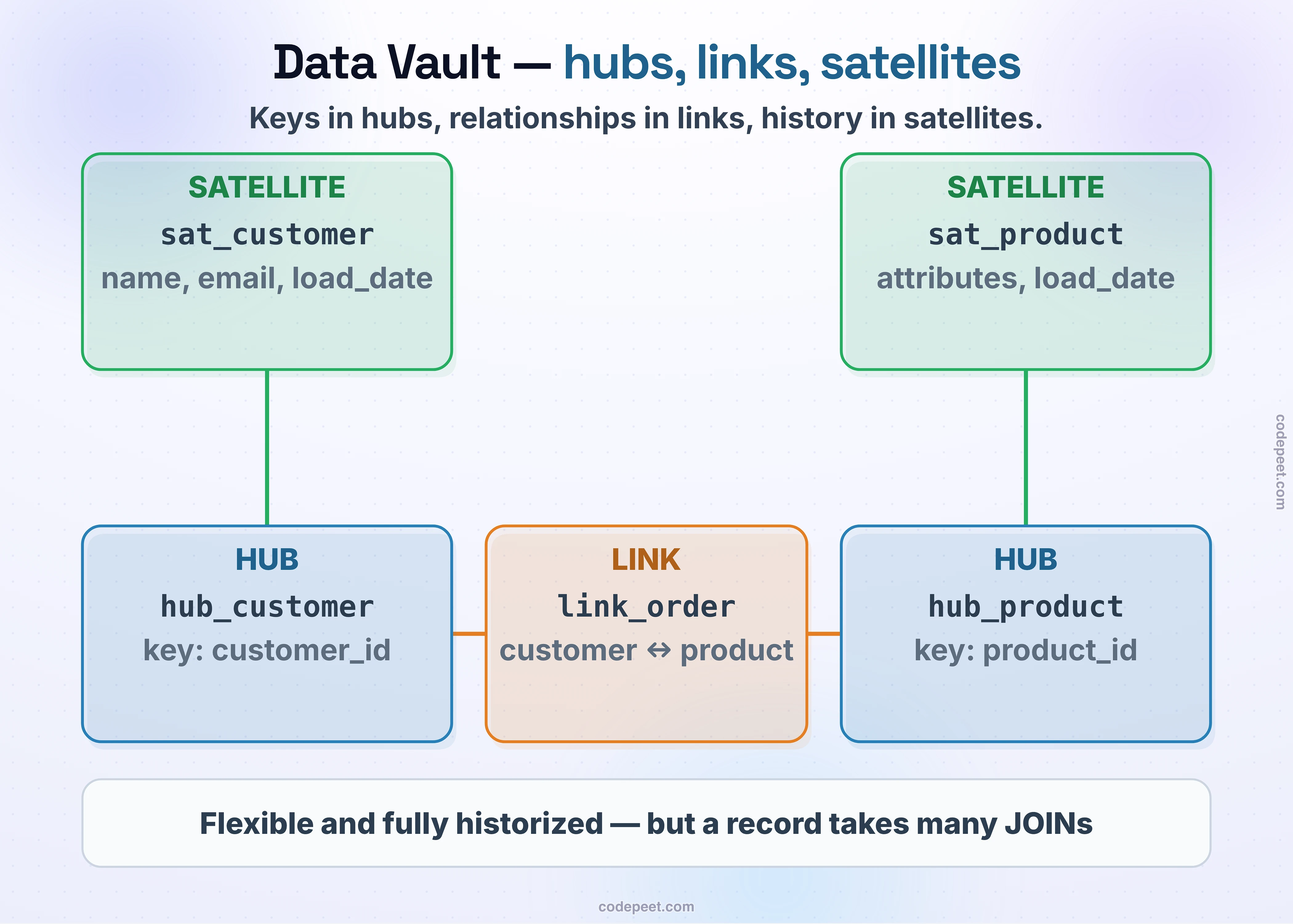
Data Vault, created by Dan Linstedt, is a hybrid modeling technique designed for agility and auditability. It breaks data into three building blocks:
| Component | Purpose | Example |
|---|---|---|
| Hub | Stores unique business keys | hub_customer (customer_id) |
| Satellite | Stores descriptive attributes + history | sat_customer (name, email, load_date) |
| Link | Stores relationships between hubs | link_order (customer_id ↔ product_id) |
Pros:
- Highly flexible — adding new sources doesn't break existing structures.
- Full historization built in (satellites track every change).
- Parallel loading — hubs, satellites, and links can be loaded independently.
Cons:
- Complex to understand for beginners.
- Requires many JOINs to reconstruct a usable record.
- Typically needs a star-schema presentation layer on top for BI tools.
- Overkill for small or simple projects.
Medallion Architecture (Bronze / Silver / Gold)
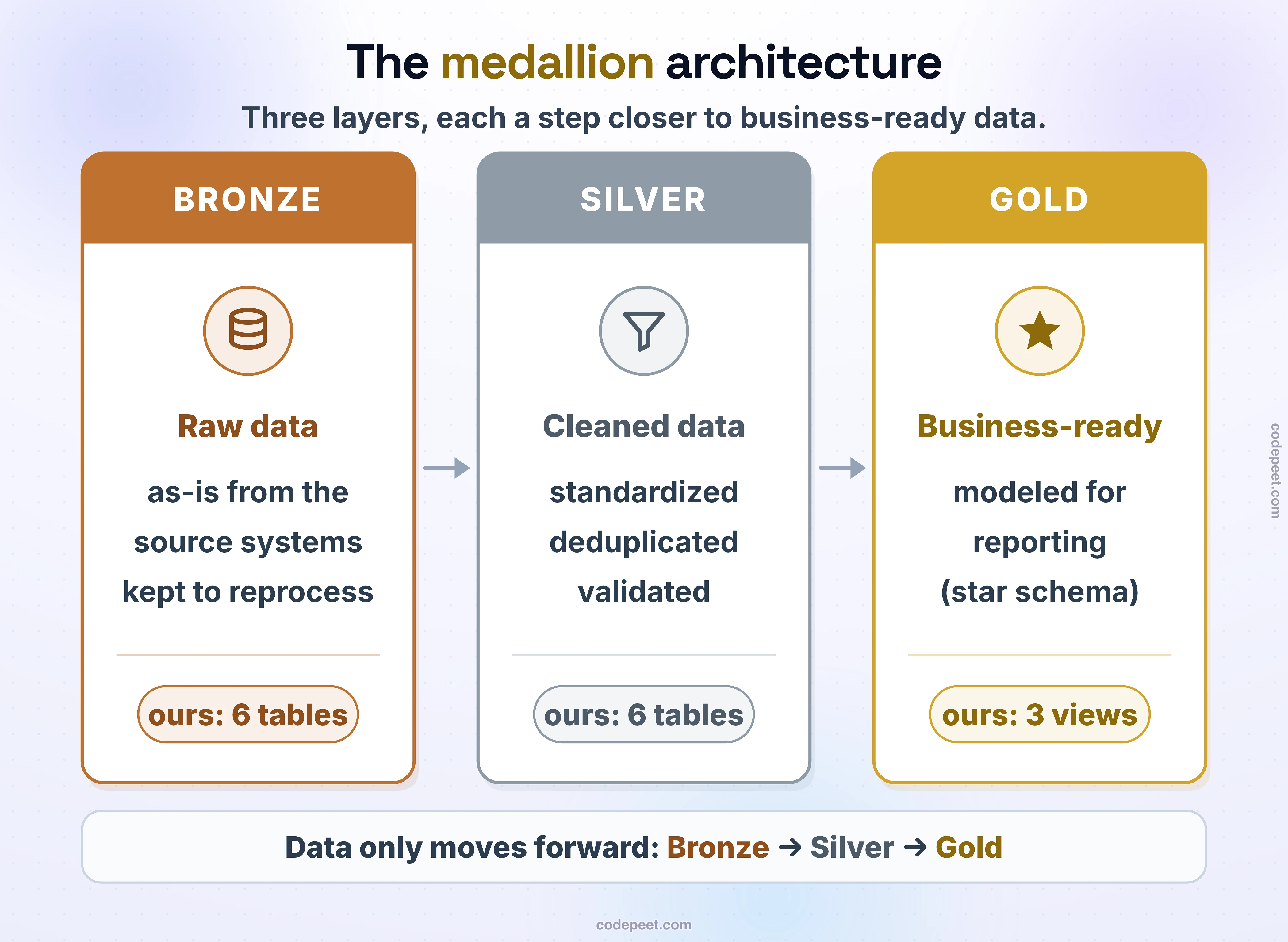
The Medallion Architecture organizes data into three progressive layers, each with a clear responsibility:
| Layer | Purpose | Data State |
|---|---|---|
| 🥉 Bronze | Land raw data exactly as-is from sources | Raw, untransformed |
| 🥈 Silver | Clean, standardize, and validate data | Cleansed, conformed |
| 🥇 Gold | Model data for business consumption | Business-ready, star schema |
Data flows in one direction: Bronze → Silver → Gold. Each layer adds more value, like refining raw ore into a polished product.
Why Medallion is popular:
- Simple mental model — everyone on the team understands "raw → clean → business-ready".
- Debugging friendly — if something looks wrong in Gold, you can trace it back through Silver to Bronze.
- Technology agnostic — works equally well in SQL Server, cloud data lakes, or modern data platforms.
- Incremental delivery — you can stand up Bronze quickly, then iterate on Silver and Gold.
Pros:
- Clear separation of concerns.
- Raw data is always preserved (Bronze).
- Easy to understand, build, and maintain.
- Scales well from small projects to enterprise.
Cons:
- Data is stored multiple times (one copy per layer), increasing storage.
- Requires disciplined pipeline design to keep layers in sync.
- Less prescriptive than Kimball or Inmon — you choose the modeling technique for each layer.
Side-by-Side Comparison
| Criteria | Kimball | Inmon | Data Vault | Medallion |
|---|---|---|---|---|
| Direction | Bottom-up | Top-down | Hybrid | Layered |
| Core model | Star schema | 3NF (EDW) | Hubs, satellites, links | Bronze / Silver / Gold |
| Complexity | Medium | High | High | Low to medium |
| Time to value | Fast | Slow | Medium | Fast |
| Raw data kept? | No | No | Yes | Yes (Bronze) |
| Historization | SCD types | SCD types | Built in | Optional |
| Best for | BI / OLAP | Enterprise | Agile, big data | Modern pipelines |
There is no single "best" architecture — the right choice depends on team size, data volume, project timeline, and organizational maturity. Many real-world warehouses combine ideas from multiple approaches.
Why Medallion for This Project
For this project, the Medallion Architecture is the ideal fit. Here's why:
- Simplicity — With only two source systems (CRM and ERP), a heavyweight approach like Inmon or Data Vault would be overkill.
- Raw data preservation — The Bronze layer gives you an exact copy of the source CSVs, making debugging easy.
- Clear transformation path — Silver handles all the messy cleansing, so Gold stays clean and focused on business logic.
- Star schema in Gold — You still get the benefits of Kimball-style dimensional modeling (fast, intuitive queries) in the final layer.
- Beginner-friendly — The layer-by-layer approach is easy to learn, implement, and explain.
In essence, Medallion gives you the best of both worlds: the structured rigor of layered data engineering and the analytical power of a star schema.
Mapping Architecture to SQL Server
In SQL Server, each Medallion layer maps neatly to a database schema:
| Layer | SQL Server Schema | Objects |
|---|---|---|
| Bronze | bronze | Tables (raw imports) |
| Silver | silver | Tables (cleaned data) |
| Gold | gold | Views (star schema) |
Using schemas within a single database keeps everything organized without the overhead of managing multiple databases.
-- Creating the three Medallion schemas in SQL Server
CREATE SCHEMA bronze;
GO

CREATE SCHEMA silver;
GO

CREATE SCHEMA gold;
GO
You'll use this structure throughout the entire project. Every table and view you create will live under one of these three schemas.
Summary
Here's what you learned in this lesson:
- Kimball builds star schemas bottom-up for fast delivery but lacks a centralized raw layer.
- Inmon builds a normalized enterprise warehouse top-down for consistency but takes longer to deliver.
- Data Vault uses hubs, satellites, and links for maximum flexibility and auditability but adds complexity.
- Medallion Architecture organizes data into Bronze (raw), Silver (clean), and Gold (business-ready) layers — striking the best balance of simplicity, traceability, and analytical power.
- This project uses Medallion Architecture with a star schema in the Gold layer, combining layered engineering with dimensional modeling.
Next, you'll dive into the detailed design of each Medallion layer.