Last Stone Weight II
Description
You have a collection of stones, each with a positive integer weight given in an array stones, where stones[i] is the weight of the i-th stone.
You are playing a stone-smashing game. On each turn, you choose any two stones and smash them together. If the two stones have weights x and y (with x ≤ y), the result of this smash is:
- If
x == y, both stones are completely destroyed. - If
x != y, the stone of weightxis destroyed, and the stone of weightyhas its weight reduced toy - x.
The game continues until at most one stone remains. Your goal is to find the minimum possible weight of the last remaining stone. If all stones are destroyed, return 0.
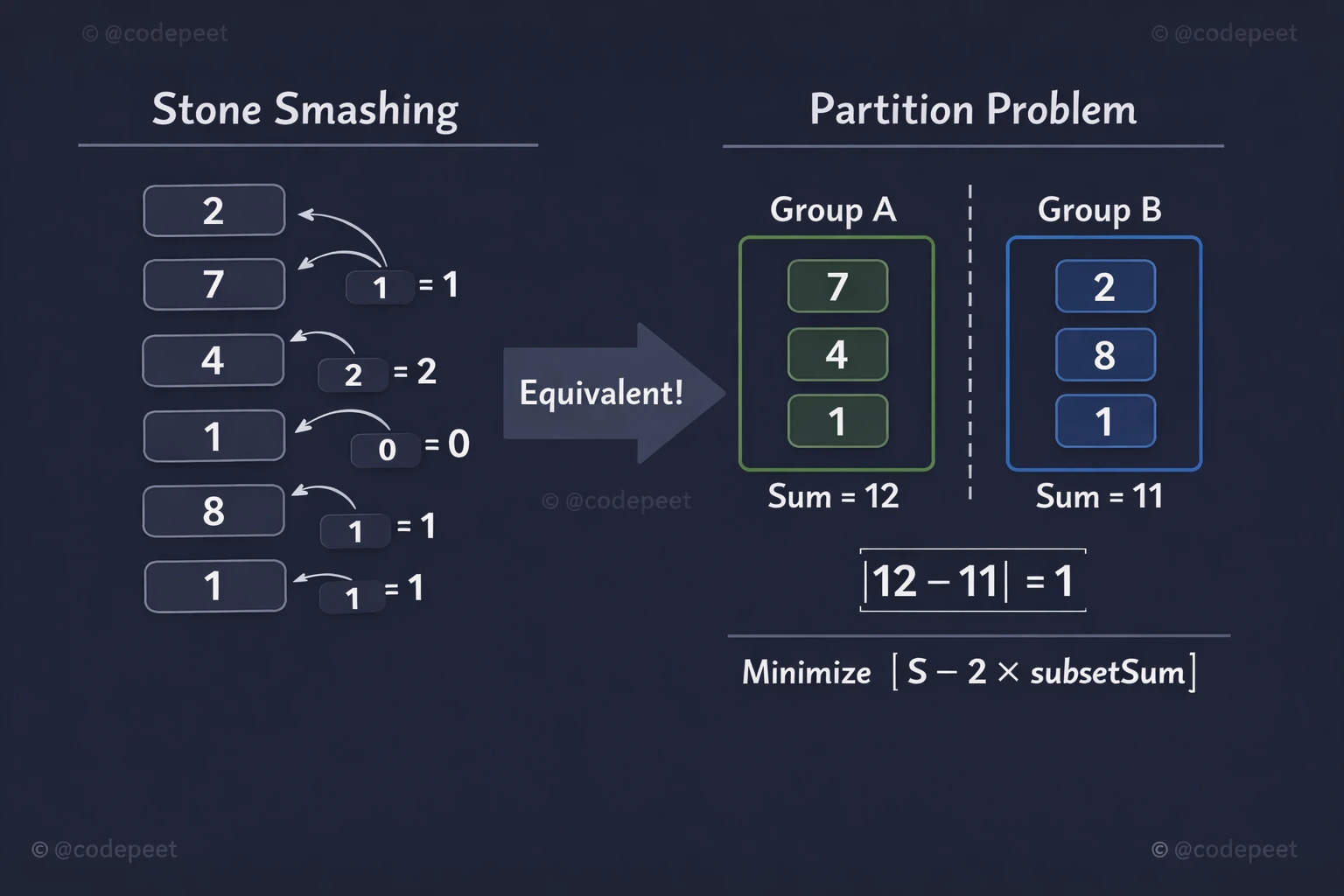
At first glance, this looks like a greedy or simulation problem, but the key insight is that the order of smashing doesn't matter — what matters is how the stones are partitioned into two groups. Every stone ultimately contributes a + or − sign to the final result. This transforms the problem into a classic subset partition problem, solvable with Dynamic Programming.
Examples
Example 1
Input: stones = [2, 7, 4, 1, 8, 1]
Output: 1
Explanation: One optimal sequence of smashes:
- Smash 2 and 4 → leftover 2
- Smash 7 and 8 → leftover 1
- Smash 1 and 1 → both destroyed
- Smash 2 and 1 → leftover 1
This corresponds to the partition: group A = {7, 4, 1} (sum 12) and group B = {2, 8, 1} (sum 11). The minimum weight is |12 − 11| = 1.
Example 2
Input: stones = [31, 26, 33, 21, 40]
Output: 5
Explanation: Total sum = 151. The best partition splits stones into two groups with sums as close to 75.5 as possible. One such partition: group A = {31, 33, 21} (sum 85) and group B = {26, 40} (sum 66). Minimum weight = |85 − 66| = 19. But a better one exists: group A = {33, 40} (sum 73) and group B = {31, 26, 21} (sum 78). Minimum weight = |78 − 73| = 5.
Constraints
- 1 ≤ stones.length ≤ 30
- 1 ≤ stones[i] ≤ 100
Editorial
Brute Force - Enumerate All Sign Assignments
Intuition
The crucial insight behind this problem is understanding what the smashing process actually computes.
When you smash two stones with weights x and y, you get |y − x|. If you then smash the result with another stone z, you get something like |z − |y − x||. Expanding this out, each original stone weight ends up with either a + or − sign in front of it.
For example, with stones [a, b, c, d], the final result after all smashing could be expressions like +a − b + c − d or −a + b − c + d, depending on how you pair them. Every possible smashing sequence corresponds to assigning each stone a + or − sign.
This means the problem is equivalent to: partition the stones into two groups (Group+ and Group−) to minimize |sum(Group+) − sum(Group−)|.
If the total sum is S, and one group has sum P, the other group has sum S − P. The final weight is |S − 2P|. To minimize this, we want P as close to S/2 as possible.
The brute force approach simply tries all possible assignments of + and − to each stone and returns the minimum absolute result.
Step-by-Step Explanation
Let's trace through stones = [2, 7, 4, 1, 8, 1] with the brute force approach:
Step 1: Calculate total sum: 2 + 7 + 4 + 1 + 8 + 1 = 23. We want to split stones into two groups with sums as close to 23/2 = 11.5 as possible. Since all weights are integers, the best achievable difference is 1 (groups of 11 and 12).
Step 2: Try assignment (+2, +7, +4, +1, −8, −1): sum = 2+7+4+1−8−1 = 5. Not minimal.
- Running minimum: 5
Step 3: Try assignment (+2, −7, +4, +1, −8, +1): sum = 2−7+4+1−8+1 = −7, |−7| = 7. Worse.
- Running minimum: 5
Step 4: Try assignment (+2, +7, +4, −1, −8, −1): sum = 2+7+4−1−8−1 = 3. Better!
- Running minimum: 3
Step 5: Try assignment (−2, +7, +4, −1, −8, +1): sum = −2+7+4−1−8+1 = 1. Excellent!
- Running minimum: 1. This corresponds to Group+ = {7, 4, 1} (sum 12), Group− = {2, 1, 8} (sum 11).
Step 6: Can we achieve 0? That would require a group summing to exactly 11.5, which is impossible with integer weights. So 1 is the theoretical minimum for odd total sum.
Step 7: But brute force doesn't know this — it must check ALL 2^6 = 64 sign assignments to be sure. With 30 stones (constraint max), that's 2^30 ≈ 1.07 billion combinations — dangerously slow.
Step 8: Final answer: 1.
Algorithm
- Define
dfs(index, currentSum)that recursively assigns + or − to each stone - Base case: If
index == n, return|currentSum|— the final stone weight for this assignment - Recursive case:
- Assign
+:add = dfs(index + 1, currentSum + stones[index]) - Assign
−:sub = dfs(index + 1, currentSum − stones[index]) - Return
min(add, sub)
- Assign
- Call
dfs(0, 0)
Code
class Solution {
public:
    int lastStoneWeightII(vector<int>& stones) {
        return dfs(stones, 0, 0);
    }

private:
    int dfs(vector<int>& stones, int index, int currentSum) {
        if (index == (int)stones.size())
            return abs(currentSum);

        int add = dfs(stones, index + 1, currentSum + stones[index]);
        int sub = dfs(stones, index + 1, currentSum - stones[index]);
        return min(add, sub);
    }
};
class Solution:
def lastStoneWeightII(self, stones: list[int]) -> int:
def dfs(index: int, current_sum: int) -> int:
if index == len(stones):
return abs(current_sum)
add = dfs(index + 1, current_sum + stones[index])
sub = dfs(index + 1, current_sum - stones[index])
return min(add, sub)
return dfs(0, 0)class Solution {
public int lastStoneWeightII(int[] stones) {
return dfs(stones, 0, 0);
}
private int dfs(int[] stones, int index, int currentSum) {
if (index == stones.length)
return Math.abs(currentSum);
int add = dfs(stones, index + 1, currentSum + stones[index]);
int sub = dfs(stones, index + 1, currentSum - stones[index]);
return Math.min(add, sub);
}
}Complexity Analysis
Time Complexity: O(2^n)
Each stone gets two choices (+ or −), creating a binary tree of depth n. The total number of leaf nodes is 2^n. With n up to 30, that's over a billion operations — too slow.
Space Complexity: O(n)
The recursion stack can go n levels deep (one level per stone). No additional data structures are used.
Why This Approach Is Not Efficient
The brute force tries all 2^n sign assignments, but many of them lead to the same running sum. For example, with stones [2, 7, 4], both (+2, −7, +4) and (−2, +7, −4) produce a sum with absolute value 1 — they explore the same territory from different paths.
The key observation is that the problem reduces to: find a subset of stones with sum as close to S/2 as possible. This is the classic 0/1 Knapsack problem, where:
- The "knapsack capacity" is
S/2(half the total sum) - Each stone either goes into the knapsack (Group A) or stays out (Group B)
- We maximize the sum in the knapsack without exceeding capacity
Once we find the maximum subset sum P ≤ S/2, the minimum final weight is S − 2P. Dynamic Programming solves this in O(n × S/2) time — polynomial rather than exponential.
Optimal Approach - 2D DP (0/1 Knapsack)
Intuition
We reformulate the problem as a 0/1 Knapsack:
- Items: Each stone, with weight = value =
stones[i] - Knapsack capacity:
target = totalSum / 2 - Goal: Maximize the total weight we can fit in the knapsack
We build a 2D table dp[i][j] where:
i= number of stones considered so far (0 to n)j= remaining knapsack capacity (0 to target)dp[i][j]= maximum sum achievable using the firstistones with capacity limitj
For each stone, we have two choices:
- Don't take it:
dp[i][j] = dp[i-1][j]— same result as without this stone - Take it (if it fits):
dp[i][j] = dp[i-1][j - stones[i-1]] + stones[i-1]— add stone's weight to best result with remaining capacity
We choose whichever option gives a larger sum.
After filling the table, dp[n][target] gives the maximum subset sum ≤ S/2. The minimum final stone weight is totalSum − 2 × dp[n][target].
Step-by-Step Explanation
Let's trace with stones = [2, 7, 4, 1, 8, 1]. Total sum = 23, target = 23 / 2 = 11.
Step 1: Initialize a 7×12 DP table. Row 0 (no stones) = all zeros. Column 0 (capacity 0) = all zeros.
Step 2: Row 1 (stone = 2): For capacity j ≥ 2, we can take this stone. dp[1][j] = 2 for all j ≥ 2. With just one stone of weight 2, we can achieve sum 2.
- Key cells: dp[1][2] = 2, dp[1][11] = 2
Step 3: Row 2 (stone = 7): Stone 7 opens new possibilities.
- dp[2][7] = max(2, 0+7) = 7 (take stone 7 alone)
- dp[2][9] = max(2, dp[1][2]+7) = max(2, 2+7) = 9 (take stones 2+7=9)
- dp[2][11] = max(2, dp[1][4]+7) = max(2, 2+7) = 9
Step 4: Row 3 (stone = 4): Combining with previous stones.
- dp[3][6] = max(2, dp[2][2]+4) = max(2, 2+4) = 6 (stones 2+4=6)
- dp[3][11] = max(9, dp[2][7]+4) = max(9, 7+4) = 11 — we hit the target! Stones {7,4} sum to exactly 11.
Step 5: Row 4 (stone = 1): Fills remaining gaps. dp[4][j] = j for all j from 0 to 11.
- Key: dp[4][3] = 3 (stones 2+1), dp[4][5] = 5 (stones 4+1), dp[4][8] = 8 (stones 7+1)
Step 6: Rows 5-6 (stones 8 and 1): No improvement beyond dp = [0,1,...,11]. The target sum of 11 was already achieved.
Step 7: Result: dp[6][11] = 11. Answer = 23 − 2×11 = 23 − 22 = 1.
The DP found that subset {7, 4} sums to 11 (or equivalently {2, 1, 8} sums to 11). The partition difference is |12 − 11| = 1.
0/1 Knapsack — Building Maximum Subset Sum Row by Row — Watch the knapsack DP table fill row by row. Each row adds a new stone to consider. At row 3, stone 4 combined with stone 7 hits the target capacity of 11 — the optimal partition is found early!
Algorithm
- Calculate
totalSum = sum(stones)andtarget = totalSum / 2 - Create a 2D table
dp[n+1][target+1], initialized to 0 - For each stone i from 1 to n:
- For each capacity j from 0 to target:
- Don't take stone:
dp[i][j] = dp[i-1][j] - Take stone (if
stones[i-1] ≤ j):dp[i][j] = max(dp[i][j], dp[i-1][j - stones[i-1]] + stones[i-1])
- Don't take stone:
- For each capacity j from 0 to target:
- Return
totalSum − 2 × dp[n][target]
Code
class Solution {
public:
    int lastStoneWeightII(vector<int>& stones) {
        int totalSum = 0;
        for (int s : stones) totalSum += s;
        int target = totalSum / 2;
        int n = stones.size();

        vector<vector<int>> dp(n + 1, vector<int>(target + 1, 0));

        for (int i = 1; i <= n; i++) {
            for (int j = 0; j <= target; j++) {
                dp[i][j] = dp[i - 1][j];
                if (stones[i - 1] <= j) {
                    dp[i][j] = max(dp[i][j],
                        dp[i - 1][j - stones[i - 1]] + stones[i - 1]);
                }
            }
        }

        return totalSum - 2 * dp[n][target];
    }
};
class Solution:
def lastStoneWeightII(self, stones: list[int]) -> int:
total_sum = sum(stones)
target = total_sum // 2
n = len(stones)
dp = [[0] * (target + 1) for _ in range(n + 1)]
for i in range(1, n + 1):
for j in range(target + 1):
dp[i][j] = dp[i - 1][j]
if stones[i - 1] <= j:
dp[i][j] = max(
dp[i][j],
dp[i - 1][j - stones[i - 1]] + stones[i - 1]
)
return total_sum - 2 * dp[n][target]class Solution {
public int lastStoneWeightII(int[] stones) {
int totalSum = 0;
for (int s : stones) totalSum += s;
int target = totalSum / 2;
int n = stones.length;
int[][] dp = new int[n + 1][target + 1];
for (int i = 1; i <= n; i++) {
for (int j = 0; j <= target; j++) {
dp[i][j] = dp[i - 1][j];
if (stones[i - 1] <= j) {
dp[i][j] = Math.max(dp[i][j],
dp[i - 1][j - stones[i - 1]] + stones[i - 1]);
}
}
}
return totalSum - 2 * dp[n][target];
}
}Complexity Analysis
Time Complexity: O(n × S/2)
Where n is the number of stones and S is the total sum. We fill a table of size n × (S/2) with O(1) work per cell. With n ≤ 30 and S ≤ 3000, the maximum number of operations is 30 × 1500 = 45,000 — extremely fast.
Space Complexity: O(n × S/2)
The full 2D DP table. For the worst case (30 stones, each 100), the table has 30 × 1500 = 45,000 entries — about 180 KB. Manageable, but we can do better.
Why This Approach Is Not Efficient
The 2D DP achieves optimal O(n × S/2) time, but the space can be improved.
Looking at the recurrence: dp[i][j] depends only on dp[i-1][j] and dp[i-1][j - stones[i-1]] — both from the previous row. We never look back more than one row.
This means we can compress the entire 2D table into a single 1D array. The critical trick: when updating the array for each stone, we must iterate backwards (from target down to stone). Iterating forwards would overwrite values that we still need for the current stone's computations, effectively using the same stone multiple times (turning it into an unbounded knapsack).
Most Optimal Approach - 1D DP (Space Optimized)
Intuition
We maintain a single 1D array dp[j] where dp[j] = the maximum sum achievable using a subset of the stones processed so far, with sum ≤ j.
For each new stone, we sweep the array right to left (from target down to stone):
dp[j] = max(dp[j], dp[j - stone] + stone)
Why backwards? Because dp[j - stone] references a value from the previous stone's iteration. If we went left to right, dp[j - stone] might have already been updated in the current iteration, effectively using the same stone twice.
Think of it like packing a suitcase: for each item, you check from the fullest possible state down to the item's weight. This ensures each item is considered at most once.
After processing all stones, dp[target] gives the maximum subset sum ≤ S/2, and the answer is totalSum − 2 × dp[target].
Step-by-Step Explanation
Let's trace with stones = [2, 7, 4, 1, 8, 1]. Total = 23, target = 11.
Step 1: Initialize dp = [0, 0, 0, 0, 0, 0, 0, 0, 0, 0, 0, 0].
Step 2: Stone = 2. Sweep j = 11 down to 2:
- Each dp[j] = max(dp[j], dp[j-2]+2). Since dp is all zeros, dp[j] becomes 2 for j ≥ 2.
- dp = [0, 0, 2, 2, 2, 2, 2, 2, 2, 2, 2, 2]
Step 3: Stone = 7. Sweep j = 11 down to 7:
- dp[9] = max(2, dp[2]+7) = max(2, 9) = 9 (combo: 2+7=9)
- dp[7] = max(2, dp[0]+7) = max(2, 7) = 7 (stone 7 alone)
- dp = [0, 0, 2, 2, 2, 2, 2, 7, 7, 9, 9, 9]
Step 4: Stone = 4. Sweep j = 11 down to 4:
- dp[11] = max(9, dp[7]+4) = max(9, 7+4) = 11 — target reached!
- dp[6] = max(2, dp[2]+4) = max(2, 6) = 6 (combo: 2+4=6)
- dp = [0, 0, 2, 2, 4, 4, 6, 7, 7, 9, 9, 11]
Step 5: Stone = 1. Sweep j = 11 down to 1:
- Fills all remaining gaps: dp[10] = max(9, dp[9]+1) = 10, dp[8] = max(7, dp[7]+1) = 8, dp[5] = max(4, dp[4]+1) = 5, dp[3] = max(2, dp[2]+1) = 3, dp[1] = max(0, dp[0]+1) = 1.
- dp = [0, 1, 2, 3, 4, 5, 6, 7, 8, 9, 10, 11]
Step 6: Stones 8 and 1 (second): dp already has all values 0..11. No cell can be improved further — every achievable sum is already maximal.
Step 7: Result: dp[11] = 11. Answer = 23 − 2×11 = 1.
The backward iteration ensured each stone was used at most once. Only one array of 12 integers was needed instead of a 7×12 table.
1D Knapsack — Backward Sweep Per Stone — Watch a single dp array evolve as each stone is processed with a backward sweep. At stone 4, the combination 7+4=11 hits the target. The backward direction prevents using a stone twice.
Algorithm
- Calculate
totalSum = sum(stones)andtarget = totalSum / 2 - Create a 1D array
dp[target+1], initialized to 0 - For each stone in the array:
- Sweep j from
targetdown tostone(backward!):dp[j] = max(dp[j], dp[j - stone] + stone)
- Sweep j from
- Return
totalSum − 2 × dp[target]
Why backward? If we iterated forward (j = stone to target), when computing dp[j], the value dp[j - stone] might have already been updated in the current iteration — effectively using the same stone multiple times. Backward iteration ensures dp[j - stone] always reflects the state from the previous stone.
Code
class Solution {
public:
    int lastStoneWeightII(vector<int>& stones) {
        int totalSum = 0;
        for (int s : stones) totalSum += s;
        int target = totalSum / 2;

        vector<int> dp(target + 1, 0);

        for (int stone : stones) {
            for (int j = target; j >= stone; j--) {
                dp[j] = max(dp[j], dp[j - stone] + stone);
            }
        }

        return totalSum - 2 * dp[target];
    }
};
class Solution:
def lastStoneWeightII(self, stones: list[int]) -> int:
total_sum = sum(stones)
target = total_sum // 2
dp = [0] * (target + 1)
for stone in stones:
for j in range(target, stone - 1, -1):
dp[j] = max(dp[j], dp[j - stone] + stone)
return total_sum - 2 * dp[target]class Solution {
public int lastStoneWeightII(int[] stones) {
int totalSum = 0;
for (int s : stones) totalSum += s;
int target = totalSum / 2;
int[] dp = new int[target + 1];
for (int stone : stones) {
for (int j = target; j >= stone; j--) {
dp[j] = Math.max(dp[j], dp[j - stone] + stone);
}
}
return totalSum - 2 * dp[target];
}
}Complexity Analysis
Time Complexity: O(n × S/2)
Same as the 2D approach. For each of n stones, we sweep through at most S/2 capacities. With n ≤ 30 and S ≤ 3000, at most 45,000 operations.
Space Complexity: O(S/2)
Only a single 1D array of size target+1 = S/2 + 1. For the worst case (total sum = 3000), this is just 1500 integers (~6 KB). Compared to the 2D table's 45,000 entries, this is a 30× space reduction.
Comparison of all three approaches:
| Approach | Time | Space | Key Idea |
|---|---|---|---|
| Brute Force (All Subsets) | O(2^n) | O(n) | Try all +/− assignments |
| 2D DP (0/1 Knapsack) | O(n × S/2) | O(n × S/2) | Full knapsack table |
| 1D DP (Space Optimized) | O(n × S/2) | O(S/2) | Backward sweep, single array |