Construct Quad Tree
Description
Given an n × n matrix grid containing only 0s and 1s, represent the grid using a Quad-Tree and return the root of that tree.
A Quad-Tree is a tree data structure where each internal node has exactly four children: topLeft, topRight, bottomLeft, and bottomRight. Every node has two attributes:
val:Trueif the node represents a region of all1s,Falseif the node represents a region of all0s. WhenisLeafisFalse,valcan be set to any value.isLeaf:Trueif the node is a leaf (the entire region it covers has the same value),Falseif the node has four children (the region contains a mix of0s and1s).
The construction follows these rules:
- If the current grid region has all the same values (all
0s or all1s), create a leaf node withisLeaf = Trueandvalequal to that uniform value. - If the current grid region has mixed values, create an internal node with
isLeaf = False, divide the region into four equal quadrants, and recursively build a child node for each quadrant.
The grid size n is always a power of 2, which guarantees that the grid can be evenly subdivided at each level until individual cells are reached.
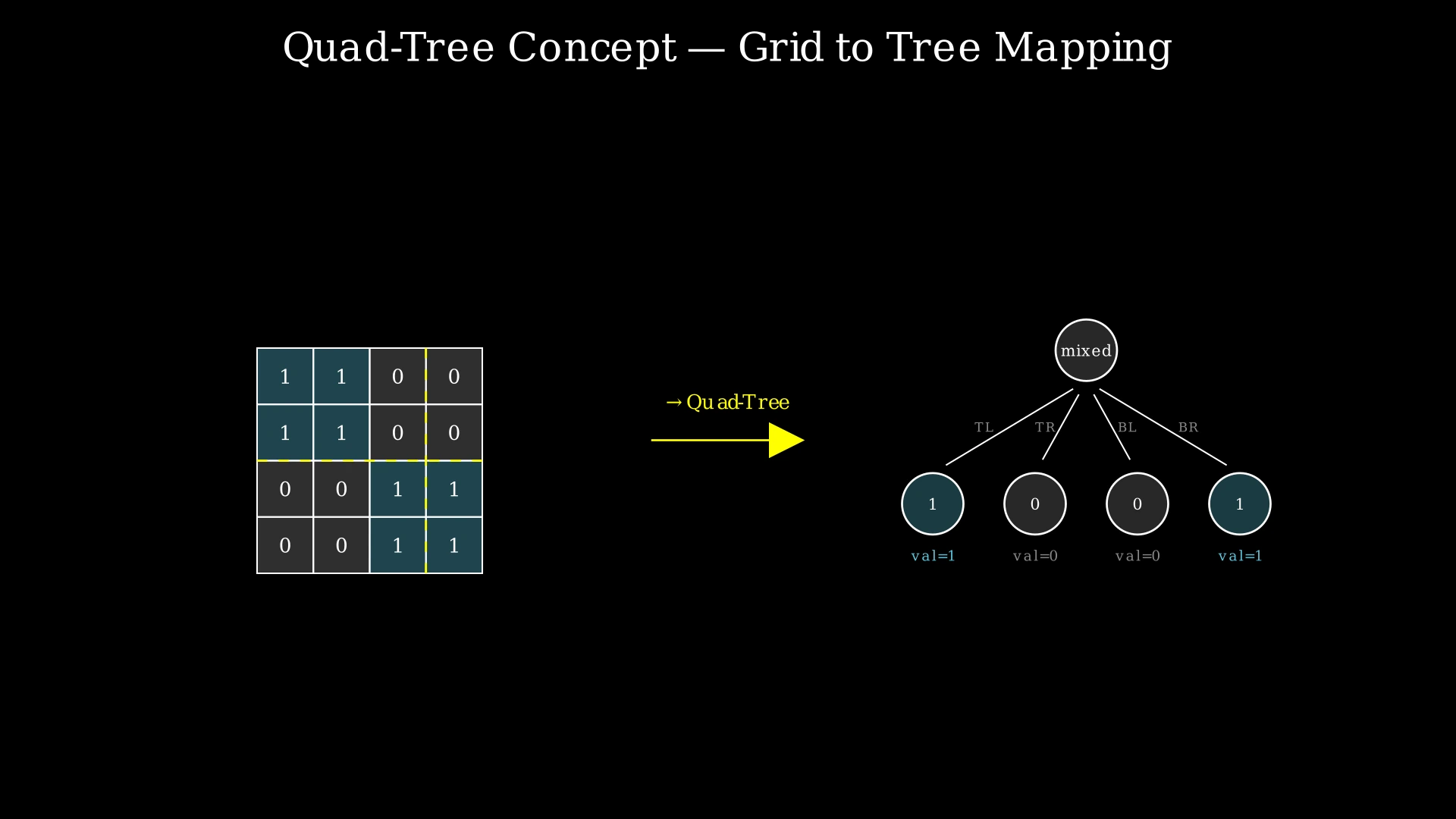
Examples
Example 1
Input: grid = [[0, 1], [1, 0]]
Output: [[0, 1], [1, 0], [1, 1], [1, 1], [1, 0]]
Explanation: The 2×2 grid has mixed values (contains both 0s and 1s), so the root is not a leaf. We divide it into four 1×1 quadrants:
- topLeft = grid[0][0] = 0 → leaf node with val=False
- topRight = grid[0][1] = 1 → leaf node with val=True
- bottomLeft = grid[1][0] = 1 → leaf node with val=True
- bottomRight = grid[1][1] = 0 → leaf node with val=False
The root node has isLeaf=False, val=True (arbitrary), and four leaf children. In the serialized output, each node is represented as [isLeaf, val].
Example 2
Input: grid = [[1,1,1,1,0,0,0,0],[1,1,1,1,0,0,0,0],[1,1,1,1,1,1,1,1],[1,1,1,1,1,1,1,1],[1,1,1,1,0,0,0,0],[1,1,1,1,0,0,0,0],[1,1,1,1,0,0,0,0],[1,1,1,1,0,0,0,0]]
Output: [[0,1],[1,1],[0,1],[1,1],[1,0],null,null,null,null,[1,0],[1,0],[1,1],[1,1]]
Explanation: The 8×8 grid has mixed values, so the root is not a leaf. Dividing into four 4×4 quadrants:
- topLeft (rows 0-3, cols 0-3): All 1s → leaf with val=True
- topRight (rows 0-3, cols 4-7): Mixed values → not a leaf, subdivide further into four 2×2 quadrants:
- topLeft of topRight: all 0s → leaf val=False
- topRight of topRight: all 0s → leaf val=False
- bottomLeft of topRight: all 1s → leaf val=True
- bottomRight of topRight: all 1s → leaf val=True
- bottomLeft (rows 4-7, cols 0-3): All 1s → leaf with val=True
- bottomRight (rows 4-7, cols 4-7): All 0s → leaf with val=False
Constraints
- n == grid.length == grid[i].length
- n == 2^x where 0 ≤ x ≤ 6
- grid[i][j] is either 0 or 1
Editorial
Brute Force
Intuition
The most direct approach follows the Quad-Tree construction rules literally. For any given rectangular region of the grid:
- Scan every cell in that region to check if all values are the same.
- If they are all the same, create a leaf node.
- If they differ, split the region into four equal quadrants and recursively process each one.
Imagine you have a large tile mosaic and want to describe it compactly. You first look at the entire mosaic — if every tile is the same color, you say "it's all blue" (one leaf). If not, you divide it into four quarters and describe each quarter separately. You keep subdividing until you reach sections that are uniform.
The expensive part is step 1: to confirm that a region is uniform, we must check every single cell in it (a mixed region can be rejected at its first mismatch). For a region of size k × k, that scan costs O(k²). Since we might do this at multiple recursion levels, the total scanning work adds up.
Step-by-Step Explanation
Let's trace through with grid = [[0, 1], [1, 0]] (a 2×2 grid):
Step 1: Consider the full 2×2 region (rows 0-1, cols 0-1). Check if all values are the same.
- Scan: grid[0][0]=0, grid[0][1]=1. Found different values (0 ≠ 1).
- The region is NOT uniform. Create an internal node (isLeaf=False).
Step 2: Divide into four 1×1 quadrants.
- topLeft: rows 0-0, cols 0-0
- topRight: rows 0-0, cols 1-1
- bottomLeft: rows 1-1, cols 0-0
- bottomRight: rows 1-1, cols 1-1
Step 3: Process topLeft quadrant (1×1, single cell). grid[0][0] = 0.
- A single cell is always uniform. Create leaf node: isLeaf=True, val=False (0).
Step 4: Process topRight quadrant (1×1). grid[0][1] = 1.
- Create leaf node: isLeaf=True, val=True (1).
Step 5: Process bottomLeft quadrant (1×1). grid[1][0] = 1.
- Create leaf node: isLeaf=True, val=True (1).
Step 6: Process bottomRight quadrant (1×1). grid[1][1] = 0.
- Create leaf node: isLeaf=True, val=False (0).
Step 7: Attach all four leaf children to the root internal node.
- Root: isLeaf=False, val=True (arbitrary)
- Children: topLeft(leaf,0), topRight(leaf,1), bottomLeft(leaf,1), bottomRight(leaf,0)
Step 8: Return the root. Serialized: [[0,1],[1,0],[1,1],[1,1],[1,0]].
Brute Force — Scan and Subdivide the Grid — Watch how we check the entire region for uniformity, then recursively subdivide mixed regions into four quadrants until each quadrant is uniform.
Algorithm
- Define a recursive function
build(row, col, size)that builds a Quad-Tree for the sub-grid starting at(row, col)with side lengthsize. - Check uniformity: Scan all
size × sizecells in the region. If all values equal the first cell's value:- Return a leaf node with
isLeaf=Trueandval= that uniform value.
- Return a leaf node with
- Subdivide: If the region is mixed:
- Create an internal node with
isLeaf=False. - Set
half = size / 2. - Recursively build four children:
topLeft = build(row, col, half)topRight = build(row, col + half, half)bottomLeft = build(row + half, col, half)bottomRight = build(row + half, col + half, half)
- Create an internal node with
- Return the root node from
build(0, 0, n).
Code
/*
// Definition for a QuadTree node.
class Node {
public:
    bool val;
    bool isLeaf;
    Node* topLeft;
    Node* topRight;
    Node* bottomLeft;
    Node* bottomRight;

    Node() : val(false), isLeaf(false), topLeft(nullptr), topRight(nullptr),
             bottomLeft(nullptr), bottomRight(nullptr) {}

    Node(bool _val, bool _isLeaf) : val(_val), isLeaf(_isLeaf),
        topLeft(nullptr), topRight(nullptr),
        bottomLeft(nullptr), bottomRight(nullptr) {}

    Node(bool _val, bool _isLeaf, Node* _topLeft, Node* _topRight,
         Node* _bottomLeft, Node* _bottomRight)
        : val(_val), isLeaf(_isLeaf), topLeft(_topLeft), topRight(_topRight),
          bottomLeft(_bottomLeft), bottomRight(_bottomRight) {}
};
*/

class Solution {
public:
    bool isUniform(vector<vector<int>>& grid, int row, int col, int size) {
        int val = grid[row][col];
        for (int i = row; i < row + size; i++) {
            for (int j = col; j < col + size; j++) {
                if (grid[i][j] != val) return false;
            }
        }
        return true;
    }

    Node* build(vector<vector<int>>& grid, int row, int col, int size) {
        if (isUniform(grid, row, col, size)) {
            return new Node(grid[row][col] == 1, true);
        }

        int half = size / 2;
        Node* node = new Node(
            true, false,
            build(grid, row, col, half),
            build(grid, row, col + half, half),
            build(grid, row + half, col, half),
            build(grid, row + half, col + half, half)
        );
        return node;
    }

    Node* construct(vector<vector<int>>& grid) {
        return build(grid, 0, 0, grid.size());
    }
};
"""
# Definition for a QuadTree node.
class Node:
def __init__(self, val, isLeaf, topLeft, topRight, bottomLeft, bottomRight):
self.val = val
self.isLeaf = isLeaf
self.topLeft = topLeft
self.topRight = topRight
self.bottomLeft = bottomLeft
self.bottomRight = bottomRight
"""
class Solution:
def construct(self, grid: List[List[int]]) -> 'Node':
def is_uniform(row, col, size):
val = grid[row][col]
for i in range(row, row + size):
for j in range(col, col + size):
if grid[i][j] != val:
return False
return True
def build(row, col, size):
if is_uniform(row, col, size):
return Node(grid[row][col] == 1, True)
half = size // 2
return Node(
True, False,
build(row, col, half),
build(row, col + half, half),
build(row + half, col, half),
build(row + half, col + half, half)
)
return build(0, 0, len(grid))/*
// Definition for a QuadTree node.
class Node {
public boolean val;
public boolean isLeaf;
public Node topLeft;
public Node topRight;
public Node bottomLeft;
public Node bottomRight;
public Node() {
this.val = false;
this.isLeaf = false;
}
public Node(boolean val, boolean isLeaf) {
this.val = val;
this.isLeaf = isLeaf;
}
public Node(boolean val, boolean isLeaf, Node topLeft, Node topRight,
Node bottomLeft, Node bottomRight) {
this.val = val;
this.isLeaf = isLeaf;
this.topLeft = topLeft;
this.topRight = topRight;
this.bottomLeft = bottomLeft;
this.bottomRight = bottomRight;
}
};
*/
class Solution {
private boolean isUniform(int[][] grid, int row, int col, int size) {
int val = grid[row][col];
for (int i = row; i < row + size; i++) {
for (int j = col; j < col + size; j++) {
if (grid[i][j] != val) return false;
}
}
return true;
}
private Node build(int[][] grid, int row, int col, int size) {
if (isUniform(grid, row, col, size)) {
return new Node(grid[row][col] == 1, true);
}
int half = size / 2;
return new Node(
true, false,
build(grid, row, col, half),
build(grid, row, col + half, half),
build(grid, row + half, col, half),
build(grid, row + half, col + half, half)
);
}
public Node construct(int[][] grid) {
return build(grid, 0, 0, grid.length);
}
}Complexity Analysis
Time Complexity: O(n² log n)
At the top level, the uniformity check scans up to n² cells. If the region is mixed, we split into four n/2 × n/2 quadrants, and each of those scans up to (n/2)² = n²/4 cells. At each recursion level, the total scanning work across all sub-problems is at most n², and there are O(log n) levels of recursion (since the grid size halves each time and n = 2^x). This gives an O(n² log n) upper bound.
The scan stops at the first mismatch, so mixed regions are often cheap to reject. A checkerboard, where every cell differs from its neighbors, subdivides every region down to single cells, the most nodes possible, yet each mixed region is rejected after reading two cells: about 1.7 n² reads in total (6,826 for a 64 × 64 grid, against n² log₂ n = 24,576). The expensive inputs are large regions that stay uniform until near their last cell.
Space Complexity: O(n²)
In the worst case (a checkerboard), every cell becomes its own leaf, giving O(n²) tree nodes. The recursion stack depth is O(log n). The dominant cost is the tree nodes themselves: O(n²).
Why This Approach Is Not Efficient
The brute force approach redundantly scans the same cells multiple times. When a region is not uniform and we subdivide it, we already scanned its cells up to the first mismatch — but then each of the four child regions scans its portion again. The same cell might be scanned at multiple recursion levels.
For example, if a 64×64 grid differs only in its last cell, the top level scans all 4,096 cells, the four 32×32 quadrants scan all 4,096 again, and the four 16×16 regions inside the last quadrant scan another 1,024: 9,556 reads in all for 4,096 cells. Every level can rescan up to n² cells, which is where the log n in the upper bound comes from; how much is actually rescanned depends on where each region's first mismatch sits.
The key insight: instead of scanning every cell in a region to determine uniformity, we can precompute a prefix sum of the grid. A 2D prefix sum lets us calculate the sum of any rectangular sub-region in O(1) time. If the sum equals 0, all cells are 0 (uniform). If the sum equals size², all cells are 1 (uniform). Otherwise, the region is mixed. This removes the rescanning entirely: every check costs O(1) whatever the grid looks like, and the bound drops from O(n² log n) to O(n²).
Optimal Approach - Prefix Sum Optimization
Intuition
The bottleneck in the brute force is checking whether a region is uniform. We scan k² cells for a k×k region. If we could answer "what is the sum of all values in this rectangle?" in O(1) time, we could determine uniformity instantly:
- Sum = 0 → all cells are 0 → uniform (val=False)
- Sum = k² → all cells are 1 → uniform (val=True)
- Otherwise → mixed → must subdivide
A 2D prefix sum gives us exactly this ability. We precompute a matrix prefix where prefix[i][j] stores the sum of all values in the sub-grid from (0,0) to (i-1, j-1). Using inclusion-exclusion, the sum of any rectangular region can be computed in O(1).
Think of it like a running tally at a warehouse. Instead of counting every box in a section each time someone asks, you maintain a cumulative total for each row and column. When asked "how many boxes are in rows 3-5, columns 2-4?", you compute the answer with just 4 lookups and some subtraction — no need to walk through each shelf.
With O(1) uniformity checks, the recursion only does O(1) work per node, and the total number of nodes is at most O(n²). So the total time drops to O(n²) — the same as just reading the input.
Step-by-Step Explanation
Let's trace through with grid = [[0, 1], [1, 0]] (a 2×2 grid):
Step 1: Build the 2D prefix sum matrix.
- prefix[0][0..2] = [0, 0, 0] (padding row)
- prefix[1][0..2] = [0, 0, 1] → prefix[1][1] = grid[0][0] = 0, prefix[1][2] = 0 + 1 = 1
- prefix[2][0..2] = [0, 1, 2] → prefix[2][1] = 0 + 1 = 1, prefix[2][2] = 0 + 1 + 1 + 0 = 2
Step 2: Start building from the full 2×2 region (row=0, col=0, size=2).
- Compute region sum using prefix sum: sum = prefix[2][2] - prefix[0][2] - prefix[2][0] + prefix[0][0] = 2 - 0 - 0 + 0 = 2.
- Is sum == 0? No. Is sum == 2² = 4? No (sum=2 ≠ 4). The region is mixed.
- Create an internal node and subdivide.
Step 3: Process topLeft (row=0, col=0, size=1).
- Sum = prefix[1][1] - prefix[0][1] - prefix[1][0] + prefix[0][0] = 0 - 0 - 0 + 0 = 0.
- Sum == 0 → all zeros → leaf with val=False.
Step 4: Process topRight (row=0, col=1, size=1).
- Sum = prefix[1][2] - prefix[0][2] - prefix[1][1] + prefix[0][1] = 1 - 0 - 0 + 0 = 1.
- Sum == 1² = 1 → all ones → leaf with val=True.
Step 5: Process bottomLeft (row=1, col=0, size=1).
- Sum = prefix[2][1] - prefix[1][1] - prefix[2][0] + prefix[1][0] = 1 - 0 - 0 + 0 = 1.
- Sum == 1 → all ones → leaf with val=True.
Step 6: Process bottomRight (row=1, col=1, size=1).
- Sum = prefix[2][2] - prefix[1][2] - prefix[2][1] + prefix[1][1] = 2 - 1 - 1 + 0 = 0.
- Sum == 0 → all zeros → leaf with val=False.
Step 7: Attach all four leaf children to the root. Return the root.
- Result: [[0,1],[1,0],[1,1],[1,1],[1,0]].
Prefix Sum Optimized — O(1) Uniformity Checks — Watch how the prefix sum matrix enables instant uniformity checks for any rectangular region, eliminating the need to scan individual cells.
Algorithm
- Precompute 2D prefix sum: Build a
(n+1) × (n+1)prefix matrix whereprefix[i][j]= sum of all values ingrid[0..i-1][0..j-1]. - Define region sum query: For a region starting at
(row, col)with side lengthsize:sum = prefix[row+size][col+size] - prefix[row][col+size] - prefix[row+size][col] + prefix[row][col]
- Define recursive builder
build(row, col, size):- Compute the region sum in O(1).
- If sum == 0: return leaf node with val=False (all zeros).
- If sum == size²: return leaf node with val=True (all ones).
- Otherwise: create internal node and recursively build four children with half the size.
- Return
build(0, 0, n).
Code
class Solution {
public:
    vector<vector<int>> prefix;

    int regionSum(int row, int col, int size) {
        return prefix[row + size][col + size]
             - prefix[row][col + size]
             - prefix[row + size][col]
             + prefix[row][col];
    }

    Node* build(int row, int col, int size) {
        int sum = regionSum(row, col, size);
        int total = size * size;

        if (sum == 0) {
            return new Node(false, true);
        }
        if (sum == total) {
            return new Node(true, true);
        }

        int half = size / 2;
        return new Node(
            true, false,
            build(row, col, half),
            build(row, col + half, half),
            build(row + half, col, half),
            build(row + half, col + half, half)
        );
    }

    Node* construct(vector<vector<int>>& grid) {
        int n = grid.size();
        prefix.assign(n + 1, vector<int>(n + 1, 0));

        for (int i = 1; i <= n; i++) {
            for (int j = 1; j <= n; j++) {
                prefix[i][j] = grid[i-1][j-1]
                             + prefix[i-1][j]
                             + prefix[i][j-1]
                             - prefix[i-1][j-1];
            }
        }

        return build(0, 0, n);
    }
};
class Solution:
def construct(self, grid: List[List[int]]) -> 'Node':
n = len(grid)
# Build 2D prefix sum
prefix = [[0] * (n + 1) for _ in range(n + 1)]
for i in range(1, n + 1):
for j in range(1, n + 1):
prefix[i][j] = (grid[i-1][j-1]
+ prefix[i-1][j]
+ prefix[i][j-1]
- prefix[i-1][j-1])
def region_sum(row, col, size):
return (prefix[row + size][col + size]
- prefix[row][col + size]
- prefix[row + size][col]
+ prefix[row][col])
def build(row, col, size):
total = region_sum(row, col, size)
if total == 0:
return Node(False, True)
if total == size * size:
return Node(True, True)
half = size // 2
return Node(
True, False,
build(row, col, half),
build(row, col + half, half),
build(row + half, col, half),
build(row + half, col + half, half)
)
return build(0, 0, n)class Solution {
private int[][] prefix;
private int regionSum(int row, int col, int size) {
return prefix[row + size][col + size]
- prefix[row][col + size]
- prefix[row + size][col]
+ prefix[row][col];
}
private Node build(int row, int col, int size) {
int sum = regionSum(row, col, size);
int total = size * size;
if (sum == 0) {
return new Node(false, true);
}
if (sum == total) {
return new Node(true, true);
}
int half = size / 2;
return new Node(
true, false,
build(row, col, half),
build(row, col + half, half),
build(row + half, col, half),
build(row + half, col + half, half)
);
}
public Node construct(int[][] grid) {
int n = grid.length;
prefix = new int[n + 1][n + 1];
for (int i = 1; i <= n; i++) {
for (int j = 1; j <= n; j++) {
prefix[i][j] = grid[i-1][j-1]
+ prefix[i-1][j]
+ prefix[i][j-1]
- prefix[i-1][j-1];
}
}
return build(0, 0, n);
}
}Complexity Analysis
Time Complexity: O(n²)
Building the prefix sum matrix takes O(n²). Each node in the Quad-Tree requires O(1) work (one prefix sum query plus creating a node). The maximum number of nodes in the tree is O(n²) (in the worst case, every cell becomes its own leaf). So the recursive construction is O(n²). Total: O(n²) + O(n²) = O(n²).
This improves on the brute force's O(n² log n) bound and removes the rescanning: every uniformity check is O(1), whatever the grid looks like.
Space Complexity: O(n²)
The prefix sum matrix uses O(n²) space. The Quad-Tree itself can have up to O(n²) nodes in the worst case. The recursion stack depth is O(log n). Total: O(n²).