The L4 / L5 / L6 Rubric
The question does not get harder
Here is the thing that surprises almost everyone preparing for a senior or staff loop: the system design question is usually the same question they ask everyone. Design the feed. Design notifications. Design the marketplace. Companies do not maintain a shelf of harder whiteboards for higher levels — what changes is what the pen expects to be able to write while you answer it. (Two honest caveats before we build on this: level names map only roughly across companies — one firm's L4 is another's IC3 or E4 — and some companies do add extra rounds at staff. The question inside the system design hour, though, is remarkably constant.)
How You're Actually Graded gave you the mechanism: the committee reads sentences, and it sets your level from them. This lesson is the calibration table — what those sentences look like at three altitudes, on the same prompt — and the one tell that separates the altitudes more reliably than any piece of technical content.
A ladder you can read in public
You do not have to guess what levels mean; some companies publish it. Dropbox's public career framework describes its mid-level engineer with: "I own and deliver projects in service of quarterly goals on the team." Its senior: "I own and deliver semi-annual/annual goals for my team," and "I am an expert at identifying the right solutions to solve ambiguous, open-ended problems that require tough prioritization." Its staff: "I deliver multi-year, multi-team product or platform goals," "defining both the what and how of things to be done."
Read the gradient in those three quotes, because it is the whole lesson: projects → a team's goals → multi-year, multi-team, and — the sharpest line — solutions → prioritized solutions → defining the what. Will Larson's StaffEng research says the same thing about time: "One unifying theme across Staff-plus work is that the timeframes are longer... weeks, months, and years," with staff engineers pointed at the "ambiguous, important problem that the company's systems are ill-shaped to address," and more likely to change a company's trajectory "by growing the engineers around you than through personal heroics."
An interview is one hour, not a quarter. So the loop cannot observe your scope directly — it observes behaviors that predict it, and converts them to sentences. That conversion is what the next two sections table out.
The law: who moves the interview
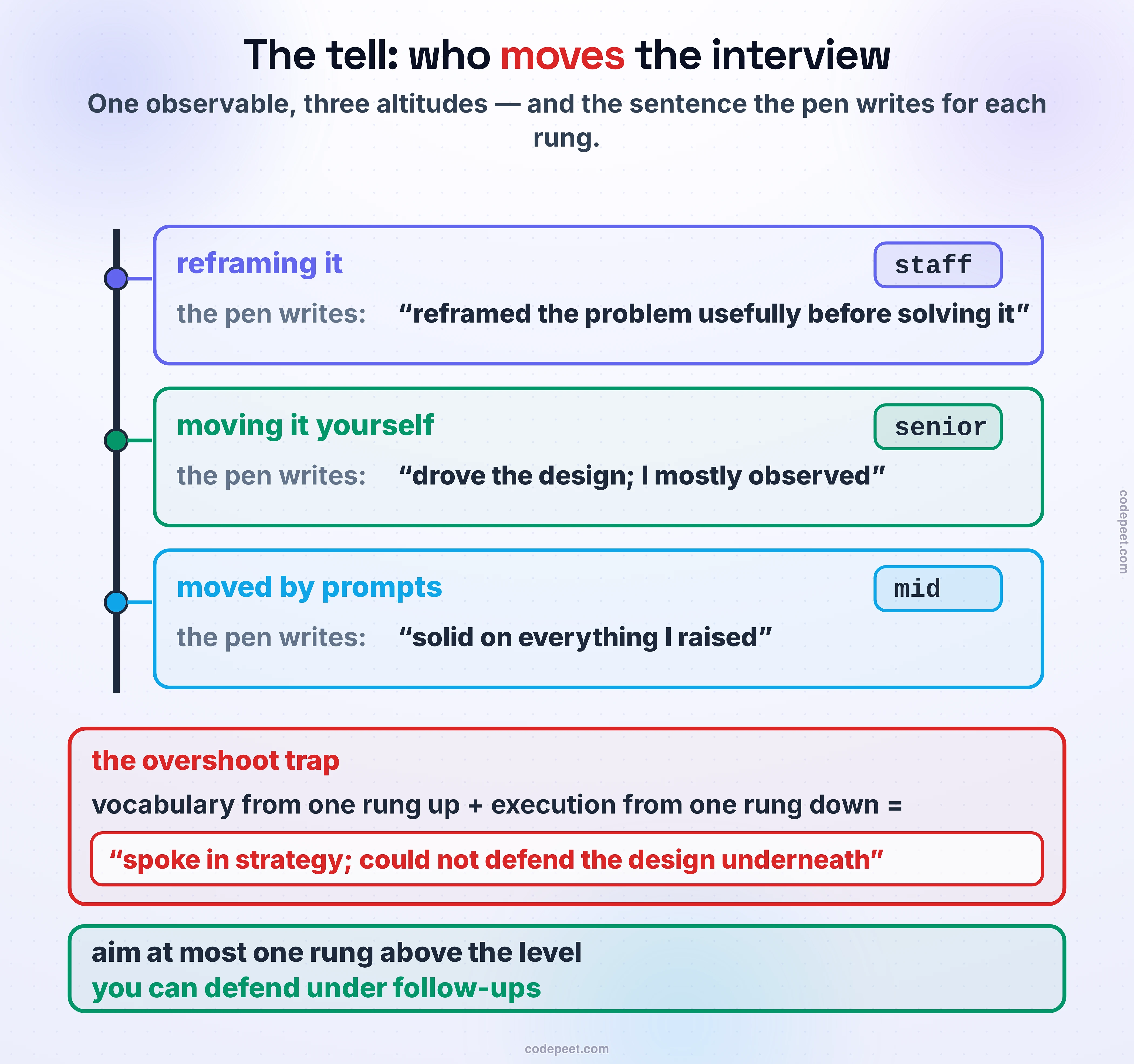
The question does not get harder with level — the ownership gets wider. An L4 answers the question. An L5 owns the problem. An L6 owns the problem-space. And the pen grades altitude with one tell: who moved the interview — moved by prompts, moving it yourself, or reframing what it is about.
The tell is observable in any five-minute stretch. If the interviewer's questions are steering you from station to station and you execute each station well, the hour is being moved by prompts — the pen can write "solid on everything I raised," which is a genuinely good mid-level sentence and cannot be a senior one. If you are scoping, prioritizing, quantifying and billing without being asked — the decision layer's whole discipline — the hour is moving under you, and the pen writes "drove the design; I mostly observed." And if, before solving the problem, you spent ninety seconds interrogating whether it is the right problem — what not to build, which team boundary the design crosses, what the one-year version obsoletes — the pen writes the staff sentence: "reframed the problem usefully before solving it."
Same prompt. Three different hours. The interviewer barely has to grade — the transcript does it.
Three altitudes, four rows
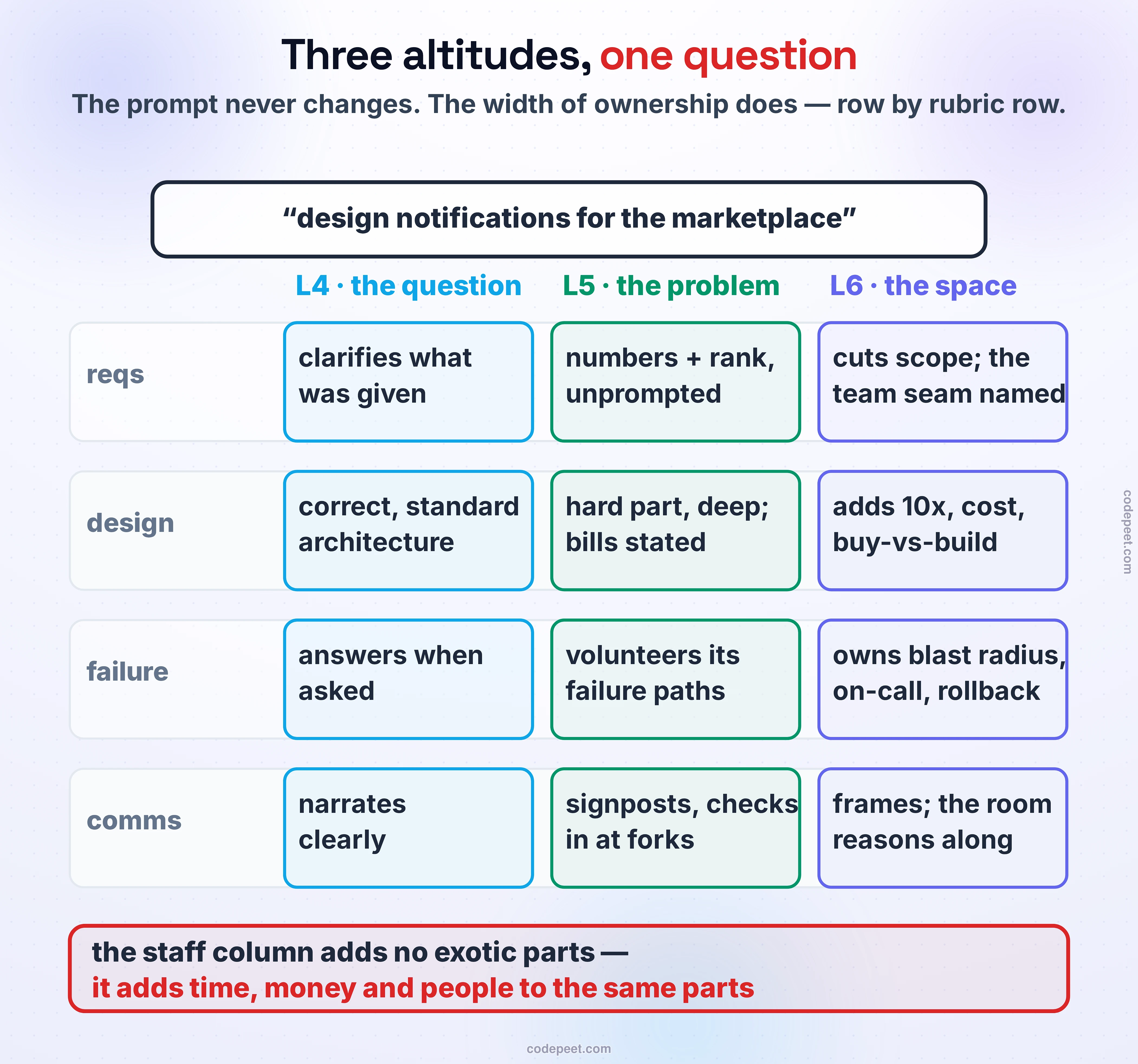
Here is the calibration grid on one prompt — Plates again, its notification path — crossed with the four canonical rubric rows. (The full, annotated answers at each level are the next three lessons; this is the map they fill in.)
| Row | L4 answers the question | L5 owns the problem | L6 owns the problem-space |
|---|---|---|---|
| Requirements | clarifies what was given | converts to numbers, prioritizes unprompted | challenges scope: what do we NOT build now; names the team seam |
| Design | correct architecture, standard parts | hardest component deep; every trade-off billed | adds the evolution path: 10x, build-vs-buy, migration cost |
| Failure | answers failure questions when asked | volunteers its own design's failure paths | volunteers ownership: blast radius across teams, on-call shape, rollback |
| Communication | narrates clearly | signposts, checks in at forks | frames decisions so the room reasons alongside |
Notice what the columns share: nothing in L6's column is harder technology than L4's. The staff column contains almost no new components — it contains wider claims about the same components: time (what this becomes), money (what this costs to run), people (who operates it, which teams it splits across). That is Dropbox's "defining both the what and how" rendered at whiteboard scale, and it is why staff candidates who chase exotic technology miss: the altitude was never in the parts list.
One beat, three altitudes
Hear the difference on a single beat — the first two minutes after the prompt "design notifications for Plates."
L4 opening: "So users need order updates by push and email — let me confirm the scale... okay, a million users. I'll start with an API gateway, a notification service, and a queue for sending." Correct, organized, and the interviewer is already composing the next prompt — the hour will be moved for them.
L5 opening: "Before drawing: three notification classes matter here — order-critical, seller alerts, marketing. They have different freshness promises; I'll say two seconds, thirty seconds, and whenever-cheap. Order-critical is the design driver, so I'm doing it first and doing it deep." The interview just started moving under the candidate: numbers, priorities, and a declared plan — unprompted.
L6 opening: "One scoping question first: is marketing traffic in scope? Because if it is, I'd argue for cutting it — it's a different system with a different team and buying it is usually right. The interesting problem is order-critical delivery, and the seam I care about is that it crosses ordering, sellers, and mobile — so the contract between those teams is my first artifact, before any box." The problem itself just got reshaped — smaller, sharper, and organizationally real.
Three competent openings. Three unmistakable altitudes. And every difference is a sentence the pen can carry to committee.
The overshoot trap
Now the warning this lesson exists to give, because the internet's version of "think like staff" produces it weekly: altitude claimed without depth underneath reads as performance, and it produces the worst sentence on the board.
The failure shape: a mid-level candidate opens with organizational strategy — team seams, build-vs-buy, multi-year evolution — because a blog said staff candidates do that. Then the follow-ups arrive, the design underneath cannot cash the claims, and the pen writes: "spoke in strategy; could not defend the design underneath." That sentence is worse than any honest L4 hour, because it adds a judgment failure to a depth failure.
The rule that survives contact: aim at most one rung above the level you can defend under follow-ups. Every altitude claim you make is a check the deep-dive must cash. L5 openings are safe exactly when your hardest-component depth is real — which nine sections of decision-layer receipts have been building. L6 openings are safe when you can also price the org and the years and then still go as deep as the L5. Undershooting has a cost too — the pen writing "executed well; waited for direction" caps you at mid regardless of your resume — but overshoot is the one that reads as a character flaw rather than a gap.
Thirty seconds in the interview
Calibration you can act on, by target level:
- Targeting mid: execute cleanly and take one visible step of ownership — one unprompted number, one volunteered trade-off. That single step is what separates "solid on everything I raised" from "showed senior signals."
- Targeting senior: the first ninety seconds decide it. Numbers, priorities, a declared plan — then the deepest dive you can defend. Your job is to make the interviewer's steering unnecessary.
- Targeting staff: reframe once, early, cheaply — one scope cut, one team seam, one build-vs-buy — then prove you still have the L5 depth. Staff is senior plus, never senior instead.
| Follow-up you will get | The altitude-aware answer |
|---|---|
| Why did you start there? | Name the driver: this component constrains the rest — the sentence that shows the plan was yours. |
| What would you cut under time pressure? | A priority order you already declared — cutting from a stated list is ownership; improvising cuts is not. |
| How does this evolve? | One concrete 10x break and its fix — evolution as engineering, not vision. |
| Who owns this in production? | The on-call shape and the team seam — the L6 row, answered in one sentence. |
| Is that over-engineering? | Maybe — here is the load number at which it stops being so. Numbers end altitude arguments. |
Where the junior answer dies
- "Higher levels get harder questions, so I'll practice harder questions." Mostly false, and it aims your practice at the wrong variable. Practice wider ownership of the questions you already know.
- "Staff means more technologies." The staff column added time, money and people — not parts. Exotic components without ownership claims read as L4 with a bigger vocabulary.
- "I'll act staff by talking strategy." The overshoot trap: altitude you cannot cash under follow-ups writes the worst sentence on the board.
- "Being helpful and responsive shows seniority." Responsive is the tell of being moved. The senior tell is the interviewer going quiet because steering became unnecessary.
- "My resume level will carry the room." The committee levels you from the sentences, not the resume — How You're Actually Graded is the mechanism, and it has no field for years of experience.
Takeaways
- The question stays; the ownership widens. L4 answers the question, L5 owns the problem, L6 owns the problem-space — the public ladders say it in their own words: projects → team goals → "multi-year, multi-team," "defining both the what and how."
- The tell is who moves the interview: moved by prompts (mid), moving it yourself (senior), reframing it (staff) — each converts to a specific pen sentence.
- Altitude is time, money and people — not parts. The staff column adds no exotic components; it adds wider claims about the same ones.
- The overshoot trap is real: strategy vocabulary without defensible depth writes "could not defend the design underneath." Aim at most one rung above what you can cash.
- Undershoot costs too: flawless execution that waits for direction caps at "solid on everything I raised." One unprompted number breaks the cap.
- Next: the calibration becomes concrete — the same Plates prompt, answered in full at mid level, annotated line by line, so you can see every one of these sentences being earned or lost.