How You're Actually Graded
The document that decides is written after you leave
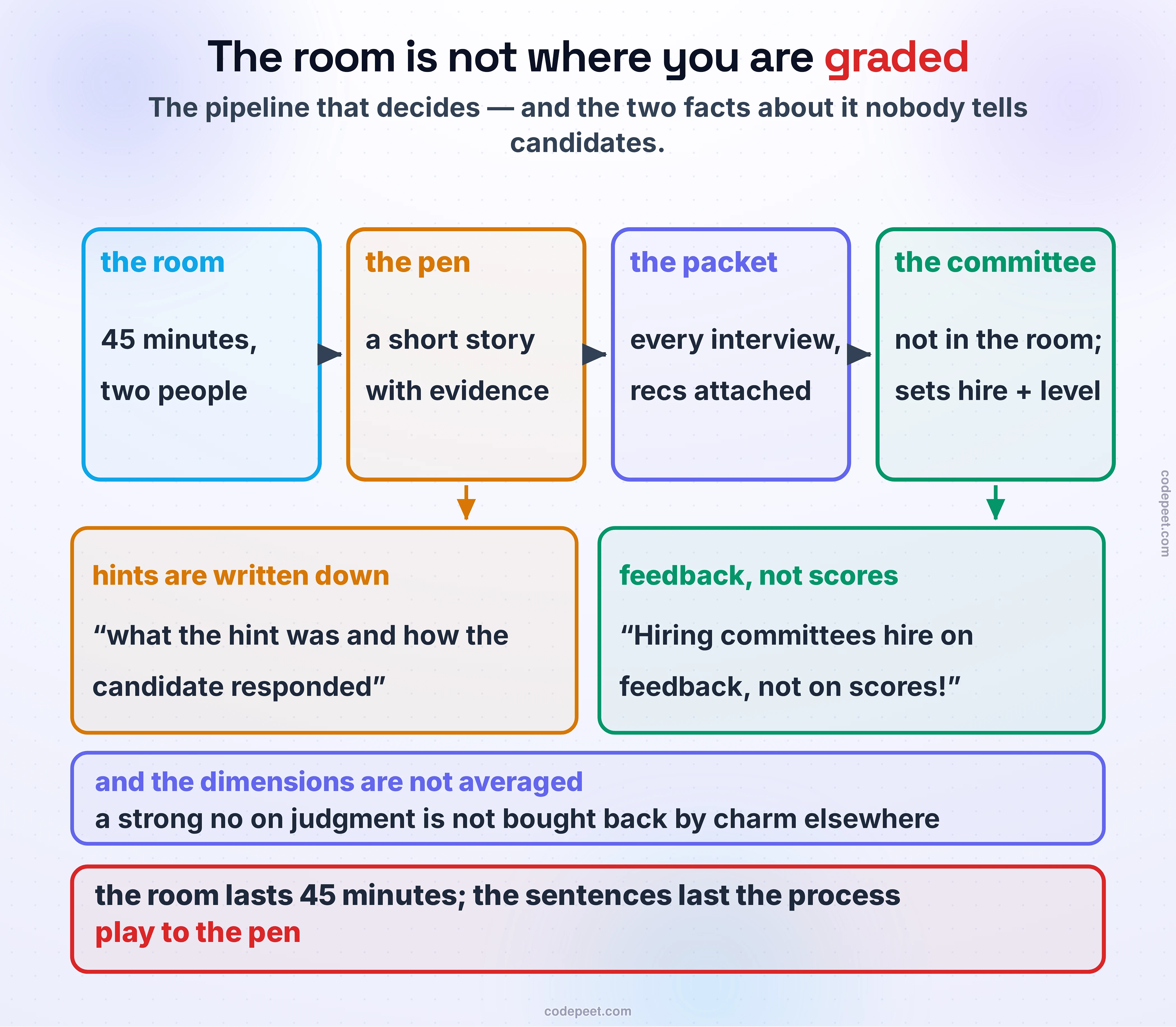
Here is the fact that reorganizes everything else in this final stretch of the course: the decision about you is not made in the room, and it is not made by the person you spent forty-five minutes with. Within a day, your interviewer writes a document. That document joins the other interviews in a packet. A committee — people who never saw your whiteboard, never heard your voice — reads the packet and decides, and in most processes it confirms or adjusts your level at the same time.
An engineer who ran hundreds of these at Google puts it in one sentence: "Hiring committees hire on feedback, not on scores!" And what does that feedback look like? His description: "Good interview feedback reads like a short story of what happened during the interview, including meaningful things the candidate said or produced (code, diagrams), what the interviewer thought of that, and why they thought that."
A short story. With quotes. Which means the real question of your interview is not did I design it well? It is: what sentences did I make it possible to write?
The scoresheet model, measured against the debrief
The model almost everyone preps with is a scoresheet: four boxes, points per box, sum at the end. It is tidy, and it fails a measurement this course already ran. Anatomy of the System Design Interview showed the same board — the same architecture, the same components — producing a hire from one candidate and a rejection from another, and left the mechanism for later. This is later.
A scoresheet cannot explain that outcome, because both candidates would tick the same boxes: right components, right connections, workable design. The debrief explains it instantly. One transcript let the interviewer write "identified the contention point unprompted and bounded it before drawing"; the other made them write "reached a similar design; needed prompting at each risk point." Same board. Different sentences. Different verdicts — because the committee never saw the board. It saw the sentences.
Even the hints you dread work this way. The same interviewer's guidance to his peers: "If you gave the candidate a hint, you want to describe what the hint was and how the candidate responded." Read that carefully: a hint is not a silent deduction. It is an event that gets written down — which means a hint you catch cleanly and build on can produce a stronger sentence than a topic you never touched.
The law: play to the pen
You are not graded on your design. You are graded on the sentences your interviewer can write about it after you leave — and hints are written down along with how you responded. Play to the pen: produce moments that convert into evidence — unprompted, quantified, owned.
Three words in that law are the three strongest things a debrief can say about you, one per dimension of the reasoning majority:
- Unprompted is the judgment word. Raised X before I asked is the single most promotable phrase in interview feedback, because it is evidence you would find the risk without a reviewer standing behind you.
- Quantified is the depth word. Sized the write rate and rejected sharding at this scale survives committee scrutiny; discussed sharding evaporates under it.
- Owned is the maturity word — and you have been practicing it for nine lessons. Every bill you learned to say out loud in the decision layer (the registry cost, the blind CDN, the Scan tax) converts, verbatim, into the sentence named the operational cost of their own choice before I asked.
The dissection, row by row
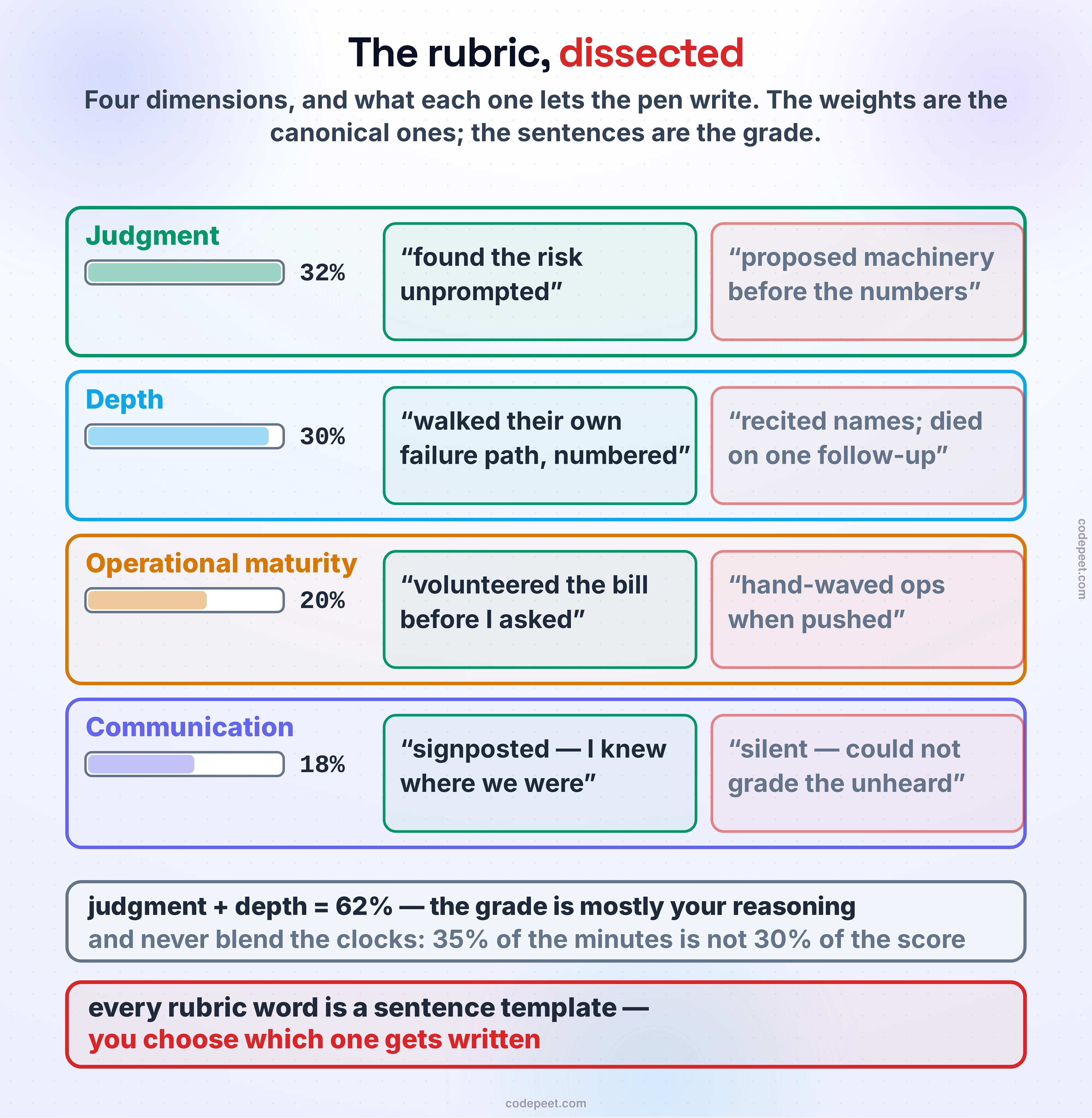
The canonical weights, from Anatomy of the System Design Interview: Judgment 32% · Depth 30% · Operational maturity 20% · Communication 18% — sixty-two percent on how you reason. Here is what each row means at the pen, positive and negative:
| Dimension | The pen writes (strong) | The pen writes (weak) |
|---|---|---|
| Judgment · 32% | identified the risk unprompted; scoped before drawing | proposed machinery before knowing the numbers; needed prompting at each fork |
| Depth · 30% | walked their own failure path with numbers | recited component names; detail did not survive a follow-up |
| Operational maturity · 20% | volunteered the bill and the failure mode | hand-waved operations when pushed |
| Communication · 18% | signposted; I always knew where we were | went silent mid-design; I could not grade what I could not hear |
Two cautions the canon insists on. First: do not blend the clock and the score. The deep dive takes 35% of your forty-five minutes; Depth carries 30% of your grade. Those are different numbers about different things. Second: the dimensions are not averaged into redemption. A committee reading "proposed sharding before asking the write rate" does not offset it with charm elsewhere — judgment failures veto, because judgment is the thing the whole hour exists to test.
One moment, three sentences
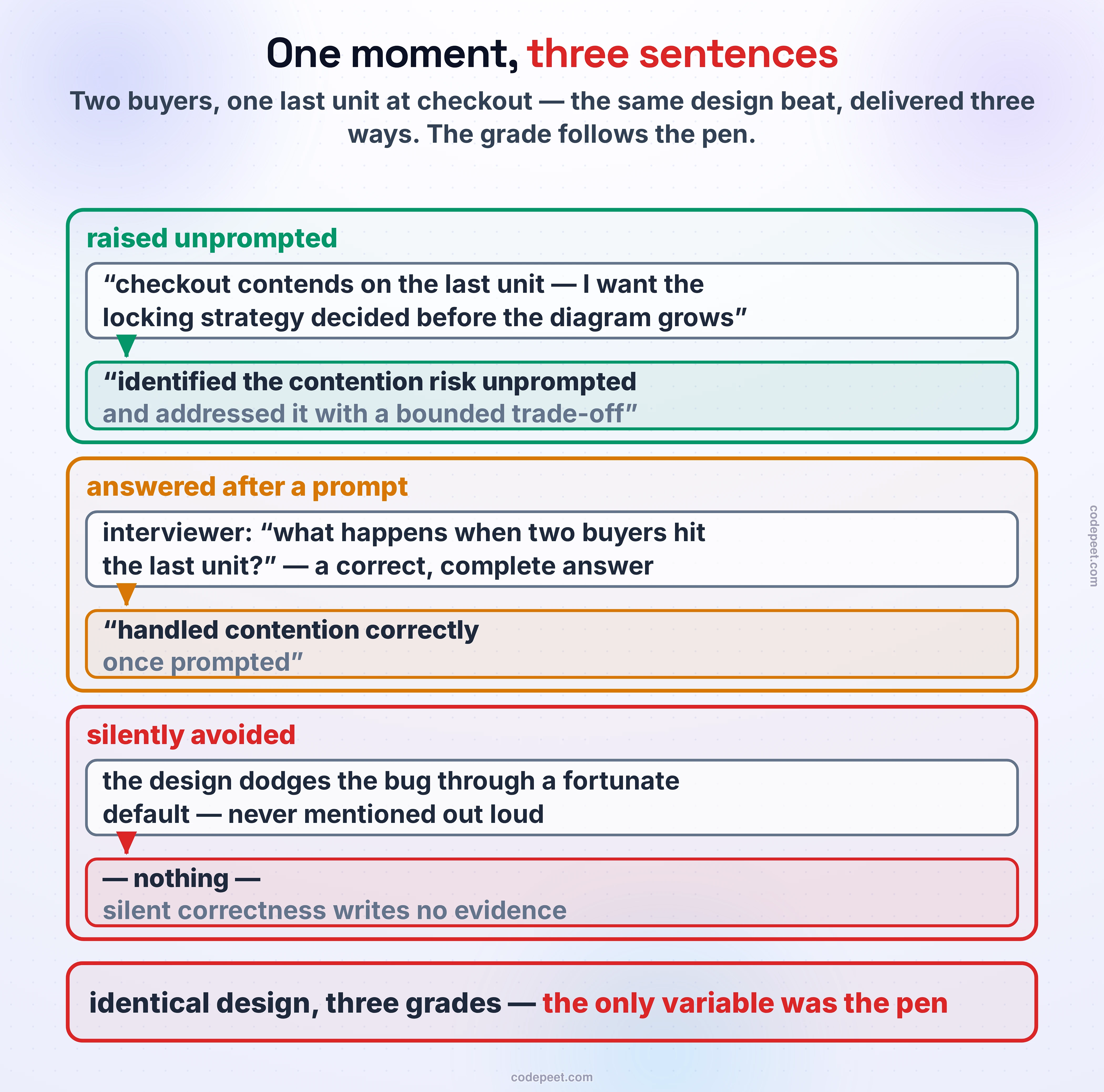
Watch the mechanism on one concrete beat from the Plates marketplace — the moment this course has rehearsed since the contention lesson: two buyers, one last unit, checkout.
Delivery one. You raise it yourself: "Checkout contends on the last unit — before the diagram grows I want the locking strategy decided, because it constrains the datastore." The pen writes: identified the contention risk unprompted and addressed it with a bounded trade-off. That sentence carries judgment, depth and ownership in one line.
Delivery two. The interviewer asks: "What happens when two buyers hit the last unit?" You answer correctly and completely. The pen writes: handled contention correctly once prompted. True. Good. And measurably weaker — the word prompted is now permanent.
Delivery three. Your design happens to avoid the bug — a fortunate default you never mention. The pen writes: nothing. Silent correctness produces no evidence, and no evidence means no grade. This is the cruelest mechanic in the process and the least taught: being right is not enough; the rightness has to pass through the pen.
The design was identical all three times. The only variable was what became writable.
The pipeline, end to end
So the full machine, the one worth picturing while you talk: the room → the pen → the packet → the committee. You control only the first stage, but everything you do there is either pen-convertible or it is lost.
One honest generalization across companies. The exact rubric words vary — Google's four attributes (general cognitive ability, role-related knowledge, leadership, and the culture attribute they famously name after themselves) are attributed to its former People Operations leadership and widely documented rather than published verbatim on a live official page; HelloInterview's four categories map onto the same shape, as Anatomy of the System Design Interview showed. The invariant is not the vocabulary. It is the mechanism: written evidence, read by people who were not there, deciding both the hire and the level. That mechanism is why this final stretch of the course exists — the next lessons calibrate what the pen writes differently about the same design at different levels.
Thirty seconds in the interview
Behaviors that convert into sentences, one per rubric row:
- Open forks out loud. "Two ways to go here — contention-first or read-path-first; I'm taking contention because it constrains the store." That is judgment, unprompted, in real time.
- Attach one number to every claim you want graded. Not "lots of writes" — "about 200 writes a second at peak, so a single leader holds." Unquantified claims are ungradeable claims.
- Volunteer one bill per major choice — the decision layer's whole discipline, now revealed as pen-play: named the cost before I asked is the operational-maturity sentence.
- Label your silences. "Give me thirty seconds to think about the failure path" converts dead air into thought before answering instead of stalled.
- Treat hints as material. When one arrives, restate it, build on it, and land it: the written record becomes took the hint and extended it beyond the ask — a strong sentence, not a deduction.
| The moment | What NOT to leave the pen | What to hand it |
|---|---|---|
| A risk you spotted | fixing it silently | naming it, then fixing it |
| A hint | a bare correct answer | the hint restated, extended, landed |
| A trade-off | the winner only | the winner plus its bill |
| Thinking time | silence | a labeled pause |
| A wrong path | quiet backtracking | "that breaks at N — reversing it" |
Where the junior answer dies
- Performing for the person instead of the pen. Rapport is pleasant and unwritable. The friendly hour that produced no evidence sentences is a rejection with a smile on it.
- Treating hints as failure. The deduction is not the hint — it is a bare response to one. "Needed a hint, then extended it beyond the ask" reads as coachability, and committees pay for coachability.
- Silent correctness. The fortunate default you never mentioned wrote nothing. If your design dodges a classic failure, say why it dodges it — convert the luck into judgment.
- Keyword deposits. Saying "we could use Kafka here" writes nothing; committees have read ten thousand Kafkas. The named contract and its bill write. Vocabulary is not evidence.
- Asking the room for the grade. "Did I pass?" cannot be answered by the only person who will never decide it. The grade is being written tomorrow, from notes — which is why every behavior in this lesson aims there.
Takeaways
- The committee reads sentences, not scores — the decision is made from a written short story by people who never saw the room, and it sets your level too.
- The canonical weights: Judgment 32 · Depth 30 · Operational maturity 20 · Communication 18 — 62% reasoning. Clock and score stay separate: 35% of the minutes is not 30% of the grade.
- The three signal words: unprompted (judgment), quantified (depth), owned (maturity) — and signposting keeps all three audible.
- Hints are written down with your response — a caught hint can outscore an untouched topic; a bare answer to one cannot.
- Silent correctness writes nothing. Rightness has to pass through the pen.
- Next: the same pen, three altitudes — what it writes about the identical design from a mid-level, a senior, and a staff candidate. That is the L4, L5 and L6 rubric, and it is where calibration begins.