Anatomy of the System Design Interview
Introduction
A candidate sits down. The interviewer says six words — "Design a food-delivery marketplace. Go." — and something drops in the candidate's stomach. Forty-five minutes to reinvent a system that real companies spent a decade and a thousand engineers building, and somewhere out there is the right answer they're supposed to already know.
That fear is the very first thing to kill, because it is simply wrong. There is no answer to recall. You are not being asked to produce a blueprint. You are being asked to produce something else entirely — and the moment you see what, the whole interview changes shape and most of the anxiety drains out of it.
This lesson is the map of the game: what this interview really is, what it actually measures (the number tends to surprise people), how the forty-five minutes are shaped, who is sitting on the other side and what they're doing, and the handful of quiet fears that sink genuinely strong engineers.
One promise about scope, so you know what today is and isn't. We'll name the five phases of the conversation here and what each one is for — but the timed, move-by-move way to actually run them is the next lesson's whole job, The Delivery Framework. The deeper questions of what to design — how to pin requirements, size the load, model the data — each get a lesson of their own. Today is the shape of the game, not the moves.
It’s a conversation, not an exam
Start with the format, because a lot of the fear comes from imagining the wrong one. A system design interview is a forty-five to sixty minute conversation, almost always remote now, over a shared canvas you both can draw on. The interviewer hands you an open, deliberately vague prompt and you decide what the system needs, how data moves through it, and what you're trading off to get there.
The prompts come in two flavors. Product design asks you to build something users touch — "design a ride-sharing app," "design a group chat." Infrastructure design hands you one focused component — "design a rate limiter," "design a service that serves an ML model." Product questions need a whole cast of pieces; infrastructure questions go narrow and deep. Either way, the blank canvas is yours to fill.
Here's the reframe that matters most: it is a conversation, not a presentation. You do not sit in silence for half an hour and then unveil a finished masterpiece. You propose an approach, the interviewer pushes on it, and you refine — together, out loud. In 2026 the interviewer often plays a role while they do it: a skeptical product manager, or a junior engineer who keeps asking "wait, why that?" Even the companies that once loved a silent whiteboard have moved to this. The pushing back is not the interviewer being difficult. It is the entire point — and we'll come back to why in a minute.
And there is no single right answer. As the team behind HelloInterview puts it plainly, "for many questions, there are many right answers." Two strong candidates can draw two genuinely different systems and both walk out with an offer. Which raises the real question: if they're not grading the answer, what on earth are they grading?
The scorecard nobody shows you
Pull apart what interviewers actually write down, and it lands in four buckets — and roughly two-thirds of the weight is on how you reason, not what you know. That single fact should reorganize your entire preparation.
One rubric that's been made public weights it like this: Judgment 32%, Depth 30%, Operational maturity 20%, Communication 18%. Look at the top two. Judgment and Depth together — sixty-two percent — grade the quality of your thinking: whether you scoped the problem before drawing, whether you went deep on the parts that carry real risk, whether your choices actually fit the requirements. HelloInterview's version uses different words for the same shape — Problem Navigation, Solution Design, Technical Excellence, Communication — but the center of gravity is identical: reasoning, then knowledge.
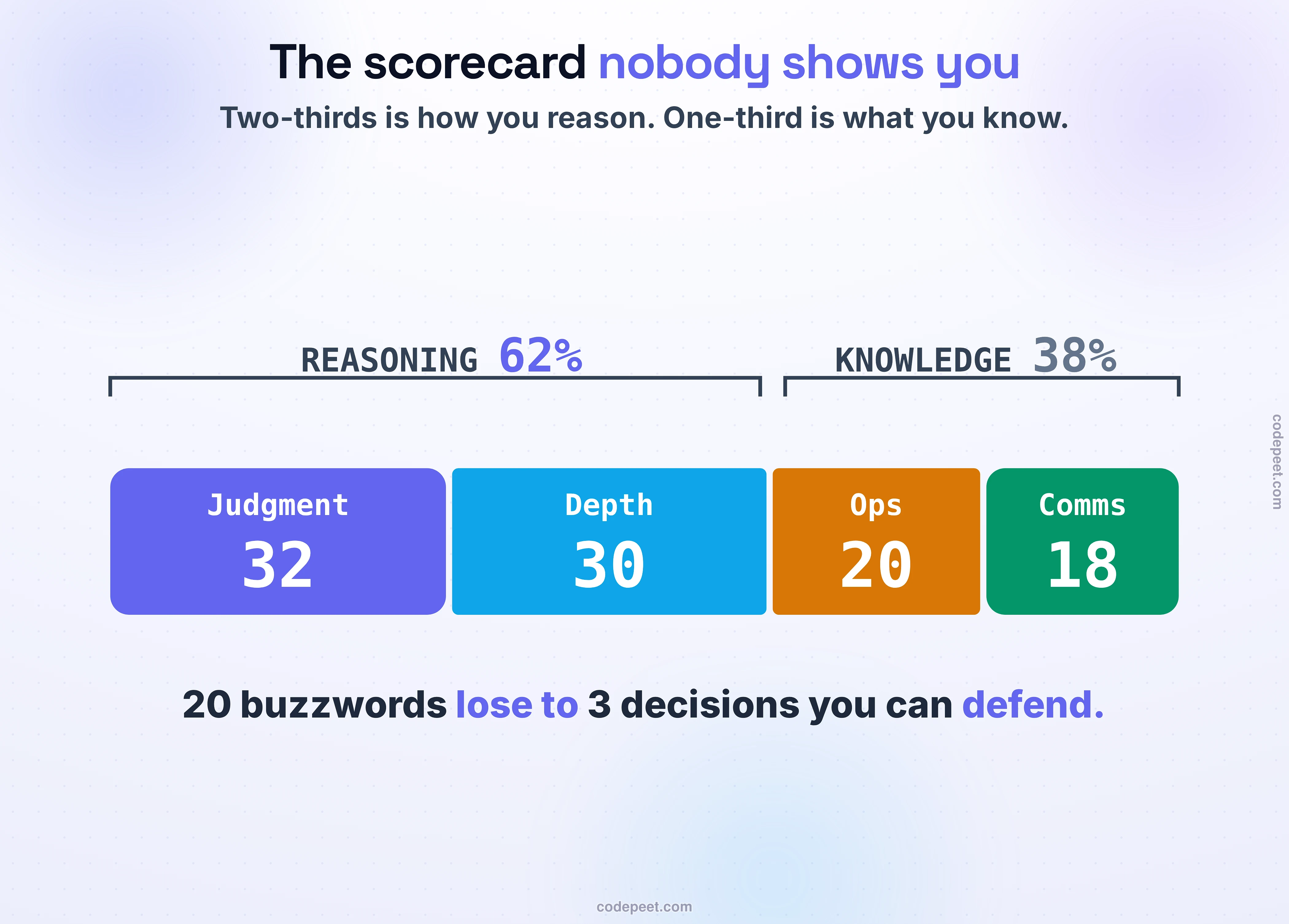
The blunt implication: if your prep is a tall stack of memorized architectures, you're optimizing for the thirty-eight percent that's knowledge — and competing there against every other candidate who memorized the exact same stack. Meanwhile the sixty-two percent that actually separates people goes untrained.
It gets sharper. A candidate who name-drops twenty technologies but reasons deeply about none should — and does — score below one who picks three decisions and defends each of them well. More boxes on the board is not more points. Past a certain point it is fewer, because every component you add is one more thing you now owe the interviewer a reason for. The whole skill is choosing the few that matter and being able to say why.
Why companies bet on this hour
So why would a company spend its most expensive engineers running a test that has no right answer and can't be cleanly graded? Because it is the closest thing they have to watching you do the actual job.
Real engineering work almost never arrives as a clean, well-specified task. It arrives as "users should be able to share files," or "search is too slow," or "we're getting paged every night and nobody knows why." Vague, under-scoped, and yours to shape. A coding interview answers one question: can you implement a well-defined thing? This interview answers a harder one: can you take ambiguity, break it into pieces, choose the right building blocks, and defend the choices out loud while someone challenges them?
That's why one hiring manager called system design "the highest-signal hour you can spend with a candidate… if you had to run just one interview, this would be it" — they put its correlation with real on-the-job performance around seventy-five percent. And it's why the interview barely exists for new grads and comes to dominate at senior levels. The more senior the role, the more the job simply is judgment under ambiguity — so the more the interview leans on the round that measures exactly that.
The 45 minutes, dissected
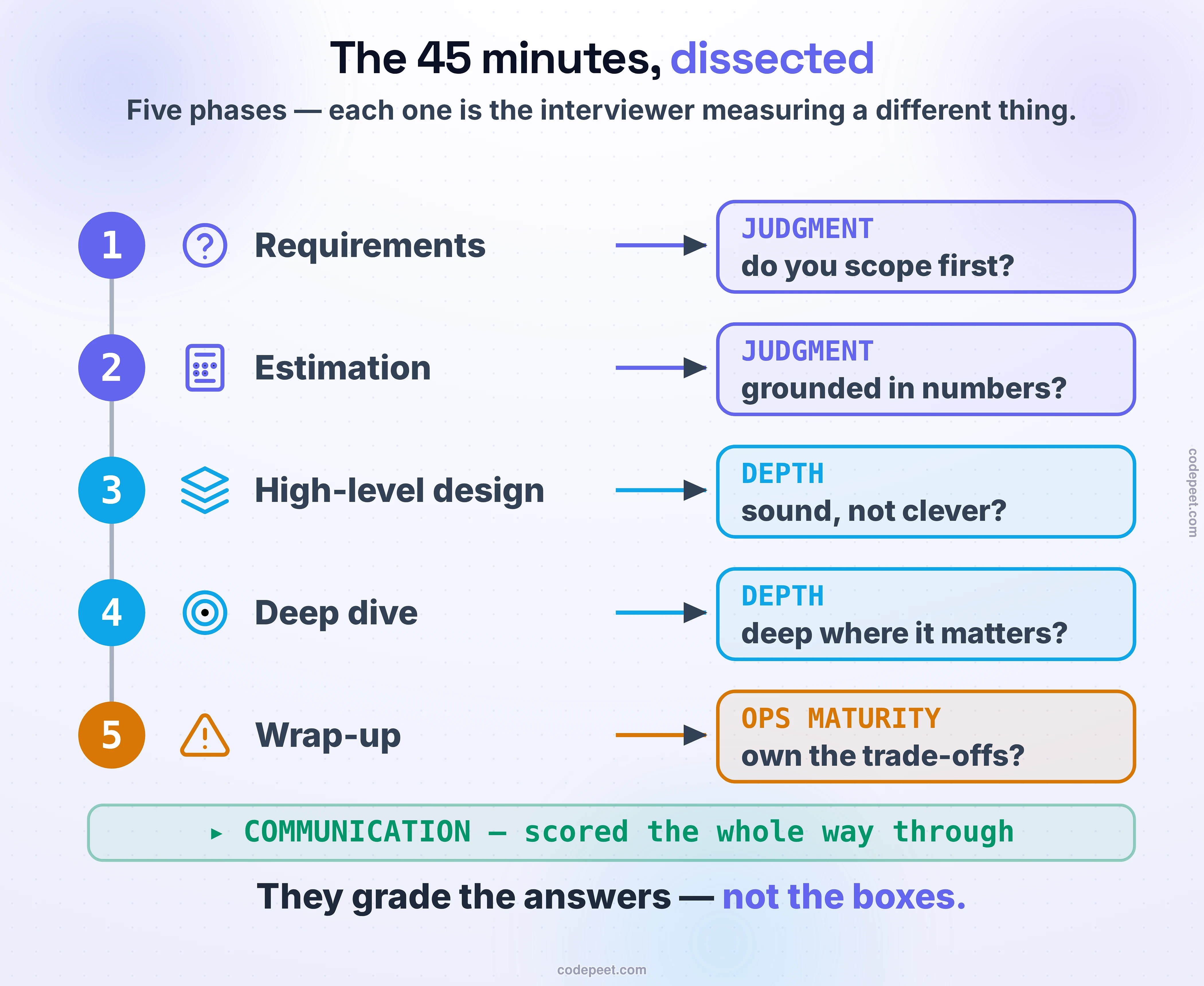
Zoom into the clock and you'll see the same five movements almost every time. The point of seeing them now isn't to memorize a script — it's to notice that each phase exists to pull a different signal out of you. The conversation is engineered, whether the interviewer says so or not, to sample all four scorecard dimensions.
-
Requirements. You clarify what to build and how well it must behave — the features, and the scale, latency, and availability targets. Signal: do you scope before you draw, or dive straight into architecture?
-
Estimation. A quick back-of-the-envelope sizing — users, writes per second, storage growth. Signal: can you ground a design in real numbers, and use them to locate the hard part?
-
High-level design. The first boxes on the board, sketched with the interviewer as a teammate, not presented at them. Signal: is your structure sound and appropriate — not clever?
-
Deep dive. You (or the interviewer) pick two or three components and open them up. Signal: can you go deep where it actually matters? At senior level you're expected to volunteer where the depth should go, not wait to be pointed at it.
-
Wrap-up. You stress the design out loud — bottlenecks and trade-offs — what happens when traffic ten-times overnight, a region goes dark, the cache fills up, the bill arrives. Signal: operational maturity, and the honesty to name the downsides of your own choices.
Five phases, five signals. That's the anatomy. Turning it into a timed, repeatable method you can run under pressure — how many minutes each phase gets, how to keep from drifting — is exactly what the next lesson, The Delivery Framework, is for.
The person across the table
It helps to know who is actually grading you, because most candidates imagine the wrong person. It is not an adversary hunting for the one thing you don't know. It is a future colleague running a small simulation of what it would be like to build something with you.
Which means the clearest sign your interview is going well is deeply counterintuitive: the questions get harder. When the interviewer starts probing deeper, doubting a choice, or expanding the scope of the problem, that is usually confidence, not a trap — they already think you're strong and they're testing for your ceiling. A neutral, poker-faced reaction isn't bad news either; good interviewers stay analytically calm on purpose. What they're really watching underneath the technical content is simple: do you treat this as a collaboration or an interrogation? When they push, do you take the point and adapt — or dig in and defend?
That reframe alone defuses a lot of interview anxiety. The full playbook for the questions that make people nervous — how much detail is enough? what if I don't know a technology they mention? do I need exact numbers? — is important enough to get its own lesson later, The Questions Everyone Asks.
See it: same board, different verdict
Everything above is one claim: the interview scores your judgment, and the components are almost a side effect. That's hard to believe until you feel it, so feel it. Below, you're the candidate. Make one judgment move per phase — clarify or dive in, ground the scale or over-build, go deep on the money path or gold-plate the trivia, take the pushback or defend against it — and watch the four signals and the live verdict move in real time. Then hit reset and run the opposite moves. The trick to notice: the boxes you end up drawing come out the same either way. The verdict does not.
Five fears, corrected
The fears that quietly sink good engineers are all the same shape — a true belief about some other kind of test, misapplied to this one. Name them and they lose their grip.
- "It's a memory test." It's a judgment test. Two-thirds of the score is reasoning; the memorized part is the smaller, more crowded half of the room.
- "There's a right answer I have to find." There are many right answers — and many wrong processes. You're graded on the process, not the destination.
- "More components means a stronger design." Twenty buzzwords lose to three decisions you can defend. Every extra box is another debt you owe the interviewer.
- "I should stay quiet until I have the whole design." Silence is a void they can't score. They're grading the conversation — and they cannot reward thinking they can't hear.
- "The interviewer poking holes means I'm failing." The poking is the test, and harder questions usually mean they're impressed enough to look for your ceiling.
What it doesn’t measure
Because you're going to be the senior engineer in the room one day, here's the honest part most guides skip. This format is the best single hour we have for evaluating design skill — and it is not the job, and it doesn't pretend to be.
Forty-five minutes on a clean whiteboard rewards a coherent narrative. It struggles to see how your decisions age: the schema migration two years later, the backward-compatibility break, the slow incremental rewrite — which is most of what senior work actually is. It quietly assumes you have full control, so it misses the parts of real systems where you don't: the team boundaries, the stakeholder tug-of-war, the decade of legacy you can't just delete. It rewards idealized design; production rewards constraint-aware execution under partial failure. And a weak interviewer can be fooled by a well-rehearsed canonical architecture — which is precisely why strong ones keep probing your reasoning until any rehearsal runs out.
Know this not to dismiss the interview, but to play it clear-eyed. It's a game with real, learnable rules and a scorecard you can now see — not a perfect oracle, and not a verdict on your worth as an engineer.
The thread from here
So the interview isn't a quiz you cram for. It's a performance of judgment you can practice — and practice is exactly what the rest of this part of the course is. Every lesson ahead sharpens one of the four signals: how to elicit and commit to requirements, how to run the five phases on a clock without drifting, a reusable template that keeps you organized under pressure, how to think out loud without drowning, and how to draw a diagram that helps you think instead of just decorating the screen.
And at the very end, you'll sit down for a full forty-five minute run on a system you'll have designed four times over by then — the food-delivery marketplace — and grade yourself the way an interviewer would, against the same rubric you just met. The fear you walked in with was of a test you might fail. What you're actually here to build is a skill. Let's start.