Communicating While Designing
The only channel
Two candidates draw the same three boxes. One gets the offer.
You already know from Anatomy of the System Design Interview that roughly two-thirds of the score is your reasoning rather than your recall. Here's the problem nobody states plainly: reasoning is invisible. It happens entirely inside your head, and the person grading it is looking at a screen with some rectangles on it.
So narration isn't a soft skill bolted onto the side of the real work. It is the only channel through which the thing being graded can reach the person doing the grading.
They cannot grade what they cannot hear.
An un-narrated design doesn't score badly because the interviewer is being harsh. It scores badly because, from where they sit, it is indistinguishable from a design nobody thought about.
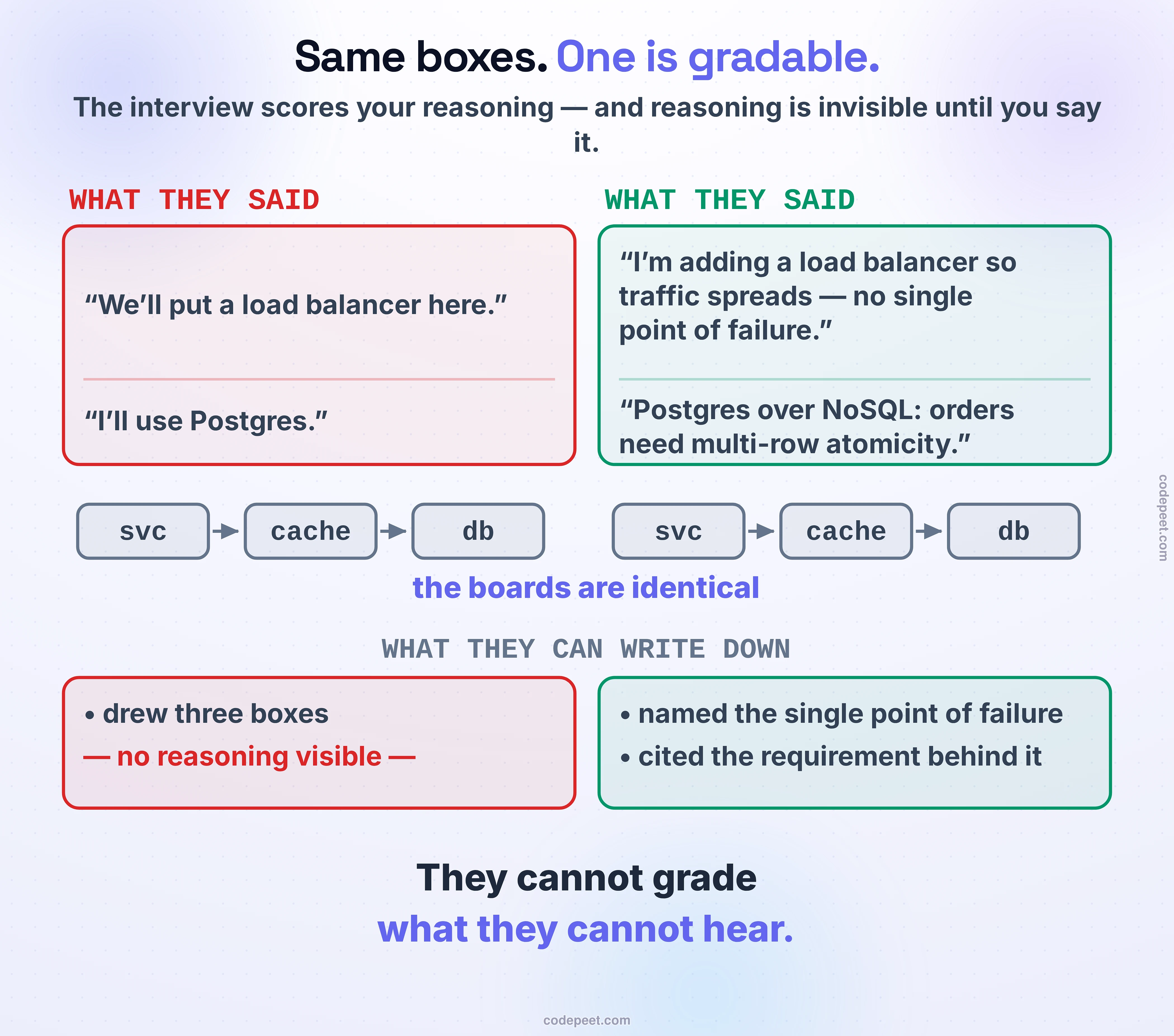
Look at what the interviewer can actually write down. On the left: drew a standard three-tier stack. That's it. That's the whole record of forty-five minutes.
On the right, from the same boxes: named the single point of failure, cited the requirement behind the datastore, knows what was traded away, knows what he'd do next. Four scorable observations that the left-hand candidate also had in his head and simply never said.
The upgrade is one word
The highest-leverage change in this entire lesson is a single word, and the word is because.
"We'll put a load balancer here."
"I'm adding a load balancer here so traffic spreads evenly and there's no single point of failure."
Same box. Same six seconds. The first is a fact — and facts are the cheap half of the scorecard, because anyone who has seen a diagram can produce them. The second is reasoning, and reasoning is the expensive half.
Run this as a rule with no exceptions: every component you place gets a clause. Not a paragraph — a clause. "...so we can scale the read path independently." "...because the menu is read far more often than it changes." "...so a courier dropping off doesn't lose the order."
If you can't produce the clause, that is extremely useful information: you've just found a box you can't defend. Better to find it yourself at minute fourteen than to have the interviewer find it at minute thirty.
The things that can never be drawn
There's a sharper way to decide what deserves airtime. Ask: could this end up on the board? If yes, drawing it is enough. If no, it only exists if you say it.
Four things fall permanently into the second category:
- The alternatives you rejected. Your board shows Postgres. It cannot possibly show that you considered a document store and turned it down. Unsaid, that consideration never happened.
- Why you committed. The reason lives in your head; the box lives on the screen.
- What you traded away. Every choice has a cost, and naming your own cost is one of the strongest maturity signals available — it's the difference between "I picked this" and "I picked this knowing what it costs me."
- What would change at a different scale. "At ten times this write rate I'd have to partition by courier region — at this rate it's not worth the complexity." That sentence shows you know where the design's ceiling is, and a diagram never can.
This also tells you what not to narrate. The components themselves are on the board — reading your own diagram aloud is the most common way to spend airtime and buy nothing.
Signpost before, check in after
Sentence-level narration makes your reasoning audible. Two conversation-level moves make it navigable, and they bracket every phase.
Signpost before you move. Say the move before you make it: "Before we design anything, let me clarify the problem." "I'm going to spend about four minutes on numbers, then get an end-to-end design up — does that sound good?" This costs five seconds and converts what would otherwise look like drifting into a visible plan. It also gives the interviewer a clean moment to redirect you before you spend the time, which is exactly when redirection is cheap.
Check in after. "I'll pause here and see if you have any questions." "Would you like me to write out the full API definition, or cover it at a high level?"
And here's the part that makes check-ins matter far more than they look. Interviewers are trained not to reveal much signal. They keep a deliberately flat face because reacting would contaminate the assessment. Add a video call, which strips out most of the small nonverbal feedback you'd normally read off a person, and you are designing almost blind.
A check-in is how you manually reacquire the signal the format deleted. You are not asking for reassurance; you're sampling. And it protects your clock, because the cheapest possible moment to discover they wanted the write path instead is before you've spent eight minutes on the read path.
Silence is fine — if you label it
Some questions need genuine thought. You're allowed to take it. The rule is narrow:
You may be quiet. You may not be quiet without saying why.
"Let me think about the write path for a second." Five words, and the next fifteen seconds of quiet are legible as concentration. Without them, over video, silence reads as stuck — because they can't see your face doing the work, and their honest interpretation of dead air is that you've hit a wall.
The instinct this replaces is worse than either: filling the gap with noise. Talking to avoid silence produces sentences with nothing in them, and those sentences don't just waste time — they bury the good ones. A labelled ten-second pause is better than sixty seconds of improvisation, every time.
The seven sentences
Everything above reduces to a small set of sentences. Not seven skills — seven sentences, each one converting something invisible in your head into something the person grading you can write down.
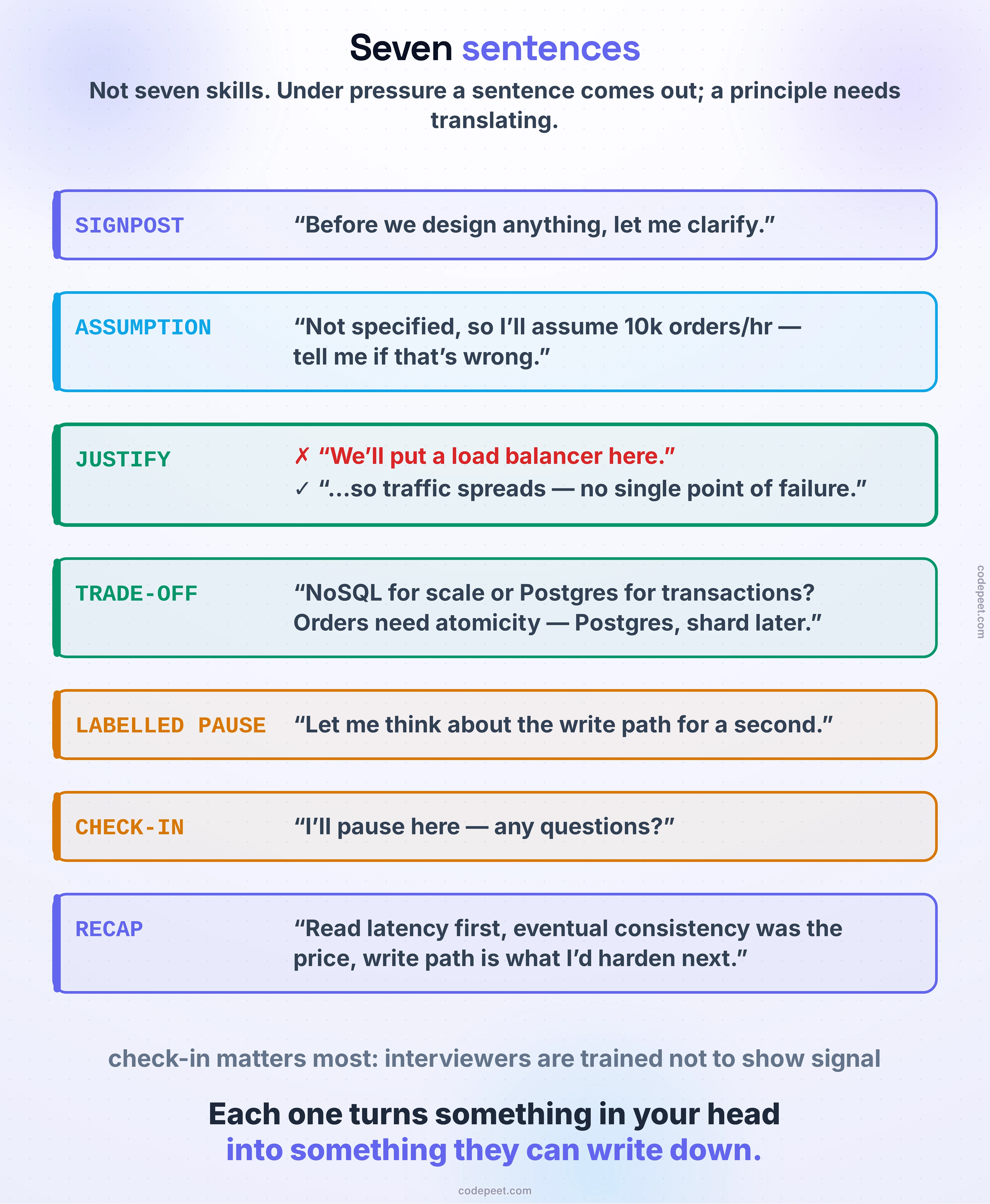
Learn them as sentences, not as principles. Under pressure, a principle needs translating and a sentence just comes out. The justify card is the one that pays for the others — if you only ever internalise one, make it the clause after the component.
Where more stops being better
Everything so far pushes one way: say more, justify more, make it audible. Now the counterweight, and it's the reason this lesson is harder than it looks.
This is the one habit in the method that has an optimum rather than a direction. Everything else you've learned points one way — scope harder, go deeper, make every box traceable. Narration doesn't. It has a floor and a ceiling.
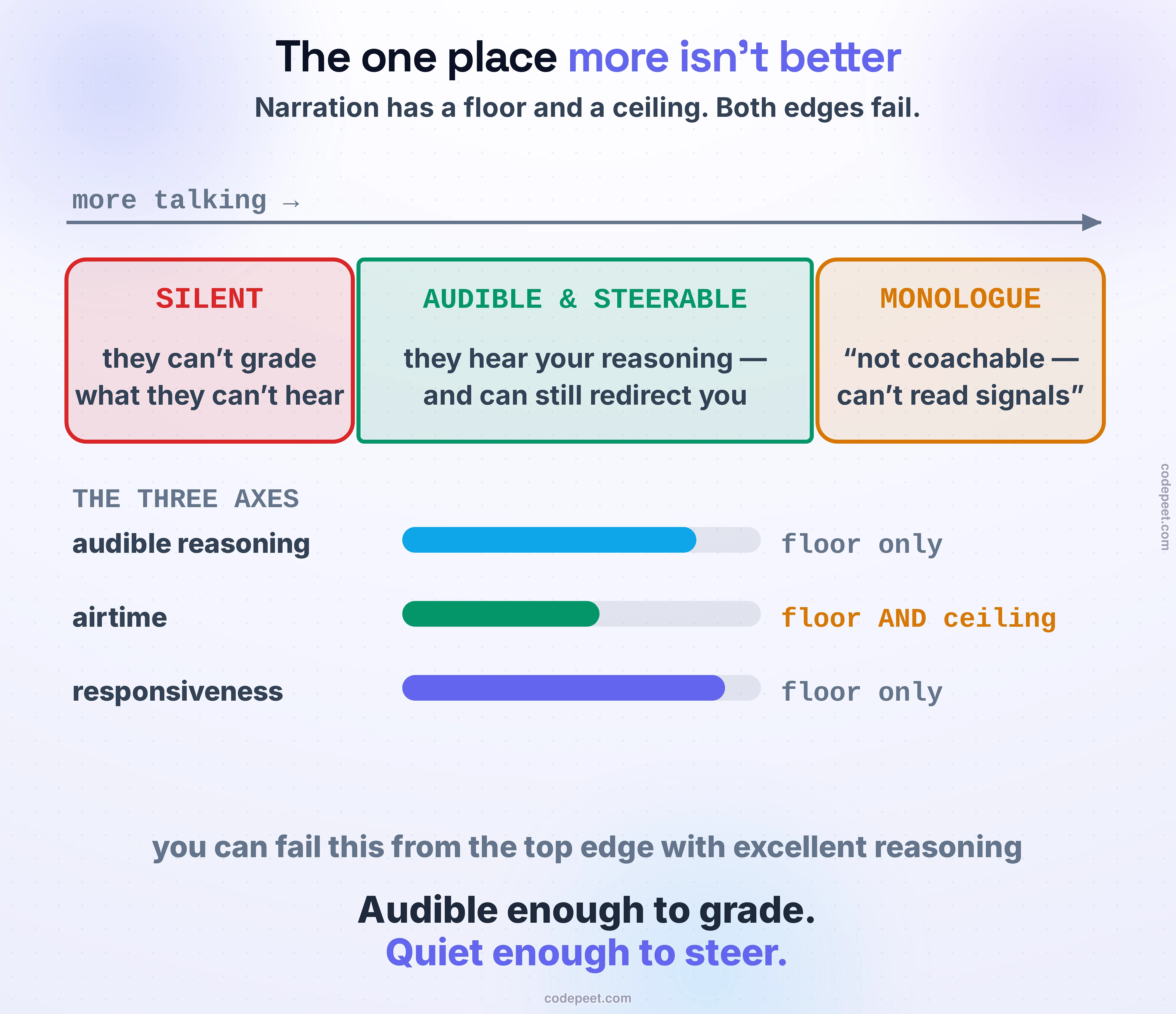
The right-hand edge is the one nobody warns you about, and strong engineers land on it more often than weak ones. You know a lot; you explain thoroughly; you're mid-flow. And somewhere in there the interview stopped being a conversation and became a lecture.
Interviewers describe this in blunt terms. "Not coachable — can't read signals" is a real rejection line, and it gets written about candidates whose technical work was fine. Some interviewers will deliberately give you room to keep going, precisely to see whether you notice that nobody has spoken in four minutes.
The mechanism is simple once you see it: the interviewer's job is to steer you toward the parts they need to assess. They have a mental list of things they must see before they can write your feedback. If you never come up for air, they can't steer — and an unsteerable candidate doesn't get to the questions where the marks were.
So the target isn't loud. It's audible and steerable: they can hear your reasoning, and they can still redirect you.
Hear it for yourself
A band is hard to feel from a description, so here's the same conversation with the meters showing.
Six moments, three ways to handle each. Watch all three meters, because they genuinely fight each other: you can't make your reasoning audible without spending airtime, and airtime is the one axis with a ceiling.
Run it three times. Once trying to say everything — and notice you can fail with excellent reasoning. Once saying almost nothing. Then once narrating properly, but talk over the interviewer when they cut in, and watch a single moment undo five good ones.
The three moments that decide it
Most of an interview is ordinary narration. Three moments carry disproportionate weight, and they're all moments where instinct is wrong.
When they cut in. The interviewer interrupts to ask about something else. Instinct says finish your sentence — you were making a good point. Don't. The interruption is the signal. They are telling you where the marks are, for free. "Good — let's go there now" costs you one abandoned sentence and buys you the rest of the interview. And be honest about what "sure, but first let me finish…" actually is: a refusal wearing a yes.
When you don't know. Bluffing is the worst option available, because this is exactly where interviewers probe hardest and a collapsing bluff costs far more than the gap. Freezing is barely better. The strong move is a shape:
"I haven't run that in production. From first principles I'd expect it to behave like X — and if that assumption is wrong, here's the part of the design that breaks."
You named the limit of your knowledge, then reasoned anyway, then said what your uncertainty would cost. That is the skill being tested, performed on live ammunition. It routinely scores better than a confident correct answer.
When you disagree. Sometimes their suggestion is genuinely worse for your requirements. You're allowed to say so — the failure mode isn't disagreeing, it's disagreeing defensively. Point back at the commitment instead of at your preference: "That would simplify the write path, but we committed to sub-100-millisecond reads and that adds a hop — unless you'd rather relax the latency target?" You've disagreed, cited the agreement you both made, and handed them the decision. Nobody's ego is in the room.
One-way and two-way doors
One phrase pair does more for how senior you sound than any amount of vocabulary, and it costs nothing to learn.
Frame each decision by reversibility. A two-way door is cheap to undo — you walk through, look around, and walk back if you don't like it. A one-way door is painful or impossible to reverse.
"Which cache we use is a two-way door — I'll take Redis and move on. The partition key is closer to a one-way door, because changing it later means a migration under load, so let me think about that one properly."
Look at what that sentence does at once. It shows you know the decisions differ in weight. It justifies moving fast on the cheap one — which reads as decisiveness rather than carelessness. It justifies slowing down on the expensive one — which reads as judgment rather than dithering. And it hands the interviewer a clean place to push.
It also solves a real problem from the previous lessons: you have thirteen minutes of High-level design and a dozen decisions. This is how you spend the time unevenly and say why — the alternative is treating every decision as equally weighty, which is precisely how the clock disappears.
Practising something you can’t hear yourself do
Narration is uniquely hard to self-assess, because while you're thinking you cannot tell how much of the thinking is leaving your mouth. It feels obvious from the inside. It very often isn't from the outside.
There's one drill that fixes this, and it takes ten minutes:
Record yourself. Take any problem. Out loud: explain the scope, ask three non-functional requirements, state a latency budget, and narrate one trade-off. Ten minutes, then play it back.
The playback is uncomfortable and that's the point — the gaps are unmissable on tape and invisible while you're in it. You will hear yourself announce a component with no clause after it. You will hear a twenty-second silence you'd have sworn was three. You will hear yourself explain something for ninety seconds that needed fifteen.
None of those are knowledge problems, which is why studying more architectures will never fix them. They're delivery problems, and hearing them once fixes most of them.
What good narration actually buys
Communication is a fifth of the rubric on its own — but that undersells it badly, because narration is also the carrier for everything else. Your judgment, your depth, your operational instincts: none of them score unless they're audible. It's the multiplier on the other four-fifths.
And there's a second payoff that has nothing to do with scoring. Narrating forces you to form the reason at the moment you make the choice, not thirty minutes later when you're challenged. Candidates who narrate well make better designs — not because talking is magic, but because a reason you have to say out loud is a reason you actually had to have.
So: a clause on every box. Say the alternatives, the cost, and the ceiling, because those can never be drawn. Signpost before, check in after. Label your silences. Stay inside the band — audible enough to grade, quiet enough to steer. Take the interruption. Say I don't know and then reason anyway. And name which doors are one-way.
You now have the clock, the board, and the voice. The last piece of the craft is the drawing itself — because a diagram the interviewer can't follow hides the reasoning you just worked so hard to make audible. That's Whiteboard & Diagram Craft, next.