Why Design Principles Exist — The Cost of Bad Design
Introduction
You have learned how to write classes, use inheritance, apply polymorphism, and model relationships between objects. You can build working software. But here is a question that separates junior developers from senior ones: can you build software that stays working when requirements change?
Most software projects do not fail because the code does not work. They fail because the code becomes impossible to change. A small requirement tweak cascades through dozens of files. A bug fix in one module breaks three others. Adding a new feature means rewriting half the system.
This is the cost of bad design — and it is devastatingly real. Industry studies consistently show that developers spend roughly 70% of their time reading and understanding existing code, not writing new code. When that existing code is poorly designed, that percentage climbs even higher, and every change becomes a minefield.
Design principles are the antidote. They are a set of guidelines that experienced developers have distilled from decades of building and maintaining large systems. They tell you not just how to write code, but how to organize code so it survives contact with the real world.
In this section, you will learn the five SOLID principles — the most widely taught and most practically useful set of design guidelines in object-oriented programming. But before we dive into each principle individually, let us first understand why design principles exist at all, and what happens when you ignore them.
The Real Cost of Bad Design
Bad design does not announce itself on day one. When you first write a class, everything feels clean and manageable — the code works, the tests pass, the feature ships. The problems surface later — when the codebase grows, when requirements change, when new developers join the team and cannot understand what the code does.
Robert C. Martin, the engineer who coined the SOLID acronym, identified three primary symptoms of rotting software design. Think of these as the "diseases" that design principles are meant to prevent:
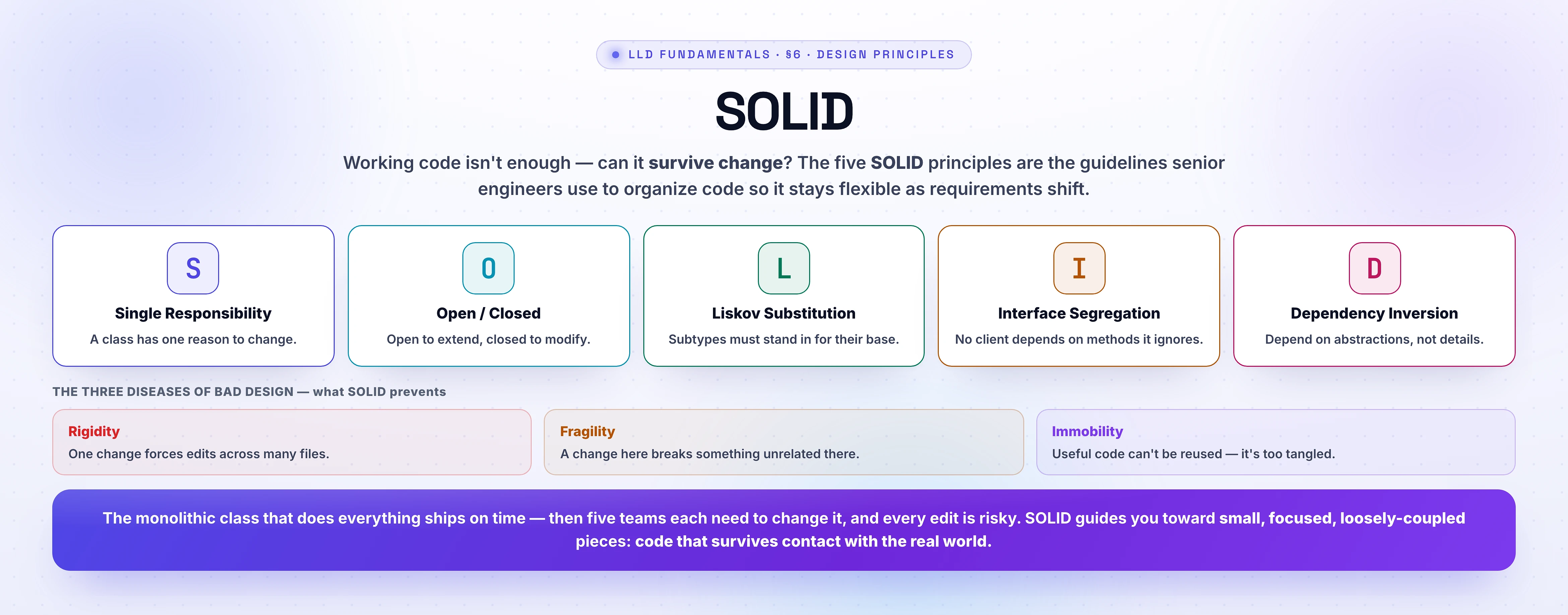
1. Rigidity — Hard to Change
A rigid system is one where every change requires modifications in many other places. You change the way a payment is processed, and suddenly you also need to update the notification system, the invoice generator, and the analytics tracker.
The root cause is usually tight coupling — classes that depend directly on each other's internal details rather than communicating through well-defined interfaces. When class A reaches into the internals of class B, and class B reaches into the internals of class C, a change to C's internals ripples through B and then through A.
Rigidity is the symptom that makes managers afraid to approve changes. "If it's working, don't touch it" becomes the team motto — not because they are lazy, but because every change is genuinely risky.
2. Fragility — Easy to Break
A fragile system is one where a change in one area unexpectedly breaks something in a completely unrelated area. You fix a bug in the search feature, and the user profile page stops loading. You update the tax calculation, and the email notification system starts sending duplicates.
This happens when classes have hidden dependencies — relationships that are not visible from the code structure but exist because of shared state, global variables, or assumptions baked into multiple places. The code looks modular, but invisible threads connect everything.
Fragility erodes trust. Teams start spending more time testing after changes than making the changes themselves.
3. Immobility — Hard to Reuse
An immobile system is one where you cannot extract a useful piece of code and reuse it in another project or another part of the same project. The piece you want is so tangled with everything around it that pulling it out would mean bringing half the codebase along.
This is the result of classes doing too many things — they mix business logic with database access, UI formatting, and error handling all in one place. The useful part (say, the pricing algorithm) cannot be separated from the useless baggage (the database queries, the HTML templates) that surrounds it.
A Real-World Analogy — The Kitchen Renovation
Imagine a house where the electrical wiring, plumbing, gas lines, and internet cables are all bundled together in the same conduit running through every wall.
When the house is first built, this seems efficient — one trench, all utilities. But what happens when you need to upgrade the internet to fiber optic?
- You cannot pull out the internet cable without disturbing the electrical wiring (rigidity)
- Tugging on one cable accidentally disconnects a gas fitting in another room (fragility)
- You cannot extend the internet wiring to a new room without also routing electrical and plumbing there (immobility)
A well-designed house runs each utility through its own dedicated channel. Upgrading internet? Only touch the internet conduit. Adding a bathroom? Only modify the plumbing. Each concern is isolated, so changes are localized and safe.
Design principles teach you to build software the same way — with each concern in its own channel, so changes in one area never risk breaking another.
A Concrete Example — The Monolithic Order Processor
Let us see these three symptoms in action with a concrete code example. This is the kind of class you might write early in your career before learning design principles.
class OrderProcessor:
    """A class that does EVERYTHING related to orders."""

    def __init__(self):
        self.orders = []

    def process_order(self, customer_name: str, items: list,
                      payment_type: str) -> None:
        # --- Tax Calculation ---
        total = 0.0
        for item in items:
            if item["category"] == "electronics":
                total += item["price"] * 1.15  # 15% tax
            elif item["category"] == "food":
                total += item["price"] * 1.05  # 5% tax
            elif item["category"] == "clothing":
                total += item["price"] * 1.10  # 10% tax
            else:
                total += item["price"]

        # --- Payment Processing ---
        if payment_type == "credit_card":
            print(f"Charging credit card for ${total:.2f}")
        elif payment_type == "paypal":
            print(f"Processing PayPal payment for ${total:.2f}")
        elif payment_type == "crypto":
            print(f"Processing crypto payment for ${total:.2f}")
        # Adding a new payment type? Modify THIS class.

        # --- Email Notification ---
        print(f"Sending email to {customer_name}: "
              f"Order confirmed, total ${total:.2f}")

        # --- Inventory Update ---
        for item in items:
            print(f"Reducing stock for {item['name']} by 1")

        # --- Invoice Generation ---
        print(f"INVOICE\nCustomer: {customer_name}\n"
              f"Total: ${total:.2f}")

        # --- Analytics Logging ---
        print(f"[Analytics] Order processed: "
              f"{len(items)} items, ${total:.2f}")

        self.orders.append({"customer": customer_name, "total": total})
import java.util.ArrayList;
import java.util.List;
import java.util.Map;
public class OrderProcessor {
private final List<Map<String, Object>> orders = new ArrayList<>();
public void processOrder(String customerName,
List<Map<String, Object>> items,
String paymentType) {
// --- Tax Calculation ---
double total = 0.0;
for (Map<String, Object> item : items) {
String category = (String) item.get("category");
double price = (double) item.get("price");
switch (category) {
case "electronics": total += price * 1.15; break;
case "food": total += price * 1.05; break;
case "clothing": total += price * 1.10; break;
default: total += price;
}
}
// --- Payment Processing ---
switch (paymentType) {
case "credit_card":
System.out.printf("Charging credit card for $%.2f%n", total);
break;
case "paypal":
System.out.printf("Processing PayPal for $%.2f%n", total);
break;
case "crypto":
System.out.printf("Processing crypto for $%.2f%n", total);
break;
}
// --- Email Notification ---
System.out.printf("Email to %s: Order confirmed, $%.2f%n",
customerName, total);
// --- Inventory Update ---
for (Map<String, Object> item : items) {
System.out.printf("Reducing stock for %s by 1%n",
item.get("name"));
}
// --- Invoice ---
System.out.printf("INVOICE%nCustomer: %s%nTotal: $%.2f%n",
customerName, total);
// --- Analytics ---
System.out.printf("[Analytics] %d items, $%.2f%n",
items.size(), total);
orders.add(Map.of("customer", customerName, "total", total));
}
}This OrderProcessor class works. It processes orders, calculates taxes, handles payments, sends emails, updates inventory, generates invoices, and logs analytics. It ships on time and passes its tests.
But now consider what happens when requirements change — as they inevitably do:
| Change Request | Who Requests It | What Happens |
|---|---|---|
| Add Apple Pay support | Payments team | Modify OrderProcessor |
| Change tax rate for luxury goods | Finance team | Modify OrderProcessor |
| Switch from email to SMS notifications | Marketing team | Modify OrderProcessor |
| Change invoice format for EU compliance | Legal team | Modify OrderProcessor |
| Add a new analytics event | Data team | Modify OrderProcessor |
Five different teams, five different change requests, but they all modify the same class. Every change is risky because touching the payment code might break the invoice code. Nothing is reusable because the tax logic is tangled with the email logic. This is rigidity, fragility, and immobility — all in one class.
Visualization
The Cost of Bad Design — Why Principles Matter
What Are Design Principles?
Design principles are guidelines for organizing code so that it remains flexible, maintainable, and understandable as it grows. They are not rigid rules that must be followed blindly in every situation — they are heuristics that experienced developers use to make better design decisions.
Think of design principles like traffic rules. You could drive without them, and for a while on an empty road at 3 AM, everything would be fine. But as soon as there are more cars, intersections, and pedestrians, the rules are what prevent chaos and collisions.
Similarly, design principles become essential as your codebase grows beyond a few hundred lines. They help you answer questions like:
- Should this logic go in this class or a new one?
- Should these two classes know about each other directly?
- How do I add a new feature without breaking existing ones?
- How do I structure code so another developer (or future me) can understand it quickly?
Design principles are not theoretical inventions. They emerged from painful experience — from real teams shipping real products and discovering, the hard way, which design decisions led to maintenance nightmares and which led to codebases that remained pleasant to work with for years.
Introducing SOLID
The most famous and widely used set of design principles in object-oriented programming is SOLID — an acronym coined by Robert C. Martin (often called "Uncle Bob") and named by Michael Feathers. Each letter represents one principle:
| Letter | Principle | One-Line Summary |
|---|---|---|
| S | Single Responsibility Principle | A class should have only one reason to change |
| O | Open/Closed Principle | Classes should be open for extension, closed for modification |
| L | Liskov Substitution Principle | Subtypes must be substitutable for their base types without breaking behavior |
| I | Interface Segregation Principle | No client should be forced to depend on methods it does not use |
| D | Dependency Inversion Principle | High-level modules should depend on abstractions, not low-level details |
These five principles are not isolated rules — they reinforce each other. Following SRP makes it easier to follow OCP. Following DIP makes it easier to follow LSP. You will see these connections throughout the upcoming tutorials.
Here is a preview of what each principle addresses:
- SRP prevents classes from becoming bloated monoliths (like our
OrderProcessor) - OCP lets you add new behavior without touching existing tested code
- LSP ensures your inheritance hierarchies actually work as expected at runtime
- ISP keeps your interfaces focused and your dependencies minimal
- DIP decouples high-level business logic from low-level implementation details
You have already encountered the seeds of these ideas. When we discussed encapsulation (S3), we talked about hiding internal details behind a public interface. When we covered polymorphism (S3), we showed how different objects can respond to the same method call — a direct enabler of OCP. When we explored composition vs inheritance (S4), we discussed why flexible delegation often beats rigid hierarchies — which connects to LSP and DIP. SOLID takes all of these OOP foundations and gives them practical, actionable structure.
How SOLID Principles Work Together
One of the most important things to understand about SOLID is that the principles are synergistic — applying one makes it easier to apply the others. Here is how they connect:
-
SRP → OCP: When a class has a single responsibility, it is much easier to extend it without modification, because there is only one axis of change to reason about.
-
OCP → LSP: When you extend behavior through subclasses or interface implementations (OCP), LSP ensures those extensions actually work as drop-in replacements.
-
ISP → DIP: When interfaces are small and focused (ISP), it becomes natural to depend on the right abstraction (DIP) rather than a bloated concrete class.
-
DIP → SRP: When you depend on abstractions, each concrete implementation tends to have a single focused responsibility.
Conversely, violating one principle often leads to violating others. The monolithic OrderProcessor we saw violates SRP (six responsibilities), which makes it impossible to follow OCP (you cannot extend payment handling without modifying the class), which creates tight coupling that violates DIP.
You will see these connections reinforced in every tutorial in this section, and you will apply all five principles together when we reach the capstone tutorial: SOLID in Action — Refactoring a Bad Design.
Design Principles Beyond SOLID
SOLID is the most well-known set of design principles, but it is not the only one. In S7, we will explore additional principles that complement SOLID:
- DRY (Don't Repeat Yourself) — eliminate duplication so changes happen in one place
- KISS (Keep It Simple, Stupid) — prefer simple solutions over clever ones
- YAGNI (You Aren't Gonna Need It) — do not build features you do not need yet
- Law of Demeter — limit how deeply objects reach into other objects' internals
- GRASP Principles — guidelines for assigning responsibilities to classes
- Composition Over Inheritance — a recurring theme you saw in S4 and will see throughout design patterns
These principles work alongside SOLID to create robust, flexible designs. Together, they form the foundation for everything that follows in this course — including the design patterns (S10-S12), architecture concepts (S13), and every design problem you will solve in the Design Problems course.
Common Misconceptions About Design Principles
Before we dive into each SOLID principle, let us clear up some misconceptions that trip up many developers:
Misconception 1: "Design principles are rules to follow always"
Reality: They are guidelines, not laws. In a small script or prototype, splitting everything into perfectly separated classes adds more complexity than it saves. The value of design principles scales with the size and lifespan of the codebase. A weekend hackathon project and a banking system that will be maintained for 20 years have different design needs.
Misconception 2: "Following SOLID means more classes, which means worse performance"
Reality: The overhead of additional classes is negligible in modern runtimes. The real cost of software is developer time — understanding the code, debugging it, and changing it safely. Well-structured code is dramatically cheaper to maintain even if it has more class files.
Misconception 3: "You should apply SOLID principles upfront before writing any code"
Reality: Design principles often emerge through refactoring. Write the simplest thing that works first, then apply principles when you notice pain — duplication, cascading changes, classes growing unwieldy. The refactoring approach (S9) is how most well-designed codebases evolve in practice.
Misconception 4: "SOLID is only for object-oriented programming"
Reality: While SOLID was articulated in the context of OOP, many of the underlying ideas (separation of concerns, depending on abstractions, keeping interfaces focused) apply to any paradigm — functions, modules, microservices, even database schemas.
Key Takeaways
- Bad design manifests as rigidity (hard to change), fragility (easy to break), and immobility (hard to reuse) — three symptoms that compound over time
- Design principles are guidelines distilled from decades of experience that help you organize code for long-term maintainability
- SOLID is the most widely taught set of OOP design principles — five principles that work together synergistically: SRP, OCP, LSP, ISP, DIP
- Design principles are not rigid rules — they are heuristics whose value scales with codebase size and team size
- You have already encountered the foundations for SOLID in S3 and S4 (encapsulation, polymorphism, composition over inheritance) — the upcoming tutorials give these concepts practical, actionable structure
- In the next six tutorials, we will study each SOLID principle in depth using the violation → fix pattern: see the problem, understand the pain, apply the principle, see the improvement