Object-Oriented Programming — The Big Picture
Introduction
In the previous two tutorials, we traced the evolution from imperative programming (flat sequential commands) to procedural programming (organizing commands into reusable functions). We saw that procedural style solved code duplication and readability, but left a fundamental problem unsolved: data and the functions that operate on that data are separate.
In our payroll example, calculate_gross_pay(hours, rate) is just a function floating in space. It doesn't "belong" to any employee. Anyone can call it with any numbers — valid or not. There's no concept of an employee as a unified entity.
Object-oriented programming (OOP) solves this by introducing the most important concept in software design: the object — a self-contained unit that bundles data (what it knows) with behavior (what it can do).
This tutorial gives you the big picture of OOP. We won't go deep into each pillar yet — that's what S3 (8 tutorials on OOP fundamentals) is for. Instead, we'll show how OOP thinking transforms the way you structure code, using our running payroll example to make the contrast concrete.
What is Object-Oriented Programming?
Object-oriented programming is a paradigm that models software as a collection of objects — each representing an entity from the problem domain. An object combines:
- State (data) — The information the object holds: an employee's name, hourly rate, hours worked
- Behavior (methods) — The actions the object can perform: calculate gross pay, calculate tax, generate pay stub
- Identity — Each object is unique. Two employees can have the same name yet still be different objects
The Paradigm Shift
Procedural thinking: "What steps does the program need to perform?"
- Define data structures. Write functions that operate on them. Organize functions into modules.
OOP thinking: "What entities exist in this problem domain, and how do they interact?"
- Identify real-world entities (Employee, PayrollSystem, TaxCalculator). Define what each entity knows and does. Let them collaborate through messages (method calls).
This shift — from thinking about procedures to thinking about entities and their interactions — is the mental model behind Low Level Design. Every design pattern, every SOLID principle, and every design problem in this course builds on this foundation.
Real-World Analogy
Think about a company:
- Procedural view: The company is a set of procedures — "hire employee procedure," "compute payroll procedure," "file taxes procedure." Data flows between procedures.
- OOP view: The company is a set of entities — employees, departments, payroll systems, tax agencies. Each entity has its own data and responsibilities. They interact by sending messages to each other: the payroll system asks each employee to calculate their pay, then tells the tax agency to file the results.
The OOP view maps naturally to how we think about the real world. And that's its power — the software model mirrors the problem domain.
The Four Pillars — A Preview
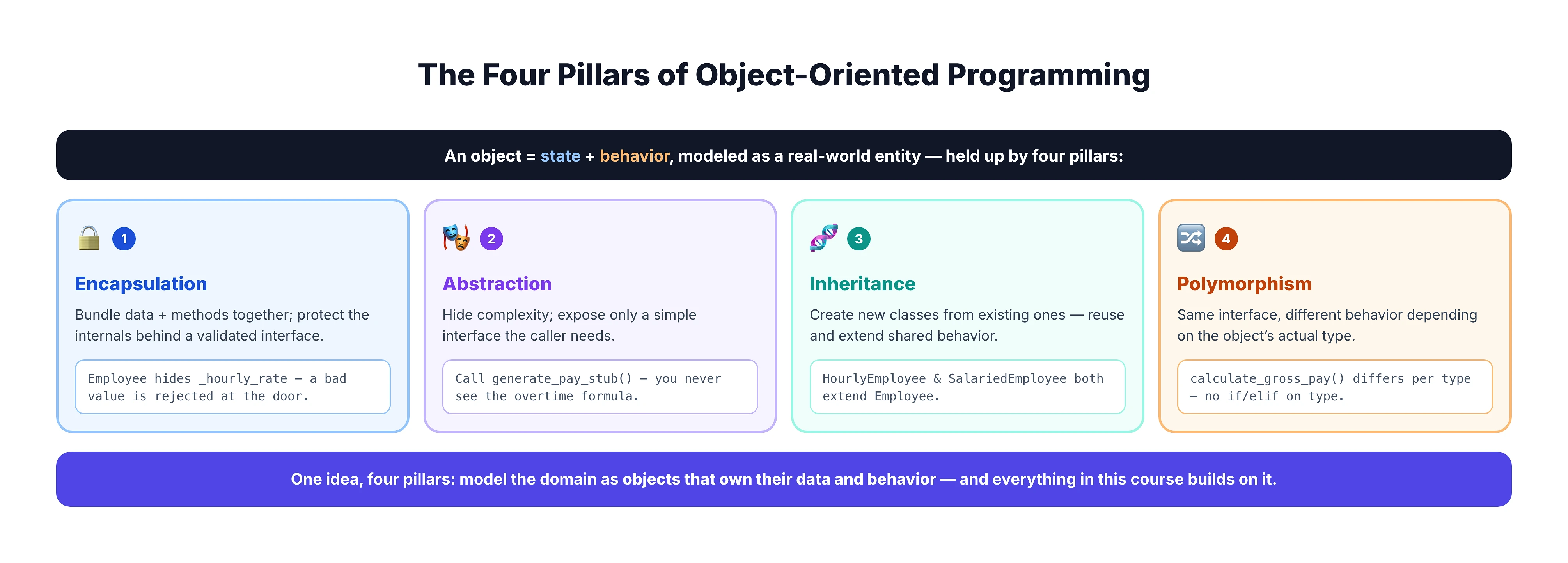
OOP rests on four fundamental pillars. We'll study each in depth in S3, but here's a high-level preview so you can see how they fit together:
1. Encapsulation
Bundle data and methods together, restrict direct access to internals.
An Employee object holds _hourly_rate privately. External code can't set it to a negative value — it must go through a validated setter. The object protects its own integrity.
2. Abstraction
Hide complexity, expose only what's needed.
When you call employee.calculate_gross_pay(), you don't need to know the overtime formula, the threshold, or the multiplier. The method handles all details internally. You interact with a simple interface.
3. Inheritance
Create new classes based on existing ones, reusing and extending behavior.
SalariedEmployee and HourlyEmployee both extend Employee. They share common attributes (name, department) but calculate gross pay differently. Write common code once.
4. Polymorphism
Same interface, different behavior depending on the object type.
The payroll system calls employee.calculate_gross_pay() on every employee. Hourly employees compute overtime. Salaried employees return their weekly salary. The same method call produces different behavior based on the actual object type — no if/elif chain needed.
These four pillars are the foundation of everything that follows in this course. For now, let's see them in action through our payroll example.
The Payroll Example — OOP Style
Let's refactor the same payroll scenario from Tutorials 1 and 2 into OOP. Same employees, same overtime rules, same tax — but fundamentally different organization.
Notice how each employee is now a self-contained object that knows its own data and can compute its own pay.
# OOP style — same payroll, modeled as collaborating objects
from abc import ABC, abstractmethod
from typing import List


class Employee(ABC):
    """Base class for all employee types.
    Bundles data (name, rate) with behavior (calculate_pay).
    """

    def __init__(self, name: str, hourly_rate: float) -> None:
        if hourly_rate < 0:
            raise ValueError("Hourly rate cannot be negative")
        self._name = name              # Encapsulated — protected attribute
        self._hourly_rate = hourly_rate

    @property
    def name(self) -> str:
        return self._name

    @abstractmethod
    def calculate_gross_pay(self, hours: int) -> float:
        """Each employee type calculates pay differently (polymorphism)."""
        pass

    def calculate_tax(self, gross_pay: float, tax_rate: float = 0.20) -> float:
        """Tax calculation shared across all employee types (inheritance)."""
        return gross_pay * tax_rate

    def generate_pay_stub(self, hours: int) -> dict:
        """Abstraction — external code calls this without knowing internals."""
        gross = self.calculate_gross_pay(hours)
        tax = self.calculate_tax(gross)
        net = gross - tax
        return {"name": self._name, "gross": gross, "tax": tax, "net": net}


class HourlyEmployee(Employee):
    """Employee paid by the hour with overtime after 40 hours."""

    def __init__(self, name: str, hourly_rate: float,
                 overtime_multiplier: float = 1.5) -> None:
        super().__init__(name, hourly_rate)
        self._overtime_multiplier = overtime_multiplier

    def calculate_gross_pay(self, hours: int) -> float:
        if hours < 0:
            raise ValueError("Hours cannot be negative")
        overtime_threshold = 40
        if hours > overtime_threshold:
            regular = overtime_threshold * self._hourly_rate
            overtime = (hours - overtime_threshold) * self._hourly_rate * self._overtime_multiplier
            return regular + overtime
        return hours * self._hourly_rate


class SalariedEmployee(Employee):
    """Employee with a fixed annual salary — no overtime."""

    def __init__(self, name: str, annual_salary: float) -> None:
        weekly_rate = annual_salary / 52
        super().__init__(name, weekly_rate)
        self._annual_salary = annual_salary

    def calculate_gross_pay(self, hours: int) -> float:
        # Salaried employees get the same pay regardless of hours
        return self._annual_salary / 52


class PayrollSystem:
    """Processes payroll for a list of employees."""

    def run_payroll(self, employees: List[Employee], hours_list: List[int]) -> None:
        total_gross = 0.0
        total_tax = 0.0
        total_net = 0.0

        for employee, hours in zip(employees, hours_list):
            # Polymorphism: same method call, different behavior per type
            stub = employee.generate_pay_stub(hours)
            total_gross += stub["gross"]
            total_tax += stub["tax"]
            total_net += stub["net"]
            print(f"{stub['name']}: Gross=${stub['gross']:.2f}, "
                  f"Tax=${stub['tax']:.2f}, Net=${stub['net']:.2f}")

        print(f"\nPayroll Summary:")
        print(f"Total Gross: ${total_gross:.2f}")
        print(f"Total Tax:   ${total_tax:.2f}")
        print(f"Total Net:   ${total_net:.2f}")


# Usage — objects model real-world entities
employees = [
    HourlyEmployee("Alice", 35.0),
    HourlyEmployee("Bob", 42.0),
    HourlyEmployee("Charlie", 28.0),
    SalariedEmployee("Diana", 114_400.0),  # $114,400/year
]
hours = [45, 38, 52, 40]

payroll = PayrollSystem()
payroll.run_payroll(employees, hours)
import java.util.List;
abstract class Employee {
private final String name;
private final double hourlyRate;
protected Employee(String name, double hourlyRate) {
if (hourlyRate < 0) {
throw new IllegalArgumentException("Hourly rate cannot be negative");
}
this.name = name;
this.hourlyRate = hourlyRate;
}
public String getName() { return name; }
protected double getHourlyRate() { return hourlyRate; }
// Polymorphism: each subclass implements this differently
public abstract double calculateGrossPay(int hours);
// Inheritance: shared tax logic
public double calculateTax(double grossPay) {
return grossPay * 0.20;
}
// Abstraction: simple interface hides complexity
public double[] generatePayStub(int hours) {
double gross = calculateGrossPay(hours);
double tax = calculateTax(gross);
double net = gross - tax;
return new double[]{gross, tax, net};
}
}
class HourlyEmployee extends Employee {
private final double overtimeMultiplier;
public HourlyEmployee(String name, double hourlyRate) {
this(name, hourlyRate, 1.5);
}
public HourlyEmployee(String name, double hourlyRate, double overtimeMultiplier) {
super(name, hourlyRate);
this.overtimeMultiplier = overtimeMultiplier;
}
@Override
public double calculateGrossPay(int hours) {
if (hours < 0) throw new IllegalArgumentException("Hours cannot be negative");
int overtimeThreshold = 40;
if (hours > overtimeThreshold) {
double regular = overtimeThreshold * getHourlyRate();
double overtime = (hours - overtimeThreshold) * getHourlyRate() * overtimeMultiplier;
return regular + overtime;
}
return hours * getHourlyRate();
}
}
class SalariedEmployee extends Employee {
private final double annualSalary;
public SalariedEmployee(String name, double annualSalary) {
super(name, annualSalary / 52);
this.annualSalary = annualSalary;
}
@Override
public double calculateGrossPay(int hours) {
return annualSalary / 52; // Fixed weekly pay
}
}
class PayrollSystem {
public void runPayroll(List<Employee> employees, int[] hoursList) {
double totalGross = 0, totalTax = 0, totalNet = 0;
for (int i = 0; i < employees.size(); i++) {
Employee emp = employees.get(i);
double[] stub = emp.generatePayStub(hoursList[i]);
totalGross += stub[0];
totalTax += stub[1];
totalNet += stub[2];
System.out.printf("%s: Gross=$%.2f, Tax=$%.2f, Net=$%.2f%n",
emp.getName(), stub[0], stub[1], stub[2]);
}
System.out.println("\nPayroll Summary:");
System.out.printf("Total Gross: $%.2f%n", totalGross);
System.out.printf("Total Tax: $%.2f%n", totalTax);
System.out.printf("Total Net: $%.2f%n", totalNet);
}
}
public class PayrollOOP {
public static void main(String[] args) {
List<Employee> employees = List.of(
new HourlyEmployee("Alice", 35.0),
new HourlyEmployee("Bob", 42.0),
new HourlyEmployee("Charlie", 28.0),
new SalariedEmployee("Diana", 114_400.0)
);
int[] hours = {45, 38, 52, 40};
PayrollSystem payroll = new PayrollSystem();
payroll.runPayroll(employees, hours);
}
}Look at what changed compared to the procedural version:
- No parallel arrays — Each employee is a single object containing name, rate, and behavior. You can't accidentally mismatch name and rate.
- Data protection —
_hourly_rateis encapsulated. Creating anHourlyEmployee("Alice", -50)throws an error. The object protects its own integrity. - Polymorphism —
PayrollSystem.run_payroll()callsemployee.calculate_gross_pay()without knowing whether it's hourly or salaried. Noif/elifneeded. - Extensibility — Need a
ContractorEmployee? Create a new class that extendsEmployeeand implementscalculate_gross_pay(). Zero changes toPayrollSystem. This is the Open/Closed Principle (S6) in action. - Self-documenting — The code reads like the problem domain: "Each employee generates their own pay stub. The payroll system runs payroll for a list of employees."
Visualization
OOP: The Big Picture — From Procedural Code to Collaborating Objects
The Side-by-Side Comparison
Here's a direct comparison of how the same payroll problem looks across all three paradigms:
| Aspect | Imperative (Tutorial 1) | Procedural (Tutorial 2) | OOP (This Tutorial) |
|---|---|---|---|
| Data structure | Parallel arrays, global variables | Parallel arrays, passed as parameters | Objects — each employee is a unit |
| Code organization | Flat sequence of commands | Functions with parameters/returns | Classes with methods and encapsulated state |
| Adding salary employee | More if/else in the main loop | More if/elif in calculate_gross_pay | New SalariedEmployee class — zero changes elsewhere |
| Data protection | None — any code can modify anything | None — functions accept any values | Encapsulation — objects validate their own data |
| Handling 10 employee types | 10-way if/elif | 10-way if/elif in functions | 10 classes, each with its own calculate_gross_pay |
| Main program reads like | A recipe (step 1, step 2, step 3...) | An outline (call function A, call B, call C) | A conversation (ask each employee for their pay stub) |
The progression is from less structure to more structure — and the key thing OOP adds that procedural can't: behavior belongs to the entity, not floating in space.
Why OOP Became the Dominant Paradigm for Large Systems
OOP isn't popular by accident. It solves the exact problems that plague large-scale software:
1. Models the Problem Domain Naturally
Real-world systems have entities (customers, orders, accounts) with properties and behaviors. OOP lets you model these directly. The code structure mirrors the problem structure — making it easier to understand, communicate, and evolve.
2. Encapsulation Controls Complexity
Each object manages its own state and exposes only what's needed. A BankAccount object enforces that balances never go negative — this rule lives in ONE place, not scattered across every function that touches balances. As systems grow to millions of lines, this boundary control is essential.
3. Polymorphism Enables Extension
New types can be added without modifying existing code. This is the foundation of the Open/Closed Principle (S6) and the key insight behind most design patterns (S10–S12). A payment system that works with PaymentMethod objects automatically supports new payment types without code changes.
4. Inheritance Enables Reuse
Common behavior can be defined once in a base class and inherited by all subtypes. Tax calculation, logging, validation — write it once, share it across 20 employee types.
5. Teams Can Work in Parallel
Different developers can work on different classes simultaneously. As long as the public interfaces (method signatures) are agreed upon, the internal implementations are independent. This is critical for companies with 100+ engineers on the same codebase.
OOP Is Not a Silver Bullet — Honest Limitations
Being fair and honest: OOP is not perfect for every problem. Understanding its limitations will make you a better designer:
1. Overhead for Simple Problems
If you're writing a 50-line script to rename files, creating FileRenamer classes with RenameStrategy interfaces is massive overkill. A procedural function is the right tool.
2. Deep Inheritance Can Backfire
Inheritance creates tight coupling between parent and child classes. A 6-level deep hierarchy becomes brittle — changes to the base class ripple unpredictably. This is why the principle "Favor Composition over Inheritance" exists (covered in S4 and S7).
3. Mutable State Still Exists
OOP encapsulates state, but objects are still mutable by default. In concurrent systems (multiple threads), mutable objects create race conditions. Functional programming (next tutorial) offers an alternative approach with immutable data.
4. Not Ideal for Pure Data Transformations
When your problem is "transform this data from format A to format B" — a pipeline of pure functions (functional programming) is often cleaner than wrapping everything in objects.
5. Over-Engineering Risk
OOP makes it easy to create elaborate class hierarchies, abstract factories, and pattern-upon-pattern architectures when a simple function would do. We'll study the KISS and YAGNI principles in S7 to guard against this.
Where This Course Goes from Here
This tutorial gave you the big picture. The rest of this course dives deep into every aspect of OOP and its applications:
- S3 (OOP Fundamentals — Core Pillars) — Deep dives into Encapsulation, Abstraction, Inheritance, and Polymorphism with realistic examples
- S4 (OOP Relationships & Advanced Concepts) — How objects relate to each other: Association, Aggregation, Composition, Dependency, and the critical "Composition vs Inheritance" decision
- S5 (UML Diagrams) — Visual modeling of class structures, interactions, and workflows
- S6 (SOLID Principles) — The five foundational principles that separate good OOP design from bad OOP design
- S10–S12 (Design Patterns) — 23 proven solutions to recurring design problems, all built on OOP
- Design Problems course — Applying OOP to real systems: Parking Lot, Elevator, Chess, Uber, and more
But first, in the next tutorial, we'll complete the paradigm overview by comparing Functional Programming vs OOP — because OOP isn't the only modern paradigm, and knowing when to use each makes you a stronger designer.
Common Misconceptions About OOP
Misconception 1: "OOP means using classes"
Reality: Placing functions inside a class doesn't make code object-oriented. OOP is about modeling entities with encapsulated state, behavior, and clear responsibilities. A class with only static methods and no attributes is procedural code wearing an OOP costume.
Misconception 2: "More classes = better design"
Reality: Good design minimizes unnecessary complexity. If a concept doesn't need to be an object, don't make it one. A MathUtils class with a calculate_tax() static method is functionally identical to a procedural function — the class adds nothing.
Misconception 3: "Inheritance is the most important feature"
Reality: Inheritance is the most overused feature. Encapsulation and polymorphism are more fundamental. Many experienced developers consider excessive inheritance the #1 OOP anti-pattern. You'll study "Composition over Inheritance" in S4 and S7.
Misconception 4: "OOP replaces procedural/functional"
Reality: In practice, you use all paradigms together. Java method bodies are imperative. Python classes use functional patterns like map() and list comprehensions. The paradigms are complementary, not competing — and the next tutorial explores exactly where functional programming fits.
Key Takeaways
- Object-oriented programming models software as a collection of objects — entities that bundle their own data (state) and behavior (methods) together
- OOP's four pillars are Encapsulation (protect data), Abstraction (hide complexity), Inheritance (reuse behavior), and Polymorphism (same interface, different behavior) — each explored in depth in S3
- The key advantage over procedural: data and behavior belong together — an employee knows how to calculate its own pay, rather than being passive data that functions act upon
- OOP enables extension without modification — add new employee types without changing existing PayrollSystem code. This is the Open/Closed Principle (S6)
- OOP is the dominant paradigm for large systems because it models problem domains naturally, controls complexity through encapsulation, and enables parallel team development
- OOP is not ideal for everything — simple scripts, pure data transformations, and highly concurrent systems may benefit from procedural or functional approaches
- This course builds entirely on OOP: design principles (S6–S7), design patterns (S10–S12), and real-world design problems all assume OOP as the foundation