The RAG Pattern: Why Retrieval Beats Memorization
Introduction
Ask a foundation model about your company's refund policy, or what happened in the news this morning, and one of two bad things happens: it says "I don't have that information," or — worse — it confidently invents an answer. The model only knows what was in its training data, frozen at a cutoff date, with no access to your private or current information.
Retrieval-Augmented Generation (RAG) is the fix, and it's the single most common pattern in production AI. Instead of trusting the model's frozen memory, you fetch the relevant text at query time and put it in the prompt — so the model answers from facts you supplied.
You've already met the building blocks (embeddings and vector search). This lesson is the why: why retrieval beats memorization, and the shape of the RAG pattern. The next lessons build the full pipeline.
You'll learn:
- Why a model's built-in memory is frozen, private-blind, and prone to confident errors
- The core idea: retrieve, then generate
- Why retrieval beats both memorization and (for knowledge) fine-tuning
- A minimal RAG you can read in 15 lines
The Core Problem: Frozen, Private-Blind, and Leaky Memory
A model's knowledge is parametric — baked into its weights during training. That creates three hard limits for real applications:
- Frozen. Training has a cutoff date. The model doesn't know anything that happened after it, and you can't update that knowledge without retraining.
- Private-blind. Your internal docs, this user's order history, last night's database row — none of it was in the training data, so the model simply cannot know it.
- Leaky / overconfident. When the model doesn't know, it doesn't reliably say so — it hallucinates a plausible-sounding answer, with no sources to check.
Think of it as a brilliant expert who read the entire internet up to a point, then was sealed in a room with no phone, no files, and no calendar — and who hates saying "I don't know." Useful, but dangerous for anything factual or current.
The Idea: Retrieve, Then Generate
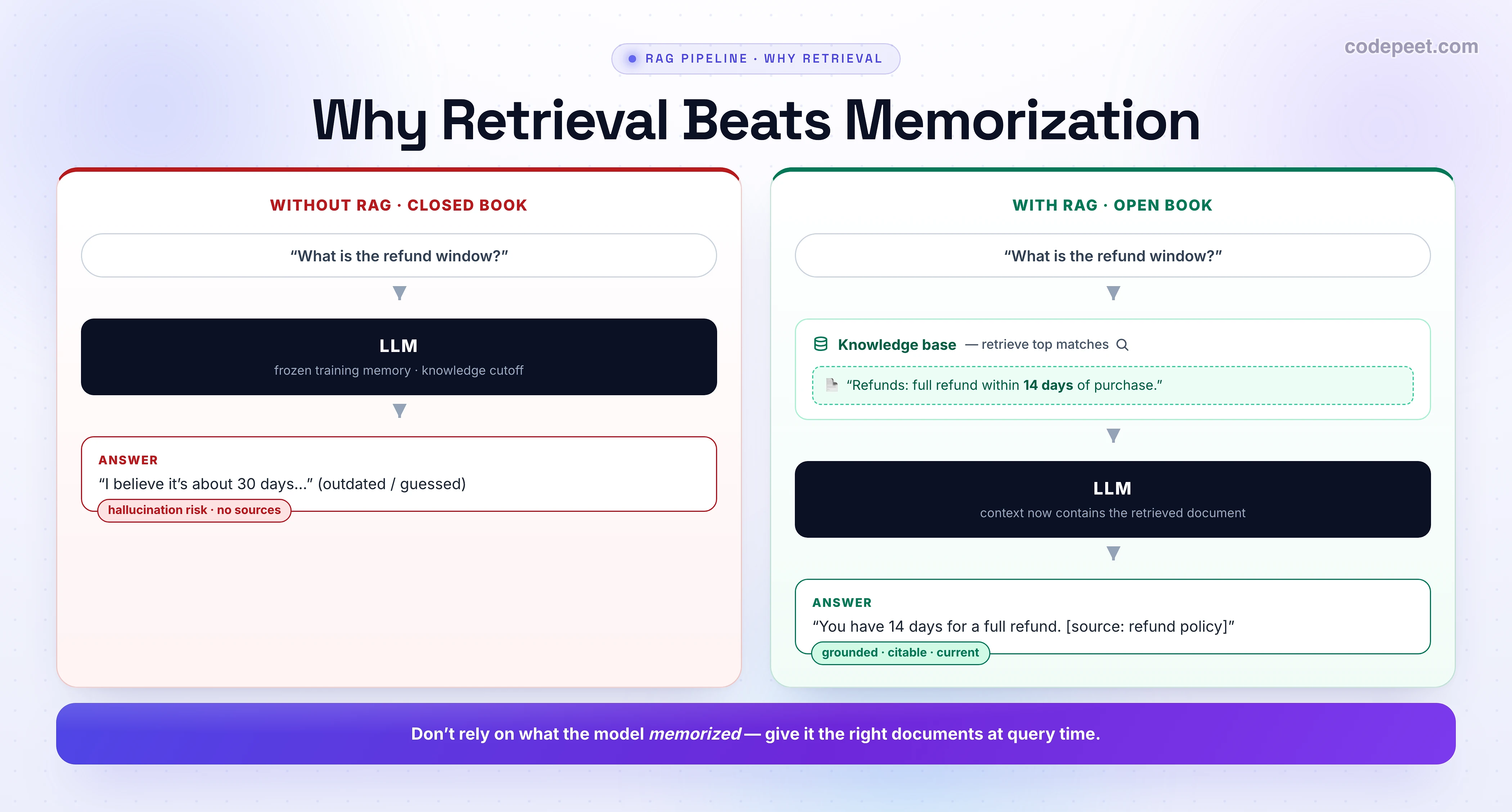
RAG turns the closed-book exam into an open-book exam.
Instead of asking the model to recall a fact from memory, you:
- Retrieve the most relevant passages from a knowledge source (docs, a wiki, a database) — using the embeddings + vector search you just learned.
- Augment the prompt by pasting those passages in as context.
- Generate an answer grounded in that supplied text, ideally with citations.
The model stops being the source of truth and becomes a reasoning-and-writing engine over text you control. That single shift is what makes AI assistants trustworthy enough to ship.
The RAG Loop (at a glance)
At a high level, every RAG system is this loop:
user query
   → embed the query
   → search the vector store for the most similar chunks   (RETRIEVE)
   → paste those chunks into the prompt as context          (AUGMENT)
   → model answers grounded in that context, with citations (GENERATE)
That's the whole pattern. Everything else in this section — chunking, hybrid search, reranking, evaluation — is about making each step better. We'll build the full pipeline in the next lesson; here, sit with the shape.
Why Retrieval Beats Memorization
Compared to leaning on the model's parametric memory, retrieving knowledge at query time wins on every axis that matters for a real product:
| Memorization (parametric) | Retrieval (RAG) | |
|---|---|---|
| Freshness | Frozen at training cutoff | Up to date — change a doc, the answer changes |
| Private data | Invisible to the model | Available — point it at your sources |
| Hallucination | High; confidently wrong | Lower — grounded in supplied text |
| Sources / trust | None | Citable — show where each fact came from |
| Cost to update | Retrain / fine-tune | Edit a document |
"But couldn't I just fine-tune the knowledge in?"
A natural question — and a key distinction you'll see again in the fine-tuning section: fine-tuning teaches a model new behavior or style; RAG gives it new knowledge. For facts that change or are private, teams consistently find RAG outperforms fine-tuning — it's cheaper, instantly updatable, and citable. (A practical rule from the field: if you need the model to know something, retrieve it; if you need it to act a certain way, consider fine-tuning.) The two even combine well — but for knowledge, retrieval is almost always the right first move.
A Minimal RAG in 15 Lines
To make it concrete, here's a from-scratch RAG over a tiny knowledge base — embed the documents, find the closest one to the query by cosine similarity, then answer only from that context. (The next lessons replace each piece with production-grade components; this is the skeleton.)
import numpy as np
from openai import OpenAI
from anthropic import Anthropic
oai, claude = OpenAI(), Anthropic()

knowledge_base = [
    "CodePeet refunds: a full refund is available within 14 days of purchase.",
    "CodePeet covers SQL, System Design, DSA, and AI Engineering.",
    "Annual plans renew automatically unless cancelled 48 hours before renewal.",
]

def embed(texts):
    r = oai.embeddings.create(model="text-embedding-3-small", input=texts)
    return np.array([d.embedding for d in r.data])

doc_vecs = embed(knowledge_base)                      # index the KB once

def retrieve(query, k=1):
    q = embed([query])[0]
    sims = doc_vecs @ q                                # cosine (vectors are ~unit length)
    return [knowledge_base[i] for i in sims.argsort()[::-1][:k]]

query = "How long do I have to get my money back?"
context = "\n".join(retrieve(query))                    # RETRIEVE

resp = claude.messages.create(                          # AUGMENT + GENERATE
    model="claude-sonnet-4-6", max_tokens=150,
    messages=[{"role": "user", "content":
        f"Answer using ONLY the context. If it's not there, say you don't know.\n\n"
        f"Context:\n{context}\n\nQuestion: {query}"}],
)
print(resp.content[0].text)
# -> "You have 14 days from the date of purchase to get a full refund."
The model never knew CodePeet's refund policy — we retrieved it and grounded the answer in it. Change the document to "30 days" and the answer changes on the very next call, with no retraining.
Visualization
What RAG Is — and Isn't
- Retrieval quality is everything. RAG answers are only as good as what you retrieve — fetch the wrong passage and the model will confidently ground its answer in the wrong fact. (This is why the next lessons obsess over chunking, hybrid search, and reranking.)
- RAG reduces hallucination, it doesn't eliminate it. A model can still misread or over-extend the context. You instruct it to stick to the context and you evaluate (later section).
- RAG ≠ conversation memory. Pasting retrieved docs is different from remembering the chat so far (that's context/session management). They're complementary.
- RAG isn't for skills. If the model can't reason through a task or write in your house style, retrieving more text won't fix it — that's a prompting or fine-tuning problem.
🧪 Try It Yourself
See why retrieval beats memorization. Ask a model a question whose answer lives only in your private notes (e.g. 'what did we decide in last Tuesday's standup?'). It can't know — it hallucinates or refuses. Now imagine pasting the relevant note into the prompt and asking again — suddenly it's right.
That's RAG in one move: fetch the relevant text, then answer from it. Why does this beat trying to bake every fact into the model? → fresh, private, verifiable, and cheap to update.

Key Takeaways
- A model's parametric memory is frozen, private-blind, and prone to confident hallucination — unfit on its own for factual, current, or private questions.
- RAG = retrieve relevant text at query time → augment the prompt → generate a grounded answer. Closed-book becomes open-book.
- Retrieval beats memorization on freshness, private data, hallucination, citability, and update cost — and beats fine-tuning when the need is knowledge (fine-tuning is for behavior).
- A working RAG is shockingly small at its core (embed → cosine search → grounded prompt); the craft is in making each step reliable.
Next: the end-to-end RAG architecture — every stage from raw documents to a cited answer.