The Idea: Models Grading Models
Introduction
Section 2 handed you a toolbox of metrics — and then, lesson after lesson, showed you their ceiling. Exact match (L160 (Functional Correctness & Exact Match)) fails a perfectly correct answer that's just worded differently. Embedding and n-gram similarity (L161 (Similarity Metrics (Embedding, BLEU/ROUGE — and Their Limits))) score a confident hallucination highly because it sounds on-topic. Every one of them compares strings and vectors — and none of them can read the one thing you actually care about: is this answer correct, faithful, and helpful?
There's exactly one tool that can read meaning at scale, and you've been holding it the whole time: another language model. The idea that opens this section is deceptively simple — let a model grade the model. A judge reads the question, the answer, and a rubric, and returns not a bare number but a verdict with reasoning. In 2023 the seminal MT-Bench / Chatbot Arena study put numbers on it: a strong judge agrees with human reviewers over 80% of the time — the same rate at which two humans agree with each other. This lesson is the idea itself; the rest of the section makes it reliable.
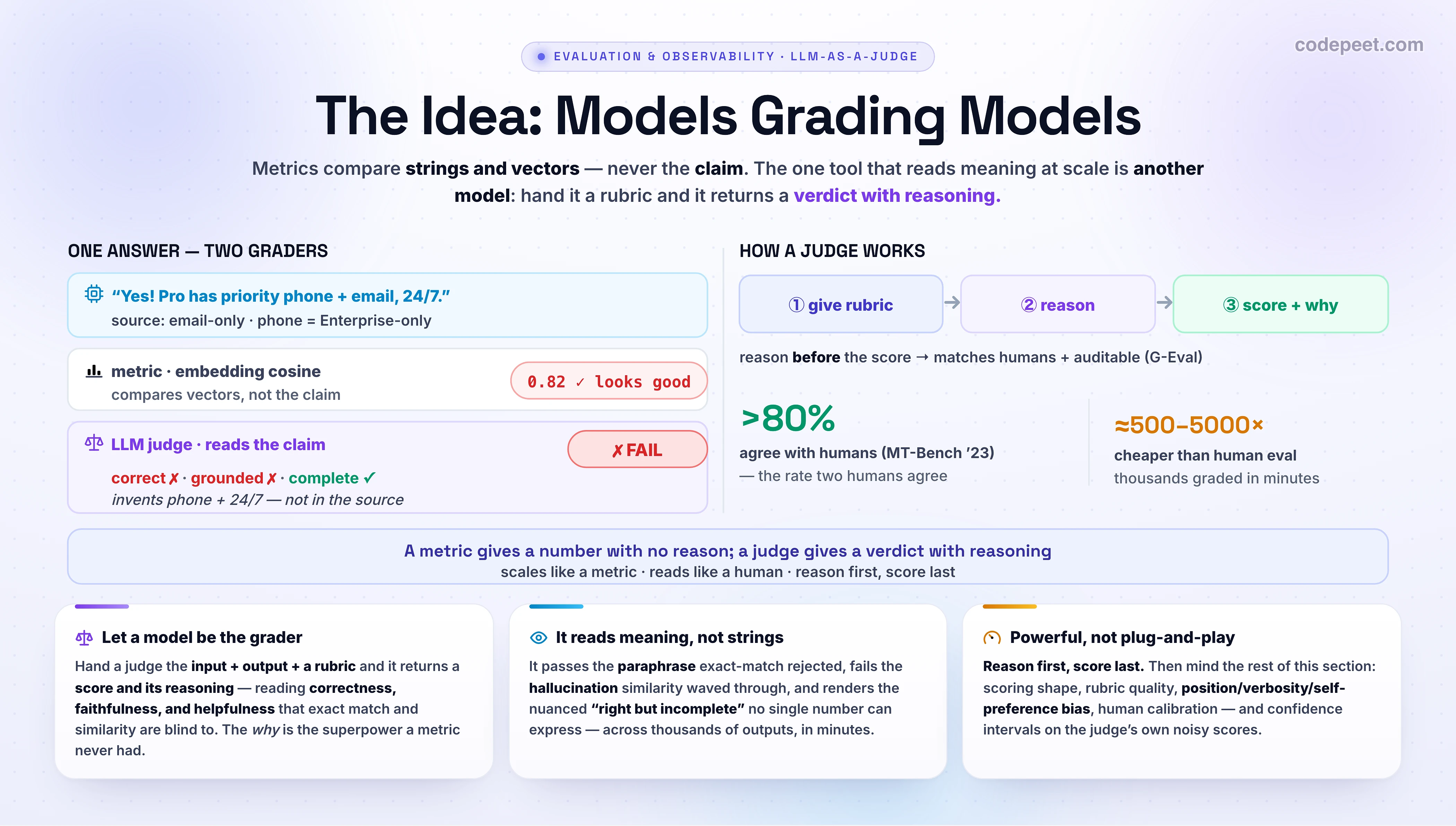
Where the Metrics Hit Their Ceiling
Hold one concrete case in your head for the whole lesson. A support bot is asked “Does the Pro plan include priority support?” It was given the doc: “Pro — $20/mo. Includes priority email support (4-hour SLA). Phone support is Enterprise-only.” Now grade three answers:
- A: “Yes, Pro comes with priority email support, answered within 4 hours.” — correct, just reworded.
- B: “Yes! Pro includes priority phone and email support, 24/7.” — wrong: it invented a phone channel and 24/7 hours.
- C: “Yes.” — true but thin.
Watch the Section-2 metrics fail all three in different directions. Exact match scores every one of them 0 — including the correct answer A — because none equals the gold string. Embedding similarity scores B high (it's full of the right words: priority, support, Pro) even though B is the one that's actually false. And neither metric has any way to say what's true of C: “right, but incomplete.”
The pattern: metrics compare form, never claim. They are blind to correctness (is it true?), faithfulness (is it grounded in the source, or invented?), and helpfulness (did it actually serve the user?). On open-ended text — the only kind that matters for real LLM products — that blindness is the whole ballgame. You need a grader that reads the way a person reads.
The Idea: Let a Model Be the Grader
LLM-as-a-judge is exactly what it sounds like: you use one model to score another model's outputs against criteria you define. The mental model is a senior editor proofreading a junior writer's draft — except both are AI, and the editor works in seconds for a fraction of a cent.
A judge takes a small, fixed bundle:
{ the input (the question/task) , the candidate output (what you're grading) , an optional reference (a gold answer, if you have one) , a rubric (what “good” means) , a scoring format (pass/fail, a 1–5 score, or A-vs-B) }
…and it returns a score and its reasoning — “partial: the answer is correct but omits the SLA, so a user still has to ask again.” That second half — the reasoning — is the superpower a metric never had. A number tells you what; a judge tells you why, in language you can read, audit, and argue with.
That's the trade it unlocks: a judge reads like a human but scales like a metric. It catches the paraphrase exact-match rejected, catches the hallucination similarity waved through, and renders the nuanced “right but incomplete” verdict no single number can express — across thousands of outputs, in minutes.
See It: Metrics vs. the Judge
Here is the entire Section-2 → Section-3 jump in one widget, on the exact support case above. Pick a candidate answer, make your own call (pass / partial / fail), then reveal what the old metrics say versus what an LLM judge says — and why. The four candidates are a designed spectrum: each one breaks a different metric.
Flip through all four. The lesson lands when you watch the same answer get a green number and a red verdict (or vice-versa): the metric scored the surface, the judge scored the substance. Candidate B is the one to sit with — a metric calls it “looks good” at 0.82 cosine precisely because it's fluent and on-topic, which is exactly when a confidently wrong answer is most dangerous. Only a grader that reads the claim catches it.
Anatomy of a Judge Call — Reason First, Then Score
Under the hood, a judge is a single, ordinary model call with an unusual job. You hand the model a grader system prompt (its criteria), the input + output to evaluate, and you ask for one specific thing: reason through each criterion before committing to a score.
from anthropic import Anthropic
import json

client = Anthropic()

# The rubric IS the eval. The judge reads the answer the way a careful human would.
RUBRIC = """You are a strict grader. Score the ANSWER against the SOURCE on three criteria:
  - correct  : do its facts match the source?
  - grounded : is every claim supported by the source (nothing invented)?
  - complete : does it actually answer the question?
Reason through each criterion FIRST, then decide. Reply as JSON only:
{"reasoning": "...", "label": "pass|partial|fail", "score": 1-5}"""

def judge(question, source, answer):
    msg = client.messages.create(
        model="claude-opus-4-8",
        max_tokens=1024,
        thinking={"type": "adaptive"},     # deliberate per criterion before scoring
        system=RUBRIC,
        messages=[{"role": "user",
                   "content": f"QUESTION: {question}\nSOURCE: {source}\nANSWER: {answer}"}],
    )
    return json.loads(msg.content[-1].text)  # last block is the verdict (after thinking)

v = judge(question, source, candidate_B)     # "Yes! Pro includes priority phone... 24/7."
print(v["label"], "-", v["reasoning"])
# -> fail - claims phone + 24/7 support, which the SOURCE never states (not grounded)
Three design choices in that snippet are doing all the work. One — explicit criteria. “Score it” is a vibe; “score correct, grounded, and complete” is an eval. Naming the dimensions is what turns a gut reaction into a repeatable measurement. Two — reasoning before the score. This is the single biggest quality lever, formalized by the G-Eval method: when the model writes its analysis first and the verdict last, agreement with human graders measurably rises — it evaluates each dimension instead of pattern-matching to a number — and every score becomes auditable, because you can read why. (That's also exactly what thinking: adaptive buys you: the model deliberates per-criterion before it answers.) Three — structured output. Returning {reasoning, label, score} as JSON makes verdicts machine-readable, so you can aggregate 10,000 of them into a dashboard. The order is the lesson: explanation first, number last — never the reverse.
Use a Judge Only Where It Earns Its Keep
A judge is powerful, but it isn't free — every call costs tokens and latency, and (as the rest of this section will show) it can be biased. So the professional habit is deterministic-first: anything you can verify with code, verify with code; send only the genuinely subjective remainder to the model.
# A judge call costs tokens + latency, and it only earns its keep on SUBJECTIVE dimensions.
# Anything VERIFIABLE -- schema, format, length, an exact ground truth -- check in code FIRST.
def evaluate(question, source, answer, gold=None):
    # 1) deterministic gates: free, instant, 100% reliable -- see L160 (Functional Correctness & Exact Match)
    if not answer.strip():
        return {"label": "fail", "why": "empty output"}
    if gold is not None and answer.strip().lower() == gold.strip().lower():
        return {"label": "pass", "why": "exact match to gold"}   # no judge needed

    # 2) only the open-ended remainder goes to the model judge
    return judge(question, source, answer)   # correctness / faithfulness / helpfulness
# Rule of thumb: if `==` or a regex can decide it, don't spend a judge on it.
Format, schema, length, required fields, an exact ground-truth answer — these are verifiable, and a == or a regex decides them for free, instantly, with 100% reliability (that's the right home for L160 (Functional Correctness & Exact Match)). Reserve the judge for what only a reader can settle: faithfulness, helpfulness, tone, reasoning quality. Splitting the two doesn't just save money — it makes your eval more reliable, because you've removed every question the judge might get wrong on things a string comparison would have nailed. If == can decide it, don't spend a judge on it.
Does It Actually Work? The Evidence
“Grade the AI with another AI” sounds circular until you look at the numbers. The technique got its name and its first rigorous measurement from Judging LLM-as-a-Judge with MT-Bench and Chatbot Arena (Zheng et al., 2023): 80 multi-turn questions across writing, reasoning, math, and coding, with pairs of human experts as the ground truth. The headline result reframed the whole field:
A strong judge (GPT-4) matched human preferences over 80% of the time — the same level of agreement that two humans reach with each other.
Follow-up work has only sharpened it: reported Pearson correlations of ~0.88–0.91 with human ratings, and Cohen's κ from 0.74 to 0.93 (substantial-to-almost-perfect agreement) across tasks. The point isn't that judges are perfect — it's that they're about as good as your human annotators, who also disagree with each other (recall L156 (Why Evaluating LLMs Is Uniquely Hard) — there often is no single right answer).
And then the economics make the decision for you. Human evaluation means an annotation team, a rubric, and weeks of turnaround — often a five-figure contract. A judge is a prompt and an API call: on the order of 500–5,000× cheaper, grading thousands of outputs in minutes, available every time you change a prompt. As the MT-Bench authors put it, LLM-as-a-judge is a scalable and explainable way to approximate human preference — the one approach that gives you the coverage of an automatic metric and the judgment of a human reviewer at the same time.
Powerful, Not Plug-and-Play
Everything above is the promise. The reason this is a whole section and not a single lesson is that a naive judge is flaky — “the wrong scoring method, the wrong prompt, the wrong rubric, and your eval scores end up just as unreliable as the model you're testing.” Here's the map of what can go wrong, and where each gets fixed:
- The scoring shape changes the answer. A 1–5 pointwise score drifts run-to-run; an A-vs-B pairwise comparison is steadier but costs more calls. That trade-off is the next lesson — L167 (Pointwise vs Pairwise / Comparative Judging).
- The rubric is the eval. A vague rubric produces vague, irreproducible scores; precise, example-anchored criteria are what make a judge trustworthy — L168 (Writing Judge Prompts & Rubrics).
- Judges have measurable biases. They favor the first-shown answer (position bias), the longer answer (verbosity bias), and their own family's outputs (self-preference). These are real and correctable — L169 (Judge Biases & How to Calibrate).
- Who validates the validator? You calibrate the judge against a small set of human labels and spot-check it forever after — L170 (Human-in-the-Loop Spot Checks).
- A judge's score is still an estimate. 85% pass on the judge is a noisy 85% — attach a confidence interval exactly as in L165 (Statistical Rigor: Sample Size & Confidence).
None of these cancel the idea. They're the difference between a judge you hope is right and a judge you've shown tracks your humans. This lesson is the idea; the rest of the section is the engineering.
🧪 Try It Yourself
Build the smallest possible judge with your own hands — 10 minutes, and the idea stops being abstract:
- Grab one open-ended output you actually have — a summary, a support reply, a RAG answer — together with whatever source/context it was supposed to use.
- Write a 3-line rubric. Just three criteria, each one sentence: e.g. correct? / grounded in the source? / complete? Naming them is the hard part — and the whole skill.
- Ask
claude-opus-4-8to grade it — reasoning first. Paste your rubric, the source, and the answer, and end with: “Reason through each criterion, then give a label (pass/partial/fail) and one sentence why.” - Now grade it yourself, blind, before you read the model's verdict. Then compare.
Where you and the judge agree, you've just felt the ~80% — the model read it the way you did. Where you disagree, look closely: nine times out of ten your rubric was ambiguous, not the judge — which is the exact lesson that L168 (Writing Judge Prompts & Rubrics) is about. Either way, you've now run the core loop of modern LLM evaluation.
Mental-Model Corrections
- “Grading AI with AI is circular / can't be trusted.” Measured against human-expert ground truth, strong judges hit >80% agreement — the same rate humans agree with each other (MT-Bench, 2023). It's an approximation of human judgment, and a well-calibrated one.
- “A judge just returns a score.” Its defining feature is the reasoning attached to the score — readable, auditable, and the thing that makes it more than a metric. Always ask for the why.
- “Ask for the score, then an explanation.” Backwards. Reason first, score last (G-Eval): writing the analysis before the number raises agreement with humans and keeps the verdict honest.
- “Use a judge for everything.” No — use deterministic checks for anything verifiable (format, schema, exact answers; see L160 (Functional Correctness & Exact Match)) and reserve the judge for the subjective dimensions only.
- “The judge is objective / unbiased.” It has position, verbosity, and self-preference biases (L169 (Judge Biases & How to Calibrate)), and its scores are noisy estimates that need confidence intervals (L165 (Statistical Rigor: Sample Size & Confidence)).
- “A good judge needs a fancy framework.” It needs a good rubric. The criteria you write decide almost everything — L168 (Writing Judge Prompts & Rubrics).
Key Takeaways
- The metrics' ceiling is meaning. Exact match and similarity compare strings/vectors and are blind to correctness, faithfulness, and helpfulness on open-ended text. The one tool that reads meaning at scale is another model.
- LLM-as-a-judge: give a model the input + output + rubric + scoring format, and it returns a score and its reasoning — reading like a human, scaling like a metric.
- Reason first, score last. Explicit criteria + chain-of-thought before the verdict (G-Eval) + structured output is what makes a judge accurate and auditable.
thinking: adaptiveis that deliberation. - It works: strong judges agree with humans >80% — the same rate two humans agree (MT-Bench, 2023; Pearson ~0.88–0.91) — at roughly 500–5,000× less cost than human eval, on thousands of outputs in minutes.
- Deterministic-first. If
==or a regex can decide it (format, schema, exact answers — L160), don't spend a judge on it. Reserve the judge for subjective dimensions. - Powerful, not plug-and-play. Mind scoring shape (L167), rubric quality (L168), biases (L169), human calibration (L170), and confidence intervals on the judge's own scores (L165). This lesson is the idea; the rest of the section makes it reliable.