The Integration Problem MCP Solves
Introduction
Welcome to Section 6 — the Model Context Protocol (MCP). You've built agents that can use tools (Section 3), plan (Section 4), and remember (Section 5). But there's a question we've waved away: how does an agent actually connect to the real world — your GitHub, your database, your Slack, your files?
So far, every tool was something you wired up by hand. That works for a demo. It falls apart the moment you want many agents talking to many systems — and that mess is exactly the problem MCP was built to solve. Before we look at how MCP works, this lesson nails why it had to exist.
The hard part of a useful agent usually isn't the model — it's the plumbing to everything the model needs to see and do. MCP is a standard for that plumbing.
In this lesson:
- Why agents are "trapped behind glass" — isolated from the data and tools that make them useful
- The N×M explosion — why hand-wiring every app to every tool doesn't scale (felt in a hands-on lab)
- We've solved this before — the LSP / USB precedent, and how a standard protocol collapses M×N → M+N
- What MCP is ("USB-C for AI"), and the 2026 reality — the standard that won
Scope: this lesson is the problem and the shape of the solution. The architecture (host/client/server) is next (L138 — MCP Architecture), the primitives (tools/resources/prompts) follow (L139 — Tools, Resources & Prompts in MCP), then you'll build a server (L140), connect an agent (L141), and cover the ecosystem & security (L142).
Agents Are Trapped Behind Glass
Start with the constraint. As Anthropic put it launching MCP: "Even the most sophisticated models are constrained by their isolation from data — trapped behind information silos and legacy systems." A model on its own is a brain in a jar (you saw this in L121 — Tools): brilliant, but it can't see your codebase, query your database, or send your email.
Tools are the fix — but how you connect them is the problem. Every connection is a custom job: authenticate to this API, parse that response shape, handle these errors, keep up with their breaking changes. As Anthropic continued: "Every new data source requires its own custom implementation, making truly connected systems difficult to scale."
And here's the kicker: that custom integration isn't reusable. The connector you wrote to plug Claude into GitHub does nothing for plugging ChatGPT into GitHub, or Claude into GitLab. Everyone rebuilds the same connectors, slightly differently, forever. Multiply that across the industry and you get an enormous amount of duplicated, brittle glue code. That duplication has a precise shape — and a name.
The N×M Explosion
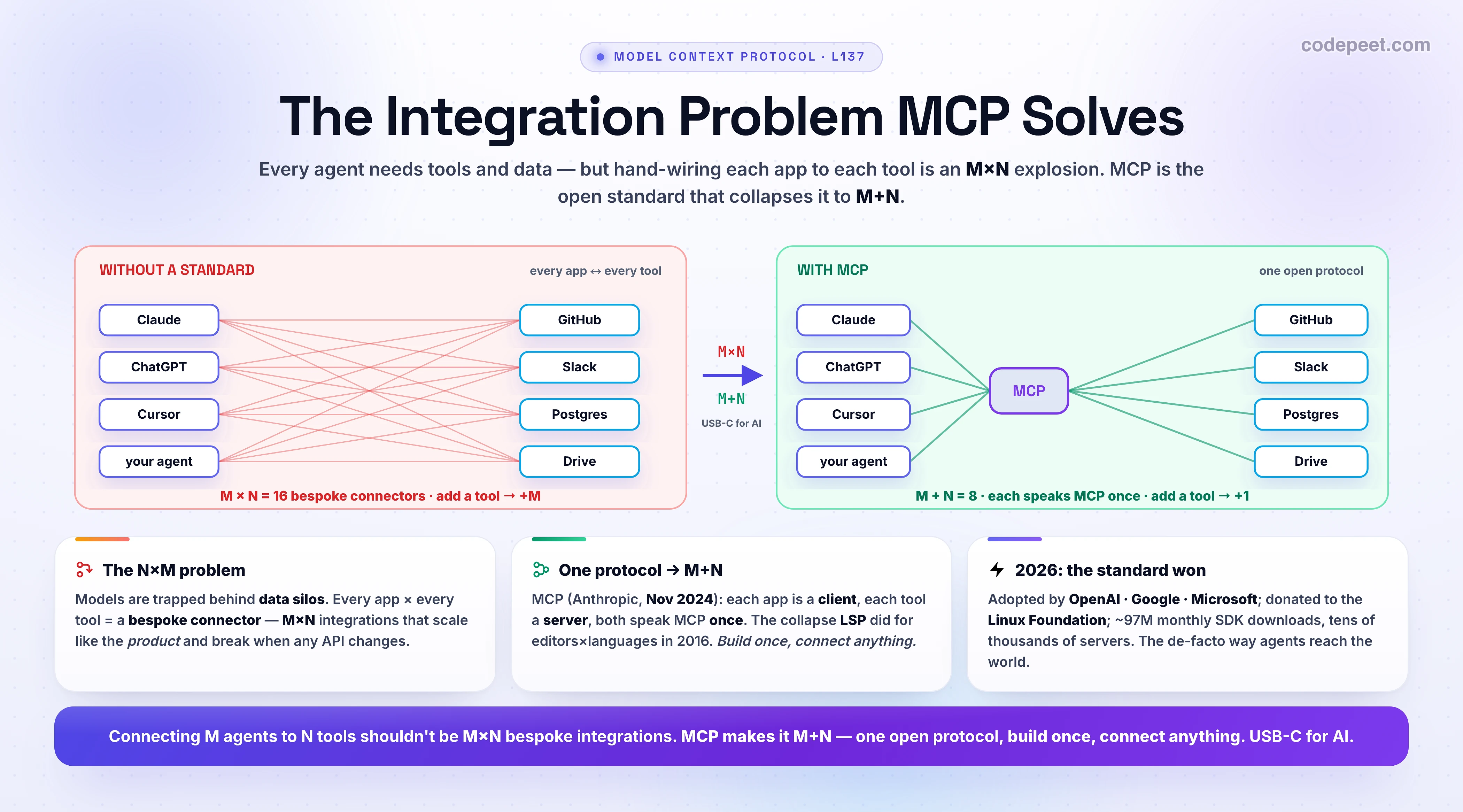
Put numbers on it. You have M AI applications (Claude, ChatGPT, Cursor, your own agent…) and N tools/data sources (GitHub, Slack, Postgres, Drive, Stripe…). If every app needs a bespoke connector to every tool, how many integrations must exist?
M × N. Every app, wired to every tool, by hand. That's the N×M problem — a combinatorial explosion of integration work.
It's not just the count — it's the growth. Add one new tool, and you must build it M times (once for every app). Add one new app, and you owe N new connectors (one for every tool). The work scales like the product, not the sum, so it gets worse the more useful the ecosystem becomes. Each connector is also owned and maintained — when GitHub changes its API, every one of those connectors might break.
This is the wall every serious agent builder hits. Feel it yourself — wire some apps to some tools, then watch what happens when you add one more:
Toggling to With MCP already spoiled the ending — the tangle collapses. But why does a protocol fix this? Because we've solved this exact shape of problem before, more than once.
We've Solved This Before — LSP & USB
The N×M explosion isn't new or AI-specific. It's a recurring pattern in computing, and the fix is always the same: a shared standard in the middle.
- The Language Server Protocol (LSP). This is MCP's direct inspiration — the spec drew heavily from it. Before LSP (Microsoft, 2016), giving M programming languages smart features (autocomplete, go-to-definition) across N editors meant M×N plugins. LSP defined one protocol: a language implements a language server once, an editor implements an LSP client once — and any editor gets any language. M×N → M+N. It transformed developer tooling.
- USB. Before it, every peripheral had its own port and cable shape (serial, PS/2, parallel…) — devices × computers, a hardware N×M mess. USB standardized the connector: any USB device works in any USB port. (MCP's nickname, "USB-C for AI," is exactly this.)
- Others everywhere: ODBC/JDBC (apps × databases → one driver interface), HTTP (browsers × servers), shipping containers (goods × ships × trucks).
The lesson of fifty years of computing: when you have an N×M integration mess, you don't write more connectors — you agree on a protocol in the middle, and the problem collapses from a product (M×N) to a sum (M+N). MCP is that move, for agents and tools.
Enter MCP — "USB-C for AI"
The Model Context Protocol (MCP) is an open standard — introduced by Anthropic on November 25, 2024 — that, in their words, "enables developers to build secure, two-way connections between their data sources and AI-powered tools." It's the protocol in the middle the previous section pointed to: technically, a client–server protocol over JSON-RPC 2.0, where
- an AI application implements the MCP client side once, and
- a tool or data source implements the MCP server side once,
and now any compliant client can talk to any compliant server. The connector you write isn't for "Claude ↔ GitHub" anymore — it's an "MCP server for GitHub," and it works with every MCP-speaking app, present and future. In code, the shift looks like this:
# BEFORE MCP — every (app, tool) pair is a bespoke integration you build & maintain:
class ClaudeGitHubConnector:   ...   # Claude   <-> GitHub
class ClaudeSlackConnector:    ...   # Claude   <-> Slack
class ChatGPTGitHubConnector:  ...   # ChatGPT  <-> GitHub   (re-implementing the same thing!)
class CursorPostgresConnector: ...   # Cursor   <-> Postgres
#   M apps  x  N tools  =  M x N connectors.  Add one tool -> write M new ones. It doesn't scale.

# WITH MCP — implement the protocol ONCE on each side; any client talks to any server:
github_server = MCPServer(tools=[...])                  # GitHub speaks MCP once -> works with EVERY app
agent = MCPClient(servers=["github", "slack", "postgres"])   # the app speaks MCP once
#   M + N.  Add one tool -> one server, and every MCP-speaking app can already use it.
That's the whole idea: build once, connect anything. You'll meet the precise architecture — the host, the client, and the server — in L138 (MCP Architecture), and what a server actually exposes — tools, resources, and prompts — in L139 (Tools, Resources & Prompts in MCP). For now, hold the shape: MCP standardizes the connection so the M×N tangle becomes M+N.
The 2026 Reality — The Standard That Won
A protocol is only as good as its adoption — a standard nobody uses is just a proposal. MCP's adoption has been extraordinary, and that's why it matters to you in 2026:
- The whole industry aligned on it. Within a year of launch, OpenAI adopted MCP (March 2025, across ChatGPT), Google DeepMind followed (April 2025), and Microsoft co-built official SDKs. Competitors rarely agree on anything — they agreed on this.
- It became neutral infrastructure. In December 2025, Anthropic donated MCP to the Linux Foundation (the new Agentic AI Foundation, co-founded with OpenAI and Block) — the same move that made Kubernetes and Linux durable, vendor-neutral standards.
- The numbers are staggering: tens of thousands of community-built MCP servers, ~97 million monthly SDK downloads, and native support in ChatGPT, Claude, Cursor, Gemini, Copilot, and VS Code.
The practical upshot: MCP is now the de-facto standard for connecting agents to tools and data. Learning it isn't optional trivia — it's how agents talk to the world in 2026. When you ship an agent, you'll either consume MCP servers or expose one; either way, this protocol is the lingua franca.
The Honest Nuance — A Protocol, Not Magic
MCP is a genuine breakthrough for plumbing — but be precise about what it does and doesn't solve, or you'll over-trust it:
- It standardizes the wiring, not the thinking. MCP gets a tool to your agent reliably; it does not make the agent good at using it. Everything from Section 3 still applies — clear tool descriptions, robust schemas, error handling (L121–L125 — Handling Tool Errors & Retries). A badly-designed tool exposed over MCP is still a badly-designed tool.
- More tools ≠ better. MCP makes it trivial to plug in dozens of servers — but the too-many-tools problem (selection accuracy degrades as the toolset grows, L121 — Tools) is now easier to trigger. Curation still matters.
- It opens a real attack surface. A standard, two-way connection to your data and tools is powerful — and dangerous. MCP has documented security issues: prompt injection through tool results, "tool poisoning," and data exfiltration through connected servers (the lethal trifecta from L121 — Tools). Connecting a random third-party MCP server is like running untrusted code near your data. (Security is serious enough to get its own treatment in L142 — The MCP Ecosystem & Security Considerations.)
MCP solves the N×M integration problem elegantly. It does not solve tool design, tool selection, or security — those are still your job. It's a power tool: it makes connecting easy, which is exactly why you must connect carefully.
🧪 Try It Yourself
Reason it through, then check with the lab:
- You support 5 AI apps and 8 tools. Without a standard, how many connectors exist? Add a 9th tool — how many new ones? Now answer both with MCP.
- In one sentence, why does a protocol-in-the-middle turn a product (M×N) into a sum (M+N)?
- Name the 2016 standard MCP is modeled on, and the N×M problem it solved.
- A teammate says "MCP means I don't have to think about tool design anymore." Why are they wrong?
- You write an MCP server for your internal wiki. Which AI apps can use it, and what did you not have to do?
→ (1) Without: 5 × 8 = 40 connectors; a 9th tool adds 5 (one per app) → 45. With MCP: 5 + 8 = 13; a 9th tool adds 1 (one server) → 14. (2) Because each side implements the protocol once and connects to the shared middle, not to each other — so you pay per app + per tool, not per app × per tool. (3) The Language Server Protocol (LSP) (Microsoft, 2016) — it collapsed M editors × N languages of bespoke plugins into M+N via language servers + LSP clients. (4) MCP standardizes the connection/transport, not the tool's quality — clear descriptions, schemas, and error handling (L121–125) still decide whether the agent can actually use the tool well; and it makes too-many-tools easier to trigger. (5) Every MCP-speaking app (Claude, ChatGPT, Cursor, Copilot, your own agent) can use it — and you did not have to write a separate integration for each; you implemented the server once.
Mental-Model Corrections
- "MCP is a tool / an API / a model." It's an open protocol — a shared language for AI apps (clients) and tools/data (servers) to talk. Like HTTP or USB, not like a specific app.
- "It's an Anthropic / Claude thing." It started at Anthropic (Nov 2024) but is now a vendor-neutral standard under the Linux Foundation, adopted by OpenAI, Google, Microsoft. A Claude-only standard would be a contradiction.
- "MCP connects the model to tools." Close — it standardizes how applications (the host around the model) connect to tools/data. The model still calls tools (Section 3); MCP is how the app sources and exposes them.
- "With MCP I don't need to build integrations." You build one MCP server per tool (or reuse a community one) instead of one per (app, tool) pair. It's M+N, not zero.
- "A standard protocol makes my agent smarter." It makes connection easier and reusable — not the agent better. Tool design, selection, and security are still on you.
- "More MCP servers = better agent." More tools can degrade selection (L121) and widen the attack surface. Curate.
Key Takeaways
- The problem: models are isolated from data; connecting M AI apps to N tools by hand means M×N bespoke connectors — a combinatorial explosion that scales like the product and breaks constantly.
- The pattern (seen before): a standard protocol in the middle collapses M×N → M+N — exactly what LSP did for editors × languages (2016) and USB did for devices × ports. Pay per app + per tool, not per app × per tool.
- MCP is that standard for agents: an open, client–server protocol (Anthropic, Nov 2024; JSON-RPC) where each app is a client and each tool a server, implemented once each. "USB-C for AI." Build once, connect anything.
- 2026: MCP won — adopted by OpenAI, Google, Microsoft; donated to the Linux Foundation; ~97M monthly SDK downloads and tens of thousands of servers. The de-facto standard for agent ↔ tool/data.
- Honest nuance: MCP standardizes the wiring, not tool design, tool selection, or security (prompt injection, tool poisoning) — those are still your job.
- Next — L138: MCP Architecture (Hosts, Clients, Servers) — how the protocol is actually structured.