Course Conclusion & The Road Ahead
You Made It
Take a moment — you reached the end of the AI Engineering course. Not by watching, but by building. Somewhere back at the start, an LLM was a mysterious box you called through an API. Now you can open that box, reason about what's inside, and assemble it into systems that ship. That's not a small thing. The gap between "I've used ChatGPT" and "I designed, evaluated, and deployed an LLM system" is exactly the gap this course was built to close — and you crossed it.
This final lesson is a conclusion and a compass. It does three things:
- Looks back — a recap of the journey across all seven parts, so you can see how far you've come and how the pieces fit into one coherent skill.
- Names what's durable — the handful of principles that will outlast every model release, so you carry the right things forward.
- Looks ahead — how to stay current without drowning, where the field is going next, the open problems worth your attention, and how your career grows from here.
A word before we start, because it matters: the field will keep moving, and that's okay. New models will land, frameworks will churn, benchmarks will be beaten. If that feels daunting, remember what you actually learned here. You didn't memorize one model's API — you learned how to think about LLM systems: how to ground them, evaluate them, make them safe, serve them affordably, and name the trade-offs. That skill is durable. The models are the weather; you learned the climate.
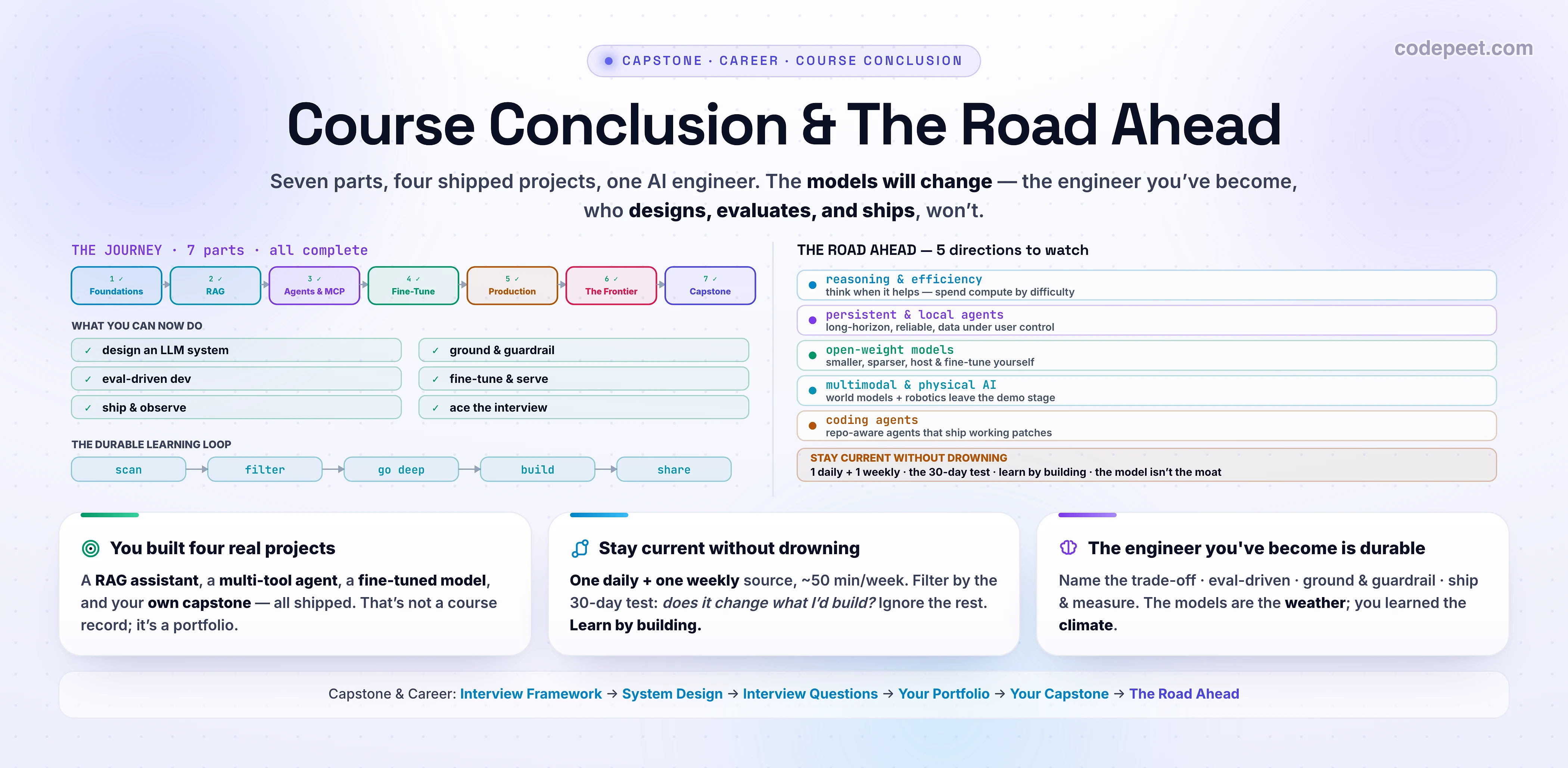
The Journey — Seven Parts, One Skill
Zoom out and look at the arc. Every part built on the last, and together they add up to the full stack of an AI engineer:
| # | Part | What you learned | What it gave you |
|---|---|---|---|
| 1 | Foundations | tokens, attention, sampling, embeddings, context | the mental model for any LLM |
| 2 | RAG | chunking, hybrid retrieval, reranking, grounding, eval | Project 1 — a RAG assistant |
| 3 | Agents & MCP | ReAct, tools, memory, guardrails, trajectory eval | Project 2 — a multi-tool agent |
| 4 | Fine-Tuning & Serving | LoRA/QLoRA, eval vs baseline, quantization, vLLM | Project 3 — a tuned, served model |
| 5 | Production & LLMOps | deploy, observability, cost, safety, eval-driven dev | the habits that survive real traffic |
| 6 | The Frontier | reasoning, computer use, coding agents, open problems | a map of where the field is going |
| 7 | Capstone & Career | interview, system design, portfolio, capstone | Project 4 + the game to get hired |
Read that list again and notice: you shipped four real projects and can speak to every layer of an LLM system with authority. The progression wasn't random — it mirrors how value actually gets built: understand the model → ground it in your data → let it act → adapt it → run it in production → track the frontier → prove it and get paid. The interactive at the end lets you click through each milestone and relive what you built there. This is your map — and you've walked all of it.
What You Can Now Do
It's worth stating plainly, because impostor syndrome will try to talk you out of it: you now have a real, marketable skill set. Not "familiarity with AI" — the concrete ability to build the systems companies are hiring for. Specifically, you can:
- Design an LLM system — clarify requirements, estimate the token budget and cost, and sketch a modular architecture (gateway → retrieval → model → guardrails → eval → observability).
- Ground and guardrail — build RAG that retrieves, reranks, cites, and abstains; defend against prompt injection and PII leaks.
- Do eval-driven development — build a golden set, run an LLM-as-judge, gate deploys on a regression score, and catch drift in production.
- Fine-tune and serve — curate data, run QLoRA, prove the gain against a baseline, quantize, and serve efficiently with routing.
- Ship and observe — deploy to production, trace requests, watch p95 and cost, and close the feedback loop.
- Design agents that reason and act — the ReAct loop, tools over MCP, memory, step budgets, and trajectory eval.
- Ace the interview and show the work — a framework for every round, a system-design method, a portfolio that survives the ten-second scan.
That's not a beginner's list — it's the job description of an AI engineer. You didn't just read about these; you built each one and can point to a shipped artifact. When someone asks "what can you do?", the answer is no longer aspirational. It's a link.
The Principles That Outlast Any Model
Models are temporary; judgment is permanent. If you forget every API in this course but keep these five principles, you'll still be a strong AI engineer in five years:
- Name the trade-off. Every real decision trades quality · latency · cost · safety. Seniors don't deal in absolutes; they say which axis they're optimizing, what they're sacrificing, and back it with a number. This one habit signals seniority in every room.
- Eval-driven development. You can't improve what you can't measure. A golden set and a regression gate turn "it seems better" into "it's 6 points better." Eval is the new system design.
- Ground and guardrail. Don't trust raw generation for facts — retrieve, cite, and abstain. Treat every input (and every retrieved document) as a potential attack surface.
- Ship and measure. Un-deployed is un-finished. Get an ugly working version live, then improve against production signals. A demo you can click beats a perfect plan.
- Reach for the simplest thing that works. Prompt → RAG → fine-tune, in that order of cost. Compose proven parts; don't reinvent. Over-engineering is the tell of an unseasoned engineer.
Notice these aren't about any specific model — they're about how you engineer. That's why they're durable. When a new model drops next month, you'll evaluate it with a golden set, ground it, name its trade-offs, and ship the simplest thing that hits your metric. The principles are the product of this course; the projects were just where you practiced them.
Staying Current — Without Drowning
AI moves fast, and the internet will happily drown you in it — a new "SOTA" model every week, a breathless "AGI is here" thread every day. The skill is not reading everything; it's filtering. The goal is to stay ahead, not to keep up with all of it.
A routine that actually works, in about 50 minutes a week:
- One daily source — a dense, low-hype scan (e.g. TLDR AI, AlphaSignal). Scan headlines, click into one item, close it. Five minutes.
- One weekly digest — for research framing and context (e.g. The Batch by Andrew Ng, Import AI by Jack Clark). Fifteen minutes.
- That's it. More than three sources creates archive shame and reading paralysis without adding signal.
The filter that keeps you sane is the 30-day test: does this change what I'd build next month? If yes, go deep and try it. If no — a benchmark bump, a framework re-skin, a hype thread — let it go. And the deepest way to learn a new thing isn't reading about it, it's building with it and then teaching it (a post, a repo, explaining it to a friend). The durable loop is scan → filter → go deep → build → share. Protect your attention like the scarce resource it is: go deep on evergreen fundamentals, act on what affects your work, and ignore the rest.
Where the Field Is Going — Five Directions to Watch
You don't need to predict the future — you need to know which way to lean. Five directions are shaping AI engineering right now:
- Reasoning & test-time compute. Models that think before answering, trained with verifiable rewards. The 2026 shift is toward efficiency — spending thinking effort in proportion to difficulty, not on every trivial call.
- Persistent & local agents. Agents that run over long horizons, hold context, and increasingly run locally with data under the user's control. The hard problem is reliability — staying on track and recovering from errors.
- Open-weight models & efficiency. Open models keep closing the gap; the era of "bigger at any cost" is over. Smaller, sparser, agent-ready models you can host and fine-tune yourself.
- Multimodal & physical AI. Text + image + video + audio in one model, plus world models that understand physics and robotics moving from demos to deployment.
- Coding agents. Repo-aware agents that read a whole codebase, run tools, and ship working patches — the tools you use to build are themselves becoming agents.
The meta-trend beneath all five: efficiency over raw scale, and a hard truth for builders — "the model won't be the moat." Frontier capability is commoditizing; the durable advantage is in distribution, proprietary data, workflow integration, evaluation, and reliability — which is exactly the engineering this course taught. The frontier keeps moving; your job is to keep pointing your skills at it.
The Open Problems — Where You Can Contribute
AI engineering is a young field with big unsolved problems — which means there's real room for you to contribute, not just consume. The honest frontier of what LLM systems still can't reliably do:
- Reliability & hallucination. There's still no universal fix — and counterintuitively, the smartest reasoning models are sometimes worse at sticking to given facts. There isn't even a single "hallucination rate": different benchmarks measure different failure modes (faithfulness, guessing vs abstaining, citation accuracy). Grounding, abstention, and verification are active engineering frontiers.
- Agent evaluation. Eval's center of gravity moved from answers to multi-step execution — tool use, recovery from failed steps, long-horizon reliability. No single benchmark predicts production failures, so the best teams treat eval as a continuous discipline (automated + model-screened + human expert).
- Autonomy, safety & alignment. The more autonomous the agent, the more prompt injection, long-horizon drift, and alignment gate what you can safely ship. Human-in-the-loop is still the answer for irreversible actions.
You can engage with these however fits: contribute to open source (thoughtfully — the community is drowning in low-effort "AI slop" PRs, so contribute quality you actually understand), share your evals and findings, write up what broke and how you fixed it, or simply build systems that handle these problems well. Every one of these frontiers is a place where a careful engineer with your toolkit can move the field — or at least their corner of it — forward.
Your Career — From Here to Senior
You're leaving this course employable — you can do the work companies are hiring for. Here's the shape of the path ahead:
- Junior / mid (0–2 years). You work with pre-trained models and APIs and ship features. The skills that separate a hire from a pass are the un-glamorous ones: error handling, input validation, and testable code — the difference between a notebook and something that survives production traffic. You have the projects; now write the boring-but-critical parts well.
- Senior (and beyond). The step up isn't more frameworks — it's judgment and communication: code-review discipline, system design, cost/reliability ownership, and mentoring. Compensation reflects it (senior AI-eng comp is strong and rising), but the real unlock is being the person who can design and defend a system, not just wire one up.
How to actually get hired and grow:
- Lead with proof, not credentials. A production-grade portfolio with live demos beats any certificate. Hiring managers hire proof.
- Tell debugging stories. "Here's what broke and how I fixed it" reveals how you think under pressure — narrate them in interviews and READMEs.
- Be the person who implements, not just discusses. Companies pay a premium for engineers who ship, not ones who only talk about AI.
- Keep the loop going: build → measure → share → learn. Your fourth project won't be your last; it's the first of the rest of your career.
Learn in Public — Compounding Beats Cramming
The engineers who grow fastest aren't the ones who read the most — they're the ones who build and share in public. It's the final beat of the learning loop (scan → filter → go deep → build → share), and it compounds in ways private study never does:
- Teaching forces understanding. You don't truly know a technique until you've explained it — a blog post, a README, a thread, a talk. The gaps you can't hand-wave past are exactly what you need to learn.
- Your work becomes discoverable. A writeup travels where a private repo can't; opportunities come inbound from things you shared, not just applications you sent (L18).
- You join the conversation. Contributing to open source, answering questions, and publishing evals puts you in the room with people ahead of you — the fastest way to level up. Contribute quality you understand, not AI-generated noise; the signal is what builds your reputation.
You don't need a big audience or a personal brand. One honest writeup per project — the problem, the hardest decision, the result with a number, the links — is enough. Do that consistently and, over a year, you'll have a body of public work that argues for you while you sleep, a network of peers, and a learning habit that keeps you sharp as the field moves. Cramming expires; compounding doesn't.
Build Responsibly — The Weight of the Skill
One last thing, and it matters more the better you get: the systems you can now build are powerful, and power asks for care. An LLM system can inform a medical question, filter a job applicant, moderate speech, or take real actions on someone's behalf. Shipping it well isn't only an engineering responsibility — it's an ethical one.
Carry a few commitments with the skill:
- Be honest about limits. These systems hallucinate, reflect biases in their data, and fail in ways that look confident. Design for that — ground, cite, abstain, and keep a human in the loop for high-stakes or irreversible decisions.
- Respect people's data and consent. Don't leak PII, don't train on what you shouldn't, keep secrets out of code, and tell users when they're talking to an AI.
- Measure harm, not just accuracy. Your evals should ask "who does this fail, and how badly?" — fairness and safety are metrics, not afterthoughts (this is the guardrail and eval discipline, pointed at impact).
- Build things worth building. The most valuable AI engineers solve real problems for real people — not the flashiest demo, but the system that genuinely helps.
You've earned a skill that a few years ago barely existed. Use it to build systems that are grounded, safe, and genuinely useful. That's not a constraint on good engineering — it is good engineering.
See It — Your Journey Map
This is your graduation console — a chance to look back at the whole journey and forward to the road ahead, in one place.
- Click each of the 7 milestones to relive what you learned there and what you built — watch the readiness bar fill as you revisit all seven.
- Read the capability badges — the durable things you can now do, not just know.
- Explore the 5 road-ahead directions — click each for what it is and a concrete thing to try next in one of your projects.
- Study the learning loop (scan → filter → build → share) and the stay-current rule — your system for the fast-moving field.
- End on the note that matters: the models change; the engineer you've become is durable.
The whole course in one view. Seven parts, four projects, one set of durable principles — and a compass for what's next. You're not at the end of the learning; you're at the start of the doing.
🧪 Try It Yourself
One last set — but these are about launching, not reviewing.
1. Set up your stay-current stack right now: pick one daily and one weekly source and subscribe. (Don't pick a third.)
2. Pick one of the five frontier directions and name a concrete experiment you could run in one of your four projects this month.
3. In one sentence each, state the five durable principles from memory. Which one do you most need to get better at?
4. Write your one-line headline as an AI engineer — the bullet you'd put at the top of your portfolio, with a number.
5. What's the next thing you'll build — and who is it for?
Reflections (yours will be personal).
1. A great default: TLDR AI (daily, 5 min) + The Batch (weekly, for research framing). Two sources, ~50 min/week, zero archive shame.
2. e.g. "Add a reasoning/extended-thinking mode to my agent's hardest step and measure the quality-vs-latency trade-off on my trajectory eval" — a real experiment, scoped to a system you already have.
3. Name the trade-off · eval-driven · ground and guardrail · ship and measure · simplest thing that works. Most engineers' weak spot is eval-driven — building the golden set feels slow until the first time it catches a regression.
4. e.g. "AI engineer — built a RAG assistant, a multi-tool agent, and a fine-tuned model that matched a frontier model at ~20× lower cost; all deployed." Outcome + a number.
5. There's no wrong answer — but there is a wrong non-answer, which is "nothing yet." Pick something small, real, and for a specific person (even if that person is you), and start this week.
Mental-Model Corrections
- "I need to keep up with every new model and paper." → You need to stay ahead, not keep up. One daily + one weekly, filter by the 30-day test, ignore the rest.
- "The newest, biggest model is always the answer." → Efficiency beat scale. Route, cache, and reach for the smallest model that hits your metric. The model isn't the moat.
- "Once I land a job, the learning is done." → The loop never stops — build → measure → share → learn. But it's sustainable, not frantic, once you have a filter.
- "Certificates and courses get me hired." → Proof does — a production portfolio with live demos and documented decisions. (You have one now.)
- "Senior means knowing more frameworks." → Senior means judgment and communication — design, code review, naming trade-offs, mentoring. Not tool count.
- "This course made me an expert." → It made you capable and independent — able to keep learning and shipping on your own. That's better than 'expert on today's tools,' because today's tools expire.
- "The field is too fast; I'll fall behind." → The fundamentals move slowly and you have them. Grounding, eval, trade-offs, and shipping will matter for years. You're not behind; you're equipped.
Key Takeaways
- You did it — by building. Seven parts, four shipped projects (RAG assistant, multi-tool agent, fine-tune & ship, and your own capstone), and the ability to design, evaluate, and ship LLM systems.
- The principles are what's durable: name the trade-off · eval-driven development · ground and guardrail · ship and measure · simplest thing that works. Models change; these don't.
- Stay current without drowning: one daily + one weekly source, the 30-day "does it change what I'd build?" filter, and the loop scan → filter → go deep → build → share.
- Lean toward where it's going: reasoning/efficiency, persistent & local agents, open-weight models, multimodal & physical AI, coding agents — and remember the model isn't the moat; engineering is.
- The open problems are opportunities: reliability/hallucination, agent evaluation, and safe autonomy are unsolved — contribute quality, share your evals, build systems that handle them well.
- Your career grows on proof: production portfolio + live demos + debugging stories > credentials; junior→senior is a shift from wiring systems to designing and defending them.
- The models are the weather; you learned the climate. Keep building, stay curious, and go make something people use. This is the end of the course — and the start of your work as an AI engineer. Congratulations. 🎓