What Is AI Engineering? (And Why It Exploded)
Introduction
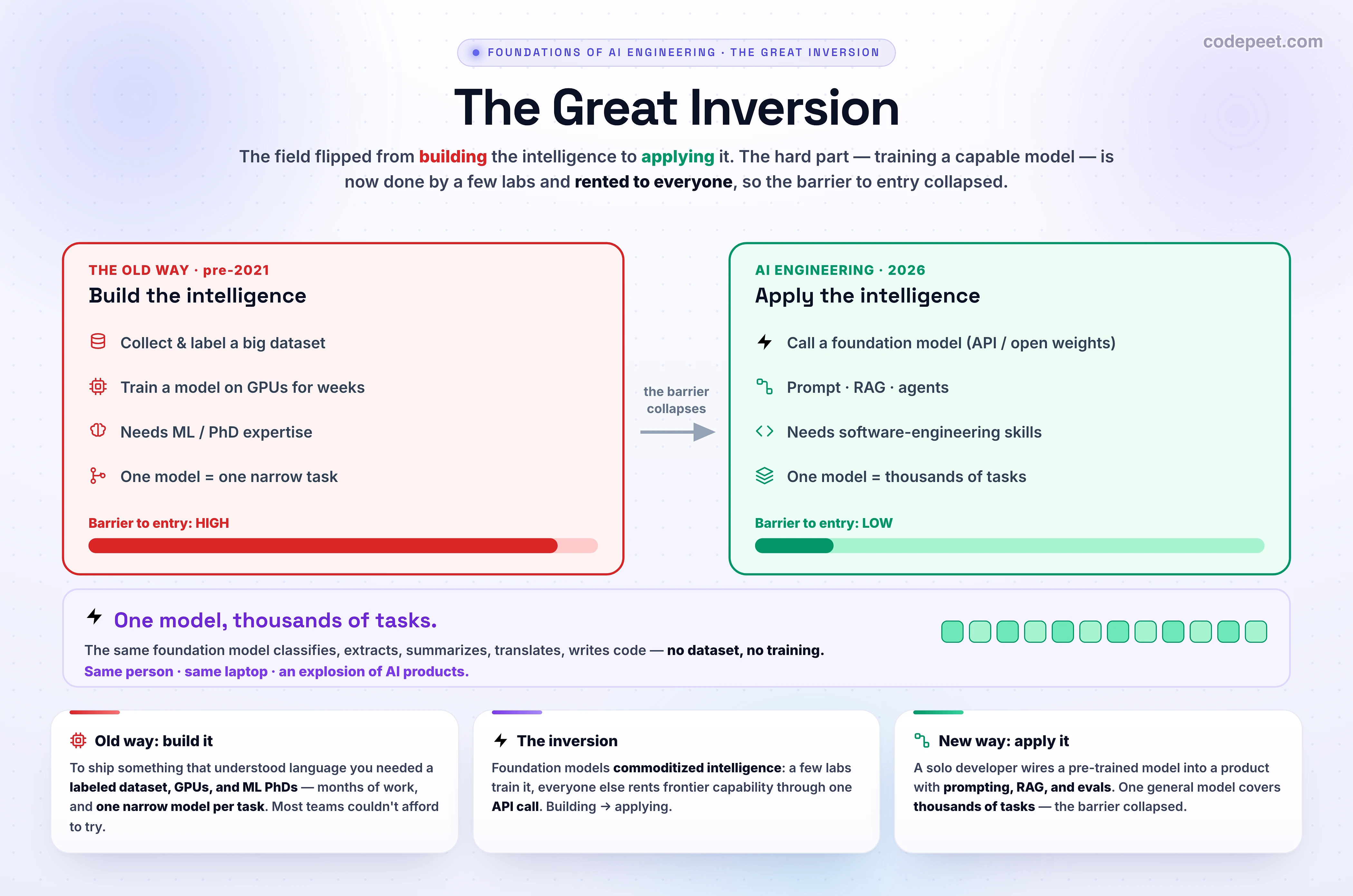
2020. To ship a feature that genuinely understood language, you needed a machine-learning team, a cluster of GPUs, a hand-labeled dataset, and months of work — usually with a PhD or two to make it behave. Most teams simply couldn't afford to try.
2026. A solo developer opens a laptop on a Saturday, calls a model someone else already trained, and by Monday their app is understanding language for thousands of users. Same person. Same laptop. The tools changed — and that changed everything.
That inversion — from building intelligence to applying it — created a brand-new discipline: AI engineering, now one of the fastest-growing roles in software. This lesson is your orientation to it.
In this lesson you'll learn:
- What AI engineering actually is (and how it differs from the AI/ML you may have heard about)
- The three forces that made it explode — and why it emerged now (a 14-year timeline)
- What an AI engineer does day to day
- A 6-line taste of why the barrier collapsed
- The misconceptions that trip people up — so you start with the right mental model
What Is AI Engineering?
AI engineering is the practice of building applications on top of readily-available foundation models — large, general-purpose models (like Claude, GPT, Gemini, Llama) that someone else trained on enormous amounts of data and exposed via an API or open weights.
The key word is on top of. You are not creating the intelligence; you are applying it — wiring a powerful general-purpose model into a real product that's reliable, fast, affordable, and safe.
Think of a foundation model as a brand-new kind of CPU: an incredibly capable, slightly unpredictable reasoning engine you can call from your code. Your job as an AI engineer is to build useful, trustworthy software around that engine — the same way backend engineers build systems around a database, not by inventing a new database.
Here's the distinction that matters most (we'll go deep on it in a later lesson):
| ML Engineer | AI Engineer | |
|---|---|---|
| Core job | Trains models on data | Builds products on pre-trained foundation models |
| Starts from | A dataset | A model endpoint + a product idea |
| Typical skills | Statistics, training pipelines, GPUs | Software engineering, prompting, retrieval, evals |
| Output | A trained model | A shipped AI feature |
Neither is "better" — they're different jobs. This course is about the second one.
Why It Exploded
AI research is decades old. So why did AI engineering explode only recently? Three forces lined up at once:
1. Foundation models commoditized intelligence. The hard, expensive part — training a genuinely capable model — is now done by a handful of labs and rented to everyone else as a model-as-a-service. You get frontier-level capability through a single API call.
2. The models became general-purpose. Older ML gave you one narrow model per task (a spam classifier, a separate translator…). A modern foundation model handles classification, extraction, summarization, translation, coding, and reasoning — thousands of tasks — out of the box. One endpoint replaces a zoo of bespoke models.
3. The barrier to entry collapsed. You no longer need labeled data, GPU clusters, or an ML PhD to start. If you can write software, you can build with AI. Coding agents (Replit, Lovable, Claude Code) pushed the barrier even lower.
The result is a hiring surge. In 2026, AI-engineer compensation has jumped sharply — by many accounts among the fastest-rising in software — with specialist LLM roles commanding a clear premium, and AI-related job postings sit well above their 2020 baseline. (Exact figures move fast and vary by source and region — treat them as direction, not gospel.) The signal is unambiguous: demand for people who can turn foundation models into products far outstrips supply.
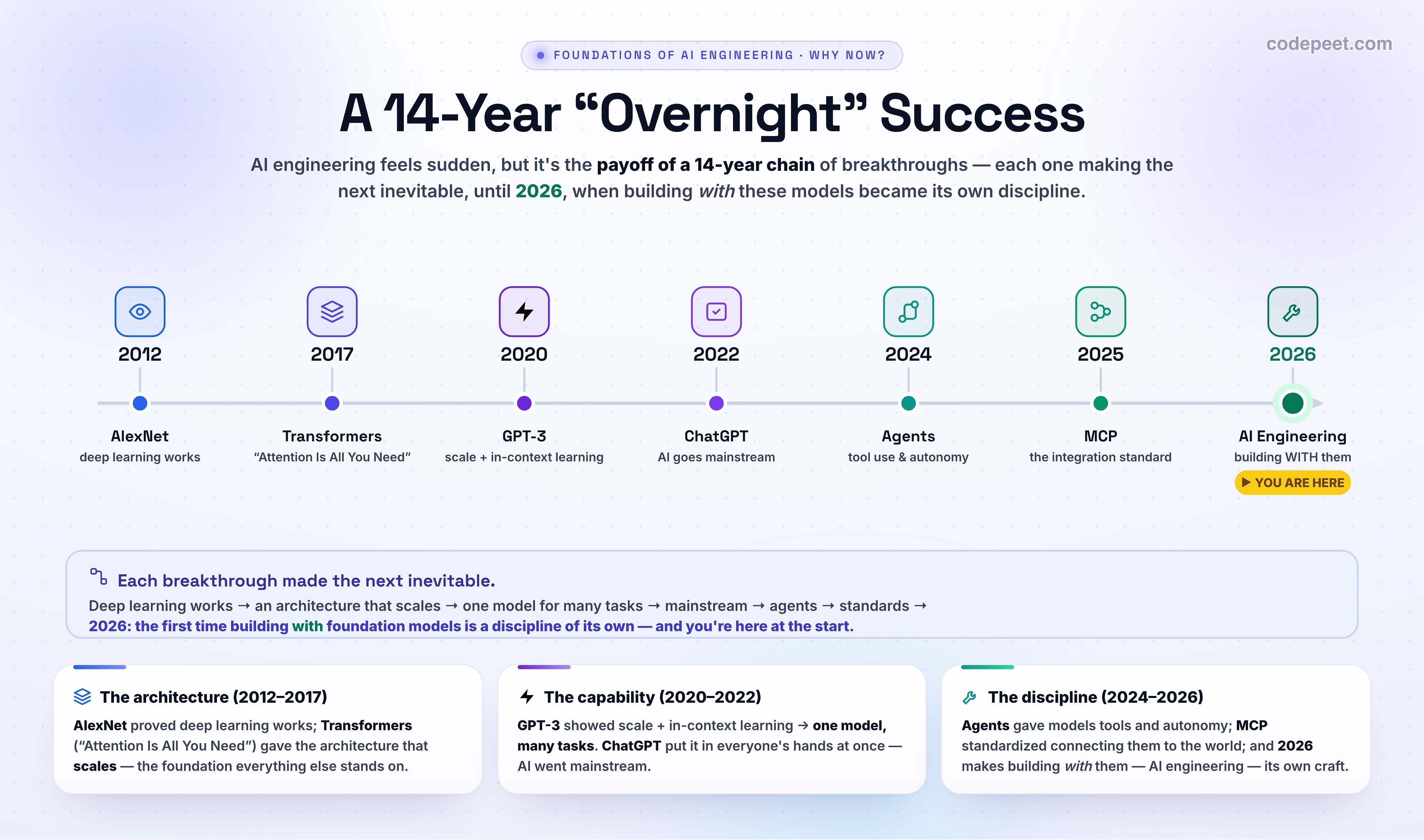
Why Now? A 14-Year "Overnight" Success
AI engineering feels sudden, but it's the payoff of a 14-year chain of breakthroughs — each one making the next inevitable:
- 2012 · AlexNet — deep learning decisively works.
- 2017 · Transformers — the architecture ("Attention Is All You Need") that scales.
- 2020 · GPT-3 — scale + in-context learning: one model, many tasks.
- 2022 · ChatGPT — AI goes mainstream; everyone feels it at once.
- 2024 · Agents — models begin using tools and taking actions.
- 2025 · MCP — a standard way to connect models to the world.
- 2026 · AI Engineering — building with these models becomes a discipline of its own.
The through-line: once the model itself became a powerful, rentable commodity, the value — and the work — shifted to building with it. That's why the role appeared exactly now, and why it's still wide open.
What Does an AI Engineer Actually Do?
Mostly: software engineering, plus a new probabilistic layer. The demo is easy; making it reliable, cheap, and safe at scale is the craft. Day to day, an AI engineer:
- Designs prompts and context — what information and instructions the model sees (prompting → context engineering).
- Connects the model to real data — retrieval-augmented generation (RAG) so answers are grounded, not guessed.
- Builds agents & tools — letting the model call functions, search, run code, take actions.
- Evaluates relentlessly — because outputs are probabilistic, you measure quality with evals instead of hoping.
- Optimizes latency & cost — caching, routing, the right model for each job.
- Adds guardrails & ships — safety, reliability, monitoring, deployment.
That list is the roadmap of this course.
A Taste: This Is All It Takes Now
To feel the inversion, here's a sentiment classifier. The old way meant gathering thousands of labeled reviews and training a model. The new way is a few lines against a foundation model — no dataset, no training. (We set up your environment properly in a later lesson; this is just to see the shift.)
# AI engineering with Claude (Anthropic)
from anthropic import Anthropic

client = Anthropic()  # reads ANTHROPIC_API_KEY from the environment

resp = client.messages.create(
    model="claude-sonnet-4-6",
    max_tokens=10,
    messages=[{
        "role": "user",
        "content": "Classify the sentiment as POSITIVE, NEGATIVE, or NEUTRAL. "
                   "Reply with one word only.\n\nReview: 'Shipping was slow but the product is fantastic.'"
    }],
)
print(resp.content[0].text)   # -> POSITIVE
# The same idea with OpenAI
from openai import OpenAI
client = OpenAI() # reads OPENAI_API_KEY from the environment
resp = client.chat.completions.create(
model="gpt-5.5",
messages=[{
"role": "user",
"content": "Classify the sentiment as POSITIVE, NEGATIVE, or NEUTRAL. "
"Reply with one word only.\n\nReview: 'Shipping was slow but the product is fantastic.'"
}],
)
print(resp.choices[0].message.content) # -> POSITIVESix lines, zero training data, works on day one — and the same model would also extract structured fields, summarize, translate, or write code. That capability-for-free is exactly why AI engineering exploded. The catch: that classifier isn't yet production-ready (what if the model replies "Positive!" with punctuation? what if the input is a prompt-injection attack? what does it cost at a million calls?). Turning this taste into a robust system is what the rest of the course is about.
See It: The Inversion Lab
Feel the inversion by shipping a few products. Pick what you'd build, and watch the old way stack up a new model, dataset, and weeks of training for each one — while the new way stays flat at a single foundation model that handles them all. Add more and the gap explodes: that's the whole reason the field took off.
The old column grows with every task; the new one doesn't. One model, thousands of tasks — the hard part (building the intelligence) is done once and rented to everyone, so you get to focus on applying it.
🧪 Try It Yourself
Spot the AI engineering. Which of these is AI engineering (building on top of foundation models) vs ML engineering (building the models)?
- Training a new language model from scratch on a GPU cluster.
- Building a support chatbot over your company's docs with an API + RAG.
- Adding a 'summarize this' button that calls GPT-5.5 and evaluates the output.
Answers: 2 and 3 are AI engineering (you use existing models, focus on the system around them). 1 is ML engineering. The whole field you're entering is about #2 and #3 — and that's why it exploded: the hard part (the model) is now a callable API.
Common Misconceptions
Start with the right mental model and you'll move much faster:
- "AI engineering is just prompt hacking." Prompting is one skill of many. The job is building systems — retrieval, evals, guardrails, monitoring, cost control.
- "You need an ML PhD." You need solid software-engineering instincts plus the skills in this course. The math-heavy model training is a different role.
- "It's just calling an API." The API call is the easy 10%. The hard 90% is making outputs reliable, grounded, fast, cheap, and safe — at scale.
- "AI engineering = ML engineering." Related but distinct: ML engineers train models; AI engineers build products on top of them. (Full breakdown in an upcoming lesson.)
Where This Course Takes You
You'll progress exactly the way modern AI teams work: foundation-model fundamentals → prompting & context engineering → RAG → agents & MCP → evaluation → fine-tuning → production (LLMOps) → portfolio capstones. Build-first, evaluate-always, ship-for-real.
Next up: The AI Stack — the three layers (application, model, infrastructure) you'll work across, and where AI engineering actually lives.
Key Takeaways
- AI engineering = building applications on top of pre-trained foundation models — applying intelligence, not creating it.
- It exploded because foundation models commoditized general-purpose intelligence, collapsing the barrier from "train your own model" to "call an API."
- An AI engineer's work is software engineering plus a probabilistic layer: prompting/context, RAG, agents, evals, cost/latency, guardrails, deployment.
- The demo is easy; production is the craft — reliability, grounding, cost, and safety are where the real engineering lives (and where this course focuses).
- It's distinct from ML engineering (which trains models) — and you don't need a PhD to be excellent at it.