AI Engineer vs ML Engineer vs Full-Stack Engineer
Introduction
Three job titles get thrown around as if they're the same thing — AI Engineer, ML Engineer, Full-Stack Engineer — and the confusion stops a lot of people from starting. "Don't I need to be a machine-learning expert first?" (Spoiler: no.)
Now that you have the three-layer AI stack from the last lesson, we can cut through the confusion cleanly: each role mostly owns a different layer. Once you see that, you'll know exactly what to learn, which jobs to target, and where you already have an edge.
You'll learn:
- The one-sentence difference between the three roles
- AI Engineer vs ML Engineer — the distinction that matters most
- AI Engineer vs Full-Stack Engineer — why it's the natural next step for web devs
- Whether you need to be an ML engineer first (you don't)
- Why you should judge skills, not titles
The One-Sentence Difference
Map the roles onto the stack and it clicks instantly:
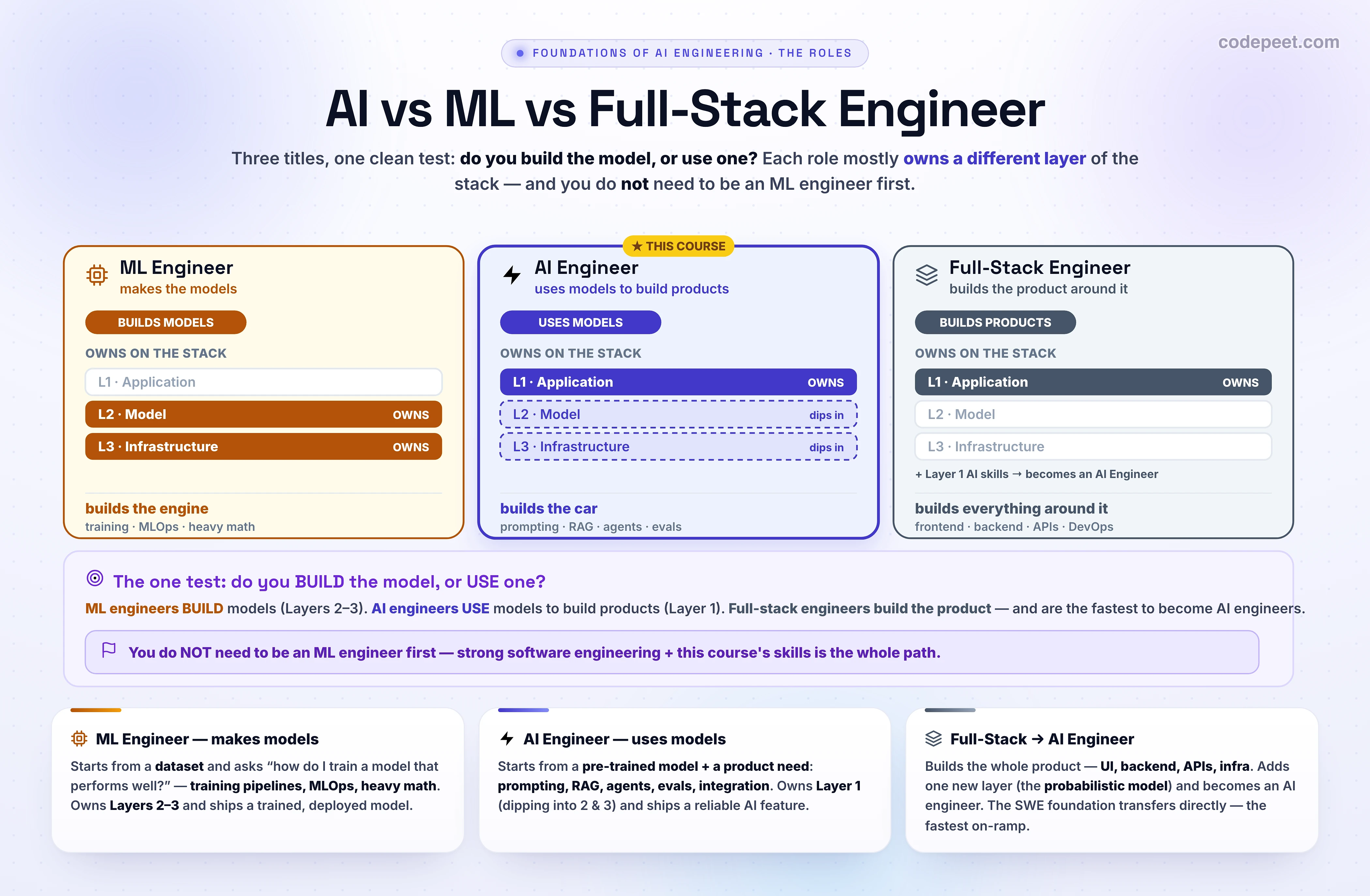
- ML Engineer — makes the models. Lives in Layer 2 (Model Development) and Layer 3 (Infrastructure): trains, fine-tunes, builds data pipelines, runs MLOps.
- AI Engineer — uses models to build products. Lives in Layer 1 (Application Development), dipping into Layer 2 (fine-tuning) and Layer 3 (deploy/observe).
- Full-Stack Engineer — builds the product (UI, backend, APIs, infra) — and, increasingly, is becoming an AI engineer by adding Layer 1 skills.
Put crudely: ML engineers build the engine; AI engineers build the car; full-stack engineers build everything around it — and are now learning to drop in the AI engine themselves.
AI Engineer vs ML Engineer (the key distinction)
This is the comparison people get wrong most often. The cleanest test: do you build the model, or use one?
| ML Engineer | AI Engineer | |
|---|---|---|
| Starts from | A dataset | A pre-trained model + a product need |
| Core question | "How do I train a model that performs well?" | "How do I turn this model into a reliable product?" |
| Models | Builds & trains them (from scratch or fine-tuned) | Uses existing ones (Claude, GPT, Llama via APIs) |
| Signature skills | ML theory, training pipelines, MLOps, math | Prompting, RAG, agents, evals, system integration |
| Math depth | High (optimization, statistics) | Moderate — enough to choose & fine-tune wisely |
| Owns (stack) | Layer 2 + Layer 3 | Layer 1 (+ dips into 2 & 3) |
| Output | A trained, deployed model | A shipped AI feature/product |
A useful framing from the field: ML engineers are the architects of algorithmic performance; AI engineers are the system integrators who turn raw models into functional applications. They overlap (both write Python, both care about data and evaluation), and at small companies one person may wear both hats — but the center of gravity is different: building models vs. building with them.
AI Engineer vs Full-Stack Engineer
Here's the one that surprises people: AI engineering is, in spirit, "full-stack engineering for the AI era." Both roles ship end-to-end products — frontend, backend, APIs, deployment. The AI engineer just adds a new layer to the toolkit: the probabilistic model layer.
What's genuinely new for a full-stack engineer moving into AI:
- Outputs are non-deterministic — the same input can give different results, so you design for variance and evaluate instead of writing exact assertions.
- You engineer context (prompts, retrieved data) rather than only writing deterministic logic.
- New cost & latency model — you budget in tokens, not just CPU/RAM.
- New failure modes — hallucination, prompt injection, truncation.
But the foundation transfers directly: backend, APIs, cloud, DevOps, product sense. That's why full-stack developers who move into AI become AI engineers, not ML engineers — their systems-and-integration instincts are exactly what Layer 1 rewards. If that's your background, you have a head start.
"Do I Need to Be an ML Engineer First?"
No. This is the single most important thing to internalize early.
You do not need to train neural networks from scratch, derive backprop, or own a GPU cluster to be an excellent AI engineer. You rent the model (Layer 2 is a lab's job) and build the product (Layer 1). What you actually need is:
- Solid software-engineering instincts (the biggest predictor of success)
- The skills this course teaches: prompting & context engineering, RAG, agents, evaluation, fine-tuning when warranted, and shipping to production
- Enough understanding of how models work (Layer 2) to make good choices — which is why we cover the foundations, without turning you into a model-training researcher
The heavy ML math is a different, optional specialization. Plenty of the best AI engineers came from web/backend development, not ML research.
Visualization
The Lines Are Blurry — Judge Skills, Not Titles
One honest caveat: titles are inconsistent across companies. At one company "AI Engineer" means exactly what we've described; at another it's an "ML Engineer who happens to work on LLMs"; at a startup it might mean "the person who does everything."
So don't over-index on the title — read the job description and look at the skills. If the role is about prompting, RAG, agents, evals, and shipping LLM-powered features, it's AI engineering, whatever it's called. If it's about training and serving custom models, that's ML engineering. The skills in this course are what hiring managers are actually screening for in 2026 — and increasingly, many product teams hire for AI-engineering skills before deep-ML or data-engineering ones.
See It: Who Do You Hire?
Read the brief, then pick the role. Six real hiring asks — for each one, decide whether it's an AI Engineer, an ML Engineer, or a Full-Stack Engineer. The single test that resolves almost every case: do you build the model, or use one?
Notice the test never asked about degrees or math — only what work the role does. Builds a model from data → ML engineer. Uses a model to ship a product → AI engineer. Builds the product shell → full-stack (the fastest on-ramp to AI engineering). Titles vary across companies, so judge the skills, not the label.
🧪 Try It Yourself
Who do you hire? A startup wants to 'build a copilot over our product docs in 6 weeks.' Is that an AI engineer, an ML engineer, or a full-stack engineer role?
→ AI engineer. It's an application built on an existing model (prompting + RAG + evals) — no model training (ML engineer) and it needs more model-savvy than a generic full-stack hire. If the ask were 'train a custom fraud model on our data,' that flips to ML engineering.
Common Misconceptions
- "AI engineering is just a watered-down ML engineering." Different focus, not a lesser one. Turning an unreliable model into a trustworthy product at scale is its own hard craft (most of this course).
- "You need a PhD / ML background." No. Strong software engineering + this course's skills. The training-math is a separate specialization.
- "Full-stack and AI engineering are unrelated." The opposite — full-stack is the most natural on-ramp; your SWE foundation transfers directly.
- "The title tells you the job." It doesn't. Read the responsibilities.
Key Takeaways
- ML engineers build models (Layers 2–3); AI engineers use models to build products (Layer 1, dipping into 2 & 3); full-stack engineers build the product and are the fastest to become AI engineers.
- The defining AI-vs-ML test: do you build the model, or use one?
- You do not need to be an ML engineer first. Solid software engineering + this course's skills is the path.
- Titles vary — judge roles by skills/responsibilities, not labels. In 2026, AI-engineering skills are in especially high demand on product teams.
Next: now that you know the role, let's see its range — what you can actually build with foundation models (the use-case map).