Tokenization: How Text Becomes Numbers (BPE)
Introduction
Last lesson we used "token ≈ word" as a training-wheels simplification. Time to take the wheels off.
Models don't process words, and they don't process letters. They process tokens — integer IDs for chunks of text — and the very first thing that happens to your prompt is tokenization: text gets chopped into tokens and turned into numbers before the model sees anything.
This sounds like a boring plumbing detail. It isn't. Tokenization explains a surprising amount of real model behavior — why ChatGPT can't reliably count the R's in "strawberry", why your API bill is shaped the way it is, and why some languages cost 2–3× more than English to process.
You'll learn:
- Why models use subword tokens (not words or characters)
- What a token actually is — and what a vocabulary is
- Byte-Pair Encoding (BPE) — how that vocabulary is built
- How to tokenize text yourself with code
- The real-world consequences (the strawberry problem, cost, multilingual)
Why Not Just Words or Characters?
You might expect the model to split on words, or on individual characters. Both extremes break:
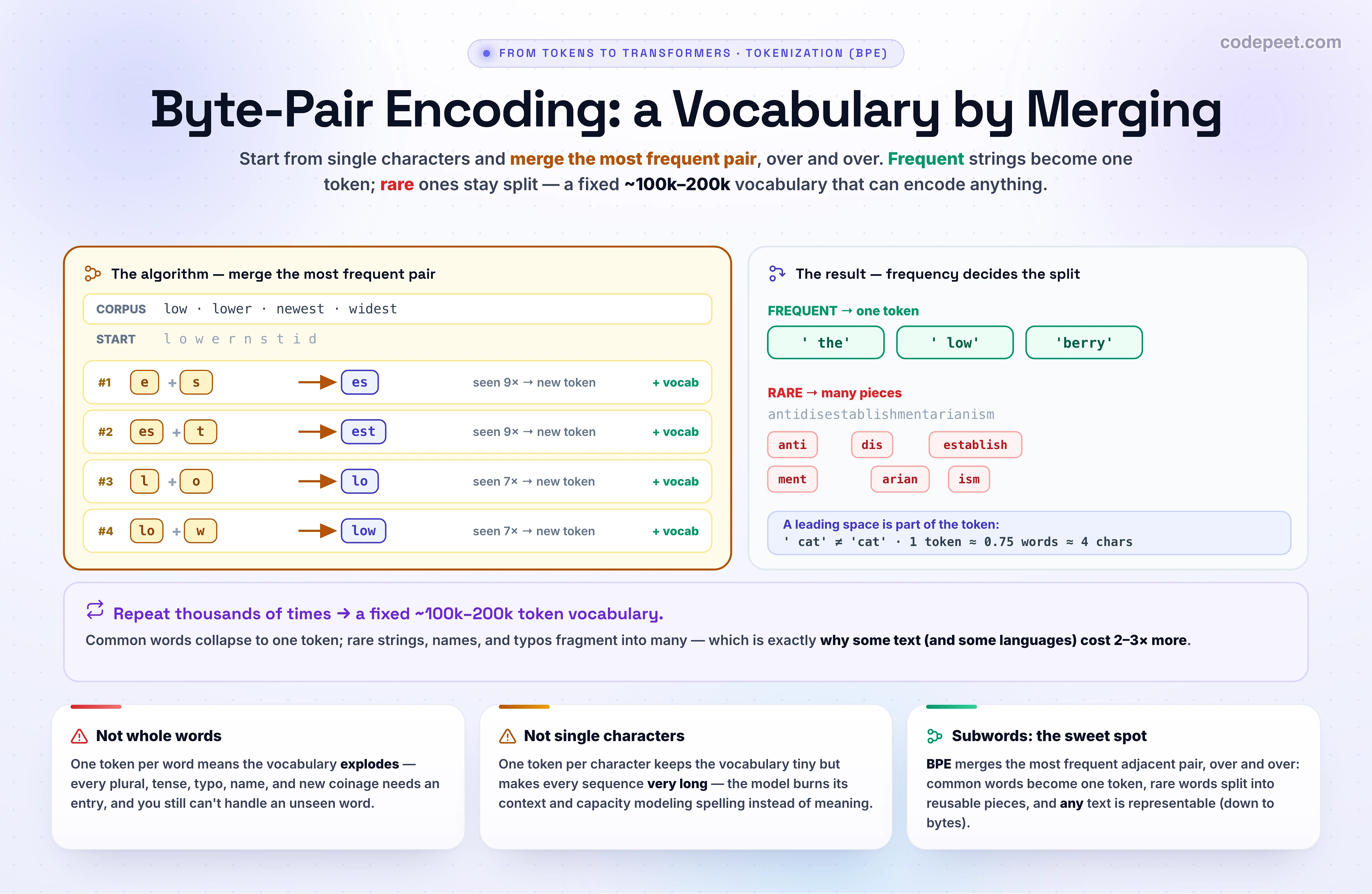
- Whole words → the vocabulary explodes. Every word, plural, tense, typo, name, and new coinage ("rizz", "GPT-4o") needs its own entry — millions of them — and you still can't handle a word you've never seen.
- Single characters → the vocabulary is tiny, but every sentence becomes a very long sequence. The model burns its limited capacity and context window modeling spelling instead of meaning.
Subword tokenization is the sweet spot in between. Common words become a single token; rare or novel words get split into reusable pieces; and anything can be represented by falling back to smaller fragments (down to bytes). You get a manageable, fixed vocabulary (today typically ~100,000–200,000 tokens) that can encode any text. The dominant method for building it is Byte-Pair Encoding.
What a Token Actually Is
A token is just an entry in the model's fixed vocabulary — a chunk of text paired with an integer ID. Tokenization maps your text to the sequence of IDs, and the model only ever works with those numbers.
"The cat sat."
   → tokens:  ["The", " cat", " sat", "."]
   → IDs:     [976,   9059,   10139,  13]
Two things to notice immediately:
- The leading space is part of the token.
" cat"(with a space) is a different token from"cat". (Remember the logprobs demo last lesson showing both'Paris'and' Paris'? Same reason.) - One token is not one word. A rough, useful heuristic for English: 1 token ≈ 0.75 words ≈ 4 characters (so ~1.33 tokens per word). You'll use this constantly to estimate cost and context budget.
Byte-Pair Encoding (BPE) — How the Vocabulary Is Built
Where does the vocabulary come from? Mostly from Byte-Pair Encoding — an old compression idea (Philip Gage, 1994) adapted for language models. The algorithm is delightfully simple:
- Start with the smallest units — individual characters (or bytes).
- Count every adjacent pair across a huge training corpus.
- Merge the most frequent pair into a new token, and add it to the vocabulary.
- Repeat thousands of times — until the vocabulary reaches the target size.
Frequent letter-sequences ("th", "ing", "tion", common whole words) get merged early and become single tokens; rare strings never merge and stay fragmented. That's exactly why common words are one token and unusual ones are split.
Tokens in Practice
You can tokenize text yourself in seconds. OpenAI's tokenizer library, tiktoken, runs locally (no API call, free). Modern OpenAI models use the o200k_base encoding (a ~200k-token vocabulary); GPT-4/3.5 used cl100k_base.
import tiktoken
enc = tiktoken.get_encoding("o200k_base")   # GPT-4o / 4.1-era vocabulary

ids = enc.encode("Tokenization isn't magic.")
print(ids)                                   # -> [2380, 2065, ... ]  (integer IDs)
print([enc.decode([i]) for i in ids])        # the actual token strings
print(len(ids), "tokens")

# The strawberry problem, made visible:
print([enc.decode([i]) for i in enc.encode("strawberry")])
# -> ['st', 'raw', 'berry']     (3 tokens — the model never sees the letters)
Note that Anthropic's Claude uses its own tokenizer (not tiktoken), so exact token counts differ between providers — but the concept is identical. For estimating Claude usage, rely on the usage field the API returns (you saw it in the API-anatomy lesson) or Anthropic's token-counting endpoint.
Why This Matters: The Strawberry Problem & Friends
Tokenization isn't trivia — it directly causes behavior you'll hit in production.
1. The famous "strawberry" failure. Ask a model "how many R's are in 'strawberry'?" and it often says 2 (the answer is 3). Why? Because the model never sees the letters — it sees the tokens ['st', 'raw', 'berry']. To count R's it would have to know each token's letter contents (st = 0, raw = 1, berry = 2) and sum them. It's not "dumb"; it's blind to spelling by construction.
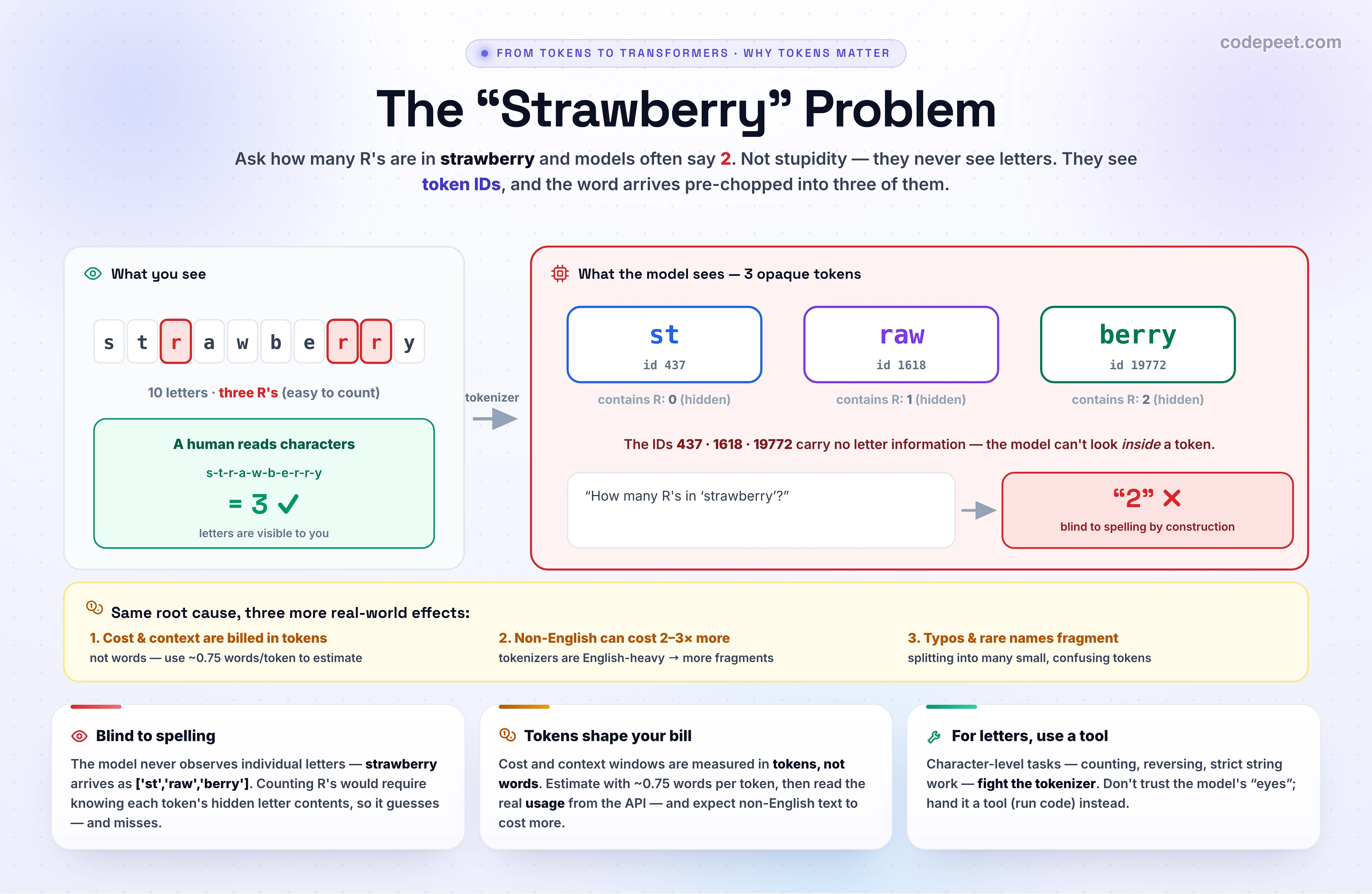
2. Cost & context are billed in tokens. Your bill and your context window are measured in tokens, not words (recall the API usage field). The 0.75-words-per-token heuristic is how you estimate both.
3. Some languages cost far more. Tokenizers are trained mostly on English, so English is compact (~1.3 tokens/word) while many other languages — and lots of code or unusual formatting — fragment into many more tokens. The same meaning can cost 2–3× more in tokens (and money, and latency) in another language.
4. Rare words and typos fragment. An unusual name or a typo splits into many small tokens, which can confuse the model and waste context.
🧪 Try It Yourself: The Tokenizer
Type anything below and watch it shatter into tokens in real time:
- Try a long, rare word like
antidisestablishmentarianism→ it splits into many sub-word pieces (the model has no single token for it). - Try
GPT-4 costs $0.03 🤖→ see how numbers, symbols, and emoji tokenize differently from words. - Watch the chars-per-token number hover near ~4 — the rule of thumb you'll use to estimate tokens (and cost) forever.
Mental-Model Corrections
- Don't ask models to do character-level work blindly. Counting letters, reversing strings, strict character manipulation — these fight the tokenizer. If you must, give the model a tool (e.g., run code) instead of trusting it to "see" letters.
- Estimate, then measure. Use ~0.75 words/token to plan, but read the real
usagenumbers from the API for anything that matters (cost, context limits). - Token counts are provider-specific. Don't assume OpenAI's count equals Claude's — different tokenizers, different numbers.
- "token ≈ word" is fine for intuition, but now you know the truth underneath — and why spelling-sensitive tasks misbehave.
Key Takeaways
- Models read tokens — integer IDs for subword chunks — not words or letters. Tokenization is the first step on every prompt.
- Subwords balance the word-vs-character tradeoff; the vocabulary (~100k–200k tokens) is built with Byte-Pair Encoding: repeatedly merge the most frequent adjacent pair.
- Rule of thumb: 1 token ≈ 0.75 words ≈ 4 English characters; leading spaces are part of tokens; counts differ per provider.
- Tokenization explains real behavior: the strawberry letter-counting failure, token-based cost/context, and why non-English text costs more.
- For character-level tasks, reach for a tool, not the model's "eyes."
Next: tokens are still just IDs with no inherent meaning. We give them meaning with embeddings — turning tokens into vectors where similar things sit close together.