Synthetic Data Generation
Introduction
L195 (Data Quality, Coverage & Quantity) said quantity has a floor you must clear, and L196 (Sourcing & Annotating Data) said hand-writing examples is slow and expensive. Synthetic data is how you square that circle — and in 2026 it's the default scaling primitive for fine-tuning: model-generated training data that amplifies a small real seed into a large, diverse set, cheaply.
But synthetic data is a loaded gun. Done well, a handful of seed examples becomes thousands of varied, challenging ones. Done badly, you get a model that's confidently mediocre — because the teacher echoed itself and the data collapsed into sameness. This lesson is the craft that separates the two: the seed → teacher → judge pipeline, the generation methods (Self-Instruct, Evol-Instruct, personas, Magpie), the collapse failure mode and its antidotes, and the legal line you can't cross with a frontier teacher.
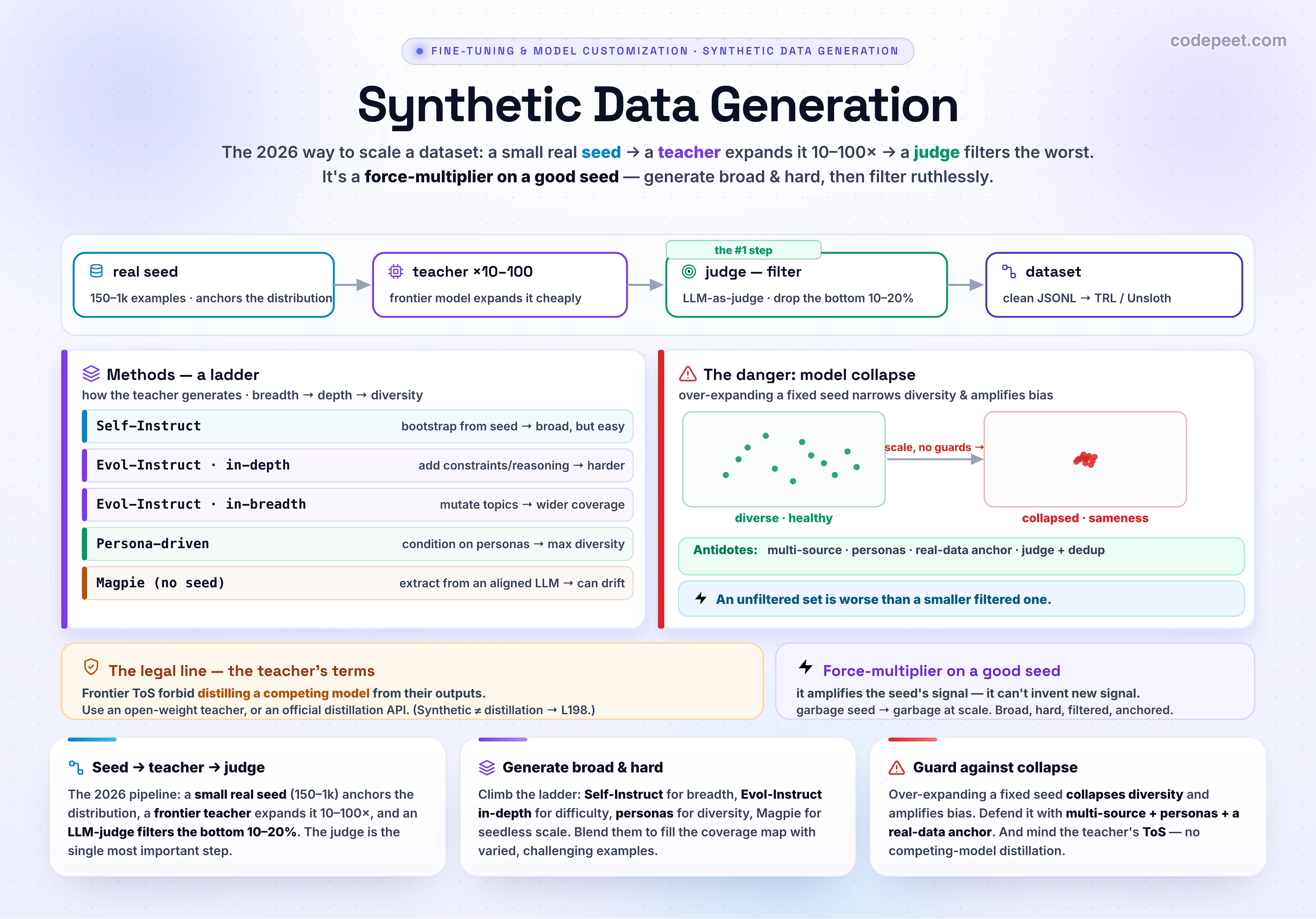
The Pipeline: Seed → Teacher → Judge → Dataset
Almost every synthetic-data recipe in 2026 is the same four steps — internalize this and you understand the whole field:
- Small real seed. ~150–1,000 real, high-quality examples (from L196) that anchor the distribution — the style, format, and kind of task you want. The synthetic set can only be as good as what the seed points at.
- Teacher expands 10–100×. A capable (often frontier) model generates the bulk, conditioned on the seed. This is where quantity comes from cheaply.
- Judge filters the bottom 10–20%. An LLM-as-judge (plus heuristics) scores every example and drops the worst. This is the single most important step — we'll see why below.
- Ship JSONL into your trainer (TRL / Unsloth).
The mental model: synthetic data is a force-multiplier on a good seed. It amplifies the signal that's already there — it can't invent signal that isn't. Garbage seed → garbage at scale. Everything else in this lesson is about making the teacher generate well and the judge filter hard.
Generation Methods: A Ladder of Sophistication
How the teacher generates is the lever on breadth and difficulty. The methods form a ladder:
- Self-Instruct — few-shot the teacher with seed examples and ask for new ones. Great for breadth/coverage, but the samples tend to be simple — it rarely produces genuinely hard examples.
- Evol-Instruct — evolve existing examples to fix that. Two directions:
- In-depth evolving — add a constraint, deepen the reasoning, concretize, or complicate the input → harder examples.
- In-breadth evolving — mutate into new but related topics → wider coverage.
- Persona-driven (e.g. PersonaHub's 1M personas) — condition each generation on a different persona → maximum diversity (varied users, tones, contexts). The strongest antidote to collapse.
- Magpie — extract instructions from an aligned model without any seed (clever prompting). Cheap and broad, but can drift off your target distribution.
- CoT-Self-Instruct — have the teacher reason/plan first, then generate a same-quality example → higher quality for reasoning tasks.
The practical recipe: Self-Instruct for breadth + Evol-Instruct in-depth for difficulty + personas for diversity. You're trying to fill the L195 coverage map with examples that are both varied and hard enough.
The Judge: Filter Ruthlessly
Here's the line to tattoo on your wall: an unfiltered synthetic dataset is worse than a smaller filtered one. Teachers hallucinate, repeat themselves, drift off-task, and produce duplicates — and remember the L195 mirror: the student imitates every bad example you keep.
So the judge is non-negotiable:
- LLM-as-judge scores each example on correctness, difficulty, and task-fit → drop the bottom 10–20%.
- Heuristic screens — grammar/format validators, length bounds, schema checks catch the obvious junk cheaply.
- Deduplication — near-duplicates add tokens, not signal (and can leak between train and eval). Dedup hard (the full pass is L199 — Cleaning, Dedup & Formatting).
One caveat that bites people: if you filter only by "difficulty" or only keep the judge's favorites, you can shrink diversity — you keep a narrow band of "perfect" examples and lose the useful variety. Filter for quality, but watch the diversity meter as you do (you'll feel this trade-off directly in the lab).
The Big Danger: Model Collapse
The defining risk of synthetic data has a name: model collapse. When you generate too much from a fixed seed (or train on synthetic data repeatedly, generation after generation), two things happen:
- Bias amplification — whatever the teacher leans toward gets reinforced and exaggerated.
- Diversity degradation — the output distribution narrows; the teacher starts echoing itself, and the variety that made the data useful drains away batch over batch.
The mirror compounds it: a slightly narrow teacher produces a narrower student, which produces a narrower one still. The antidotes are all about preserving diversity:
- Multi-source generation — blend several teachers / personas / temperatures. Multi-source synthetic data is the most effective at maintaining output diversity (ACL 2026).
- Anchor with real data — keep real seed examples in the mix and verify synthetic against reality; don't let the set become 100% model-generated.
- Filter + dedup — the judge and dedup pass actively fight the narrowing.
Watch for it in the lab: crank expansion with a narrow seed and the guards off, and you'll see the task-space scatter collapse toward a single blob. Turn on personas / multi-source / real-anchor and it spreads back out.
In Code: Generating (Self-Instruct + Evol)
The generation step is just prompting a teacher — but the prompt encodes the method. Here's Self-Instruct for breadth and Evol-Instruct for depth/diversity:
# SEED -> TEACHER. Few-shot the teacher with real seed examples; ask for NEW ones.
SELF_INSTRUCT = '''You generate training data for a support classifier.
Here are {k} real examples:\n{seed_examples}
Write {n} NEW, varied tickets in the same JSON format. Vary topic, length, and tone.
Do NOT copy the seeds.'''

# EVOL-INSTRUCT: make an example HARDER (in-depth) or NEW-TOPIC (in-breadth).
EVOL_IN_DEPTH   = 'Rewrite this ticket to be harder: add a constraint or a second \
intent or an ambiguous detail - WITHOUT changing the correct label.\n\n{ex}'
EVOL_IN_BREADTH = 'Write a brand-new ticket on a DIFFERENT topic than this one, \
same format and difficulty.\n\n{ex}'

# Persona-driven diversity: condition each batch on a different persona + high temp.
gen = teacher(SELF_INSTRUCT.format(k=8, n=20, seed_examples=sample(seed, 8)),
              system=f'You are writing as: {persona}', temperature=1.0)
In Code: Judging & Guarding Diversity
Then filter — and anchor the result in real data so it doesn't collapse:
# The JUDGE is the most important step. Score, threshold, dedup, keep the top.
JUDGE = '''Rate this training example 1-5 on correctness, difficulty, and task-fit.
Reply JSON {{"score": int, "reason": str}}.\n\nExample: {ex}'''

scored = [(ex, judge(JUDGE.format(ex=ex)).score) for ex in generated]
kept   = [ex for ex, s in scored if s >= 4]          # drop the bottom ~10-20%
kept   = dedup(kept, threshold=0.9)                  # near-dupes add tokens, not signal

# GUARD diversity: blend multiple teachers/personas AND keep REAL data in the mix,
# or the distribution collapses across batches (model collapse).
final = mix(kept, real_seed, real_ratio=0.15)        # anchor ~15% real
write_jsonl(final, 'train.jsonl')                    # -> TRL / Unsloth
The Legal Layer: Teacher Terms & the Distillation Line
This is a different legal issue from L196's PII — it's about the teacher you generate with. Frontier providers (OpenAI, Anthropic, Mistral, xAI) attach anti-competitive distillation clauses to their terms: you generally may not use their outputs to build a competing model. You may own your outputs, but using them to train models is restricted — read the teacher's terms before you generate.
- The blessed path: official distillation APIs (e.g., OpenAI's) are a vendor-sanctioned way to train a smaller model on a frontier teacher — they resolve the ToS question.
- The legal status is contested but ToS still binds you: distillation copies behavior, not text, and AI outputs largely aren't copyrightable (Thaler v. Perlmutter) — but a contract (the ToS) is a contract regardless.
- Open-weight teachers (Llama, Qwen, Mistral-open) sidestep much of this — check their license, but they're often far more permissive for generating training data.
Note the boundary with the next lesson: synthetic data generation = learn from generated examples; L198 (Model Distillation) = a student mimics a teacher's outputs/logits to compress a big model into a small one. Related, but different goals.
See It: The Synthetic Data Factory
Run the pipeline and watch diversity live. Start with a narrow seed, Self-Instruct, and crank expansion to ×100 with the guards off — watch the scatter collapse into a blob and the collapse-risk go red. Now fix it: switch to Persona-driven or Evol in-breadth, turn on multi-source and real-anchor, and watch it spread back out. Then play with the judge — loosen it to 100% and quality drops (junk gets in); tighten it and quality climbs. The verdict always names the binding constraint.
The lesson you can see: scale without diversity guards = collapse. A great synthetic set is broad, hard, filtered, and anchored — never just big.
Why This Matters
Synthetic data is the difference between a fine-tuning project that's bottlenecked on human labeling and one that scales to thousands of curated examples in an afternoon. It's how small teams compete: a sharp seed + a frontier teacher + a ruthless judge can produce a dataset that used to take a labeling vendor months. But it's also the easiest way to quietly poison a model — collapse and bias amplification are invisible until your model is bland and skewed in production. Knowing the pipeline, the methods, and (above all) the judge + diversity guards is what makes synthetic data a superpower instead of a footgun. Next, L198 (Model Distillation) takes the teacher–student idea one step further.
🧪 Try It Yourself
Cause and then cure a collapse in the Synthetic Data Factory:
- Cause it. Narrow seed, Self-Instruct, expansion ×100, guards off. What happens to the scatter and the collapse-risk meter, and why (in terms of the teacher echoing itself)?
- Cure it. Without lowering expansion, get collapse risk back to Low. Which three controls did you use, and which gave the biggest jump in diversity?
- The judge trade-off. Set the judge to keep 100% — what happens to quality? Now tighten to ~80%. Why is "an unfiltered set worse than a smaller filtered one"?
Bonus: you want to generate a training set from GPT-class outputs to ship a commercial model. What's the legal risk, and what's the vendor-blessed way to do it?
Mental-Model Corrections
- "More synthetic data is always better." Past a point, expanding a fixed seed collapses diversity. Scale with diversity guards (multi-source, personas, real anchor), not without.
- "Synthetic data can create new capability." It amplifies the seed/teacher's signal — it can't invent signal that isn't there. Garbage seed → garbage at scale.
- "Generate, then just train on it." No — the judge filter is the most important step. An unfiltered set is worse than a smaller filtered one.
- "Self-Instruct is enough." It gives breadth but easy examples. Add Evol-Instruct in-depth for difficulty.
- "I own the model's outputs, so I can train anything on them." Frontier ToS forbid building competing models from their outputs — use an open-weight teacher or an official distillation API.
Key Takeaways
- The pipeline: small real seed → teacher expands 10–100× → judge filters bottom 10–20% → JSONL. Synthetic data is a force-multiplier on a good seed.
- Methods ladder: Self-Instruct (breadth, easy) → Evol-Instruct (in-depth = harder, in-breadth = wider) → personas (diversity) → Magpie (no seed, can drift). Blend them.
- The judge is the most important step: an unfiltered set is worse than a smaller filtered one — LLM-as-judge + heuristics + dedup.
- Beware model collapse: over-generating narrows diversity and amplifies bias. Guard it with multi-source + personas + a real-data anchor.
- Mind the law: frontier ToS forbid competing-model distillation — use open-weight teachers or official distillation APIs.
Next: L198 — Model Distillation — the teacher–student technique for compressing a big model's capability into a small, cheap one.