Most Profit Assigning Work
Description
You have n jobs and m workers.
- Job
ihas a difficultydifficulty[i]and paysprofit[i]. - Worker
jhas an abilityworker[j]and can only do a job whose difficulty is at most that ability.
Each worker does at most one job. A job can be done by any number of workers: if three workers all take the same job paying 5, they earn 15 together. A worker who cannot do any job earns 0.
Assign the workers so that the total pay is as large as possible, and return that total.
Examples
Example 1
Input: difficulty = [5, 2, 8, 4], profit = [30, 10, 25, 40], worker = [3, 6, 9, 1]
Output: 90
Explanation: Each worker simply takes the best-paying job they are able to do:
- Ability 3: only the difficulty-2 job is easy enough → 10.
- Ability 6: the jobs of difficulty 5, 2 and 4 are easy enough; the best pays 40 → 40.
- Ability 9: every job is easy enough, and the best still pays 40. The hardest job, difficulty 8, pays only 25, so a harder job is not always better → 40.
- Ability 1: no job is easy enough → 0.
Total: 10 + 40 + 40 + 0 = 90.
Example 2
Input: difficulty = [3, 3], profit = [7, 9], worker = [3, 3, 3]
Output: 27
Explanation: Two jobs share difficulty 3. All three workers can do both, and all three take the one paying 9. A job can be done by any number of workers: 9 + 9 + 9 = 27.
Example 3
Input: difficulty = [10, 20], profit = [5, 8], worker = [4, 9]
Output: 0
Explanation: Both jobs are harder than both workers, so nobody can work.
Constraints
- n == difficulty.length
- n == profit.length
- m == worker.length
- 1 ≤ n, m ≤ 10^4
- 1 ≤ difficulty[i], profit[i], worker[i] ≤ 10^5
Editorial
Brute Force
Intuition
Workers do not compete with each other: a job can be done by any number of them, and nobody's choice limits anyone else's. So the total is largest when every worker takes the best-paying job they can do. Each worker is a small problem of their own.
The most direct way to solve it: for each worker, look at every job, skip the ones that are too hard, and keep the highest pay among the rest. A worker who finds nothing earns 0.
Step-by-Step Explanation
We trace Example 1. The first worker checks the four jobs one by one; the other three workers do the same, shown one step each.
Step 1: The jobs are (difficulty 5, pay 30), (2, 10), (8, 25) and (4, 40). The total starts at 0.
Step 2: Worker 3, job 0: difficulty 5 > 3, too hard.
Step 3: Worker 3, job 1: difficulty 2 ≤ 3, pay 10 — the best so far.
Step 4: Worker 3, job 2: difficulty 8 > 3, too hard.
Step 5: Worker 3, job 3: difficulty 4 > 3, too hard. This worker earns 10; total 10.
Step 6: Worker 6: the jobs of difficulty 5, 2, 4 are easy enough; the best pays 40 — earns 40; total 50.
Step 7: Worker 9: the jobs of difficulty 5, 2, 8, 4 are easy enough; the best pays 40 — earns 40; total 90.
Step 8: Worker 1: every job is too hard — earns 0; total 90.
Step 9: Return 90 = 10 + 40 + 40 + 0, after 4 × 4 = 16 checks.
Brute Force — Every Worker Checks Every Job — Top row: each job's difficulty; bottom row: its pay. Amber jobs are too hard for the worker, green is the best pay they can reach.
Algorithm
- Set
total = 0. - For each worker's
ability:- Set
best = 0. - For each job
(d, p): ifd ≤ ability, setbest = max(best, p). - Add
besttototal.
- Set
- Return
total.
Code
#include <algorithm>
#include <vector>
using namespace std;

class Solution {
public:
    int maxProfitAssignment(vector<int>& difficulty, vector<int>& profit, vector<int>& worker) {
        int total = 0;
        for (int ability : worker) {
            int best = 0;  // a worker who can do no job earns 0
            for (int i = 0; i < (int)difficulty.size(); i++)
                if (difficulty[i] <= ability) best = max(best, profit[i]);
            total += best;
        }
        return total;
    }
};
class Solution:
def maxProfitAssignment(self, difficulty: list[int], profit: list[int], worker: list[int]) -> int:
total = 0
for ability in worker:
best = 0 # a worker who can do no job earns 0
for d, p in zip(difficulty, profit):
if d <= ability:
best = max(best, p)
total += best
return totalclass Solution {
public int maxProfitAssignment(int[] difficulty, int[] profit, int[] worker) {
int total = 0;
for (int ability : worker) {
int best = 0; // a worker who can do no job earns 0
for (int i = 0; i < difficulty.length; i++)
if (difficulty[i] <= ability) best = Math.max(best, profit[i]);
total += best;
}
return total;
}
}Complexity Analysis
Let n be the number of jobs and m the number of workers.
Time Complexity: O(n · m). Every worker checks every job.
Space Complexity: O(1). Only a few running totals.
Why This Approach Is Not Efficient
With 10^4 jobs and 10^4 workers, that is 10^4 × 10^4 = 10^8 checks. Measured at that size, it takes about 2 seconds in Python (0.1 s in C++).
The waste is that every worker asks almost the same question, "the best pay among jobs no harder than me", and each one answers it from scratch. A worker with ability 9 rechecks every job a worker with ability 6 already checked, just to find the same 40.
That question has a shape we can use. As ability grows, more jobs become possible, so the best pay can only stay the same or go up. It is a staircase that never steps down. If we build that staircase once, every worker can simply read it off.
Better Approach - Sort the Jobs, Keep a Running Best, Binary Search
Intuition
Build the staircase once, then let every worker read it.
- Sort the jobs by difficulty, easiest first.
- Walk the sorted jobs keeping a running best pay. After each job, record the best pay among that job and every easier one. Because the running best never goes down, a hard job that pays less than an easier one simply leaves the staircase flat.
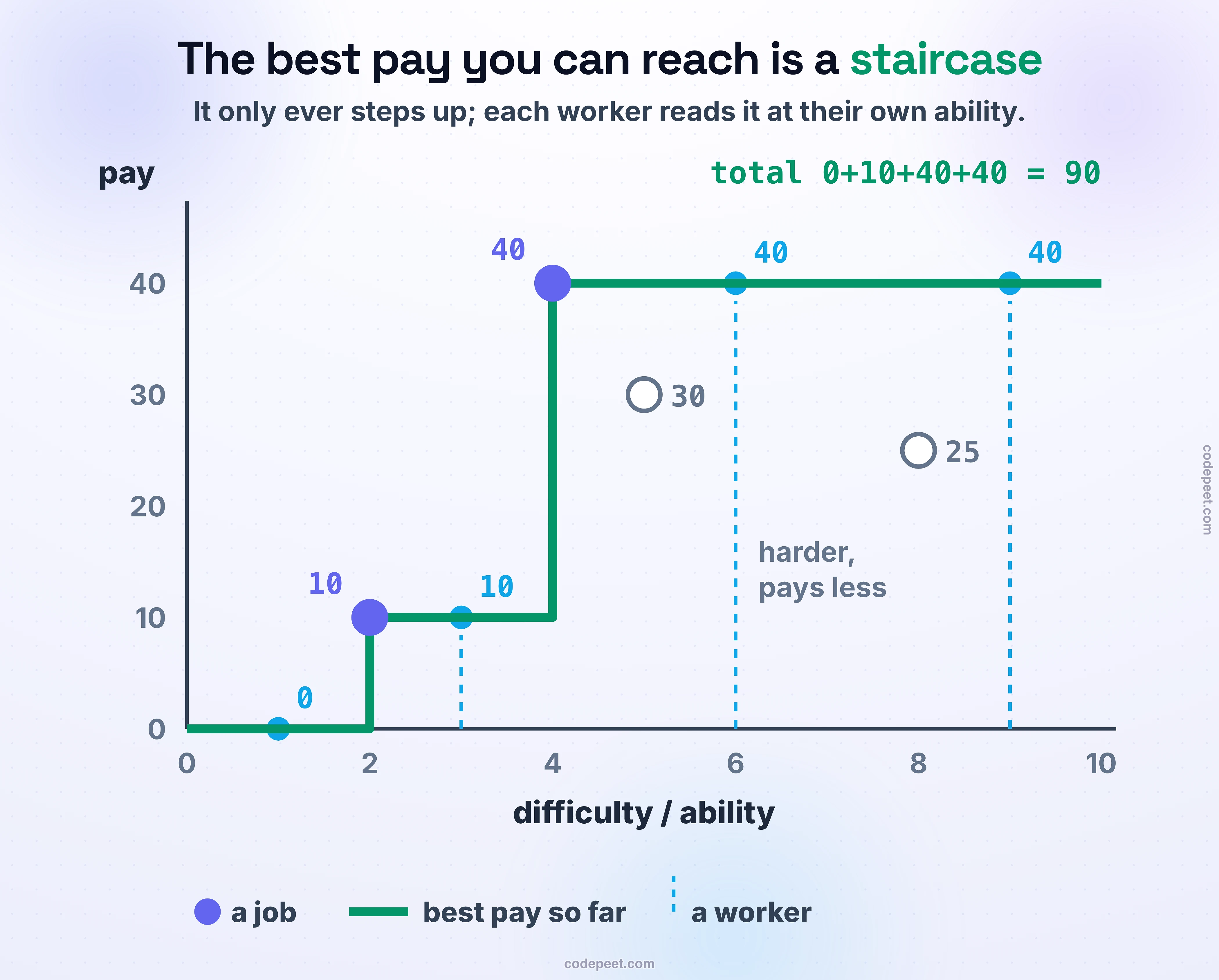
- For each worker, find how many jobs are easy enough, meaning how many sorted difficulties are ≤ their ability. Their pay is the running best at the last of those jobs, or 0 if there are none.
The difficulties are sorted, so step 3 is a binary search. Look at the middle job. If it is easy enough, so is everything before it, and the answer lies to the right. Otherwise it and everything after it are too hard, and the answer lies to the left. Each look halves what is left, so about 14 looks are enough for 10^4 jobs.
Step-by-Step Explanation
We trace Example 1 again. After sorting, the three rows are difficulty, pay, and the running best. The first worker's binary search is shown look by look.
Step 1: Sort the jobs by difficulty: (2, 10), (4, 40), (5, 30), (8, 25).
Step 2: Difficulty 2 pays 10: the best so far becomes 10.
Step 3: Difficulty 4 pays 40: the best so far becomes 40.
Step 4: Difficulty 5 pays 30, less than 40: the best so far stays 40.
Step 5: Difficulty 8 pays 25, less than 40: the best so far stays 40.
Step 6: Worker 3: start with lo = 0 and hi = 4. The middle difficulty 5 > 3, so the answer lies to the left — hi = 2.
Step 7: Worker 3: middle difficulty 4 > 3, so the answer lies to the left — hi = 1.
Step 8: Worker 3: middle difficulty 2 ≤ 3, so the answer lies to the right — lo = 1. So 1 job is easy enough and the worker earns 10.
Step 9: Worker 6: the search finds 3 easy-enough jobs → earns 40; total 50.
Step 10: Worker 9: the search finds 4 easy-enough jobs → earns 40; total 90.
Step 11: Worker 1: no job is easy enough → earns 0; total 90.
Step 12: Return 90.
Sorted Jobs, a Running Best, and a Binary Search — Rows: difficulty, pay, and the best pay among that job and all easier ones. Each worker binary-searches the difficulties and reads the bottom row.
Algorithm
- Sort the jobs
(difficulty, profit)by difficulty. - Walk them in order with
running = 0. At jobi, setrunning = max(running, profit)and storediffs[i] = difficultyandbest_so_far[i] = running. - For each worker's
ability:k= the number of entries indiffsthat are ≤ability(binary search).- If
k > 0, addbest_so_far[k − 1]to the total.
- Return the total.
Code
#include <algorithm>
#include <utility>
#include <vector>
using namespace std;

class Solution {
public:
    int maxProfitAssignment(vector<int>& difficulty, vector<int>& profit, vector<int>& worker) {
        int n = difficulty.size();
        vector<pair<int, int>> jobs(n);
        for (int i = 0; i < n; i++) jobs[i] = {difficulty[i], profit[i]};
        sort(jobs.begin(), jobs.end());  // easiest first
        vector<int> diffs(n), bestSoFar(n);
        int running = 0;
        for (int i = 0; i < n; i++) {
            running = max(running, jobs[i].second);  // the best pay among all jobs this easy or easier
            diffs[i] = jobs[i].first;
            bestSoFar[i] = running;
        }
        int total = 0;
        for (int ability : worker) {
            int k = upper_bound(diffs.begin(), diffs.end(), ability) - diffs.begin();  // how many jobs are easy enough
            if (k > 0) total += bestSoFar[k - 1];
        }
        return total;
    }
};
import bisect
class Solution:
def maxProfitAssignment(self, difficulty: list[int], profit: list[int], worker: list[int]) -> int:
jobs = sorted(zip(difficulty, profit)) # easiest first
diffs, best_so_far = [], []
running = 0
for d, p in jobs:
running = max(running, p) # the best pay among all jobs this easy or easier
diffs.append(d)
best_so_far.append(running)
total = 0
for ability in worker:
k = bisect.bisect_right(diffs, ability) # how many jobs are easy enough
if k > 0:
total += best_so_far[k - 1]
return totalimport java.util.Arrays;
class Solution {
public int maxProfitAssignment(int[] difficulty, int[] profit, int[] worker) {
int n = difficulty.length;
int[][] jobs = new int[n][];
for (int i = 0; i < n; i++) jobs[i] = new int[]{difficulty[i], profit[i]};
Arrays.sort(jobs, (a, b) -> Integer.compare(a[0], b[0])); // easiest first
int[] diffs = new int[n], bestSoFar = new int[n];
int running = 0;
for (int i = 0; i < n; i++) {
running = Math.max(running, jobs[i][1]); // the best pay among all jobs this easy or easier
diffs[i] = jobs[i][0];
bestSoFar[i] = running;
}
int total = 0;
for (int ability : worker) {
int k = countAtMost(diffs, ability); // how many jobs are easy enough
if (k > 0) total += bestSoFar[k - 1];
}
return total;
}
// Binary search: the number of values in the sorted array that are <= x.
private int countAtMost(int[] sorted, int x) {
int lo = 0, hi = sorted.length;
while (lo < hi) {
int mid = (lo + hi) / 2;
if (sorted[mid] <= x) lo = mid + 1;
else hi = mid;
}
return lo;
}
}Complexity Analysis
Let n be the number of jobs and m the number of workers.
Time Complexity: O(n log n + m log n). Sorting costs n log n, the running best is one pass over the jobs, and each worker does one binary search of about log n looks. At full size that is roughly 10^4 × 14 + 10^4 × 14 steps instead of 10^8. Measured, it takes about 4 ms in Python.
Space Complexity: O(n) for the sorted jobs and the running best.
A common variation sorts the workers too and walks both lists together with two pointers instead of binary searching. It costs about the same, O(n log n + m log m).
Why This Approach Is Not Efficient
At this problem's limits the sorted approach is already fast, and it is the right choice whenever difficulties can be huge numbers. Here, though, every value is a whole number no larger than 10^5, and that opens a shortcut.
The sort and the binary searches exist only to find a worker's place on the staircase. If we simply stored the staircase at every whole-number difficulty from 0 to 10^5, a worker with ability a could read position a directly. There would be no sorting and no searching.
Optimal Approach - A Best-Pay Table for Every Difficulty
Intuition
Make a table best with one slot for every difficulty from 0 up to the largest value in the input.
- Drop each job into its slot. Slot
dkeeps the highest pay among jobs of difficulty exactlyd. Two jobs with the same difficulty keep the better one. - Carry the best pay rightward. Walk the slots from left to right with
best[x] = max(best[x], best[x − 1]). Every job counted in slotx − 1is easier thanx, so it can be done atxtoo. After this pass,best[x]is exactly the staircase value, the best pay among all jobs no harder thanx. - Each worker reads one slot. A worker with ability
aearnsbest[a].
Step-by-Step Explanation
We trace Example 1 once more. Each cell is one difficulty slot from 0 to 9; the highlighted cell is the one being written or read, and the formula underneath shows the calculation.
Step 1: Make a table best with one slot for each difficulty 0 to 9, all 0.
Step 2: Job (difficulty 5, pay 30) → best[5] = 30.
Step 3: Job (difficulty 2, pay 10) → best[2] = 10.
Step 4: Job (difficulty 8, pay 25) → best[8] = 25.
Step 5: Job (difficulty 4, pay 40) → best[4] = 40.
Step 6: best[1] = max(0, 0) = 0.
Step 7: best[2] = max(10, 0) = 10.
Step 8: best[3] = max(0, 10) = 10 — the easier job wins.
Step 9: best[4] = max(40, 10) = 40.
Step 10: best[5] = max(30, 40) = 40 — the easier job wins.
Step 11: best[6] = max(0, 40) = 40 — the easier job wins.
Step 12: best[7] = max(0, 40) = 40 — the easier job wins.
Step 13: best[8] = max(25, 40) = 40 — the easier job wins.
Step 14: best[9] = max(0, 40) = 40 — the easier job wins.
Step 15: Worker 3 earns best[3] = 10; total 10.
Step 16: Worker 6 earns best[6] = 40; total 50.
Step 17: Worker 9 earns best[9] = 40; total 90.
Step 18: Worker 1 earns best[1] = 0; total 90.
Step 19: Return 90.
A Best-Pay Table With One Slot per Difficulty — Jobs are dropped into the slot for their difficulty, one pass carries the best pay rightward, and each worker reads the slot for their ability.
Algorithm
- Let
size= the largest value amongdifficultyandworker, plus 1. Createbestof that size, all 0. - For each job
(d, p):best[d] = max(best[d], p). - For
xfrom 1 tosize − 1:best[x] = max(best[x], best[x − 1]). - Return the sum of
best[a]over every worker's abilitya.
Code
#include <algorithm>
#include <vector>
using namespace std;

class Solution {
public:
    int maxProfitAssignment(vector<int>& difficulty, vector<int>& profit, vector<int>& worker) {
        // Every value is a whole number up to 10^5, so keep one slot per difficulty.
        int size = max(*max_element(difficulty.begin(), difficulty.end()),
                       *max_element(worker.begin(), worker.end())) + 1;
        vector<int> best(size, 0);
        for (int i = 0; i < (int)difficulty.size(); i++)
            best[difficulty[i]] = max(best[difficulty[i]], profit[i]);  // the best job at exactly this difficulty
        for (int x = 1; x < size; x++)
            best[x] = max(best[x], best[x - 1]);  // ... or at any easier difficulty
        int total = 0;
        for (int ability : worker) total += best[ability];
        return total;
    }
};
class Solution:
def maxProfitAssignment(self, difficulty: list[int], profit: list[int], worker: list[int]) -> int:
# Every value is a whole number up to 10^5, so keep one slot per difficulty.
size = max(max(difficulty), max(worker)) + 1
best = [0] * size
for d, p in zip(difficulty, profit):
best[d] = max(best[d], p) # the best job at exactly this difficulty
for x in range(1, size):
best[x] = max(best[x], best[x - 1]) # ... or at any easier difficulty
return sum(best[a] for a in worker)class Solution {
public int maxProfitAssignment(int[] difficulty, int[] profit, int[] worker) {
// Every value is a whole number up to 10^5, so keep one slot per difficulty.
int size = 0;
for (int d : difficulty) size = Math.max(size, d);
for (int a : worker) size = Math.max(size, a);
int[] best = new int[size + 1];
for (int i = 0; i < difficulty.length; i++)
best[difficulty[i]] = Math.max(best[difficulty[i]], profit[i]); // the best job at exactly this difficulty
for (int x = 1; x <= size; x++)
best[x] = Math.max(best[x], best[x - 1]); // ... or at any easier difficulty
int total = 0;
for (int ability : worker) total += best[ability];
return total;
}
}Complexity Analysis
Let n be the number of jobs, m the number of workers and V the largest value, at most 10^5.
Time Complexity: O(n + m + V). One pass drops the jobs in, one pass over the V slots builds the staircase, and each worker is a single lookup. Nothing is sorted.
Space Complexity: O(V) for the table, 10^5 + 1 integers at most.
How the two compare. At this problem's limits, the table and the sorted approach both finish in about 4 ms in Python. The difference shows when there are many more jobs and workers: with a million of each, and values still at most 10^5, we measured 71 ms for the table against 1.13 s for the sorted approach. The table's cost depends on V, though. If difficulties could be as large as 10^9, the table would be far too big, and the sorted approach would be the right one.