Tree Data Structure Basics
Description
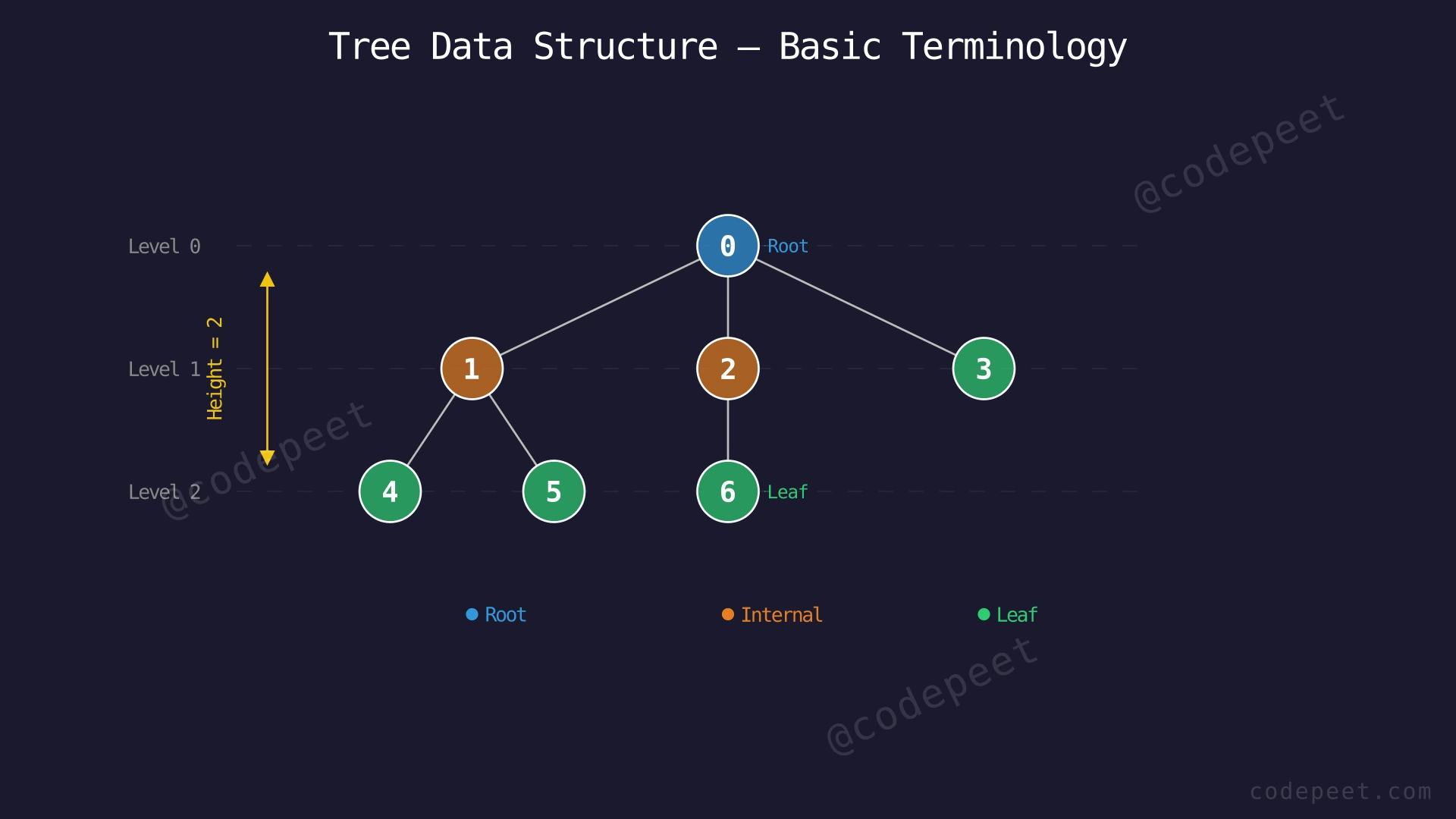
A tree is a hierarchical, non-linear data structure composed of nodes connected by edges. Unlike arrays or linked lists where data is stored sequentially, a tree organizes data across multiple levels, forming a parent–child relationship.
Given a tree with N nodes numbered 0 to N-1 and N-1 edges (where each edge [u, v] means node u is the parent of node v), implement a tree data structure that supports these fundamental operations:
- getRoot() — Return the root node (the node with no parent).
- getParent(node) — Return the parent of the given node.
- getChildren(node) — Return a list of all direct children of the given node.
- getLeaves() — Return all leaf nodes (nodes with no children).
- getHeight() — Return the height of the tree (the length of the longest path from root to any leaf).
Key Terminology:
- Root: The topmost node with no parent.
- Leaf (External Node): A node with no children.
- Internal Node: A node with at least one child.
- Parent: The immediate predecessor of a node.
- Child: The immediate successor of a node.
- Depth of a node: Number of edges from the root to that node.
- Height of the tree: Maximum depth among all nodes.
- Degree of a node: The number of children it has.
Examples
Example 1
Input:
N = 7
edges = [[0,1], [0,2], [0,3], [1,4], [1,5], [2,6]]
Tree structure:
       0
      /|\
     1  2  3
    /\   \
   4  5   6
Queries and Outputs:
- getRoot() → 0
- getParent(5) → 1
- getChildren(0) → [1, 2, 3]
- getChildren(1) → [4, 5]
- getLeaves() → [3, 4, 5, 6]
- getHeight() → 2
Explanation: Node 0 has no parent, so it is the root. Node 5's parent is node 1 (from edge [1,5]). Node 0 has three children: 1, 2, and 3. Nodes 3, 4, 5, and 6 have no children, making them leaves. The longest path from root to a leaf is 0→1→4 (or 0→1→5 or 0→2→6), which has 2 edges, so the height is 2.
Example 2
Input:
N = 4
edges = [[0,1], [1,2], [2,3]]
Tree structure (skewed / linear):
0 → 1 → 2 → 3
Queries and Outputs:
- getRoot() → 0
- getParent(2) → 1
- getChildren(1) → [2]
- getLeaves() → [3]
- getHeight() → 3
Explanation: This is a skewed tree where every node except the last has exactly one child. The only leaf is node 3. The height equals 3 because the single root-to-leaf path 0→1→2→3 has 3 edges.
Example 3
Input:
N = 1
edges = []
Queries and Outputs:
- getRoot() → 0
- getChildren(0) → []
- getLeaves() → [0]
- getHeight() → 0
Explanation: A single-node tree has the root as its only node. Since the root has no children, it is also a leaf. The height is 0 because there are no edges at all.
Constraints
- 1 ≤ N ≤ 10^5
- The edges form a valid tree (connected, acyclic, exactly N-1 edges)
- 0 ≤ node < N for all query arguments
- Each node has at most N-1 children (general / N-ary tree)
Editorial
Brute Force
Intuition
The simplest way to represent a tree is with a parent array. Imagine you have a class register and the only thing you write down for each student is the name of their direct supervisor. That single column of information — 'who is my parent?' — is enough to reconstruct the entire tree.
We create an array parent of size N where parent[i] stores the parent of node i. The root has no parent, so we mark it as -1.
This representation makes it trivial to look up any node's parent (just read the array), but answering other questions becomes cumbersome. For example, to find the children of a node, you have no direct way — you must scan the entire parent array and collect every node that lists the target as its parent. Similarly, finding leaves requires checking, for every single node, whether anyone else claims it as a parent — a doubly-nested scan.
Step-by-Step Explanation
Let us trace the getChildren(0) operation on the tree from Example 1.
First, we build the parent array from edges [[0,1],[0,2],[0,3],[1,4],[1,5],[2,6]]:
parent = [-1, 0, 0, 0, 1, 1, 2]
(Index 0 has parent -1 because it is the root.)
Now, to find children of node 0, we scan every index and check if parent[i] == 0:
Step 1: Initialize scan. We have parent = [-1, 0, 0, 0, 1, 1, 2] and target node = 0. Result list is empty.
Step 2: Check index 0 — parent[0] = -1. Is -1 equal to 0? No. Node 0 is the root itself, not a child of node 0. Skip.
Step 3: Check index 1 — parent[1] = 0. Is 0 equal to 0? YES. Node 1 is a child of node 0. Add 1 to result. Result = [1].
Step 4: Check index 2 — parent[2] = 0. Is 0 equal to 0? YES. Node 2 is a child of node 0. Result = [1, 2].
Step 5: Check index 3 — parent[3] = 0. Is 0 equal to 0? YES. Node 3 is a child. Result = [1, 2, 3].
Step 6: Check index 4 — parent[4] = 1. Is 1 equal to 0? No. Node 4's parent is 1, not 0. Skip.
Step 7: Check index 5 — parent[5] = 1. Is 1 equal to 0? No. Skip.
Step 8: Check index 6 — parent[6] = 2. Is 2 equal to 0? No. Skip.
Step 9: Scan complete. Children of node 0 = [1, 2, 3]. We had to examine all 7 nodes just to find 3 children.
Brute Force — Scanning Parent Array for Children of Node 0 — Watch how we must scan every single element of the parent array to find which nodes have node 0 as their parent.
Algorithm
Build:
- Create a
parentarray of size N, initialized to -1. - For each edge [u, v], set
parent[v] = u.
getRoot():
- Scan the
parentarray and return the index whereparent[i] == -1.
getParent(node):
- Return
parent[node].
getChildren(node):
- Initialize an empty list
children. - For each index
ifrom 0 to N-1, ifparent[i] == node, appenditochildren. - Return
children.
getLeaves():
- For each node
i, scan the entireparentarray to check if any node hasias its parent. - If no node lists
ias parent, theniis a leaf.
getHeight():
- For each node
i, trace the parent chain fromiup to the root, counting edges to compute depth. - Return the maximum depth across all nodes.
Code
#include <vector>
#include <algorithm>
using namespace std;

class TreeParentArray {
    vector<int> parent;
    int n;

public:
    void buildTree(int numNodes, vector<vector<int>>& edges) {
        n = numNodes;
        parent.assign(n, -1);
        for (auto& edge : edges) {
            parent[edge[1]] = edge[0];
        }
    }

    int getRoot() {
        for (int i = 0; i < n; i++) {
            if (parent[i] == -1) return i;
        }
        return -1;
    }

    int getParent(int node) {
        return parent[node];
    }

    vector<int> getChildren(int node) {
        vector<int> children;
        for (int i = 0; i < n; i++) {
            if (parent[i] == node) {
                children.push_back(i);
            }
        }
        return children;
    }

    vector<int> getLeaves() {
        vector<int> leaves;
        for (int i = 0; i < n; i++) {
            bool isLeaf = true;
            for (int j = 0; j < n; j++) {
                if (parent[j] == i) {
                    isLeaf = false;
                    break;
                }
            }
            if (isLeaf) leaves.push_back(i);
        }
        return leaves;
    }

    int getHeight() {
        int maxDepth = 0;
        for (int i = 0; i < n; i++) {
            int depth = 0;
            int curr = i;
            while (parent[curr] != -1) {
                depth++;
                curr = parent[curr];
            }
            maxDepth = max(maxDepth, depth);
        }
        return maxDepth;
    }
};
class TreeParentArray:
def build_tree(self, num_nodes, edges):
self.n = num_nodes
self.parent = [-1] * num_nodes
for u, v in edges:
self.parent[v] = u
def get_root(self):
for i in range(self.n):
if self.parent[i] == -1:
return i
return -1
def get_parent(self, node):
return self.parent[node]
def get_children(self, node):
children = []
for i in range(self.n):
if self.parent[i] == node:
children.append(i)
return children
def get_leaves(self):
leaves = []
for i in range(self.n):
is_leaf = True
for j in range(self.n):
if self.parent[j] == i:
is_leaf = False
break
if is_leaf:
leaves.append(i)
return leaves
def get_height(self):
max_depth = 0
for i in range(self.n):
depth = 0
curr = i
while self.parent[curr] != -1:
depth += 1
curr = self.parent[curr]
max_depth = max(max_depth, depth)
return max_depthimport java.util.*;
class TreeParentArray {
int[] parent;
int n;
void buildTree(int numNodes, int[][] edges) {
n = numNodes;
parent = new int[n];
Arrays.fill(parent, -1);
for (int[] edge : edges) {
parent[edge[1]] = edge[0];
}
}
int getRoot() {
for (int i = 0; i < n; i++) {
if (parent[i] == -1) return i;
}
return -1;
}
int getParent(int node) {
return parent[node];
}
List<Integer> getChildren(int node) {
List<Integer> children = new ArrayList<>();
for (int i = 0; i < n; i++) {
if (parent[i] == node) {
children.add(i);
}
}
return children;
}
List<Integer> getLeaves() {
List<Integer> leaves = new ArrayList<>();
for (int i = 0; i < n; i++) {
boolean isLeaf = true;
for (int j = 0; j < n; j++) {
if (parent[j] == i) {
isLeaf = false;
break;
}
}
if (isLeaf) leaves.add(i);
}
return leaves;
}
int getHeight() {
int maxDepth = 0;
for (int i = 0; i < n; i++) {
int depth = 0;
int curr = i;
while (parent[curr] != -1) {
depth++;
curr = parent[curr];
}
maxDepth = Math.max(maxDepth, depth);
}
return maxDepth;
}
}Complexity Analysis
Build Time: O(N)
We iterate over the N-1 edges once, performing a constant-time array assignment for each.
getRoot: O(N)
We scan the parent array until we find -1. In the worst case, the root is the last element.
getParent: O(1)
Direct array lookup.
getChildren: O(N)
We must scan all N entries of the parent array since children are not stored explicitly. Every single call costs O(N) regardless of how many children exist.
getLeaves: O(N²)
For each of the N nodes, we scan the entire parent array to determine whether it appears as any node's parent. Outer loop × inner loop = N × N = O(N²).
getHeight: O(N × H) where H is the tree height
For each node, we trace the parent chain upward to the root. In a balanced tree H = O(log N), but in a skewed tree H = O(N), making the worst case O(N²).
Space Complexity: O(N)
Only the parent array of size N is stored.
Why This Approach Is Not Efficient
The parent-array-only approach has a critical flaw: it stores the tree from the child's perspective but forces us to answer questions from the parent's perspective.
Finding children requires a full O(N) scan every time because we have no direct way to look up which nodes list a given node as their parent. With N up to 10^5, even a single getChildren call touches 10^5 entries. If we call getChildren for every node (which getLeaves essentially does), we end up with 10^5 × 10^5 = 10^10 operations — far beyond any reasonable time limit.
The getHeight operation suffers similarly. For a skewed tree (essentially a linked list), tracing parent pointers from the deepest node to the root takes O(N) steps, and doing this for all N nodes yields O(N²).
The core insight: If we also store the relationship from the parent's perspective — that is, maintain an explicit list of children for each node — then getChildren becomes a direct O(1) lookup, getLeaves drops to O(N), and getHeight can be computed in O(N) with a single DFS traversal.
Optimal Approach - Adjacency List
Intuition
The fix is beautifully simple: store the tree from both perspectives.
Imagine a school directory. The parent-array approach is like only having a column 'Student → Teacher'. If the principal asks 'who are Teacher X's students?', you must read every row. But if you also maintain a column 'Teacher → List of Students', the answer is instant.
We build two data structures:
- A
parentarray (same as before) for O(1) parent lookups. - A
childrenadjacency list — an array of lists wherechildren[v]stores all direct children of nodev.
Both are built simultaneously in a single O(N) pass over the edges. Now:
- getChildren is a direct lookup into the children list — O(1).
- getLeaves scans the children array once and collects nodes with empty lists — O(N).
- getHeight uses a single DFS (Depth-First Search) traversal starting from the root. At each node, we recursively compute the height of all subtrees and take the maximum, adding 1 for the current edge. This visits each node exactly once — O(N).
The DFS for height follows a simple recursive formula:
height(node) = 0                          if node is a leaf
height(node) = 1 + max(height(child))     for each child
Written as a recursive function, this DFS goes one call deeper per level. A skewed tree like Example 2 can have N − 1 = 99,999 levels, which exceeds Python's default recursion limit (1,000) and overflows Java's default thread stack. So the code runs the same DFS with an explicit stack: a node is pushed once on the way down, and once more so it can be finished after all its children, when 1 + max(height(child)) is known. Children are pushed in reverse, so the first child is on top and the nodes are visited in exactly the order of the trace below.
Step-by-Step Explanation
Let us trace the getHeight() operation using DFS on the tree from Example 1:
       0
      /|\
     1  2  3
    /\   \
   4  5   6
We perform DFS from the root (node 0) and compute the height bottom-up.
Step 1: Start DFS at root node 0. Depth = 0. Visit its first child.
Step 2: Recurse into node 1 (child of 0). Depth = 1. Visit node 1's first child.
Step 3: Recurse into node 4 (child of 1). Depth = 2. Node 4 has no children — it is a leaf. Return height = 0.
Step 4: Backtrack to node 1. Node 4 returned 0. Now visit node 1's next child: node 5.
Step 5: Recurse into node 5 (child of 1). Depth = 2. Node 5 has no children — leaf. Return height = 0.
Step 6: Backtrack to node 1. Both children processed. height(1) = 1 + max(0, 0) = 1. Return 1 to node 0.
Step 7: Back at node 0. Node 1 returned 1. Now visit next child: node 2. Depth = 1.
Step 8: Recurse into node 6 (child of 2). Depth = 2. Node 6 is a leaf. Return height = 0.
Step 9: Backtrack to node 2. height(2) = 1 + 0 = 1. Return 1 to node 0.
Step 10: Back at node 0. Now visit last child: node 3. Node 3 is a leaf. Return height = 0.
Step 11: All children of node 0 processed. height(0) = 1 + max(1, 1, 0) = 2. The tree height is 2. We visited each of the 7 nodes exactly once.
DFS Height Computation — Visiting Every Node Once — Watch how a single DFS traversal computes the height bottom-up by visiting each node exactly once and propagating subtree heights upward.
Algorithm
Build:
- Create a
parentarray of size N (initialized to -1) and an array of listschildrenof size N. - For each edge [u, v]: set
parent[v] = uand appendvtochildren[u]. - Identify the root as the node with
parent[i] == -1. Store it for O(1) access.
getRoot():
- Return the stored root value.
getParent(node):
- Return
parent[node].
getChildren(node):
- Return
children[node](the pre-built list).
getLeaves():
- Iterate over all nodes. If
children[i]is empty, addito the result.
getHeight():
- Create
height[]of size N, all 0, and a stack holding(root, not finished). - While the stack is not empty, pop
(node, finished):- If it is not finished, push
(node, finished)back, then push(child, not finished)for each child in reverse order, so the first child is processed first. - If it is finished, all its children are done: set
height[node] = 1 + max(height[child])over its children. A leaf keeps 0.
- If it is not finished, push
- Return
height[root].
Code
#include <vector>
#include <algorithm>
#include <utility>
using namespace std;

class TreeAdjList {
    vector<vector<int>> children;
    vector<int> parent;
    int root;
    int n;

public:
    void buildTree(int numNodes, vector<vector<int>>& edges) {
        n = numNodes;
        children.resize(n);
        parent.assign(n, -1);

        for (auto& edge : edges) {
            children[edge[0]].push_back(edge[1]);
            parent[edge[1]] = edge[0];
        }

        root = -1;
        for (int i = 0; i < n; i++) {
            if (parent[i] == -1) {
                root = i;
                break;
            }
        }
    }

    int getRoot() {
        return root;
    }

    int getParent(int node) {
        return parent[node];
    }

    vector<int> getChildren(int node) {
        return children[node];
    }

    vector<int> getLeaves() {
        vector<int> leaves;
        for (int i = 0; i < n; i++) {
            if (children[i].empty()) {
                leaves.push_back(i);
            }
        }
        return leaves;
    }

    int getHeight() {
        // The same DFS as height(node) = 1 + max(height(child)), run on an
        // explicit stack: a skewed tree can be 10^5 levels deep
        vector<int> height(n, 0);
        vector<pair<int, bool>> stk = {{root, false}};
        while (!stk.empty()) {
            int node = stk.back().first;
            bool childrenDone = stk.back().second;
            stk.pop_back();
            if (!childrenDone) {
                stk.push_back({node, true});  // finish node after its children
                for (int i = (int)children[node].size() - 1; i >= 0; i--) {
                    stk.push_back({children[node][i], false});  // first child on top
                }
            } else {
                for (int child : children[node]) {
                    height[node] = max(height[node], 1 + height[child]);
                }
            }
        }
        return height[root];
    }
};
class TreeAdjList:
def build_tree(self, num_nodes, edges):
self.n = num_nodes
self.children = [[] for _ in range(num_nodes)]
self.parent = [-1] * num_nodes
for u, v in edges:
self.children[u].append(v)
self.parent[v] = u
self.root = -1
for i in range(num_nodes):
if self.parent[i] == -1:
self.root = i
break
def get_root(self):
return self.root
def get_parent(self, node):
return self.parent[node]
def get_children(self, node):
return self.children[node]
def get_leaves(self):
return [i for i in range(self.n)
if not self.children[i]]
def get_height(self):
# The same DFS as height(node) = 1 + max(height(child)), run on an
# explicit stack: a skewed tree can be 10^5 levels deep, too deep
# for recursion
height = [0] * self.n
stack = [(self.root, False)]
while stack:
node, children_done = stack.pop()
if not children_done:
stack.append((node, True)) # finish node after its children
for child in reversed(self.children[node]):
stack.append((child, False)) # first child on top
else:
for child in self.children[node]:
height[node] = max(height[node], 1 + height[child])
return height[self.root]import java.util.*;
class TreeAdjList {
List<List<Integer>> children;
int[] parent;
int root;
int n;
void buildTree(int numNodes, int[][] edges) {
n = numNodes;
children = new ArrayList<>();
parent = new int[n];
Arrays.fill(parent, -1);
for (int i = 0; i < n; i++) {
children.add(new ArrayList<>());
}
for (int[] edge : edges) {
children.get(edge[0]).add(edge[1]);
parent[edge[1]] = edge[0];
}
root = -1;
for (int i = 0; i < n; i++) {
if (parent[i] == -1) {
root = i;
break;
}
}
}
int getRoot() {
return root;
}
int getParent(int node) {
return parent[node];
}
List<Integer> getChildren(int node) {
return children.get(node);
}
List<Integer> getLeaves() {
List<Integer> leaves = new ArrayList<>();
for (int i = 0; i < n; i++) {
if (children.get(i).isEmpty()) {
leaves.add(i);
}
}
return leaves;
}
int getHeight() {
// The same DFS as height(node) = 1 + max(height(child)), run on an
// explicit stack: a skewed tree can be 10^5 levels deep
int[] height = new int[n];
Deque<int[]> stack = new ArrayDeque<>();
stack.push(new int[]{root, 0});
while (!stack.isEmpty()) {
int[] top = stack.pop();
int node = top[0];
if (top[1] == 0) {
stack.push(new int[]{node, 1}); // finish node after its children
List<Integer> kids = children.get(node);
for (int i = kids.size() - 1; i >= 0; i--) {
stack.push(new int[]{kids.get(i), 0}); // first child on top
}
} else {
for (int child : children.get(node)) {
height[node] = Math.max(height[node], 1 + height[child]);
}
}
}
return height[root];
}
}Complexity Analysis
Build Time: O(N)
We iterate over N-1 edges once, performing O(1) work per edge (one array assignment and one list append).
getRoot: O(1)
The root is identified and stored during the build phase.
getParent: O(1)
Direct array lookup, same as the brute force.
getChildren: O(1)
Direct lookup into the pre-built children list. The list itself has size equal to the number of children, but accessing the list reference is constant time.
getLeaves: O(N)
A single scan over all N nodes, checking if their children list is empty. Each check is O(1).
getHeight: O(N)
The DFS visits each node exactly once. Each node is pushed twice (once on the way down, once to be finished), and each children list is scanned twice, which sums to 2(N − 1) child lookups across the entire traversal. Total work: O(N).
Space Complexity: O(N)
We store the parent array (N entries) and the children adjacency list. The total number of entries across all children lists equals N-1 (one per edge). So total space is O(N) + O(N) = O(N). getHeight's stack and height array add another O(N) while it runs.
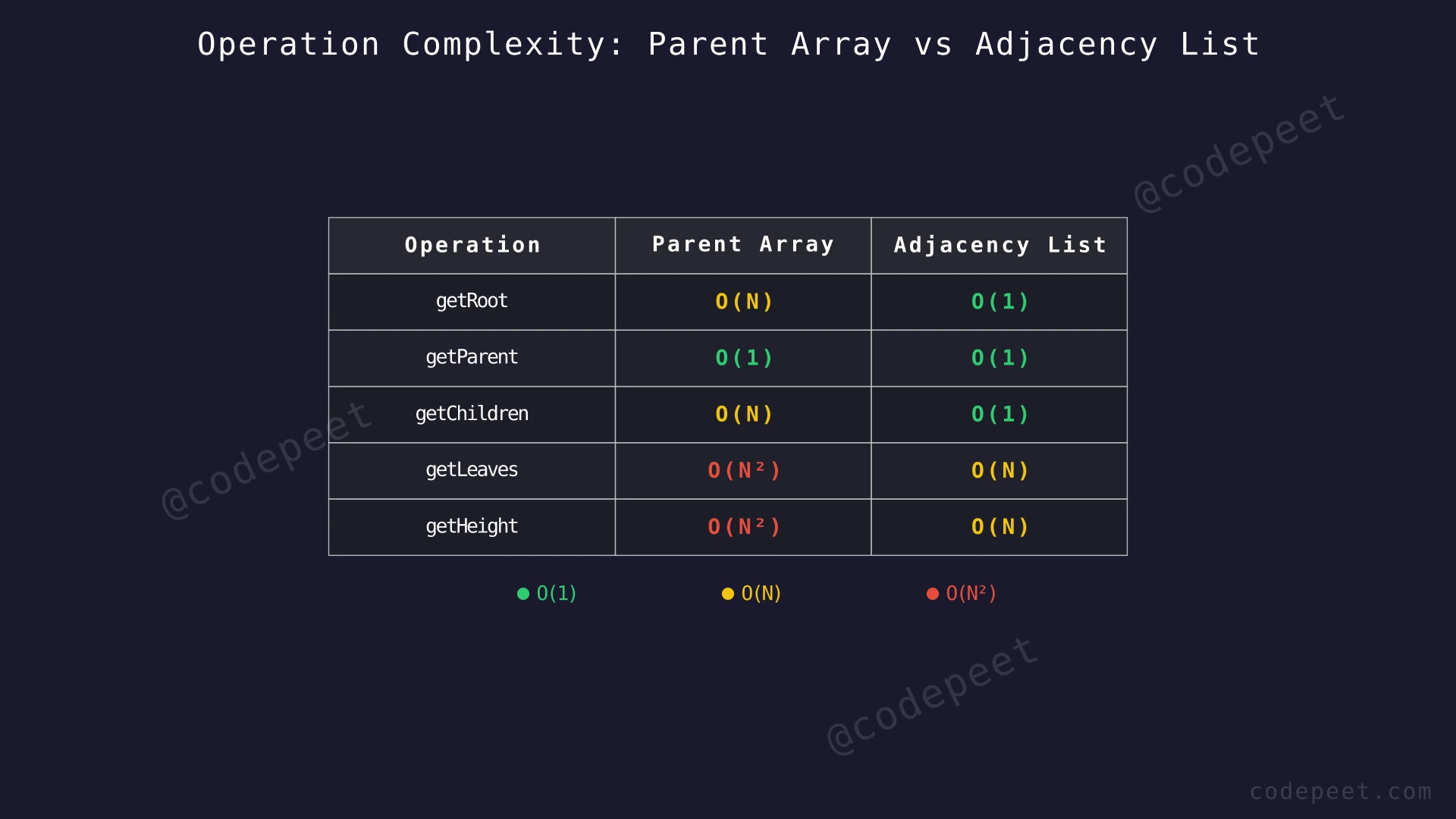
Comparison with Brute Force:
The most dramatic improvement is in getChildren (O(N) → O(1)), getLeaves (O(N²) → O(N)), and getHeight (O(N²) → O(N)). By investing O(N) extra space for the children lists, every operation becomes optimal.