Delete Columns to Make Sorted
Description
You are given an array strs of n strings, all of the same length. Write the strings one under another and they form a grid of letters: row r is the string strs[r], and column c is the letter at position c of every string, read from top to bottom.
A column is sorted when its letters are in alphabetical order from top to bottom. Equal letters next to each other are allowed, so a column reading a, c, c, f is sorted, while a, c, b is not.
Delete every column that is not sorted, and return the number of columns you delete.
Examples
Example 1
Input: strs = ["ape", "bee", "rye", "gum"]
Output: 2
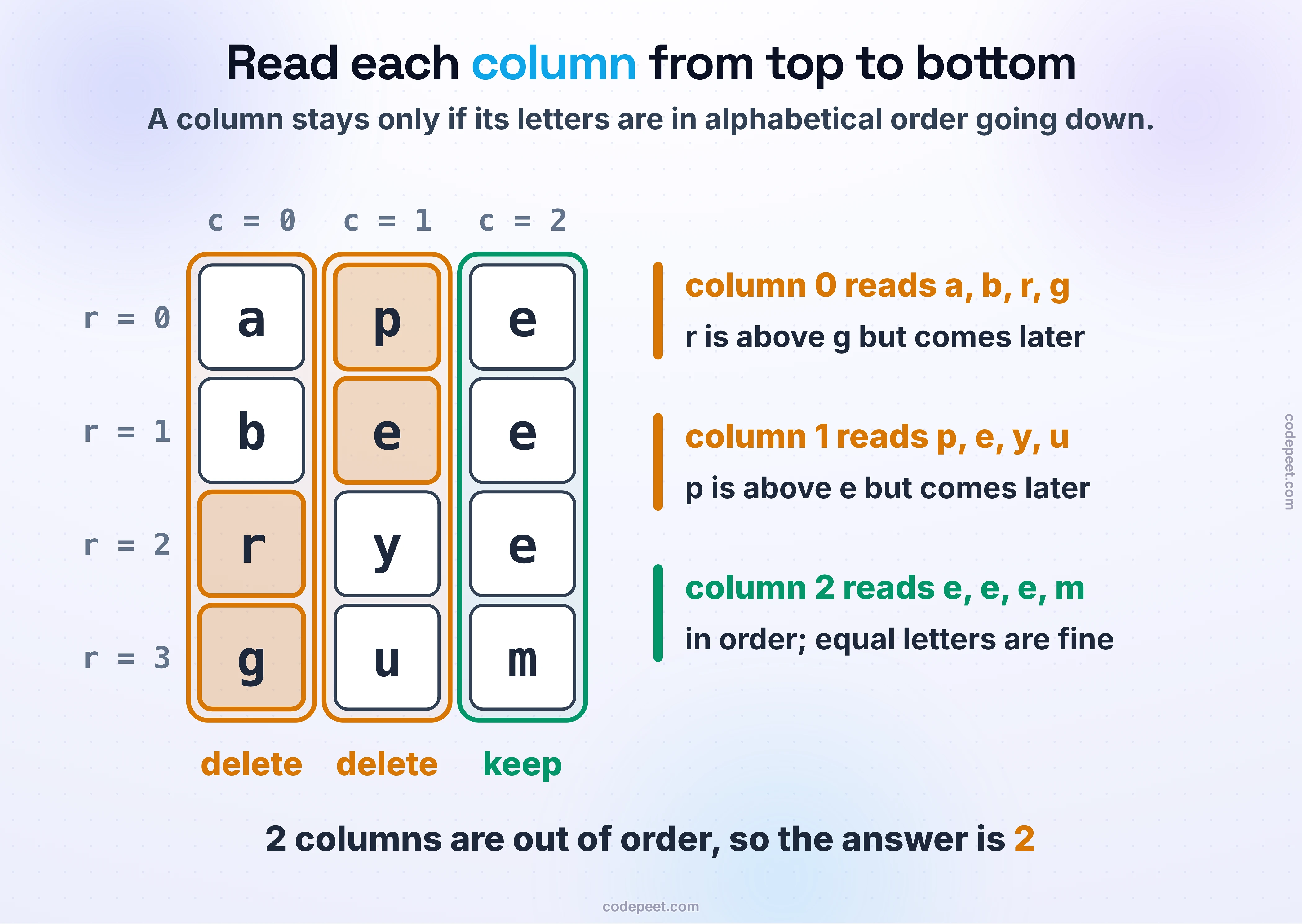
Explanation: Written one under another, the strings form this grid:
ape
bee
rye
gum
- Column 0 reads a, b, r, g. r is above g but comes later in the alphabet, so the column is deleted.
- Column 1 reads p, e, y, u. p is above e but comes later, so the column is deleted.
- Column 2 reads e, e, e, m. Equal letters are allowed and m comes after e, so the column is sorted and stays.
Two columns are deleted.
Example 2
Input: strs = ["zebra"]
Output: 0
Explanation: There is only one row, so every column holds a single letter, and a single letter is always in order. Nothing is deleted.
Example 3
Input: strs = ["top", "sip", "ran"]
Output: 3
Explanation:
top
sip
ran
- Column 0 reads t, s, r. t is above s but comes later.
- Column 1 reads o, i, a. o is above i but comes later.
- Column 2 reads p, p, n. The two p's are fine, but p is above n and comes later.
Every column is deleted, so the answer is 3, the length of each string.
Constraints
- n == strs.length
- 1 ≤ n ≤ 100
- 1 ≤ strs[i].length ≤ 1000
- All the strings in
strshave the same length. - strs[i] consists of lowercase English letters.
Editorial
Brute Force
Intuition
Reading the grid. strs[r][c] is the letter in row r, column c: first pick the string, then the position inside it. So column c is strs[0][c], strs[1][c], …, strs[n − 1][c], and the number of columns is the length of each string, m = len(strs[0]).
Comparing letters. In code, a letter is stored as a number, its character code, and comparing two letters compares those numbers. The lowercase letters have codes in alphabetical order: 'a' is 97, 'b' is 98, and so on up to 'z' at 122. So for two letters, x > y means exactly "x comes later in the alphabet than y".
Each column is decided on its own. Deleting a column removes only that column's letters; every other column keeps exactly the letters it had. So there is nothing to choose or plan: the answer is simply the number of columns that are not sorted. (There are harder versions of this problem where the rows, read as whole words, must end up in order. There, deletions do affect each other. Here they do not.)
Start from the definition. A column is sorted when every letter is at most every letter below it. So check exactly that: for every pair of rows i < j, compare strs[i][c] with strs[j][c]. As soon as one pair has the upper letter later in the alphabet, the column is not sorted, and its remaining pairs do not need to be looked at.
Step-by-Step Explanation
We trace Example 1, strs = ["ape", "bee", "rye", "gum"]. The two cells being compared light up in blue. Once a column is decided, it turns green if it stays and orange if it is deleted.
Step 1: Write the strings one under another: 4 rows and 3 columns. deleted starts at 0.
Step 2: Column 0, rows 0 and 1: a and b, in order.
Step 3: Column 0, rows 0 and 2: a and r, in order.
Step 4: Column 0, rows 0 and 3: a and g, in order.
Step 5: Column 0, rows 1 and 2: b and r, in order.
Step 6: Column 0, rows 1 and 3: b and g, in order.
Step 7: Column 0, rows 2 and 3: r is above g but comes later, out of order. Column 0 is deleted (deleted = 1).
Step 8: Column 1, rows 0 and 1: p is above e but comes later, out of order. Column 1 is deleted (deleted = 2); its other 5 pairs are skipped.
Step 9: Column 2, rows 0 and 1: e and e, the same letter, allowed.
Step 10: Column 2, rows 0 and 2: e and e, the same letter, allowed.
Step 11: Column 2, rows 0 and 3: e and m, in order.
Step 12: Column 2, rows 1 and 2: e and e, the same letter, allowed.
Step 13: Column 2, rows 1 and 3: e and m, in order.
Step 14: Column 2, rows 2 and 3: e and m, in order. All 6 pairs are in order, so column 2 stays.
Step 15: Columns 0 and 1 are deleted and column 2 stays. Return 2, after 13 comparisons.
Brute Force — Every Pair of Rows in Each Column — The grid of Example 1. In each column, every letter is compared with every letter below it until a pair is out of order or all pairs pass.
Algorithm
- Set
deleted = 0. Letmbe the length of each string. - For each column
cfrom 0 to m − 1:- For every pair of rows
i < j: ifstrs[i][c] > strs[j][c], the column is not sorted. Add 1 todeletedand go straight to the next column.
- For every pair of rows
- Return
deleted.
Code
#include <string>
#include <vector>
using namespace std;

class Solution {
    bool inOrder(const vector<string>& strs, int c) {
        for (int i = 0; i < (int)strs.size(); i++)
            for (int j = i + 1; j < (int)strs.size(); j++)
                if (strs[i][c] > strs[j][c]) return false;
        return true;
    }

public:
    int minDeletionSize(vector<string>& strs) {
        int deleted = 0;
        for (int c = 0; c < (int)strs[0].size(); c++)
            if (!inOrder(strs, c)) deleted++;
        return deleted;
    }
};
class Solution:
def minDeletionSize(self, strs: list[str]) -> int:
deleted = 0
for c in range(len(strs[0])):
if not self.in_order(strs, c):
deleted += 1
return deleted
def in_order(self, strs: list[str], c: int) -> bool:
for i in range(len(strs)):
for j in range(i + 1, len(strs)):
if strs[i][c] > strs[j][c]:
return False
return Trueclass Solution {
public int minDeletionSize(String[] strs) {
int deleted = 0;
for (int c = 0; c < strs[0].length(); c++)
if (!inOrder(strs, c)) deleted++;
return deleted;
}
private boolean inOrder(String[] strs, int c) {
for (int i = 0; i < strs.length; i++)
for (int j = i + 1; j < strs.length; j++)
if (strs[i].charAt(c) > strs[j].charAt(c)) return false;
return true;
}
}Complexity Analysis
Let n be the number of strings (the rows) and m their length (the columns).
Time Complexity: O(m · n²). A column has n(n − 1)/2 pairs of rows, 6 for 4 rows and 4,950 for 100 rows, and a sorted column has every one of them checked.
Space Complexity: O(1). Only a counter and loop indexes.
Why This Approach Is Not Efficient
The number of pairs grows with the square of the number of rows: twice the rows means about four times the pairs. At the full size, 100 rows and 1,000 columns with every column sorted, that is 1,000 × 4,950 = 4,950,000 comparisons. Measured in Python, this takes about 78 ms on that grid; the final approach takes about 1.6 ms on the same grid.
We need a test for "is this column sorted?" whose cost grows more slowly than n². One familiar tool gives it: a list is sorted exactly when sorting it changes nothing, and sorting n letters takes about n × log₂ n comparisons, around 660 for 100 letters instead of 4,950.
Better Approach - Sort a Copy of Each Column
Intuition
A column is sorted exactly when putting it in order changes nothing. So for each column, copy its letters into a list, sort a second copy, and compare the two lists position by position. If they are the same, the column was already in order and stays. If they differ anywhere, some letter was out of place and the column is deleted.
Equal letters cause no trouble. Sorting keeps equal letters side by side, so a column like e, e, e, m sorts to itself and stays.
In Python, zip(*strs) hands you the columns directly: list(zip("ape", "bee")) is [('a', 'b'), ('p', 'e'), ('e', 'e')]. The code below builds each column by hand so that it reads the same in all three languages.
Step-by-Step Explanation
We trace Example 1 again. The top row is the column as read down the grid; the row under it is its sorted copy. Positions where the two lists agree turn green, and the first position where they differ turns orange. The last frame lists the three columns with their verdicts.
Step 1: Copy column 0: a, b, r, g.
Step 2: Its sorted copy is a, b, g, r. They differ at row 2 (r against g), so column 0 is deleted (deleted = 1).
Step 3: Copy column 1: p, e, y, u.
Step 4: Its sorted copy is e, p, u, y. They differ at row 0 (p against e), so column 1 is deleted (deleted = 2).
Step 5: Copy column 2: e, e, e, m.
Step 6: Its sorted copy is e, e, e, m, identical, so column 2 stays.
Step 7: Two columns changed when sorted. Return 2.
Sort a Copy of Each Column and Compare — Each column of Example 1 as a list (top row) above its sorted copy (second row); the first place they differ decides that the column is deleted.
Algorithm
- Set
deleted = 0. - For each column
c:- Build
column, the lettersstrs[0][c], strs[1][c], …, strs[n − 1][c]. - Build
sorted_copy, a sorted copy ofcolumn. - If
columnandsorted_copydiffer, add 1 todeleted.
- Build
- Return
deleted.
Code
#include <algorithm>
#include <string>
#include <vector>
using namespace std;

class Solution {
public:
    int minDeletionSize(vector<string>& strs) {
        int deleted = 0;
        for (int c = 0; c < (int)strs[0].size(); c++) {
            string column;
            for (const string& row : strs) column += row[c];
            string order = column;
            sort(order.begin(), order.end());
            if (column != order) deleted++;
        }
        return deleted;
    }
};
class Solution:
def minDeletionSize(self, strs: list[str]) -> int:
deleted = 0
for c in range(len(strs[0])):
column = [row[c] for row in strs]
if column != sorted(column):
deleted += 1
return deletedimport java.util.Arrays;
class Solution {
public int minDeletionSize(String[] strs) {
int deleted = 0;
for (int c = 0; c < strs[0].length(); c++) {
char[] column = new char[strs.length];
for (int r = 0; r < strs.length; r++) column[r] = strs[r].charAt(c);
char[] order = column.clone();
Arrays.sort(order);
if (!Arrays.equals(column, order)) deleted++;
}
return deleted;
}
}Complexity Analysis
Time Complexity: O(m · n log n). Each column is copied in O(n) and sorted in O(n log n). (Python's sort first looks for stretches that are already in order, so on a column that is already sorted it needs only one pass.)
Space Complexity: O(n). The column and its sorted copy, rebuilt for every column.
Why This Approach Is Not Efficient
Sorting fixed the square growth, but it lost something the pair check did well.
- It cannot stop early. The pair check stopped at the first bad pair. Sorting always reads and rearranges the whole column, even when the first two letters already show it is out of order, as in column 1 of Example 1,
p, e, y, u. On a grid of random letters this happens all the time: a column almost always goes backwards within its first few rows (the next approach needs about 1.7 comparisons per column on average). Measured in Python on 100 × 1,000 random letters, sort-and-compare takes about 4.0 ms, while the pair check takes 0.2 ms and the next approach 0.1 ms. - It builds two copies of every column, O(n) extra memory, only to answer yes or no.
- It works out more than was asked. Sorting produces the complete correct order of the column; the question only needs to know whether the order is already right.
On a grid where every column is sorted, Python's sort is quick (1.3 ms) because it runs as compiled code and spots the existing order in one pass. The waste shows whenever a column could have been rejected early.
Optimal Approach - Compare Only Neighbours and Stop Early
Intuition
Keep the early stop of the pair check and the low cost of a single pass, with no copies. Two ideas do it.
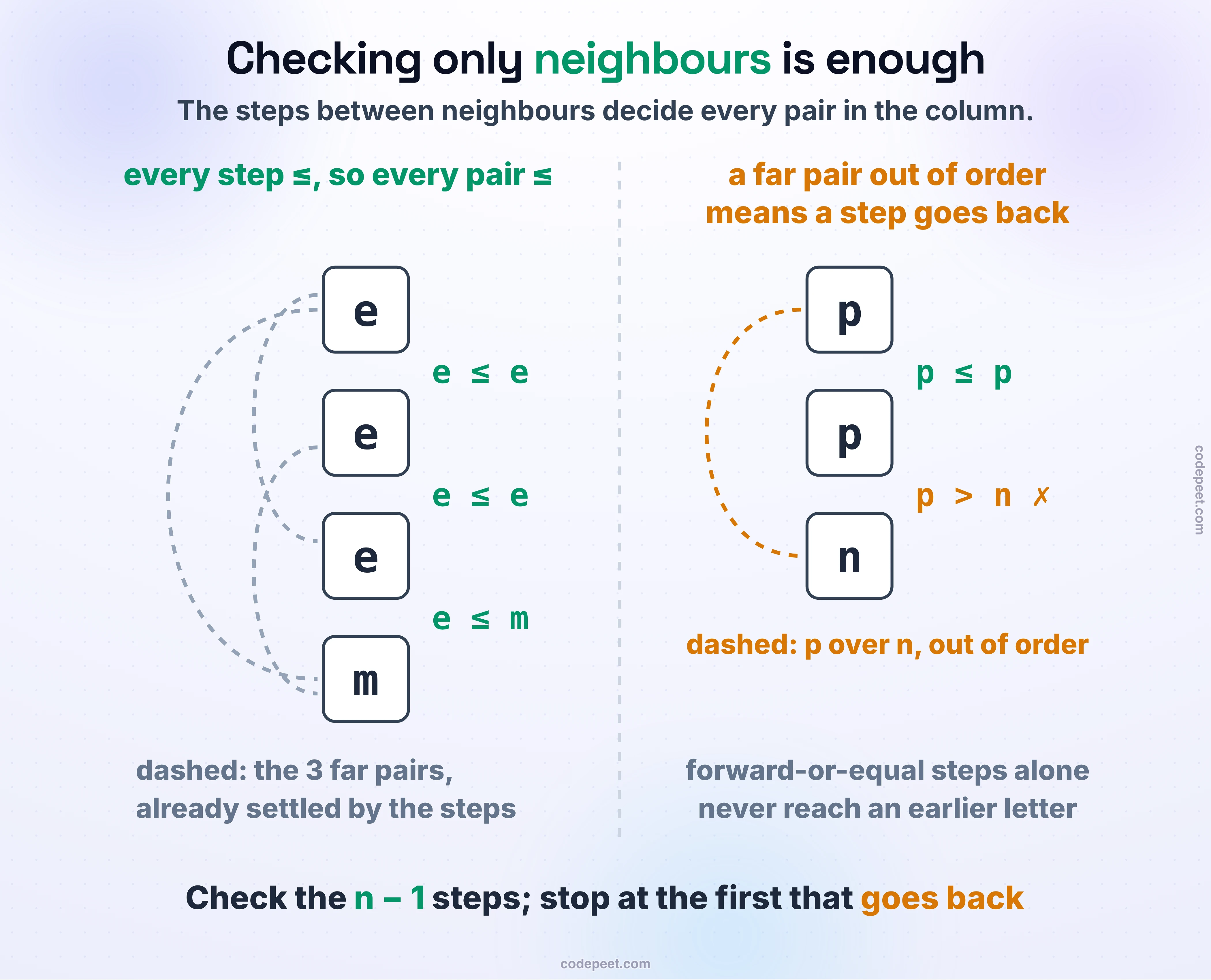
Idea 1: checking neighbours is enough. Compare each letter only with the letter directly below it. This decides the column in both directions.
- If every letter is at most the one below it, the column is sorted. The steps chain together. In
e, e, e, m, e ≤ e, e ≤ e and e ≤ m, so the topeis at most everything below it, and the same holds for every other letter. The far-apart pairs never need a check of their own. - If some pair is out of order, some step between them goes backwards. Say row
iholds a letter later than rowjfurther down. Reading down fromitoj, the letters start later and end earlier, and forward-or-equal steps alone can never reach an earlier letter, so at least one step between them goes backwards. In column 2 of Example 3,p, p, n, the far pair p over n is out of order, and so is the step p → n.
So a column is sorted exactly when none of its n − 1 neighbouring steps goes backwards.
Idea 2: stop at the first backwards step. One backwards step is enough to delete a column, and nothing further down can undo it. So leave the column right there and move to the next one.
Together: at most n − 1 comparisons per column instead of n(n − 1)/2, often just one or two, and no extra memory.
Step-by-Step Explanation
We trace Example 1 one last time. Only a letter and the letter directly below it are compared now. Columns turn green when they stay and orange when they are deleted.
Step 1: The same grid. deleted starts at 0.
Step 2: Column 0, rows 0 and 1: a then b, fine.
Step 3: Column 0, rows 1 and 2: b then r, fine.
Step 4: Column 0, rows 2 and 3: r then g goes backwards. Column 0 is deleted (deleted = 1).
Step 5: Column 1, rows 0 and 1: p then e goes backwards. Column 1 is deleted (deleted = 2), and y and u below are never read.
Step 6: Column 2, rows 0 and 1: e then e, equal, allowed.
Step 7: Column 2, rows 1 and 2: e then e, equal, allowed.
Step 8: Column 2, rows 2 and 3: e then m, fine. No step went backwards, so column 2 stays.
Step 9: Return 2, after 7 comparisons instead of 13.
Compare Only Neighbours, Stop at the First Backwards Step — The grid of Example 1. Each letter is compared only with the one directly below it, and a column is left as soon as a step goes backwards.
Algorithm
- Set
deleted = 0. - For each column
cfrom 0 to m − 1:- For each row
rfrom 1 to n − 1: ifstrs[r − 1][c] > strs[r][c], add 1 todeletedand break out to the next column.
- For each row
- Return
deleted.
The break matters. Column 1 of Example 1, p, e, y, u, goes backwards twice, at p → e and at y → u. Without the break it would be counted twice, and the answer would come out as 3 instead of 2. A column is deleted once, however many backwards steps it has.
Use >, not >=. Equal letters are allowed. With >=, column 2 of Example 1 (e, e, e, m) would be deleted by mistake.
A single row needs no special case. With n = 1 the inner loop never runs and the answer is 0, which is right: one letter is always in order.
Code
#include <string>
#include <vector>
using namespace std;

class Solution {
public:
    int minDeletionSize(vector<string>& strs) {
        int deleted = 0;
        for (int c = 0; c < (int)strs[0].size(); c++)
            for (int r = 1; r < (int)strs.size(); r++)
                if (strs[r - 1][c] > strs[r][c]) {  // one drop is enough to delete the column
                    deleted++;
                    break;
                }
        return deleted;
    }
};
class Solution:
def minDeletionSize(self, strs: list[str]) -> int:
deleted = 0
for c in range(len(strs[0])):
for r in range(1, len(strs)):
if strs[r - 1][c] > strs[r][c]: # one drop is enough to delete the column
deleted += 1
break
return deletedclass Solution {
public int minDeletionSize(String[] strs) {
int deleted = 0;
for (int c = 0; c < strs[0].length(); c++)
for (int r = 1; r < strs.length; r++)
if (strs[r - 1].charAt(c) > strs[r].charAt(c)) { // one drop is enough to delete the column
deleted++;
break;
}
return deleted;
}
}Complexity Analysis
Time Complexity: O(n · m). Each column costs at most n − 1 comparisons and often far fewer; on random letters, about 1.7. On the full-size grid with every column sorted it makes 1,000 × 99 = 99,000 comparisons, against 4,950,000 for the pair check.
Space Complexity: O(1). A counter and two loop indexes; nothing is copied.
No method can do better in the worst case. Take a grid of at least two rows in which every letter is b. Every column is sorted, so the answer is 0. Suppose some method skipped one of its letters. That letter might instead have been an a, if it is below the top row (earlier than the b above it), or a c, if it is in the top row (later than the b below it). Either change makes its column unsorted and the answer 1. Having never looked, the method gives the same answer for both grids, so it is wrong on one of them. So on that grid every one of the n × m letters has to be read: O(n · m) is the least any method can do, and this approach reaches it.